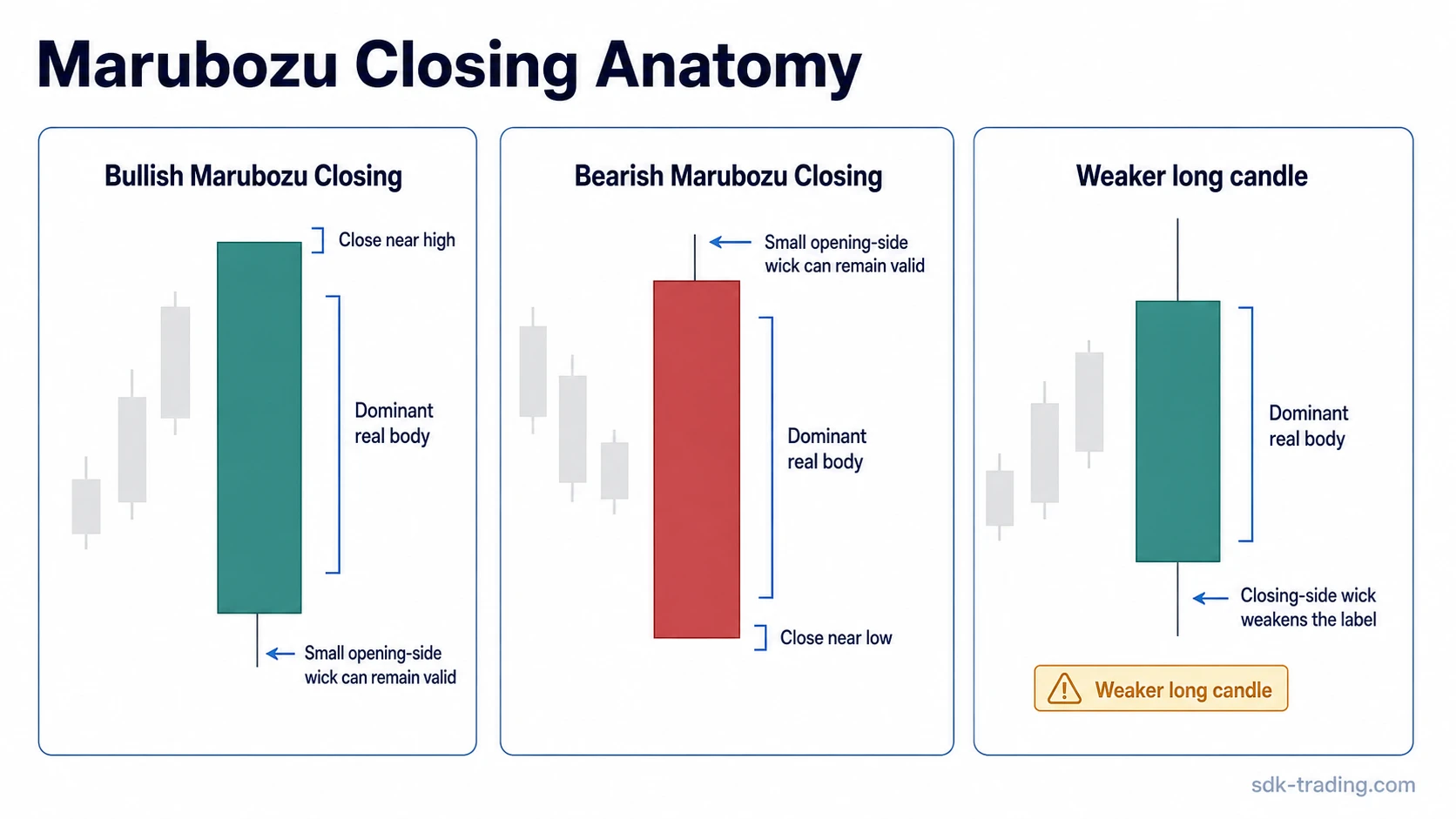
A Marubozu Closing candlestick is a body-dominant candle that finishes at or very near one session extreme. In a bullish version, the close is near the high. In a bearish version, the close is near the low. The defining test is whether pressure remains visible at the closing edge, not whether the candle simply looks large.
A large body relative to the full candle range supports the structure, but body size alone is not enough. If the candle pulls back before the close and leaves a meaningful wick on the closing side, the Marubozu Closing label weakens or fails.
Key Points
- Marubozu Closing is identified by where the candle closes, not only by how large the candle looks.
- A bullish Marubozu Closing closes at or very near the high of the session.
- A bearish Marubozu Closing closes at or very near the low of the session.
- A small opening-side wick can remain valid if the closing side stays visually anchored near the extreme.
- A meaningful wick on the closing side can weaken or invalidate the classification.
- Later candles can support or weaken the interpretation, but the initial label comes from the candle’s own close location.
What Is a Marubozu Closing Candlestick?
A Marubozu Closing candlestick is a close-driven form of marubozu. The candle has a dominant real body and finishes at, or very close to, one end of its range. The closing side is the defining side: the upper edge for a bullish candle and the lower edge for a bearish candle.
The opening side does not need to be perfectly clean. A small opposite wick can appear near the open without destroying the classification, as long as the body still dominates and the close remains near the relevant extreme. The closing side matters more because it shows whether pressure stayed present until the candle finished.
Definition: A Marubozu Closing candle is a candlestick with a dominant real body that closes at or very near the session high or low. The closing side should leave little or no wick, while a small wick near the opening side can still be acceptable.
How to Identify Marubozu Closing
Identification starts with the close. For a bullish Marubozu Closing, the close should sit at or very near the candle’s high. For a bearish Marubozu Closing, the close should sit at or very near the candle’s low.
After the close is checked, the body should be compared with the full candle range. A strong candidate has a real body that dominates most of the candle. Small noise near the opening side can be acceptable, but a visible rejection wick near the closing side changes the reading.
- Bullish Marubozu Closing: the candle closes at or near the high, with little or no upper wick.
- Bearish Marubozu Closing: the candle closes at or near the low, with little or no lower wick.
- Valid opening-side flexibility: a small wick near the open can remain acceptable.
- Weakening condition: a meaningful wick near the close shows that price backed away from the extreme.
Diagnostic Boundary
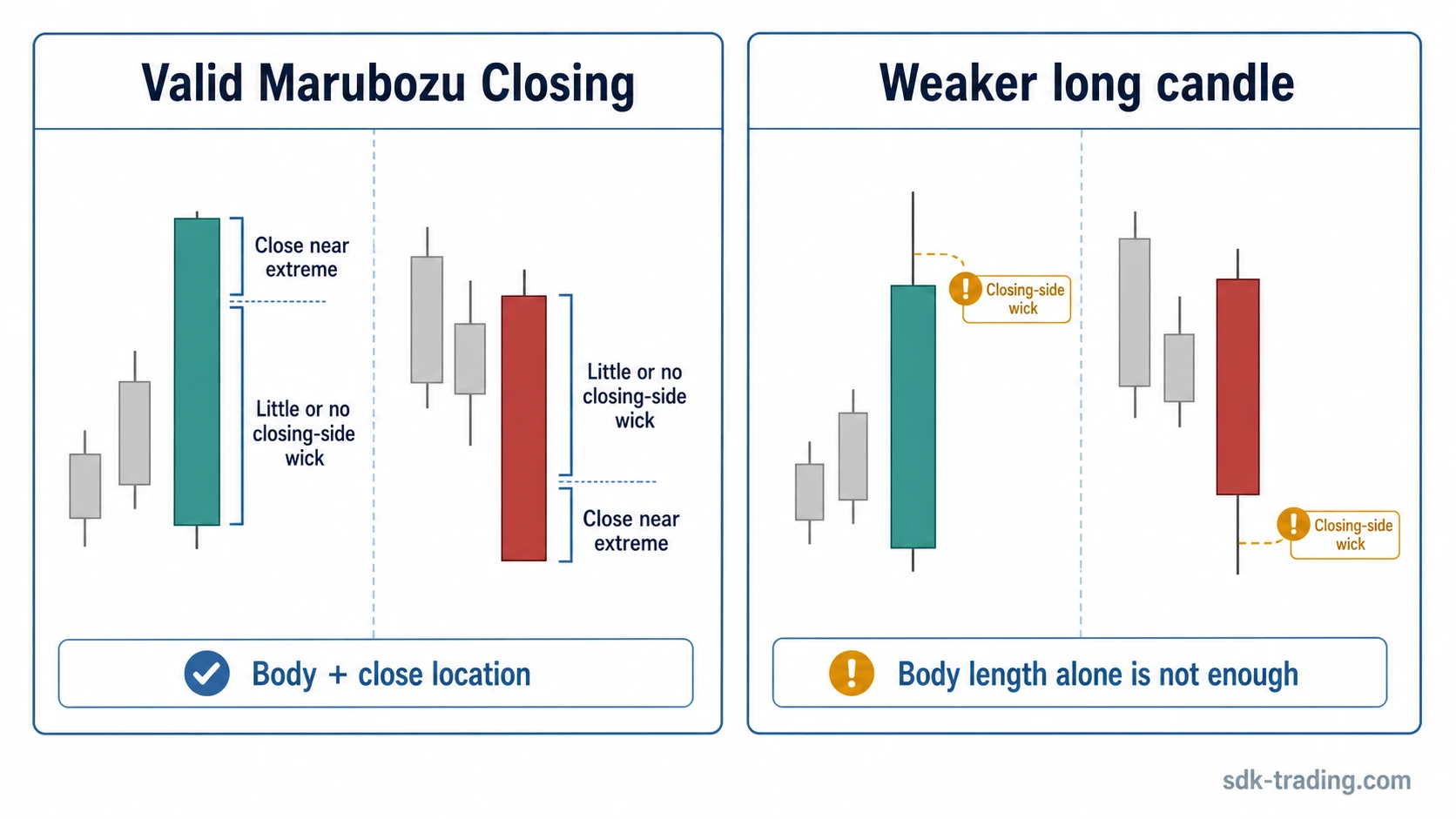
The most common mistake is treating any long candle as Marubozu Closing. A long candle may still fail the classification if the close is not anchored near the high or low. The deciding evidence is the relationship between the close and the candle extreme.
| Diagnostic question | Stronger Marubozu Closing reading | Weaker or invalid reading |
|---|---|---|
| Where is the close? | At or very near the session high or low | Away from the session extreme |
| Is there a closing-side wick? | None or visually tiny | Meaningful wick near the close |
| Does the body dominate? | The real body makes up most of the candle range | The body does not dominate the range |
| Can the opening side have a wick? | A small opening-side wick can remain valid | The wick changes the body-to-range relationship too much |
| Does the close stay anchored at the extreme? | The close remains visually near the high or low | The close backs away enough to create closing-side rejection |
When a Long Candle Is Not Marubozu Closing
A candle can look forceful and still fail the Marubozu Closing test. If a bullish candle has a large body but closes visibly below the high, the upper wick shows that price backed away before the close. That rejection weakens the closing-side structure even if the candle still has a large real body.
The same logic applies to a bearish candle. A large bearish body does not automatically qualify if the candle closes clearly above the low. A lower wick near the close shows that selling pressure did not remain fully anchored at the session extreme.
The useful distinction is simple: body length shows range expansion, while close location shows whether pressure lasted into the end of the candle. Marubozu Closing needs both a dominant body and a close near the relevant extreme.
Bullish and Bearish Marubozu Closing
A bullish Marubozu Closing finishes near the high of its range. Structurally, that means the candle did not leave much visible rejection above the close. The candle may still have a small lower wick near the open, but the upper side should remain clean or nearly clean.
A bearish Marubozu Closing finishes near the low of its range. Structurally, that means the candle did not leave much visible rejection below the close. A small upper wick near the open can remain acceptable if the lower closing side stays close to the candle extreme.
These forms describe candle anatomy. They do not establish direction, continuation, reversal, or reliability by themselves. The quality of the reading depends on surrounding structure, later acceptance, and whether the next candles hold above or below the closing area instead of quickly returning into the body.
Marubozu Closing vs Full Marubozu
A full Marubozu has little or no wick on both sides of the candle. The open and the close are both positioned very close to opposite extremes, creating a clean body-dominant shape from start to finish.
Marubozu Closing is narrower. It emphasizes the closing side of the candle. The opening side may contain a small wick, but the close should still finish near the high or low. That is why the subtype is useful when the candle is not clean enough to be treated as a full marubozu, but the closing edge still shows persistent pressure.
Marubozu Closing vs Marubozu Opening
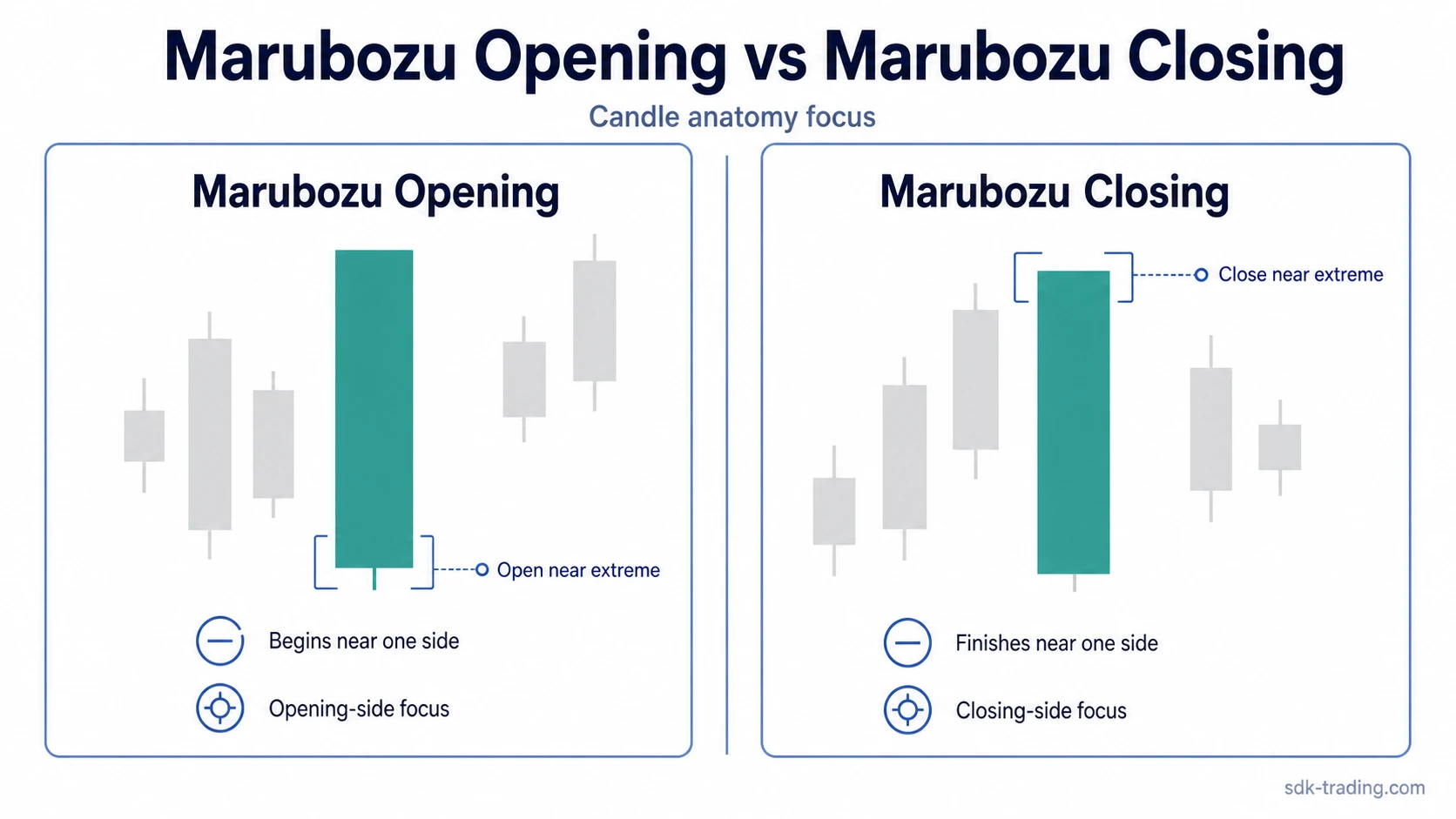
Marubozu Opening and Marubozu Closing separate two different parts of the candle. Marubozu Opening focuses on where the candle begins. Marubozu Closing focuses on where the candle finishes.
The distinction matters when the candle has one clean side and one imperfect side. A candle that opens near one extreme but does not close near the opposite extreme may fit opening-side logic more than closing-side logic. A candle that starts with a small wick but finishes near the opposite extreme may fit closing-side logic more clearly.
Reading Quality After the Candle
A candle can meet the Marubozu Closing structure and still produce a weak reading if later candles quickly return into its body. The initial label comes from the candle’s close location, but later behavior shows whether the closing-side pressure was accepted or rejected.
Later-candle reliability is a separate question: whether price accepts the closing area or quickly returns into the candle body. Marubozu Closing reliability focuses on that later response, while identification starts with the close, the closing-side wick, and the body-to-range relationship.
FAQ
What is a Marubozu Closing candle?
A Marubozu Closing candle is a candlestick with a dominant real body that closes at or very near the high or low of the session, leaving little or no wick on the closing side.
Can Marubozu Closing have a small wick?
Yes. A small wick on the opening side can remain valid. A meaningful wick on the closing side is more damaging because it shows that price moved away from the relevant extreme before the candle closed.
Is every long candle a Marubozu Closing candle?
No. A long candle needs a close near the high or low to qualify. If the candle closes away from the extreme, the closing-side structure is weaker even when the real body is large.
How is Marubozu Closing different from full Marubozu?
A full Marubozu has little or no wick on both sides. Marubozu Closing is defined mainly by the closing side, so a small opening-side wick can still be acceptable.
How is Marubozu Closing different from Marubozu Opening?
Marubozu Opening focuses on where the candle begins. Marubozu Closing focuses on where the candle finishes and whether the close stays near the high or low.