Marubozu closing reliability is the question of whether a close near the candle extreme still matters after the next market response appears. The candle can close near its high or low, but reliability depends on whether that closing area is later accepted, rejected, or quickly neutralized.
This separates the reliability check from the marubozu closing candle definition. The shape records where the candle finished; the reliability test asks whether range quality, location, liquidity, and later price behavior support that close.
Key Points
- A marubozu close carries more weight when price holds near the range extreme after the candle forms.
- The reading weakens when price quickly accepts back into prior congestion.
- A strong close is not the same as later confirmation.
- A fast return into the prior range is one of the clearest signs that the close failed to hold meaning.
What Marubozu Closing Reliability Means
Definition: Marubozu closing reliability describes how well a close near the high or low of a candle remains meaningful after surrounding structure and later price behavior are checked.
The close matters because it records where the candle finished. A close near the high can show demand lasting into the end of the candle. A close near the low can show supply lasting into the end of the candle.
The structure behind the candle is separate from the reliability question. Marubozu closing candles describe the closing form itself; reliability asks whether that close still deserves trust after the next market response is visible.
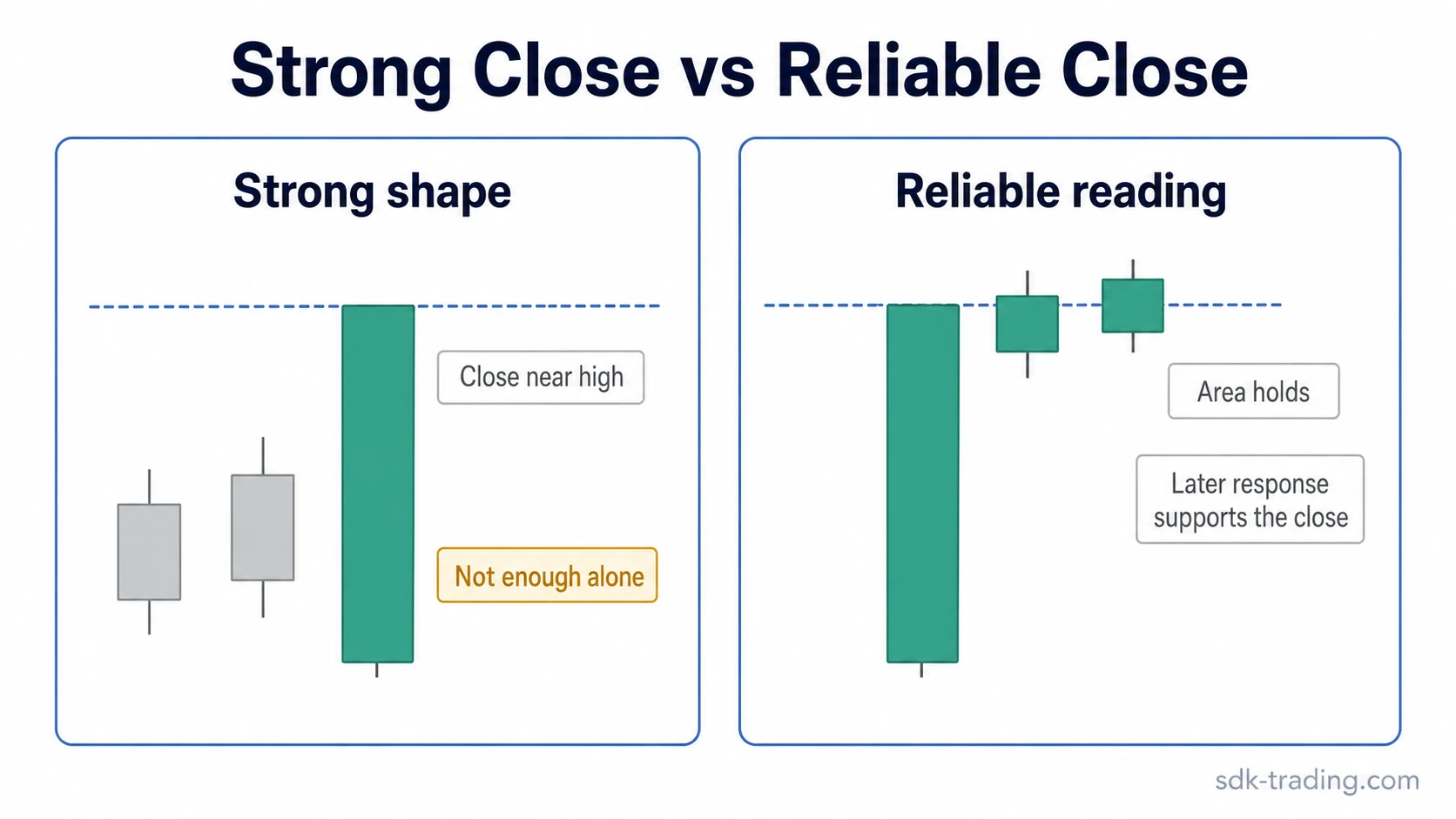
Strong Close or Reliable Close?
| Not this | Instead this |
|---|---|
| A close near the high or low automatically predicts continuation. | The close gains weight only when later behavior does not erase the pressure. |
| A wide real body is enough by itself. | Range quality, location, liquidity, and follow-through decide the reading. |
| Every marubozu-style close has the same quality. | The same shape can mean different things in trends, congestion, exhaustion, or thin liquidity. |
| A strong close is already confirmation. | Reliability describes candle quality; confirmation depends on later acceptance or rejection. |
Conditions That Make the Close More Reliable
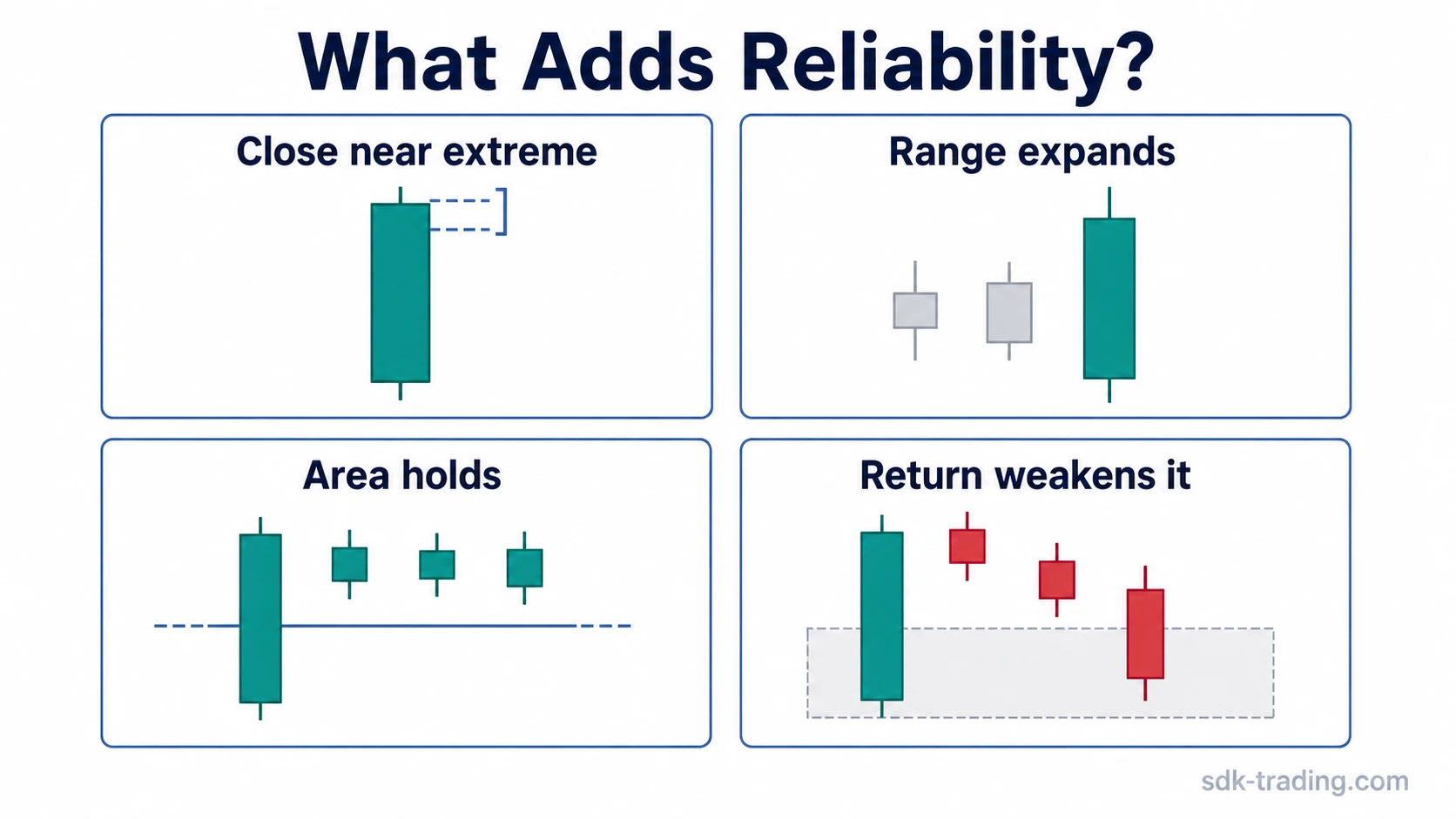
A marubozu close can carry more weight when the real body expands compared with recent candles and the candle finishes near one side of its range. That combination suggests the move did not simply drift into the close; pressure remained active into the final portion of the candle.
Location changes the reading. A close near the high becomes more defensible when price holds outside the area it attempted to leave instead of immediately falling back inside it. A close near the low becomes more defensible when price stays below the area it attempted to break instead of quickly reclaiming it.
Liquidity and market state also affect reliability. A clean close is easier to evaluate when the move is not formed in visibly thin or distorted conditions. After an extended move, a large close near the extreme can reflect late pressure rather than fresh acceptance.
Stronger and Weaker Reliability Conditions
| Condition | More reliable reading | Less reliable reading |
|---|---|---|
| Closing location | The candle finishes near the high or low. | The candle leaves a clear rejection wick against the closing direction. |
| Range quality | The real body expands compared with nearby candles. | The range is narrow, compressed, or visually ordinary. |
| Location | The close holds beyond congestion or a recently tested area. | The candle forms inside choppy congestion. |
| Later behavior | Price remains near or beyond the closing area. | Price quickly accepts back into the prior range. |
| Liquidity | The move avoids visibly thin or distorted conditions. | The shape appears during thin or distorted movement. |
| Market state | The close forms before obvious exhaustion or immediate rejection appears. | The candle appears after repeated extension or visible exhaustion. |
What Weakens a Marubozu Close
A marubozu close weakens when it forms inside congestion. In that setting, a close near the high or low may only mark movement from one side of a range to the other. The candle can look decisive while the broader structure remains unresolved.
The reading also weakens when the next candles retrace directly into the prior range. A bullish close near the high loses quality if price immediately falls back into the candle body or into the congestion it tried to leave. A bearish close near the low loses quality if price quickly trades back above the area that was supposed to show pressure.
Long wicks against the closing direction reduce the quality of the reading. A candle that closes near the high but leaves rejection above the close is different from a candle that finishes cleanly at the upper extreme. The same logic applies in reverse for bearish candles near the low.
A strong close after a long directional run can also be less reliable than it appears. If the candle arrives after repeated expansion candles, fading range quality, or stretched movement, the close may reflect late pressure rather than fresh acceptance.
Reliability vs Confirmation
Reliability describes candle quality at the close; confirmation depends on what later candles do with that closing area.
Reliability describes the quality of the marubozu close. It asks whether the candle deserves weight based on closing location, range quality, structure, and liquidity.
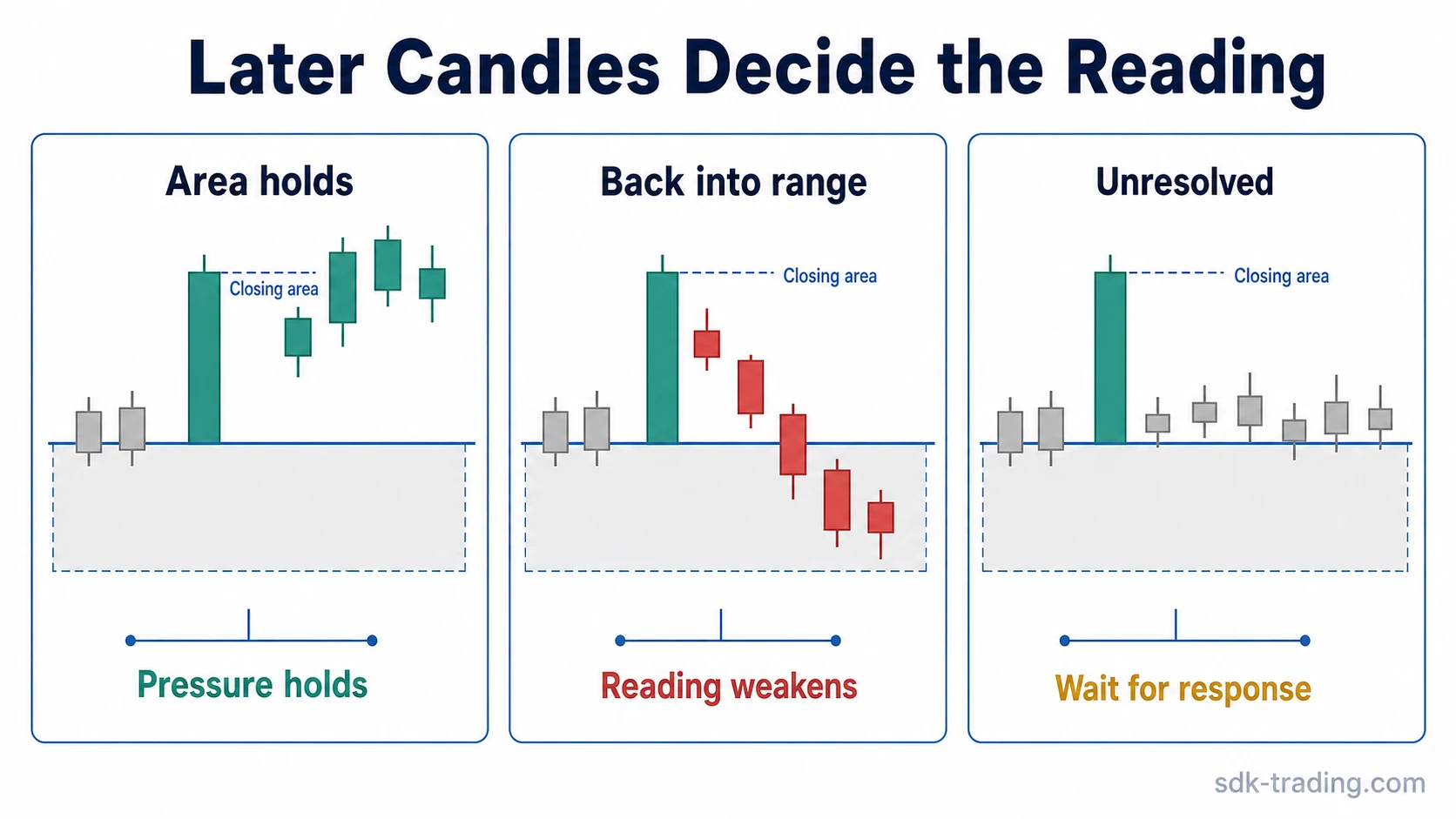
Confirmation describes what later candles do. They can support the reading by holding beyond the tested area, or weaken it by accepting back into the prior range.
A marubozu close can be strong enough to deserve attention and still need later evidence before the reading carries more weight. A candle-quality clue is not a complete trading decision by itself.
Failure-Mode Example
Price has been moving sideways inside a narrow range. A large bullish candle appears and closes near its high, slightly above the upper edge of the range. The candle passes the shape test because the close sits near the extreme and the body is wider than the recent candles.
The next candles fail to hold above the range. Price moves back below the breakout area and begins trading inside the prior congestion again.
The original close still showed pressure at the time it formed. The problem is that later acceptance back into the prior range reduced the value of that pressure. A stronger reading would need price to hold near or above the closing area instead of quickly returning into congestion.
Bullish and Bearish Closing Readings
A bullish marubozu close is more reliable when the candle closes near the high and later price action does not quickly fall back into the prior range. The close suggests demand lasted into the end of the candle, but the reading carries more weight only if the market continues to respect that area.
A bearish marubozu close is more reliable when the candle closes near the low and later price action does not quickly reclaim the prior range. The close suggests supply lasted into the end of the candle, but the reading weakens if price quickly trades back above the area that was supposed to hold as pressure.
The broader marubozu candlestick concept covers the full candle family. Closing reliability is narrower: it asks whether the final location of the candle still matters after structure and reaction are checked.
Common Mistakes
Treating the real body as enough evidence. A wide body can show movement, but the quality of that movement depends on where it forms and whether price accepts the new area.
Ignoring the next candle. A close near the high or low can show pressure, but a fast return into the prior range often means the pressure failed to hold.
Reading thin movement as clean control. Low-participation conditions can create a clean candle shape without strong reliability behind it.
FAQ
What makes a marubozu close more reliable?
A marubozu close becomes more reliable when later candles continue to respect the closing area instead of quickly accepting back into prior congestion or the old range.
What is the difference between a strong close and a reliable close?
A strong close describes where the candle finished. A reliable close means later price behavior supports that closing area instead of neutralizing it immediately.
Why does a fast return into the prior range weaken the reading?
A fast return into the prior range means the market did not continue to respect the area that made the candle look decisive at the close.
Can a marubozu close look strong but still fail?
Yes. A close near the high or low can look strong inside congestion, thin liquidity, or a late extended move while still failing to create reliable acceptance afterward.
Is volume enough to make a marubozu close reliable?
No. Volume can add context, but reliability still depends on location, range quality, liquidity, and whether later candles accept or reject the closing area.