A Marubozu Opening candlestick is a single-candle structure where price opens at or very near one end of the candle’s range and then expands away from that opening level.
The classification depends on the open, not just on a large body. A bullish Marubozu Opening starts near the low and rises; a bearish Marubozu Opening starts near the high and falls. A meaningful wick on the opening side makes the structure less clean.
Fast read: Marubozu Opening describes where the candle starts. It can show strong directional movement from the open, but it is not a standalone trading signal without market context and later price behavior.
Key Points
- The defining feature is where the candle opens, not only the size of the body.
- A bullish Marubozu Opening opens near the low and closes higher.
- A bearish Marubozu Opening opens near the high and closes lower.
- A small opening-side wick can still fit the structure, but a meaningful opening-side wick weakens it.
- Marubozu Opening is classified by where the candle starts; Marubozu Closing is classified by where the candle finishes.
How a Marubozu Opening Candle Forms
A marubozu candle is recognized by body dominance. In the opening variant, that body dominance starts from the opening area: price opens near one side of the candle’s full range and travels away from that side during the session.
The open acts as the anchor for the classification. If price opens near the low and spends most of the candle moving upward, the structure is bullish. If price opens near the high and spends most of the candle moving downward, the structure is bearish.
The body should take up most of the candle’s range. A short wick near the opening side may still be acceptable because markets rarely print perfect candles. The classification becomes less clean when the opening-side wick is large enough to show that price first moved meaningfully against the later body direction.
How to Identify a Marubozu Opening Candle
| Check | Stronger opening reading | Weaker opening reading |
|---|---|---|
| Opening location | Open is at or very near one end of the full candle range. | Open is too far from the range extreme. |
| Movement away from open | Price travels mainly away from the opening area. | Price overlaps around the open before direction becomes clear. |
| Body dominance | The real body occupies most of the high-to-low range. | The body is large, but the candle has enough wick activity to weaken the clean marubozu-style structure. |
| Opening-side wick | The wick near the open is absent or small. | The wick near the open is large enough to weaken the open-location reading. |
| Interpretation limit | The candle records directional expansion from the open. | The candle is treated as a complete signal without structure or later confirmation. |
Common misread: not every large candle is a Marubozu Opening candle. The key test is whether price opened near one extreme and then moved away from that opening area with a dominant body.
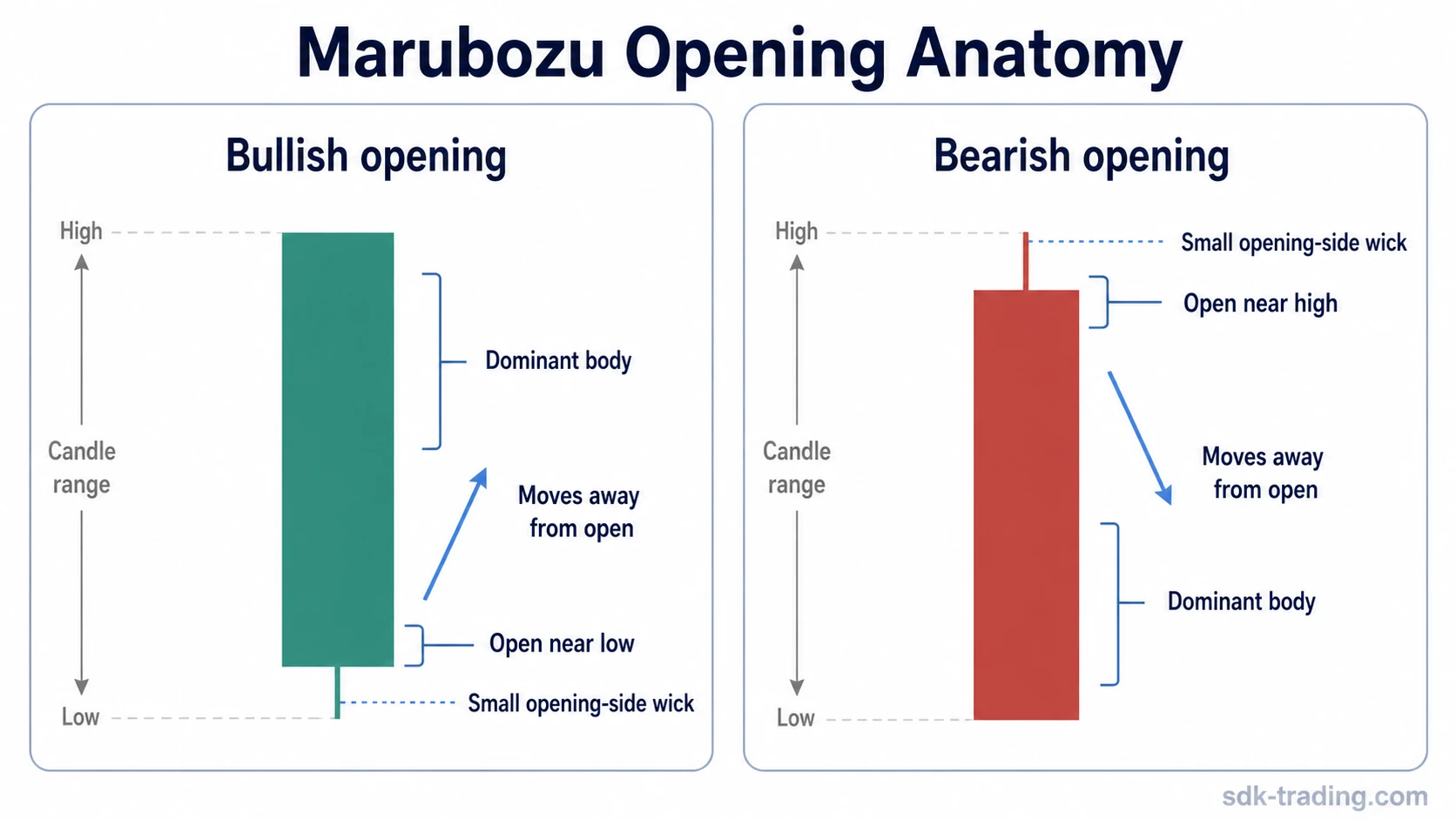
Bullish and Bearish Marubozu Opening
A bullish Marubozu Opening begins near the low of the candle. The candle then moves upward and closes higher, leaving a large body with little or no lower wick near the open.
A bearish Marubozu Opening begins near the high of the candle. The candle then moves downward and closes lower, leaving a large body with little or no upper wick near the open.
The same boundary applies on both sides. In a bullish Marubozu Opening, a large lower wick weakens the clean opening read. In a bearish Marubozu Opening, a large upper wick creates the same problem on the opposite side.
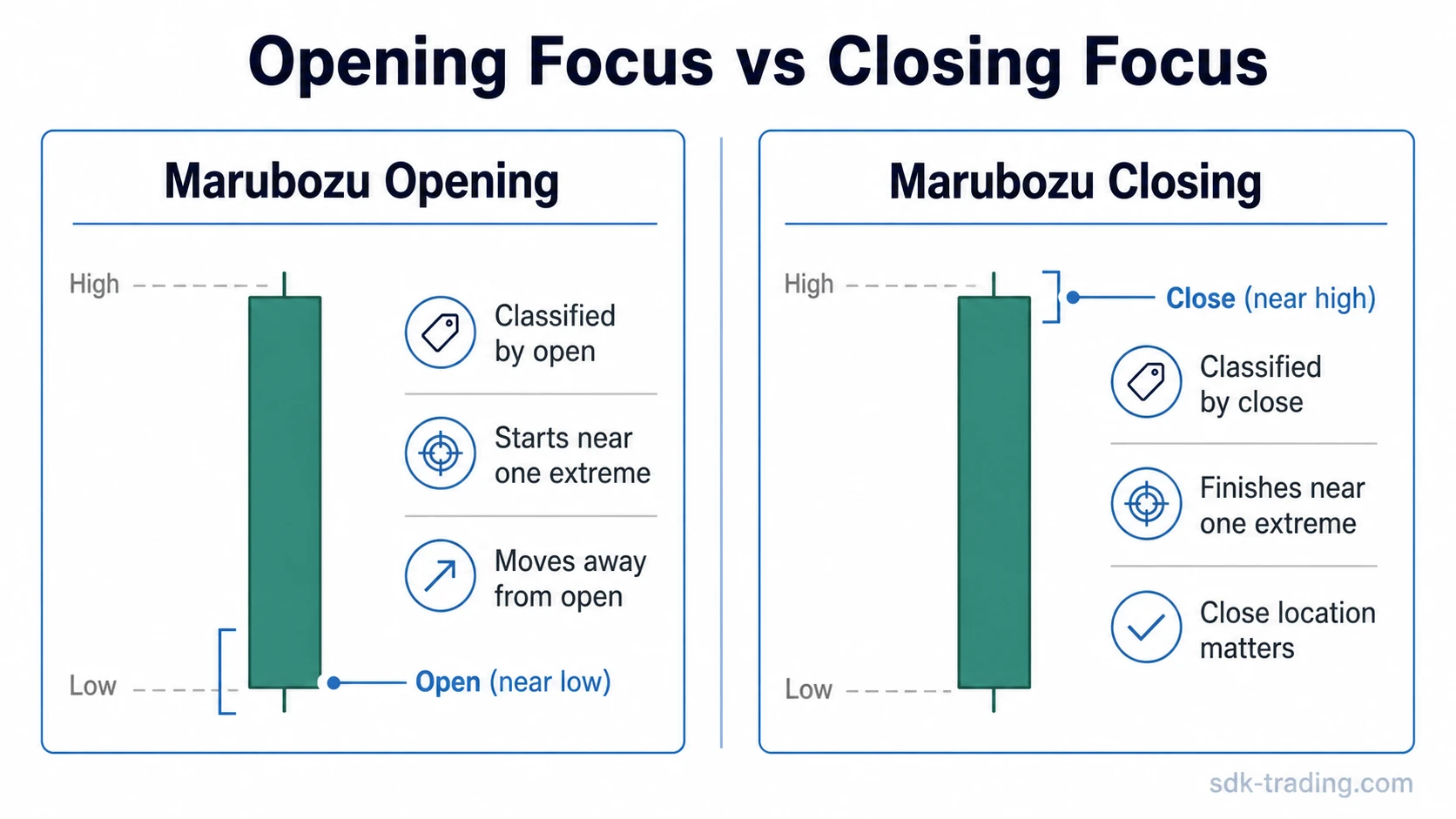
Marubozu Opening vs Marubozu Closing
Marubozu Opening and Marubozu Closing describe different parts of the candle. The opening version is classified by where price starts. The closing version is classified by where price finishes.
The difference matters because a candle can begin cleanly from one extreme but fail to close near the opposite extreme. It can also close strongly near an extreme after a less clean opening. The opening label describes the start of the intraperiod move, while the closing label describes the final position of the close.
| Structure | Classification focus | Useful question |
|---|---|---|
| Marubozu Opening | Where the candle opens | Did price begin near one extreme and move away from the open? |
| Marubozu Closing | Where the candle closes | Did price finish near one extreme after the session’s movement? |
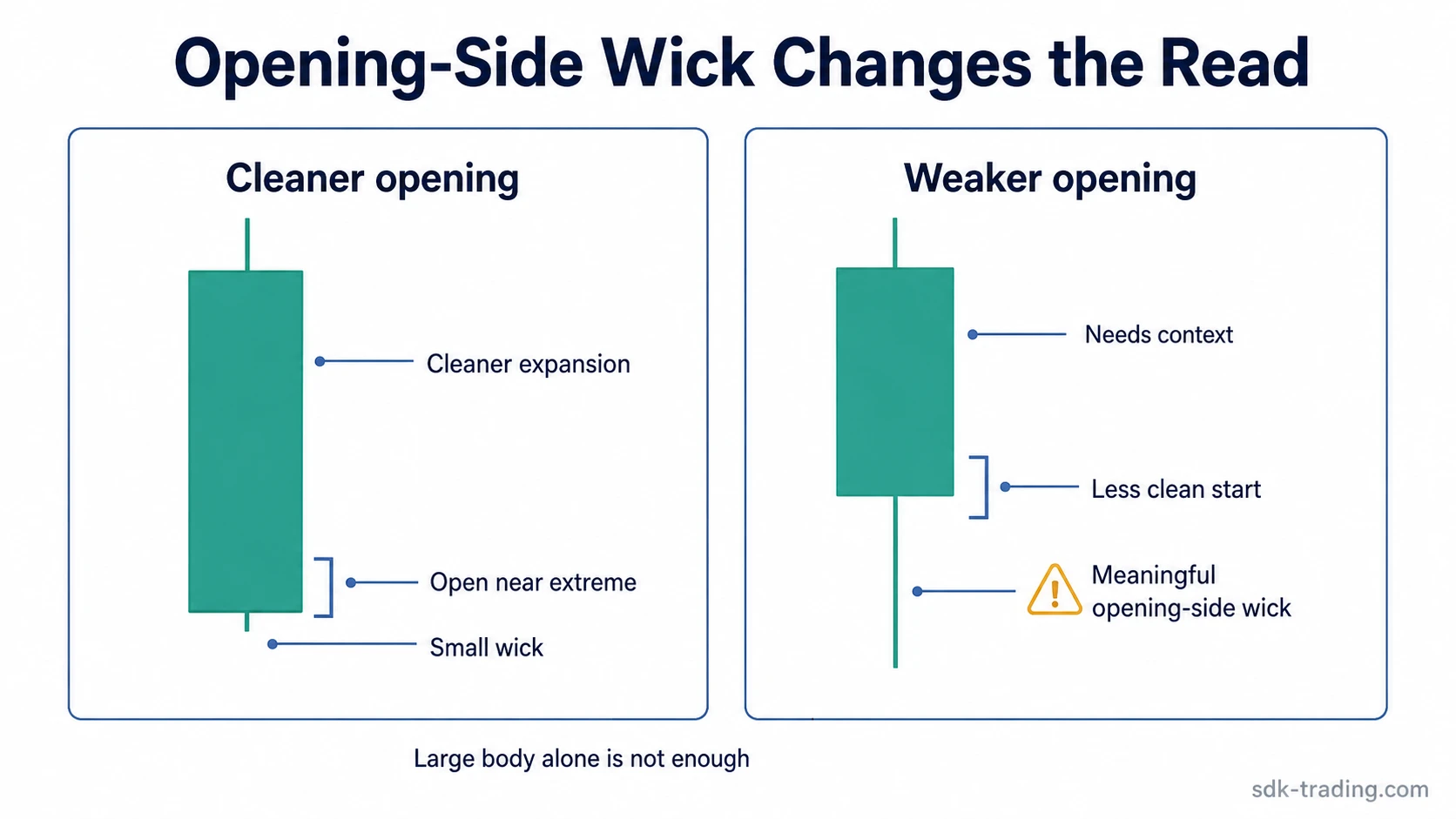
What Weakens the Reading
The classification becomes less clean when the candle leaves a meaningful wick on the opening side. That wick shows that price did not start cleanly from the range extreme before moving away.
Fast overlap back around the opening level also weakens the displacement. A candle may look strong at first glance, but if later price action quickly returns to the opening area, the clean directional expansion becomes less convincing.
Market context still matters. A Marubozu Opening candle near an important range edge can carry a different interpretation from the same candle printed in the middle of noisy consolidation. The candle describes intraperiod behavior; it does not determine what price must do next.
Simple Marubozu Opening Example
Price has been moving sideways near the upper edge of a short-term range. A new candle opens close to its low and then spends most of the session moving upward, leaving a broad body and only a small lower wick. The candle fits a bullish Marubozu Opening structure because the open forms near the lower extreme and price expands away from it.
The structure is less clean if the same candle first drops meaningfully below the open, creates a visible lower wick, and only later rallies. The final body may still look strong, but the opening-side wick shows that the candle did not begin with clean upward expansion from the opening area.
Related Concepts
The broader marubozu family helps separate strong-body candle structures from other single-candle patterns. The opening variant focuses on the start of the candle, while the closing variant focuses on the final position of the close and its Marubozu Closing reliability. When the candle’s body terminology needs more precision, the real body is the distance between the open and close.
FAQ
What is a Marubozu Opening candlestick?
A Marubozu Opening candlestick forms when price opens at or very near one end of the candle’s range and then moves away from that opening level with a dominant real body.
Is a small wick allowed on a Marubozu Opening candle?
Yes. A small wick near the opening side can still fit the structure, but a meaningful opening-side wick weakens the classification.
What is the difference between Marubozu Opening and Marubozu Closing?
Marubozu Opening is classified by where the candle opens. Marubozu Closing is classified by where the candle closes.
Is a Marubozu Opening candle a trading signal?
No. It describes how price moved during one candle. Market context and later price behavior are needed before the reading becomes more useful.