A hammer is the stricter name for a lower-wick candle with a small body near the upper part of its range. A pin bar is broader: it focuses on dominant wick rejection, so the same lower-wick candle can sometimes fit both labels.
Key Points
- A hammer is the stricter candlestick label.
- Hammer classification depends on a small body near the upper part of the candle range.
- Pin bar classification depends more on dominant wick rejection.
- A lower-wick candle can sometimes be both, but not every pin bar is a hammer.
Hammer vs Pin Bar: The Core Difference
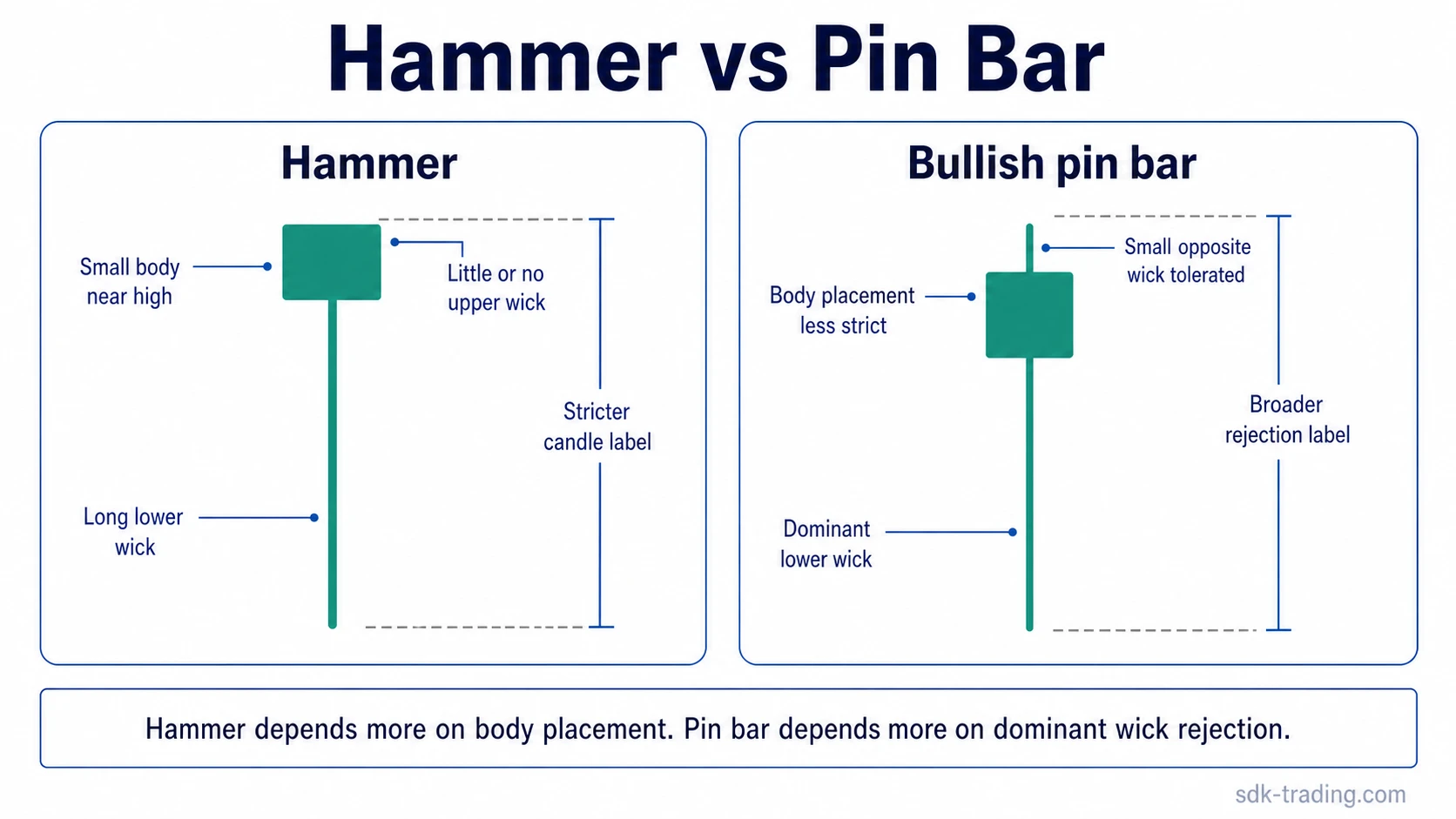
The core difference is that a hammer is a more specific candlestick structure, while a pin bar is a broader price-action rejection label. A hammer usually needs a small real body near the top of the candle range, a long lower wick, and little or no upper wick. A pin bar can still be valid when the body is less perfectly placed, as long as one wick clearly dominates the candle and shows a failed price probe.
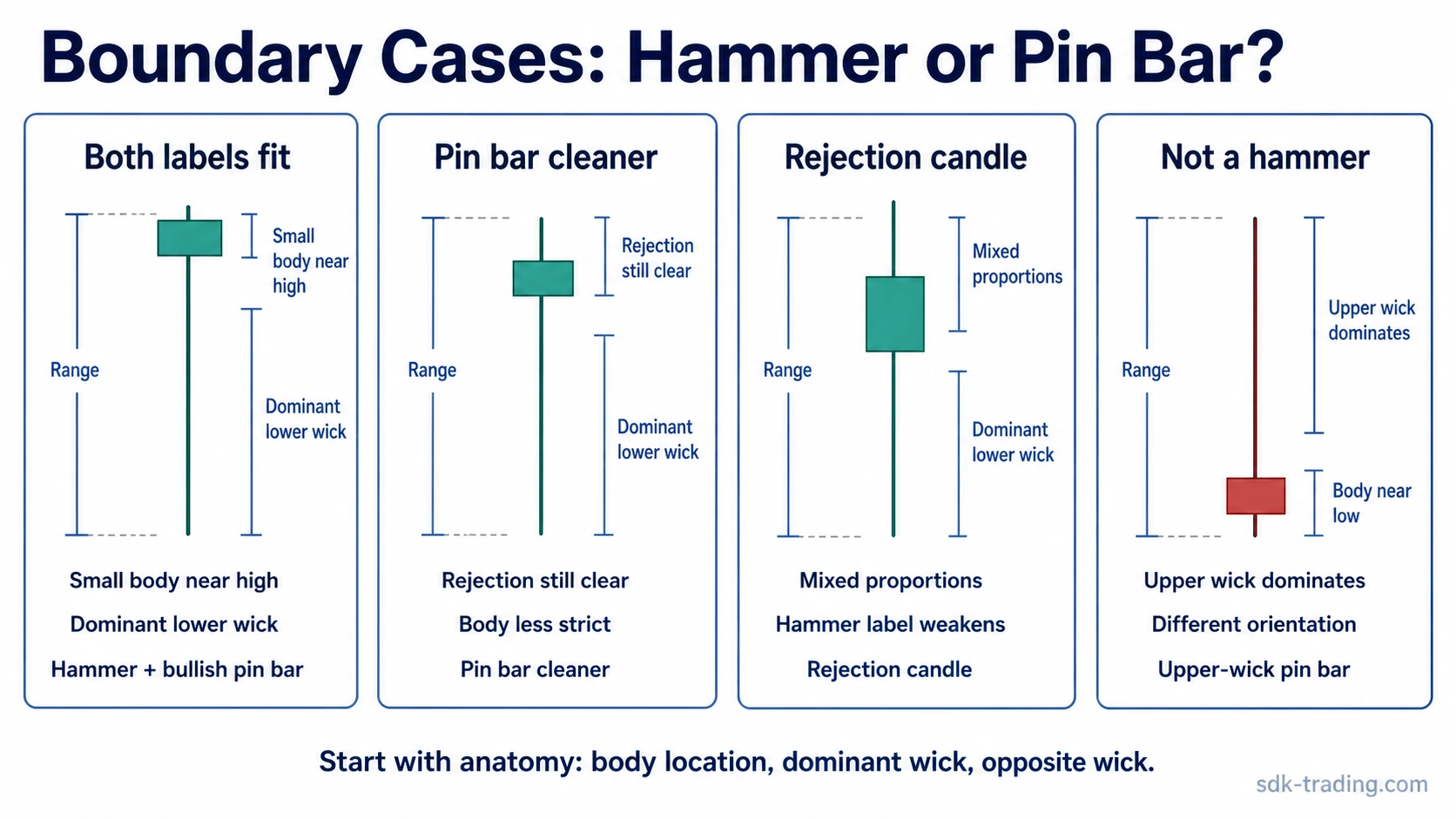
That distinction matters most in borderline candles. A clean lower-wick rejection with a tight upper body can be called both a hammer and a bullish pin bar. If the body drifts lower inside the range, or if the upper wick becomes more visible, the hammer label weakens sooner than the pin bar label.
Are Hammer and Pin Bar the Same?
A hammer and a pin bar are not always the same label. A clean hammer can often be described as a bullish pin bar because both can show lower-wick rejection, but the two names come from different classification systems. Hammer is the stricter candlestick-pattern label. Pin bar is the broader price-action label for a candle where one wick dominates the range.
The practical difference is that hammer classification asks whether the candle has the correct lower-wick anatomy: small body near the high, long lower shadow, and little or no upper shadow. Pin bar classification asks whether the candle shows a clear rejected probe. Because of that, a candle can remain a valid pin bar even when it is no longer a clean textbook hammer.
Reliability boundary: The label alone does not make either candle more reliable. A hammer or pin bar becomes more meaningful only when its location, prior movement, nearby support or resistance, and later confirmation support the rejection reading. Without that context, the name only describes the candle shape.
Where the Two Labels Overlap
The overlap appears when the candle rejects lower prices and closes near the upper part of the range. The long lower wick shows that price traded lower during the candle, but that lower area was not retained by the close. The small body near the upper range gives the candle the shape commonly associated with a textbook hammer.
The same candle can also fit bullish pin bar logic because the dominant lower wick is the main feature. Under the pin bar lens, the most important detail is the failed lower probe. Under the hammer lens, the body must also be placed tightly enough near the high to preserve the classical structure.
Overlap: a lower-wick rejection candle with a small upper-range body can be both a hammer and a bullish pin bar.
Divergence: when the body moves too far away from the high, or the upper wick becomes meaningful, the candle may still be a pin bar but becomes less defensible as a textbook hammer.
Where Hammer and Pin Bar Diverge
Hammer classification is more sensitive to candle anatomy. The body should sit close to the high, the lower wick should dominate, and the upper wick should be absent or very small. If those proportions weaken, the candle may still express lower rejection, but the hammer label becomes less precise.
Pin bar classification is more flexible because it describes rejection through wick dominance. A pin bar can be bullish when the lower wick dominates, or bearish when the upper wick dominates. That broader naming logic is why a candle can be a pin bar without being a hammer.
Hammer vs Pin Bar Criteria
| Criterion | Hammer | Pin bar | Practical classification note |
|---|---|---|---|
| Body placement | Small body near the upper part of the candle range. | Body can be less tightly placed if wick rejection is clear. | Body placement is the main separator in borderline lower-wick candles. |
| Lower wick | Long lower wick is required for the classical shape. | Long lower wick can create a bullish rejection reading. | A dominant lower wick can make both labels possible. |
| Upper wick | Little or no upper wick is preferred. | A smaller opposite wick may be tolerated if one wick clearly dominates. | A visible upper wick weakens hammer classification faster. |
| Directional orientation | Lower-wick structure only. | Can describe lower-wick or upper-wick rejection. | An upper-wick rejection candle can be a pin bar, but not a hammer. |
| Context | Often discussed after selling pressure or near a lower reaction area. | Can appear at either side of a range, level, or tested area. | Context helps interpretation, but the label still starts with candle anatomy. |
| Naming logic | Classical candlestick taxonomy. | Price-action rejection terminology. | Different trading vocabularies can name the same lower-wick candle differently. |
Same Candle, Different Label
Consider a candle that sells into a previously watched lower area, briefly trades below it, then closes back near the upper part of its range. The long lower wick supports a rejection reading, but the label still depends on anatomy: lower rejection alone does not automatically make the candle a textbook hammer.
If the body is compact and placed tightly near the high, with little or no upper wick, both labels are defensible. The candle has the anatomy of a hammer and the rejection logic of a bullish pin bar.
If the body closes above the midpoint but not close to the high, the pin bar label may remain cleaner. The long lower wick still describes a failed lower probe, but the body placement is no longer strong enough for a clean hammer classification.
Practical Boundary Cases
| Boundary case | More accurate label | Why |
|---|---|---|
| Small body tightly near the high, long lower wick, almost no upper wick. | Hammer and bullish pin bar. | The candle satisfies strict hammer anatomy while also showing lower-wick rejection. |
| Dominant lower wick, but the body sits slightly lower inside the range. | Pin bar may be cleaner. | The rejection is still visible, but the hammer structure is less textbook. |
| Long lower wick with a visible upper wick. | Usually pin bar or rejection candle, depending on proportions. | The upper wick weakens the clean hammer shape faster than it invalidates broader wick-rejection logic. |
| Dominant upper wick with a small body near the low. | Upper-wick pin bar, not hammer. | Hammer classification is lower-wick specific; upper-wick rejection belongs to a different candle family. |
Common Misread
The label is not a trade decision. Calling a candle a hammer or a pin bar only describes shape, wick dominance, and rejection behavior. It does not confirm direction, define risk, or prove that the next candle must follow through.
The safer reading is anatomical first: where is the body, which wick dominates, and how much of the probe was retained or rejected by the close? Only after that does broader market structure decide whether the candle has any practical relevance.
How This Differs From Nearby Candle Comparisons
Hammer vs hanging man is mainly a location and implication problem because both can share a lower-wick shape. Inverted hammer vs shooting star focuses on upper-wick orientation and trend context. Gravestone doji comparisons depend on tiny-body doji classification. Doji vs spinning top depends on body compression, not on the strictness of the hammer label.
Hammer vs pin bar is narrower. The issue is whether a lower-wick rejection candle deserves the stricter hammer name, or whether the broader pin bar label describes it more accurately.
FAQ
Is every hammer also a pin bar?
Many textbook hammers can also be described as bullish pin bars because both can show lower-wick rejection. The overlap is strongest when the hammer has a small body near the high and a dominant lower wick.
Can every pin bar be called a hammer?
No. Pin bar is broader. A pin bar can have an upper wick, a less tightly placed body, or a rejection shape that does not meet the stricter hammer structure.
What body placement makes the hammer label stronger?
The hammer label is stronger when the real body is small and positioned near the upper part of the candle range. The farther the body moves away from the high, the weaker the textbook hammer classification becomes.
Can a pin bar have an upper wick instead of a lower wick?
Yes. A pin bar can describe upper-wick rejection or lower-wick rejection. A hammer is specifically a lower-wick candle structure, so an upper-wick pin bar should not be called a hammer.
Why do traders use different names for similar-looking candles?
Different naming systems emphasize different details. Classical candlestick terminology focuses on named candle structures, while price-action terminology often focuses on rejection behavior and wick dominance.