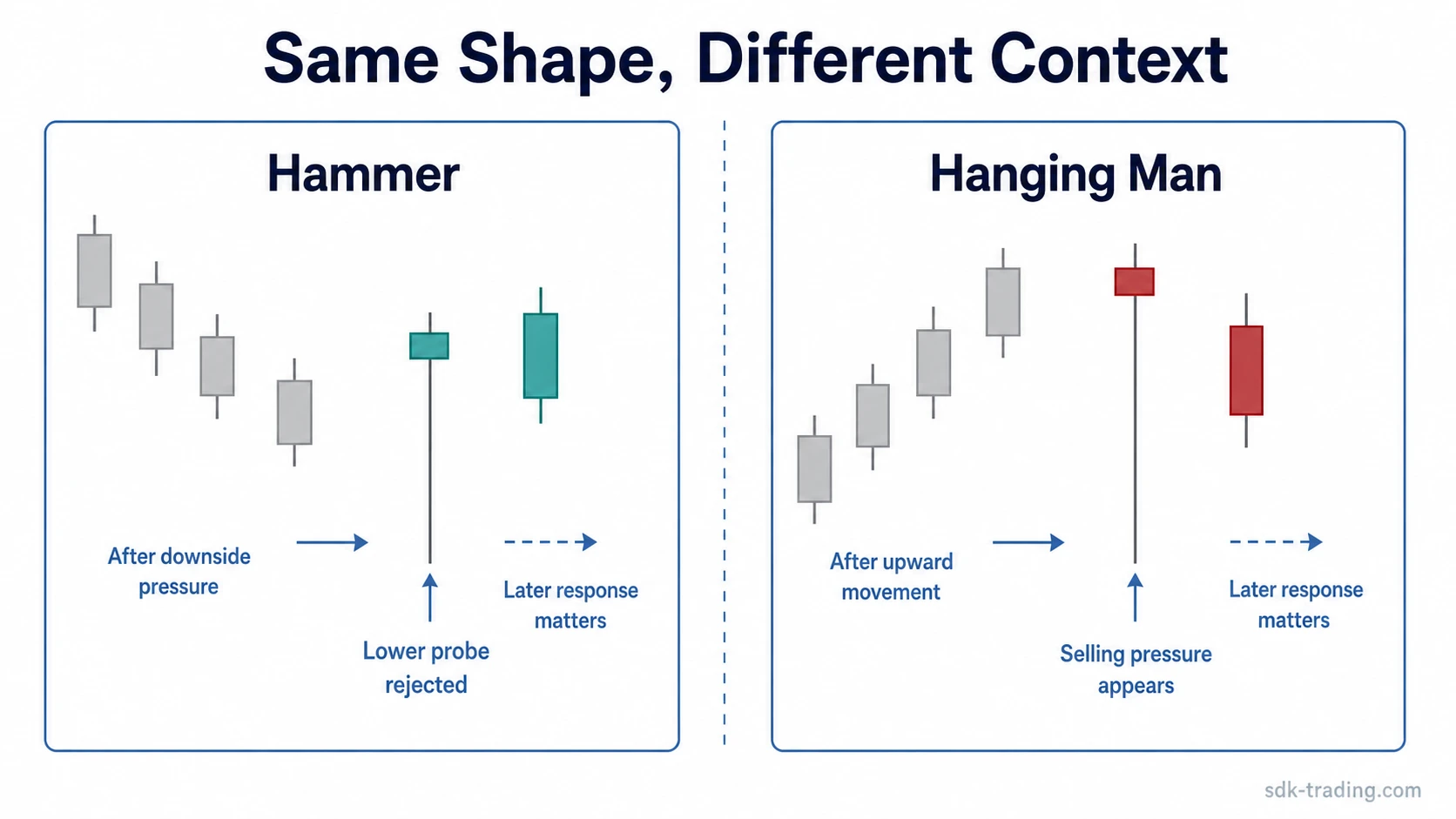
A Hammer and a Hanging Man can share the same lower-shadow candle shape. The difference is not the shape itself; it is the prior price sequence. A Hanging Man appears after upward movement, while a Hammer appears after downside pressure. Shape starts the comparison, but prior trend, candle location, and later response decide which reading is more defensible.
Immediate Difference
The Hammer and Hanging Man are often confused because both can have a small real body near the upper part of the candle range and a long lower shadow. That shared structure does not make them interchangeable. The prior move changes what the lower shadow means.
After a decline, the lower shadow can record a failed push lower and recovery. After an advance, the same lower shadow can warn that selling pressure appeared inside a previously rising sequence. Later candles then clarify whether the first reading held or failed.
- Both candles can share the same basic lower-shadow structure.
- A Hammer generally follows selling pressure or a decline.
- A Hanging Man generally follows upward movement or an advance.
- Shape alone is not enough to classify the candle.
- Later candles can strengthen, weaken, or leave the reading unresolved.
Hammer vs Hanging Man: Decision Criteria
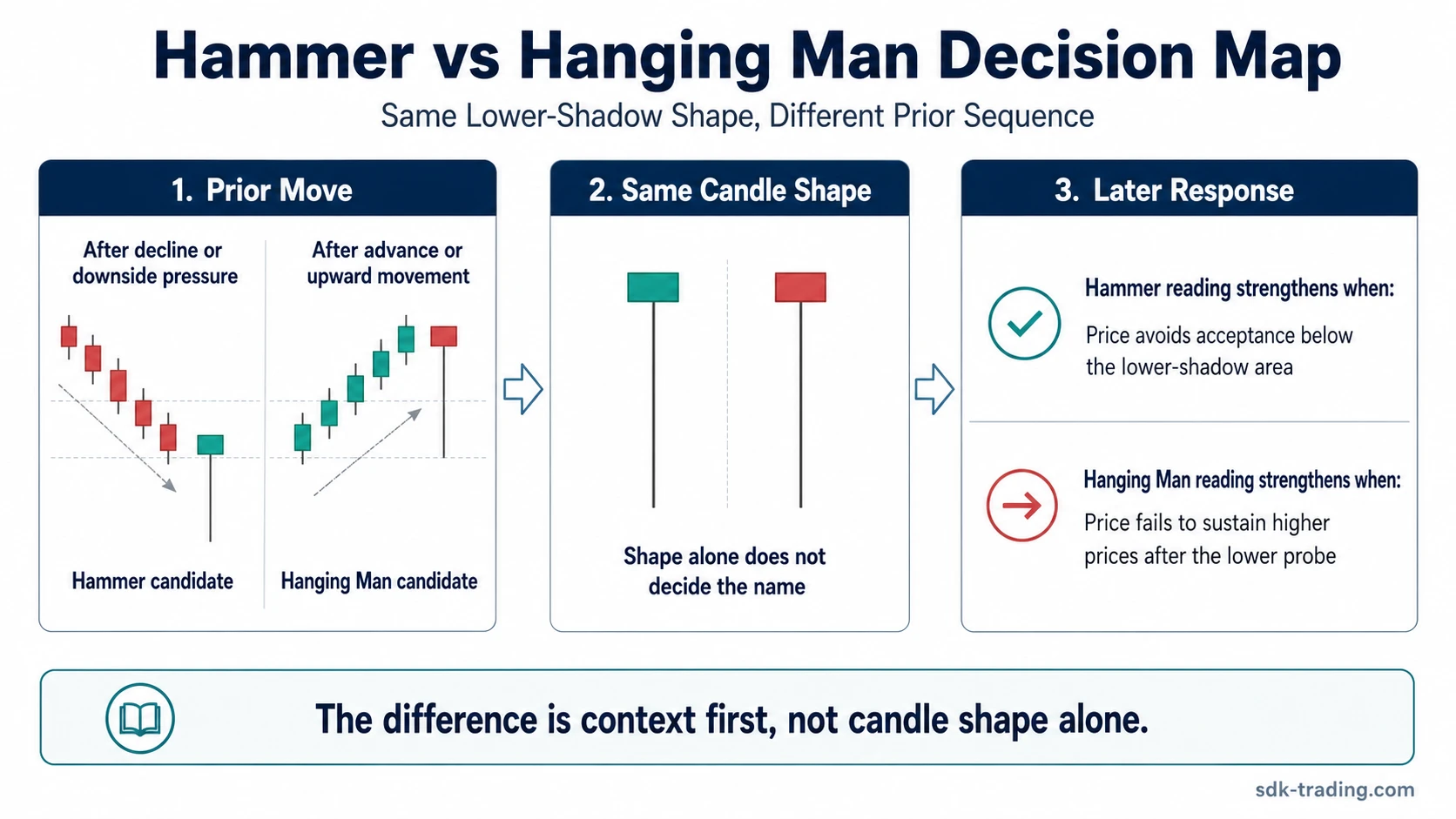
The safest way to separate the two labels is to classify the candle by sequence first, then interpret the response. A lower-shadow candle after weakness asks a different question than the same shape after strength.
| Criterion | Hammer | Hanging Man |
|---|---|---|
| Prior move | Usually appears after decline, downside pressure, or a lower-price test. | Usually appears after advance, upward movement, or a mature push higher. |
| Candle structure | Small body near the upper range with a long lower shadow. | Small body near the upper range with a long lower shadow. |
| Main question | Were lower prices rejected after sellers tested lower levels? | Did selling pressure appear after buyers had already pushed price higher? |
| Stronger reading | Later candles hold above the lower-shadow area and avoid accepting lower prices. | Later candles fail to sustain higher prices and start accepting lower levels. |
| Weaker reading | Price moves back into or below the lower-shadow area. | Price reclaims higher ground and the lower probe has little follow-through. |
| Use this lens when | The issue is whether a decline is starting to reject lower prices. | The issue is whether an advance is starting to show supply pressure. |
Same Shape, Different Reading
A lower-shadow candle after a decline can show that sellers pushed price below a recent area, but the close recovered before the candle finished. That does not confirm a reversal by itself. It only shows that the lower probe was rejected during that candle.
A lower-shadow candle after an advance carries a different question. The close may still recover, but the lower shadow shows that sellers were able to interrupt the advance and push price meaningfully lower during the candle. That makes the next candles important because they show whether the advance absorbs the pressure or begins to fail.
The same candle shape can create opposite-looking assumptions if the prior sequence is ignored. After a decline, the focus is failed lower acceptance. After an advance, the focus is whether selling pressure is starting to challenge the upward move.
Common Misreads
| Misread | Why it weakens the label | Better diagnostic check |
|---|---|---|
| Shape alone decides the label | A long lower shadow and a small body do not decide whether the candle is a Hammer or a Hanging Man. | Check the prior move first; without it, the same shape is only a lower-shadow candle with incomplete context. |
| Every lower-shadow candle is a Hammer | A Hammer reading needs downside context. | Use the Hammer label only when the candle appears after decline, pullback, or lower-area testing. |
| A Hanging Man confirms immediate weakness | A Hanging Man records selling pressure after upward movement, but it does not prove that an advance has ended. | Check whether later candles show that the lower probe mattered or was absorbed. |
When Each Label Fits Better
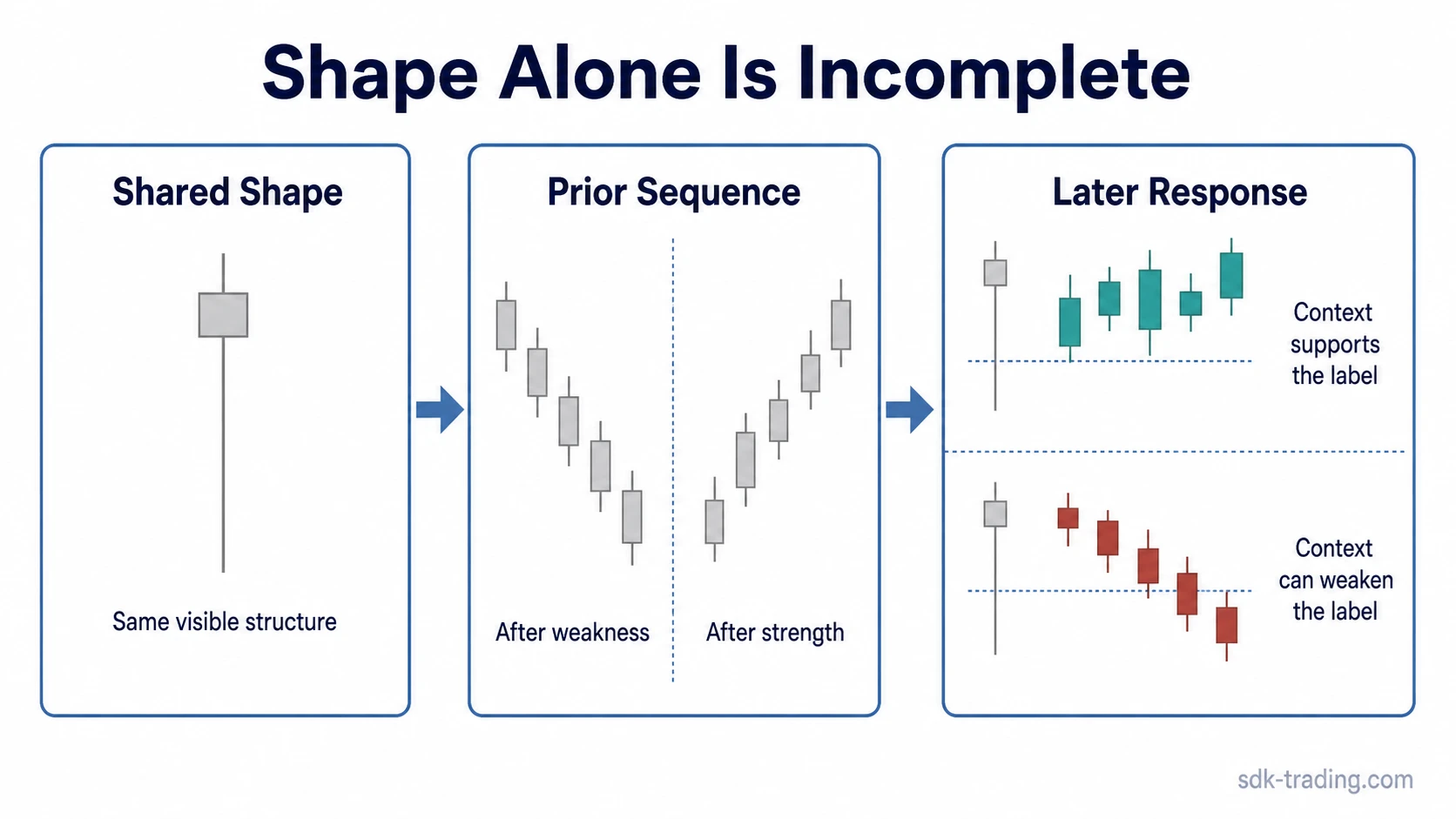
Use the Hammer label when the candle appears after selling pressure and the main issue is whether the market rejected lower prices. Later candles strengthen that reading when they stay above the lower-shadow area or build a stronger response from that area.
Use the Hanging Man label when the candle appears after upward movement and the main issue is whether sellers are starting to interrupt the advance. The concern becomes more defensible when the next candles fail to reclaim strength or begin accepting lower prices.
If the prior move is unclear, the label is weaker. Treat the candle as unresolved until the surrounding sequence shows whether the lower area was rejected, accepted, or ignored.
Hammer vs Hanging Man Is Not Hammer vs Pin Bar
Hammer versus Hanging Man is mainly a context distinction: the same-looking lower-shadow candle receives a different label after a different prior move. Hammer versus pin bar is a broader candle-classification distinction. Mixing the two comparisons can blur the main decision: whether the candle follows weakness or strength.
Frequently Asked Questions
Can a Hammer and Hanging Man look identical?
Yes. They can share a small body near the upper part of the range and a long lower shadow. The difference comes from the prior move: Hammer after downside pressure, Hanging Man after upward movement.
Is a Hammer always bullish?
No. A Hammer can suggest rejection of lower prices, but the reading depends on where it appears and how later candles behave. If price later accepts the lower-shadow area, the Hammer reading weakens.
Is a Hanging Man always bearish?
No. A Hanging Man records selling pressure after an advance, but it does not confirm a reversal by itself. Later candles need to show whether sellers actually changed the sequence.
What if the prior trend is unclear?
If the prior move is unclear, the label is less reliable. The candle is better treated as an unresolved lower-shadow candle until the surrounding price sequence gives it a clearer role.
What is the biggest mistake when comparing Hammer and Hanging Man candles?
The biggest mistake is classifying the candle from shape alone. Prior price sequence, candle location, and later response are what separate the two readings.