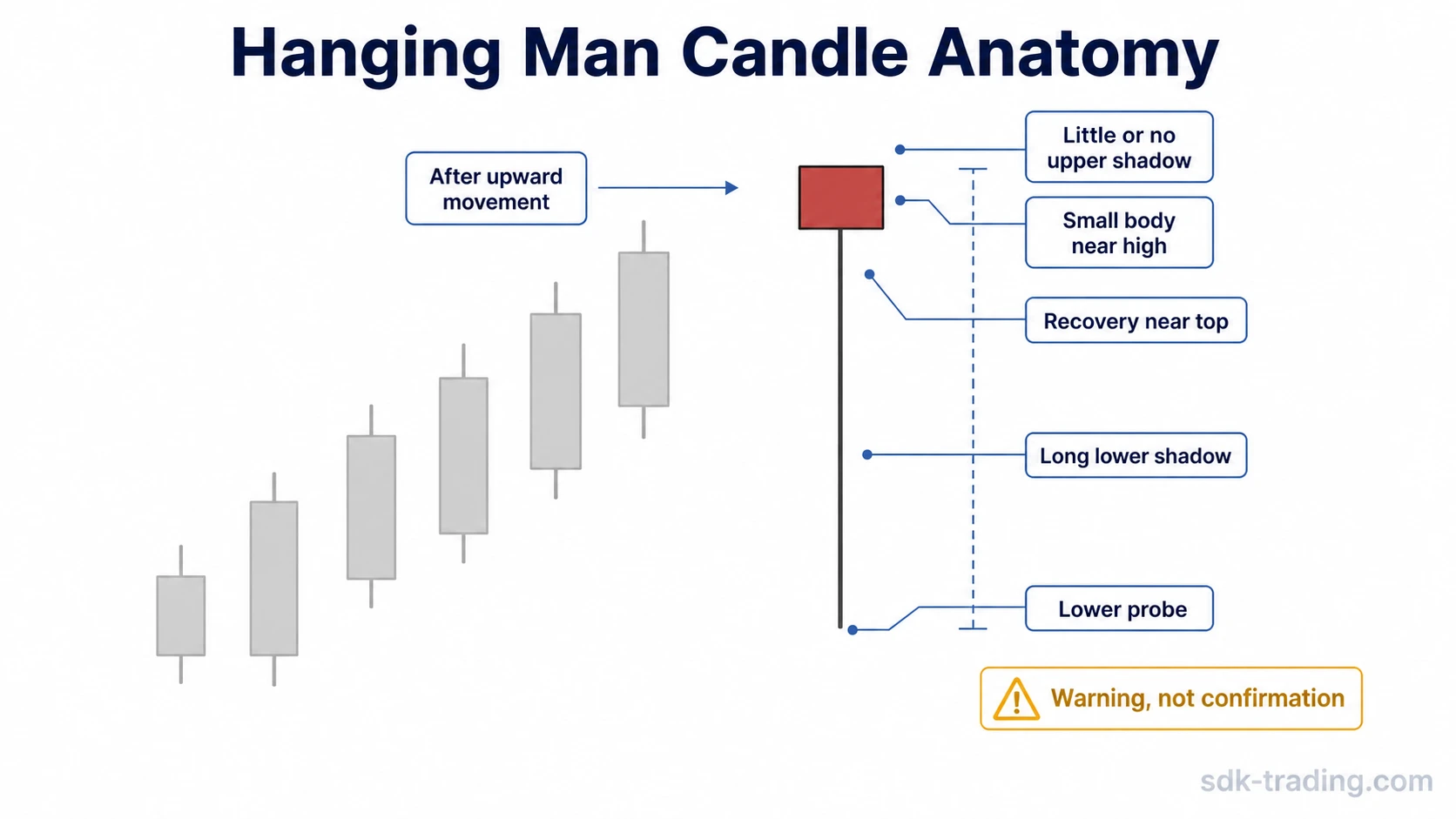
A hanging man candlestick is a bearish reversal warning that appears after upward price movement. It has a small real body near the top of the candle range, a long lower shadow underneath it, and little or no upper shadow. The candle does not confirm a reversal by itself; later price response must show that buyers failed to hold the upper recovery area.
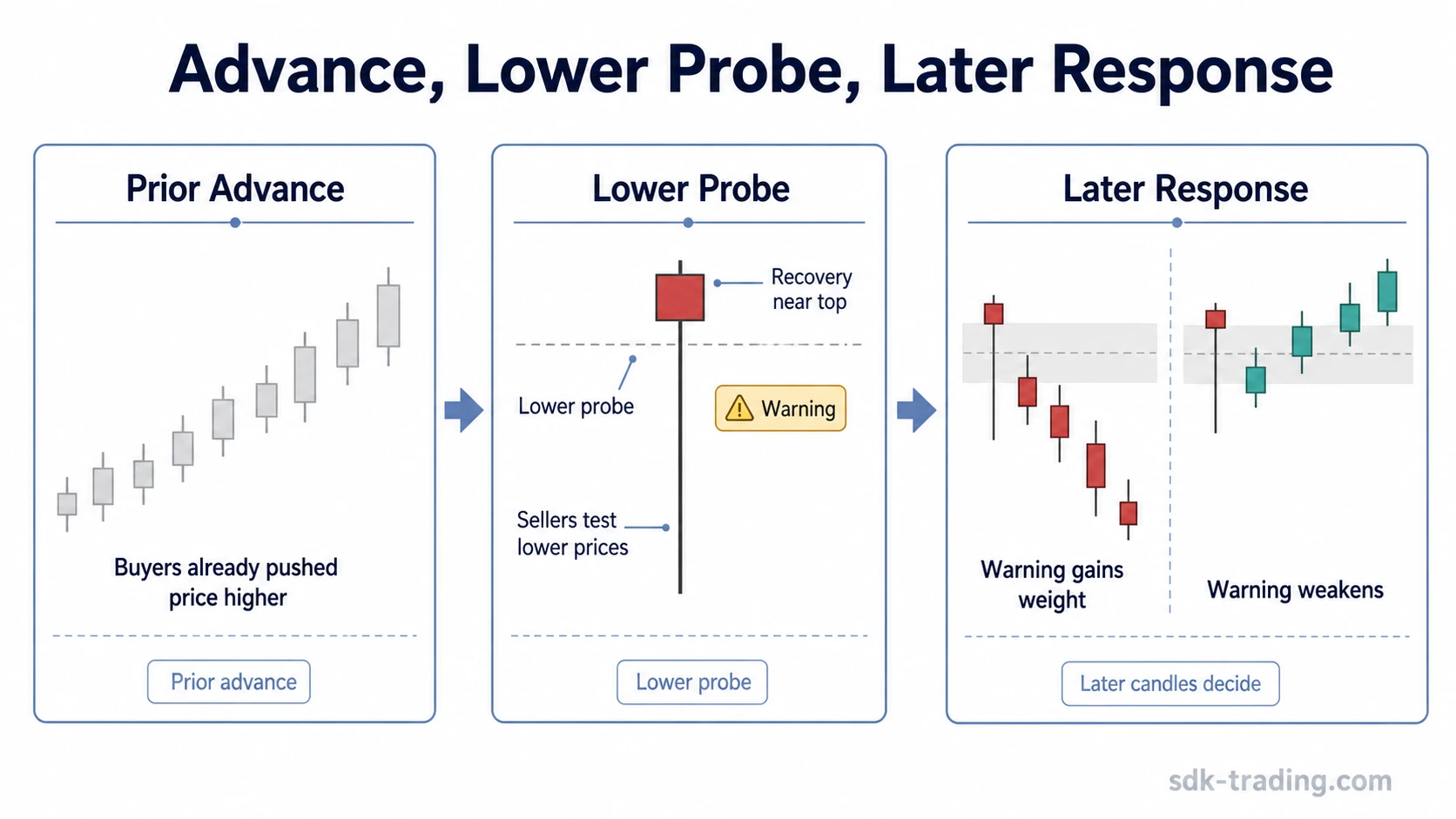
The candle does not say that the advance has already reversed. It says that price was tested lower during the candle period and then recovered. The useful reading starts with that tension: buyers recovered the close, but sellers were strong enough to probe below the body during an advance.
Key Points
- A hanging man needs prior upward movement; the same shape after a decline belongs closer to a hammer reading.
- The body should sit near the upper part of the candle range, with a lower shadow that is clearly longer than the body.
- The lower shadow shows a tested extreme below the body, not a clean downside decision by itself.
- Body color can add detail, but sequence, body placement, lower-shadow dominance, and later response matter more.
- The reading weakens if price quickly accepts back above the upper body area and continues higher.
Hanging Man Candlestick Meaning
A hanging man candlestick means that downside pressure appeared inside an advance, even though price recovered before the close. The close near the upper range can look stable, but the long lower shadow records a rejected probe below the body.
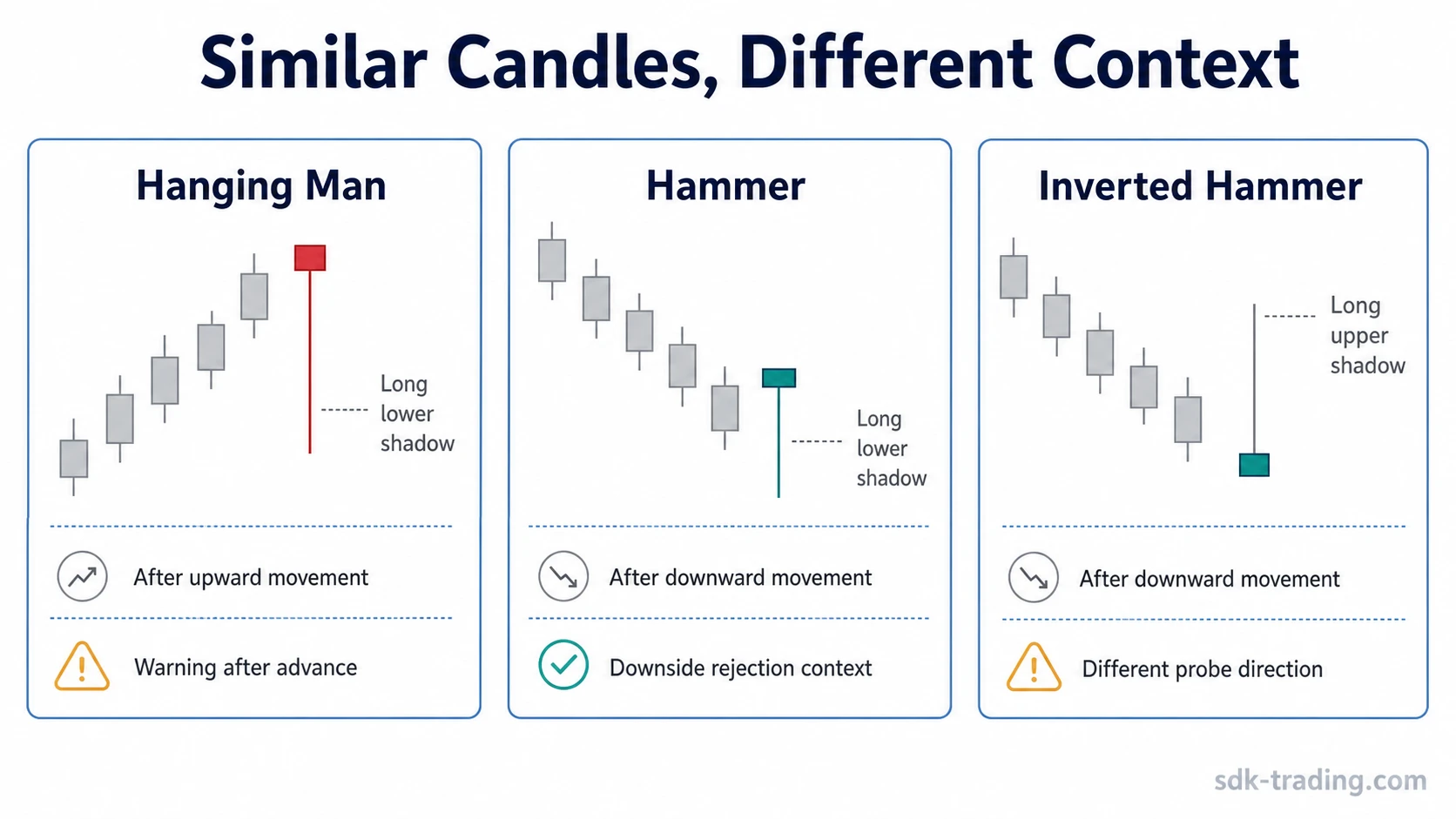
The pattern is context-dependent. A candle with a small upper body and a long lower shadow is not a hanging man everywhere; after a decline, the same outline is closer to a hammer. The hanging man label belongs to the post-advance version of the structure.
The cleanest interpretation is not “sell because the candle appeared.” A better reading is: the advance was tested from below, and later candles decide whether that lower probe becomes meaningful or gets absorbed.
How to Identify a Hanging Man
Start with the sequence before the candle. The structure should appear after an advance, a rally attempt, or a local upward leg. Without that prior movement, the lower-shadow shape loses the warning role.
| Diagnostic check | Cleaner reading | Weaker reading |
|---|---|---|
| Prior sequence | Clear upward movement before the candle. | Sideways chop, random noise, or a prior decline. |
| Body position | Small real body near the upper part of the full range. | Large body, midpoint body, or a close far from the upper range. |
| Lower shadow | Dominant lower shadow that is visibly longer than the body. | Only a minor tail, or mixed upper and lower shadows with no dominant probe. |
| Upper shadow | Little or no upper shadow. | A dominant upper shadow, which points toward another candle family. |
| Later response | Price fails to reclaim or hold the upper body area after the warning. | Fast recovery and continued acceptance above the candle area. |
Why the Lower Shadow Matters
The long lower shadow is the diagnostic feature because it shows that price moved well below the body during the candle period. That lower test is not automatically bearish; it is a record of stress inside an advance.
The recovery into the upper range is why the candle remains conditional. If the next candles hold above the body area and the advance continues, the lower probe was absorbed. If later candles lose the body area or fail to reclaim it, the warning becomes more defensible.
Red vs Green Hanging Man Candlestick
A hanging man candlestick can have either a red body or a green body. The body color can add context, but it does not override the main requirements: prior upward movement, a small body near the upper range, a dominant lower shadow, and later price response.
| Body color | What it can suggest | What it does not prove |
|---|---|---|
| Red hanging man | Price closed below the open after the lower probe, which can make the warning look heavier. | It does not confirm a reversal without later bearish response. |
| Green hanging man | Price closed above the open after the lower probe, showing stronger recovery into the close. | It does not cancel the warning if the candle appears after an advance and later price action weakens. |
The common mistake is treating candle color as the whole signal. A green body can still be a hanging man if the structure and prior advance are present. A red body can still fail if buyers quickly regain control.
Clean, Weak, and Invalid Hanging Man Readings
A clean hanging man reading has a prior upward sequence, a small body near the upper range, a dominant lower shadow, and later candles that do not quickly accept back above the body area. It is still a warning, not a completed market call.
A weak reading has mixed evidence. The lower shadow may be present, but the body may be too large, the prior movement may be unclear, or later candles may remain trapped inside the same range without resolving the test.
An invalid reading appears when buyers regain the upper body area quickly and hold it. In that case, the lower probe has not changed the sequence; the candle becomes a failed warning rather than a durable rejection clue.
Hanging Man vs Similar Candles
The hanging man is easy to confuse with nearby single-candle structures because several candles use small bodies and long shadows. The boundary is not only shape; it is prior sequence plus shadow direction.
| Candle | Shared feature | Diagnostic boundary |
|---|---|---|
| Hanging man | Small body and long lower shadow. | Appears after upward movement and warns that the advance was tested from below. |
| Hammer | Small body and long lower shadow. | Appears after downward movement, so the same shape carries a different contextual reading. |
| Inverted hammer | Small body with a long shadow. | The dominant shadow is above the body, not below it. |
| Gravestone doji | Upper-range rejection theme. | Usually has little or no real body and a dominant upper shadow. |
| Exhaustion candle | Can appear late in a move. | Focuses on stretched participation or range behavior, not only a small body with a lower probe. |
The most common confusion is covered directly in hammer vs hanging man. Both can share the same lower-shadow outline, but the prior price sequence changes the interpretation.
An inverted hammer uses the opposite shadow direction, so it should not be treated as a hanging man variant.
How Later Price Response Changes the Reading
The hanging man candle marks the first warning area. Later response decides whether that warning strengthens, stays unresolved, or fails.
Price response becomes more useful when later candles lose the hanging man body area, fail to recover above it, or keep closing below the upper part of the candle range. The concept of hanging man confirmation focuses on that follow-through sequence: whether buyers fail to reclaim the recovered area or absorb the warning and continue higher.
The reading weakens when price quickly moves back through the upper body area and holds there. That behavior shows acceptance back into the recovered area, which reduces the value of the original lower probe.
Common Hanging Man Misreads
| Misread | Why it weakens the label | Better diagnostic check |
|---|---|---|
| Reading the shape without the prior advance | A small body and long lower shadow are not enough. | Check whether there was enough prior upward movement for the hanging man label to be useful. |
| Treating the candle as a completed reversal | The candle records a tested extreme and recovery, not a completed bearish case. | Check whether later candles fail to sustain the recovered area. |
| Overweighting red or green body color | A red body can look more negative and a green body can look less negative, but color does not replace structure. | Use body placement, lower-shadow dominance, location, and later response before body color. |
| Ignoring the uptrend-specific role | The concept of hanging man in uptrend depends on the candle appearing after an advance rather than in random chart noise. | Separate the uptrend-specific hanging man role from the same lower-shadow shape in other locations. |
Frequently Asked Questions
What does a hanging man candlestick mean?
A hanging man candlestick means that price was tested lower during an advance and then recovered near the upper part of the candle range. It can warn that downside pressure appeared, but later candles decide whether the warning gains or loses weight.
How do you identify a hanging man candle?
Look for prior upward movement, a small real body near the top of the candle range, a long lower shadow, and little or no upper shadow. The candle should not be judged without the sequence around it.
When does a hanging man reading become stronger?
The reading becomes stronger when the candle appears after a real advance, tests lower prices, recovers into the upper part of the range, and later candles fail to sustain the recovered area.
Does the candle color matter for a hanging man?
Candle color can add detail, but it is secondary. Body placement, lower-shadow dominance, prior upward movement, and later price response carry more diagnostic value.
How is a hanging man different from a hammer?
A hanging man appears after upward movement and warns that the advance was tested from below. A hammer has a similar lower-shadow shape but appears after downward movement, where the reading is different.