A hanging man candlestick in an uptrend starts with prior upward movement, not shape alone. A small body with a long lower shadow is not enough unless the candle appears after an advance and sits high enough in that advance for the downside probe to matter.
What Evidence Is Needed Before Calling It a Hanging Man?
Use the checks below as a label filter. The candle needs structure, location, and sequence before any later response can be interpreted with more weight.
| Evidence check | Enough for the label? | Why it matters |
|---|---|---|
| Clear prior upward movement | Required | The candle is a warning after an advance, not a standalone shape. |
| Small real body near the upper range | Required | The close shows recovery from the lower probe, rather than simple downside acceptance. |
| Long lower shadow | Required | The lower shadow shows that price tested lower levels during the candle. |
| Little or no upper shadow | Helpful structural filter | A small upper shadow keeps the candle focused on the lower probe and recovery. |
| Elevated structural location | Strongly needed | A candle near the upper part of an advance carries more warning value than the same shape in random chop. |
| Later bearish response | Not required for the label | Later candles determine whether that warning receives follow-through or loses relevance. |
A full hanging man candlestick reading can include anatomy, psychology, and follow-through, but the prior advance is the first filter before those later details become useful.
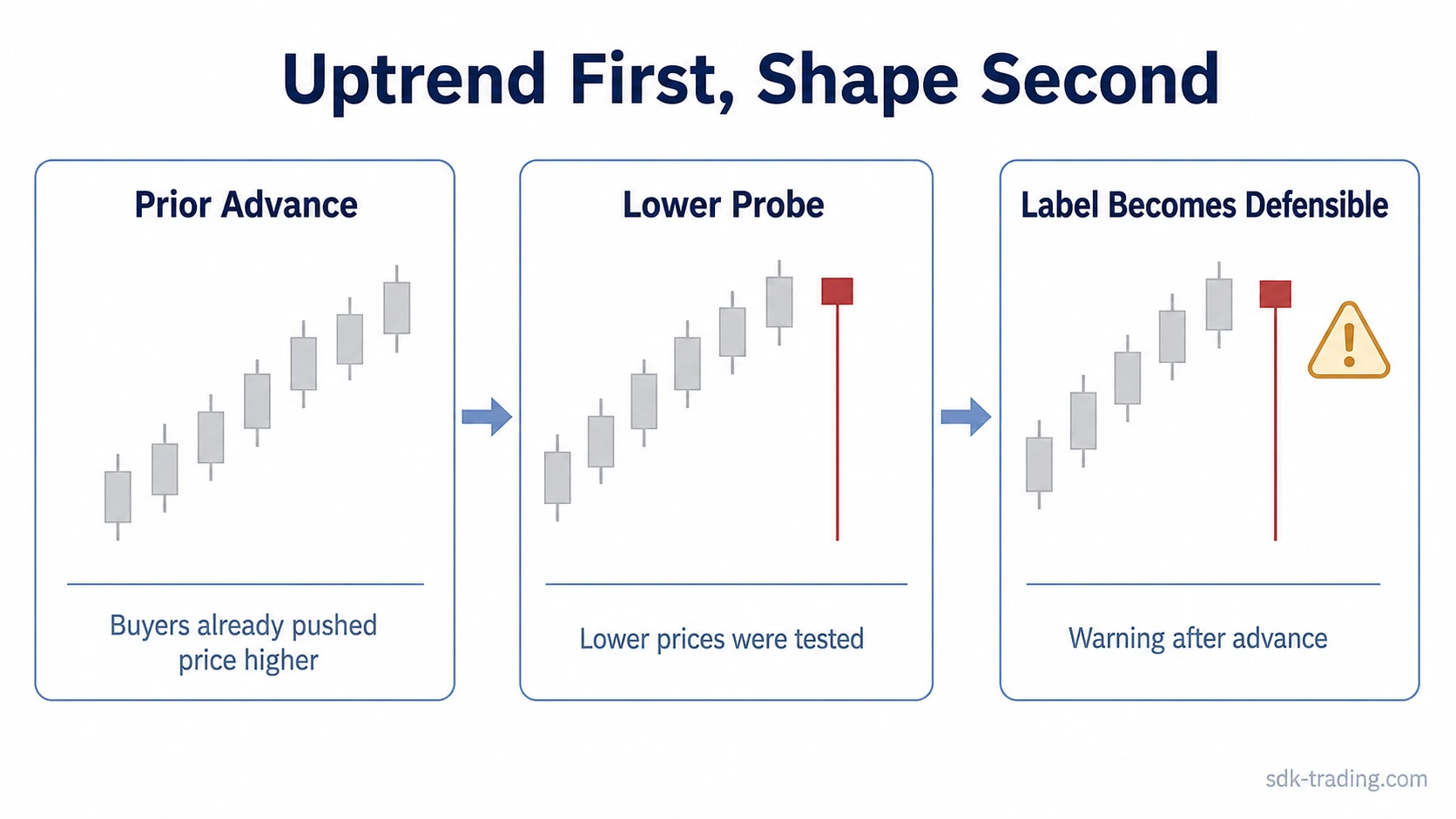
Why Prior Upward Movement Changes the Reading
Visual similarity is the main trap. In a declining sequence, the same lower-shadow shape can belong to an already weak market. After an advance, it records a downside test against buyers who had controlled the prior sequence, which is why the candle location changes the reading.
The body also matters. A small body near the upper range shows that price recovered from the intraperiod low, but it does not erase the fact that lower prices were tested. If the body becomes extremely small, a near-doji candlestick reading may also be relevant, especially when the open and close are nearly equal.
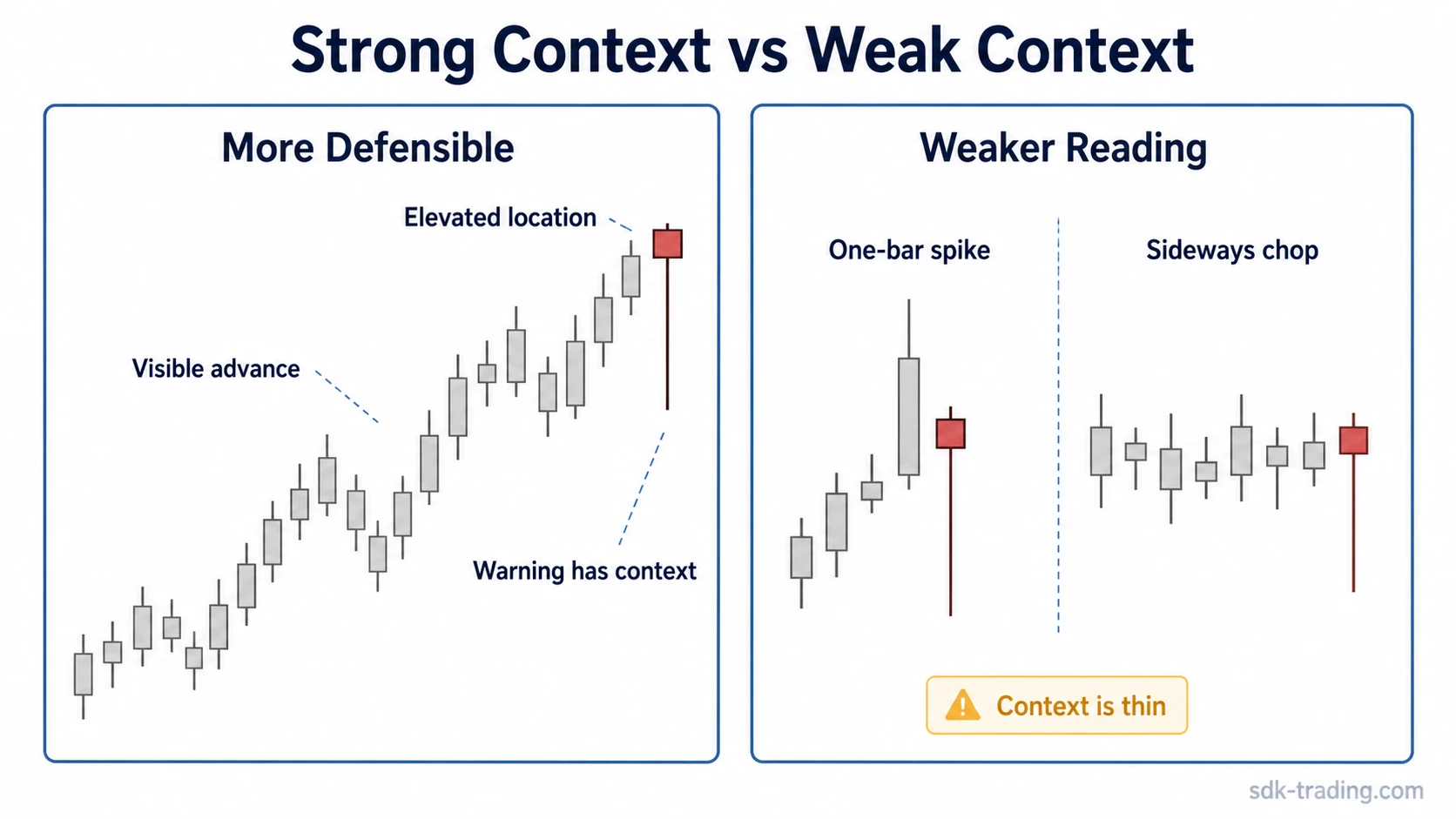
When the Uptrend Context Is Weak
Not every candle after a higher close has enough prior movement to support the hanging man label. The context is weak when the advance is only a brief pop, a sideways drift, or a move that has already lost structure before the lower-shadow candle appears.
| Market context | Diagnostic reading |
|---|---|
| Candle appears after a clean multi-swing advance | The hanging man context is more defensible because buyers have already driven price higher. |
| Candle appears inside sideways chop | The label is weaker because the candle is not clearly warning after an advance. |
| Candle appears after a one-bar spike | The uptrend evidence may be too thin unless the larger structure already shows upward pressure. |
| Candle appears after structure has already failed | It may be late evidence of weakness rather than the first warning inside an advance. |
| Candle appears during a mature advance near prior supply | The warning is easier to justify than during an early expanding leg with clean acceptance higher. |
A mature advance does not automatically reverse, and an early expanding move does not automatically continue. The narrower issue is whether the candle location gives the lower-shadow structure enough prior-uptrend context before any stronger interpretation is made.
Hanging Man Candlestick in an Uptrend Example
Price advances through several candles and reaches an elevated area where previous rallies or supply responses have slowed the move. During the next candle, price trades noticeably lower, then recovers enough to close near the upper part of the range. The long lower shadow makes the candle tempting to label immediately.
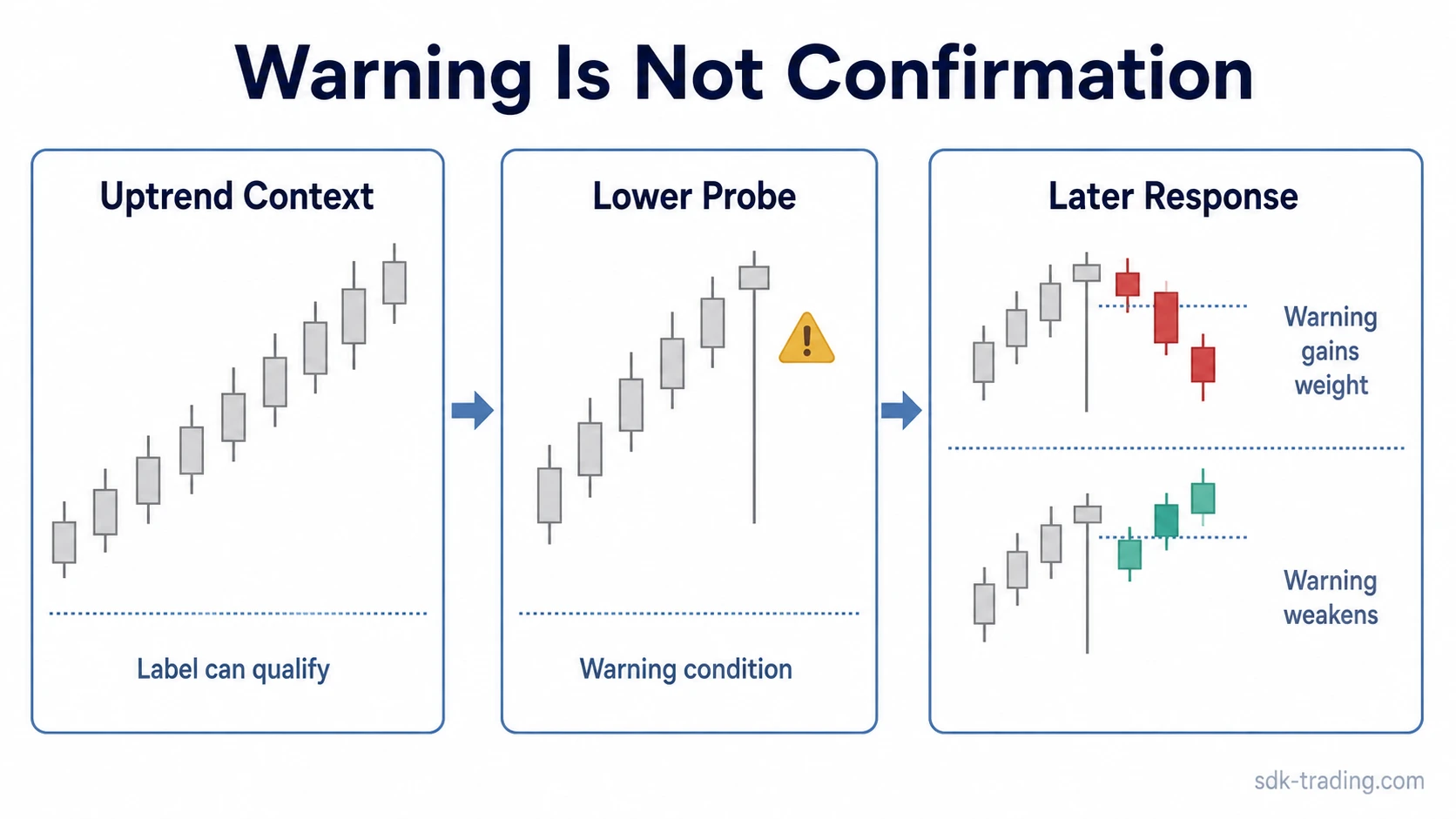
At that point, the candle marks a warning condition rather than a completed reversal claim.
The next comparison is not an entry decision. It is whether later candles accept lower prices, reject the probe, or absorb the warning by continuing higher.
What Uptrend Context Does Not Prove
Uptrend context makes the hanging man label possible, but it does not prove that sellers have taken control. It only shows that the lower-shadow candle appeared after buyers had already pushed price higher.
The narrow support-page question is whether the prior advance is strong enough for the label to be valid. Confirmation is a separate check: later candles must show whether the downside probe gains weight, gets absorbed, or loses relevance.
Candle color can influence tone, but it is not the main filter. A red body may look more cautionary and a green body may look less severe, yet prior sequence, structural position, shadow behavior, and later response carry more interpretive weight.
Common Misreads
| Misread | Cleaner Reading |
|---|---|
| Calling the shape first | Sequence is part of the label, not a detail added afterward. |
| Ignoring where the candle forms | The same shape in a flat range does not carry the same warning profile. |
| Treating body color as the decision | Color adds tone, but it does not replace sequence, location, and response. |
| Confusing context with confirmation | Context qualifies the label. Later response tests whether the warning matters. |
Frequently Asked Questions
Can a hanging man appear without an uptrend?
The label is weak without prior upward movement. Shape alone is not enough because the hanging man reading depends on a lower probe after an advance.
What does the uptrend condition actually prove?
It proves only that the candle appeared after prior upward movement. It does not prove reversal, seller control, or failed demand unless later candles support that warning.
Is the candle color important?
Body color can affect tone, but prior sequence, range placement, lower-shadow behavior, and later response matter more.
How is this different from hanging man confirmation?
Uptrend context qualifies the label. Confirmation evaluates what price does afterward and whether the warning receives follow-through.