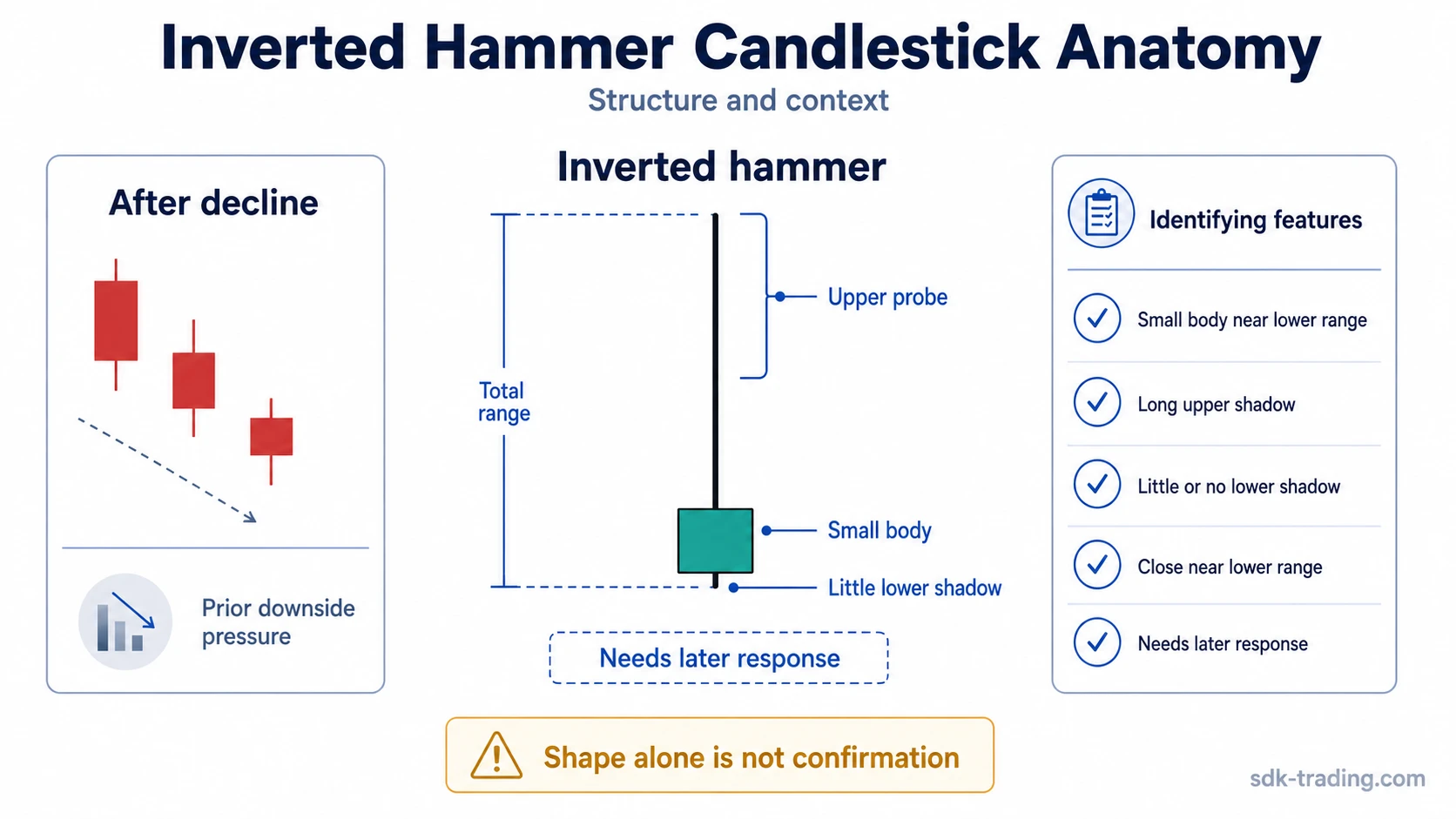
An inverted hammer candlestick is not confirmed by its shape alone. It is an upper-price probe that appears after downside pressure, with a small body near the lower part of the candle and a long upper shadow showing that price tested higher but did not fully hold the test.
The useful question is not whether the candle looks bullish in isolation. The useful question is whether the prior decline, the candle structure, and the later candles support the idea that selling pressure is weakening instead of simply producing a failed recovery attempt.
Fast read: an inverted hammer needs a prior decline, a small real body near the lower range, a dominant upper shadow, little or no lower shadow, and later price behavior that does not immediately accept lower prices again.
What Is an Inverted Hammer Candlestick?
An inverted hammer candlestick is a single-candle pattern that forms after downward movement. It has a small real body near the lower part of the candle range and a long upper shadow above the body.
The long upper shadow shows that buyers or short-covering pressure tested higher prices during the candle. The close near the lower range shows that the higher test was not fully accepted by the close. That tension is why the candle is best read as an early pressure-shift warning, not as a complete reversal signal.
The pattern becomes more useful when it appears after sellers have already pushed price lower. Without that prior downside pressure, the same shape may be only an upper-wick candle, a noisy indecision candle, or a different structure with a different meaning.
How to Identify an Inverted Hammer
The inverted hammer has a simple visible structure, but each part of the candle carries a different diagnostic job. The body shows net progress, the upper shadow shows the tested area, and the close shows whether that test was accepted or rejected by the end of the candle.
| Part of the Candle | What to Look For | How to Read It Safely |
|---|---|---|
| Prior sequence | Downward movement before the candle appears. | The candle needs downside pressure before the inverted hammer label is meaningful. |
| Real body | Small body near the lower part of the candle range. | The open and close are close together, so the candle does not show strong net control by itself. |
| Upper shadow | Long upper wick, commonly much larger than the body. | Price tested higher, but the test still needs later acceptance to matter. |
| Lower shadow | Little or no lower wick. | The main visible test is above the body, not below it. |
| Close location | Close remains near the lower range, not near the high. | The candle shows a probe into higher prices, not a completed hold above the tested area. |
Body color can change the tone, but it does not decide the pattern. A green inverted hammer may look stronger because the close is above the open, while a red inverted hammer can still qualify if the body is small, the upper shadow dominates, and the candle appears after downside pressure.
Why Downtrend Context Matters
The inverted hammer is a context-dependent candle. After a decline, the long upper shadow can show that price finally tested above the recent downside flow. That test may matter because it appears after sellers have already been active.
Inverted hammer in downtrend context separates a meaningful upper-price probe from a random upper wick. In a flat or already recovered sequence, the same candle shape may not carry the same reversal-warning logic.
Context also prevents confusion with nearby candle types. A long upper shadow after upward movement often belongs closer to shooting star logic. A long upper shadow inside choppy sideways movement may simply show unresolved two-way testing.
Inverted Hammer Meaning: Upper Probe, Not Proof
The inverted hammer means that price was able to test higher after a prior decline, but that higher area was not fully held by the candle close. This makes the candle a pressure-change clue rather than proof that a new trend has started.
A stronger reading develops only if later candles stop accepting lower prices, recover part of the tested area, or show that sellers are no longer extending the prior decline cleanly. A weaker reading develops if the market treats the upper shadow as a failed recovery attempt and continues lower.
Safe interpretation note: read the inverted hammer as a possible change-of-pressure marker. The candle can identify where price tested higher, but later acceptance or rejection decides whether that test becomes useful.
Clean, Weak, and Invalid Inverted Hammer Readings
A clean inverted hammer reading is not only about a long upper wick. It is about the relationship between the prior decline, the candle anatomy, and what price does after the candle appears.
| Reading Quality | What It Looks Like | Diagnostic Meaning |
|---|---|---|
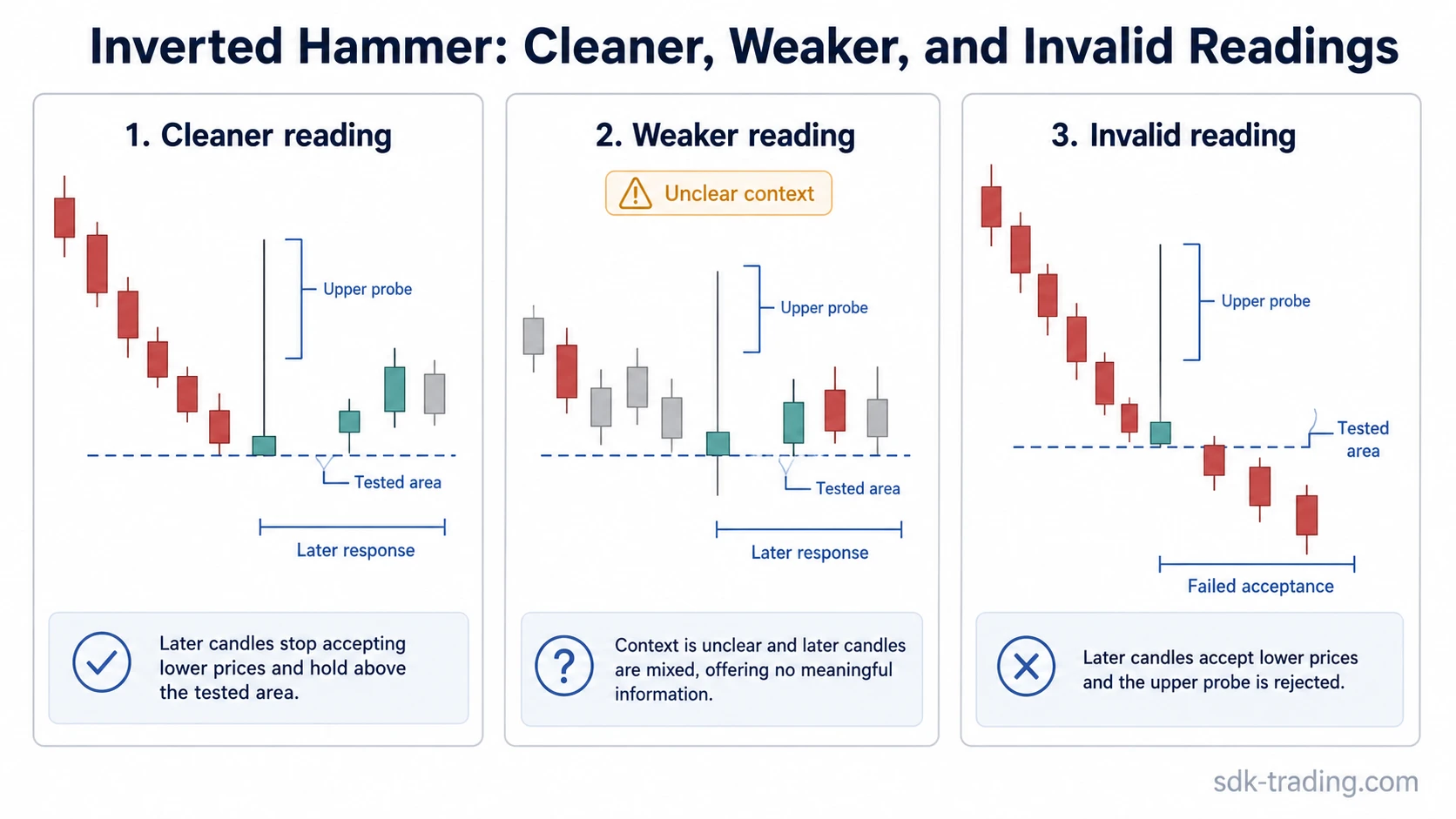
| Cleaner reading | Prior decline, small body near the lower range, dominant upper shadow, little lower shadow, and later candles stop accepting deeper lows. | The upper probe has some support from later behavior. It still needs structure, but the candle is no longer isolated. |
| Weaker reading | Mixed shadows, larger body, unclear prior decline, sideways context, or follow-through that remains unresolved. | The candle may still be useful to observe, but the label is less reliable and the reading should remain cautious. |
| Invalid or failed reading | Price continues lower, rejects the recovery attempt, or accepts below the candle area soon after the pattern appears. | The upper shadow becomes evidence of failed acceptance rather than a useful reversal warning. |
This clean / weak / invalid split keeps the candle from being overread. A visually correct inverted hammer can still fail if later price action shows that sellers remain in control.
Later Acceptance vs Failed Acceptance
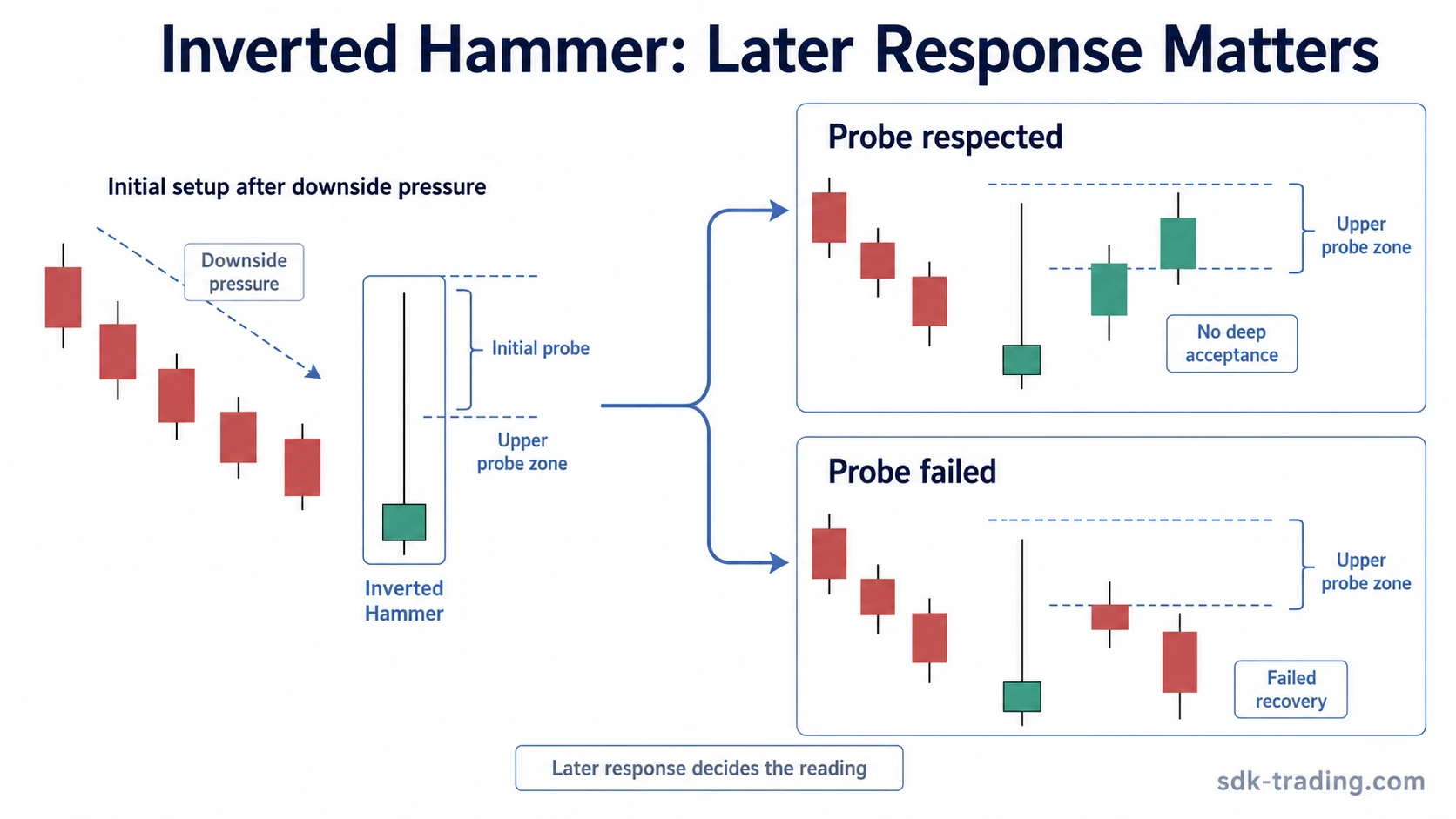
Inverted hammer confirmation is not contained inside the candle itself. It comes from the next candles and from whether price accepts or rejects the area tested by the upper shadow.
A more defensible reading appears when the market avoids deeper downside acceptance after the inverted hammer, begins to hold higher closes, or recovers enough of the tested area to show that the upper probe was not immediately rejected.
A failed reading appears when later candles move lower with little resistance, close below the inverted hammer area, or treat the upper shadow as a failed attempt to recover. In that case, the candle did not create a usable change in pressure. It only marked where the recovery attempt failed.
Red vs Green Inverted Hammer
A green inverted hammer closes above its open, while a red inverted hammer closes below its open. The green version can look stronger at first glance, but color is secondary to structure, context, and later response.
| Body Color | What It Adds | What It Does Not Prove |
|---|---|---|
| Green body | The candle closed above its open, which can make the upside probe look more constructive. | It does not confirm a reversal without later acceptance or stronger structure. |
| Red body | The candle still can qualify if the body is small and the upper shadow dominates. | It does not automatically invalidate the pattern if the anatomy and context are still present. |
The safer hierarchy is structure first, context second, later response third, and body color last. Color can refine the reading, but it should not replace the diagnostic sequence.
Simple Inverted Hammer Example in Context
Price has declined for several candles, but the latest push lower no longer extends cleanly. One candle then trades above the recent intraday range, leaves a long upper shadow, and closes near the lower part of its own range.
The tempting interpretation is that buyers appeared after the decline. The missing confirmation is that buyers did not hold the higher test by the close. The candle becomes more meaningful only if the following candles stop accepting lower prices or begin to recover part of the upper-shadow area.
If price continues lower without respecting the tested area, the interpretation changes. The long upper shadow then looks less like early demand and more like a failed recovery attempt inside an ongoing decline.
Inverted Hammer vs Similar Single-Candle Structures
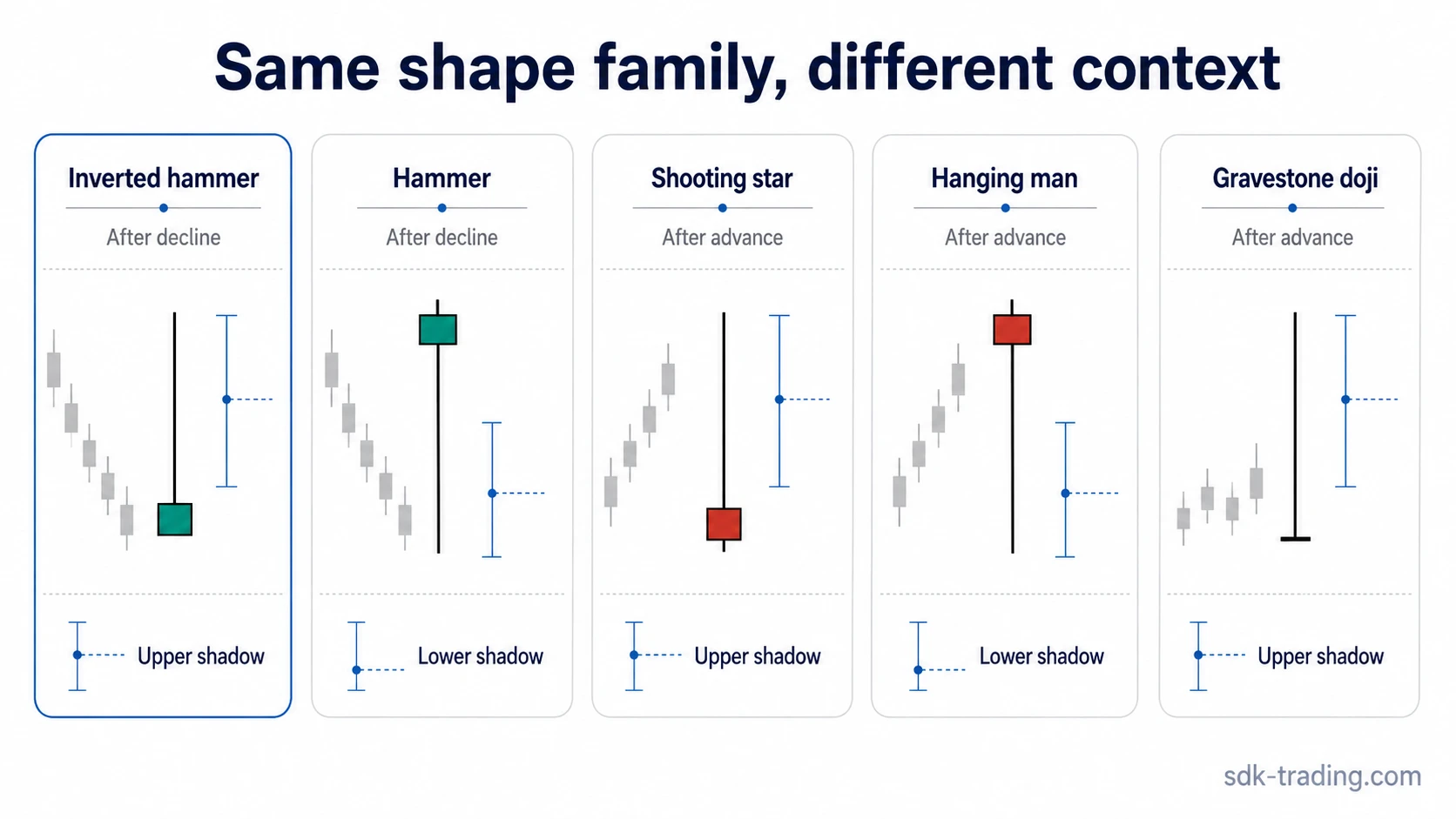
The inverted hammer is often confused with other single-candle structures because several candles can share small bodies and long shadows. The difference comes from shadow direction, body location, and the prior sequence.
| Candle | Typical Structure | Usual Context | Main Boundary |
|---|---|---|---|
| Inverted hammer | Small body near the lower range with a long upper shadow. | After downward movement. | Upper-price probe after downside pressure. |
| Hammer | Small body near the upper range with a long lower shadow. | After downward movement. | Lower-shadow rejection rather than upper-shadow probing. |
| Shooting star | Small body near the lower range with a long upper shadow. | After upward movement. | Same broad shape family, but opposite prior context. |
| Hanging man | Small body near the upper range with a long lower shadow. | After upward movement. | Lower-shadow structure after an advance, not upper probing after decline. |
| Gravestone doji | Open and close compressed near the low with a long upper shadow. | Often read as rejection or failed acceptance, depending on context. | Doji-style open-close compression, not a small-bodied hammer family candle. |
A hammer uses lower-shadow rejection after downside pressure, while an inverted hammer uses an upper-shadow probe after downside pressure.
The inverted hammer vs shooting star distinction is mostly about prior direction. Downside pressure before the candle supports inverted hammer logic, while upside pressure before the same broad shape supports shooting star logic.
Common Mistakes When Reading an Inverted Hammer
The most common mistake is treating the long upper shadow as proof that buyers have taken control. The upper shadow shows that price traded higher, but the close near the lower part of the range also shows that the higher level was not fully held.
- Reading shape without sequence: the candle needs prior downward movement before the inverted hammer label carries useful meaning.
- Ignoring the close location: a long upper shadow with a weak close can still show failed upside acceptance.
- Overweighting body color: green can look stronger and red can look weaker, but later price response matters more than color alone.
- Calling every upper wick an inverted hammer: the candle needs the right body location, shadow balance, and context.
- Confusing similar candles: upper-shadow candles after upward movement usually belong closer to shooting star logic.
- Treating the pattern as a decision rule: candlestick analysis is a timing and interpretation layer, not a complete trading system.
FAQ
Is an inverted hammer bullish?
An inverted hammer can be read as a possible bullish reversal warning after a decline, but the shape does not confirm that shift by itself. The reading improves only if later candles stop accepting lower prices or begin to recover part of the tested area.
Does an inverted hammer need a downtrend?
Yes. The inverted hammer label is strongest after prior downward movement. Without a decline, the same upper-shadow structure may be a different candle reading or simply an unresolved wick.
Can an inverted hammer be red?
Yes. A red inverted hammer can still have the required structure if it has a small body near the lower range, a long upper shadow, and little or no lower shadow. The later response usually matters more than body color.
What confirms an inverted hammer?
Confirmation comes from later candles, not from the inverted hammer alone. The reading becomes stronger when price stops accepting lower levels, begins to hold higher closes, or recovers part of the area tested by the upper shadow.
What makes an inverted hammer fail?
The reading weakens when price continues lower after the candle, fails to reclaim the tested area, or shows no evidence that selling pressure has changed. In that case, the upper shadow may mark failed acceptance rather than a useful reversal warning.