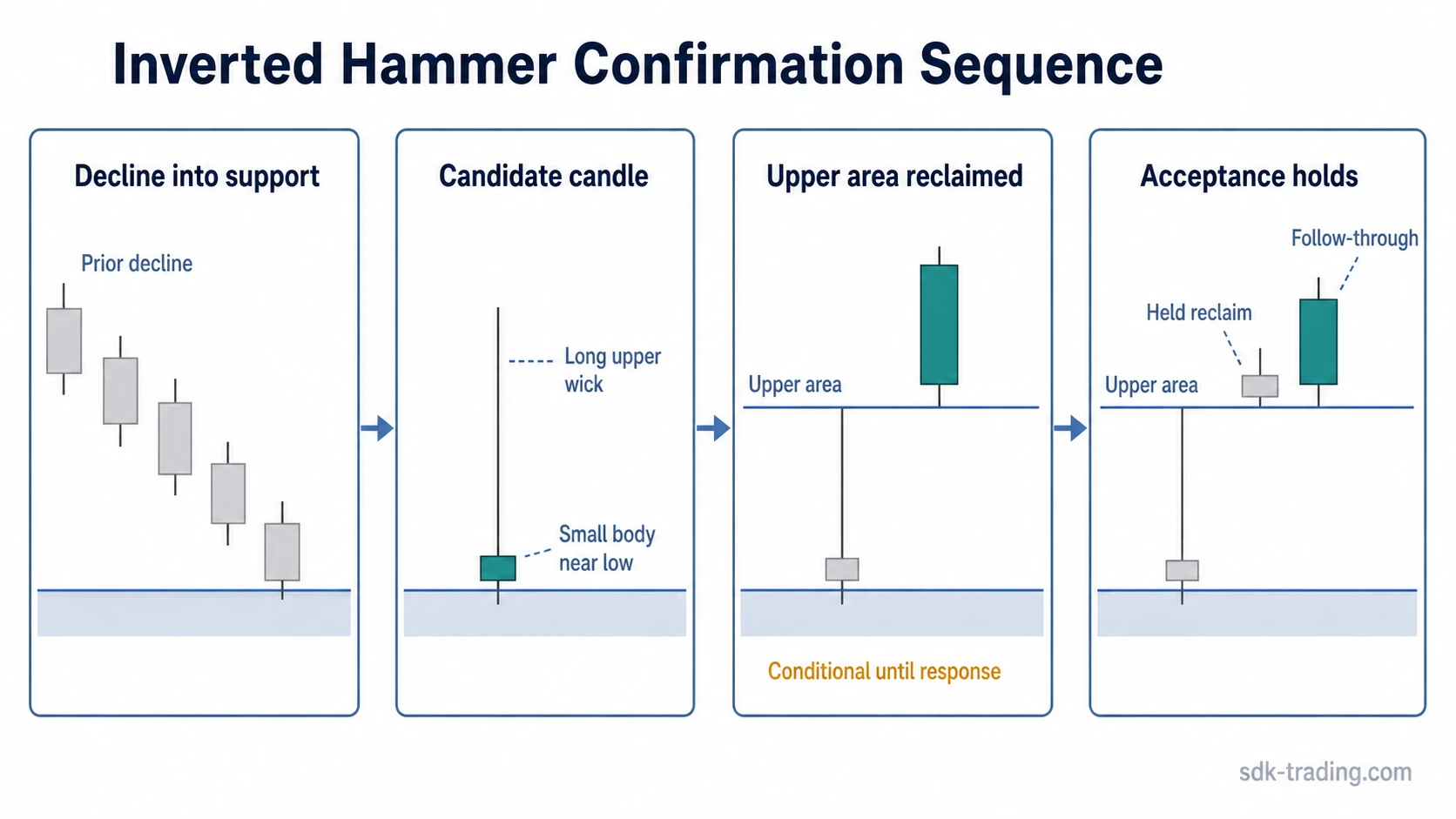
Inverted hammer confirmation means later candles accept the bullish probe instead of rejecting the candle’s upper area. The pattern is often confirmed too early: after a decline, the candle can show buyers testing higher prices, but the reading remains conditional until price holds or extends that higher area.
The candle is the warning; the later response decides whether the warning becomes useful. A close above the inverted hammer’s upper area, successful acceptance after a reclaim, or continued follow-through gives the bullish reading more evidence. A weak bounce that stays inside the candle’s range does not do the same job.
Key Points
- The inverted hammer shape shows an upper-wick probe, not completed confirmation.
- The reading improves when later candles reclaim and hold the candle’s upper area.
- Volume and support matter only when the later price result also supports acceptance.
What Confirms an Inverted Hammer?
Inverted hammer confirmation means later price action supports the bullish probe created by the candle. The strongest evidence usually comes from acceptance above the candle’s upper area or high, followed by price holding that reclaimed area rather than immediately falling back into the range.
An inverted hammer candlestick has a small real body near the lower part of the candle and a long upper shadow. After a decline, that upper shadow shows that buyers pushed price higher during the period, but the close did not fully hold the advance.
Confirmation improves when the next candles show that the upper-wick probe was not only temporary. A bullish close above the candle’s upper area, a gap or reclaim that holds, or follow-through that does not immediately fail can support the bullish interpretation. If price cannot regain the upper area, the candle remains only a possible early warning.
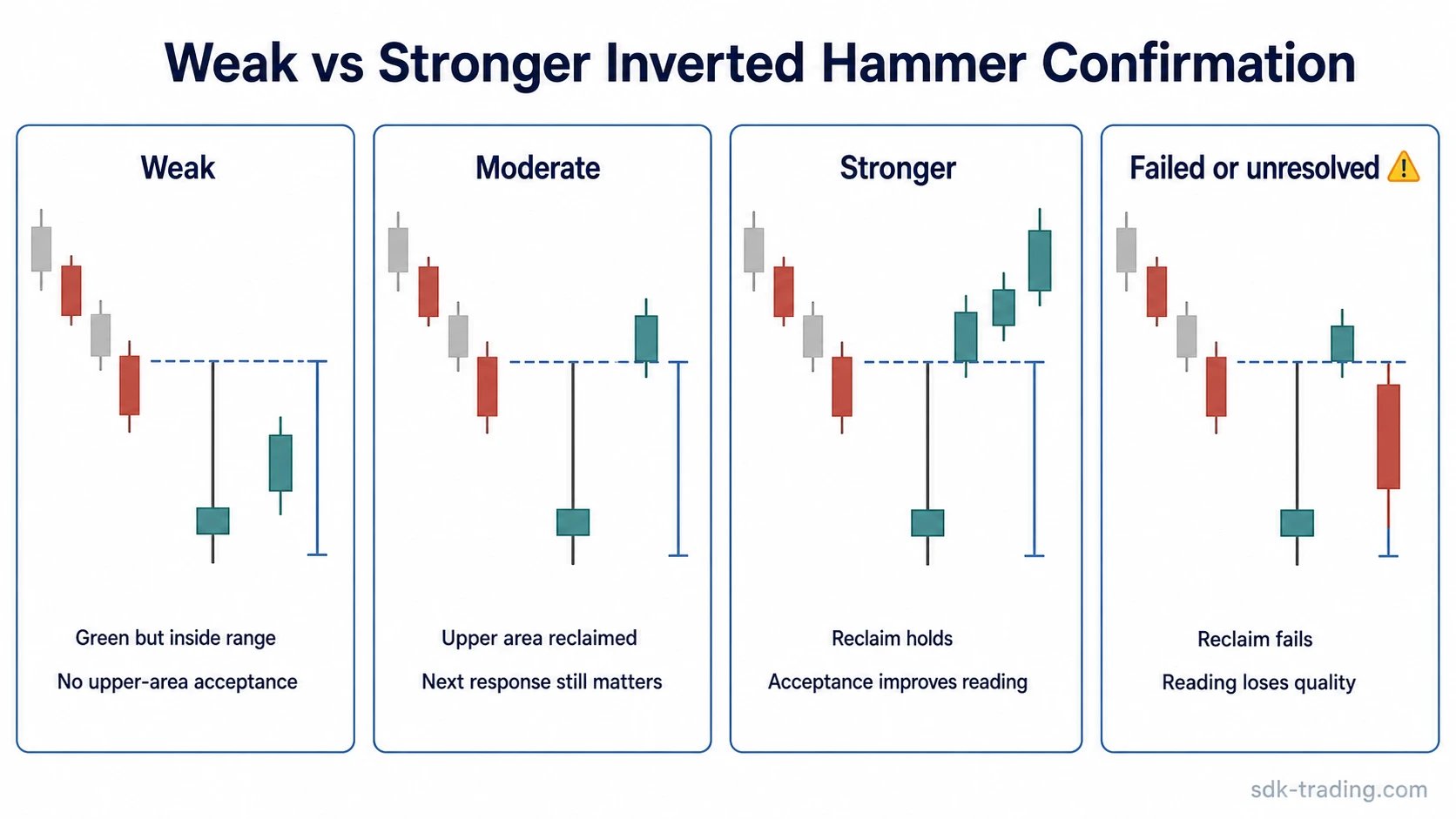
Weak, Moderate, and Stronger Inverted Hammer Confirmation
| Later behavior | Reading quality | Safer reading |
|---|---|---|
| The next candle is green but stays inside the inverted hammer range. | Weak | Color improved, but price has not accepted useful territory above the candle. |
| Price trades higher but closes back below the upper area. | Weak to moderate | The market tested higher prices but did not prove acceptance. |
| A later candle closes above the inverted hammer high or upper area. | Moderate | The bullish probe has follow-through, but the next response still matters. |
| Price reclaims the upper area, holds it, and continues higher without immediate rejection. | Stronger | Acceptance above the first wick test gives the bullish interpretation stronger evidence than an inside-range bounce. |
| Price breaks above the candle but quickly falls back into or below the range. | Failed or unresolved | The attempted confirmation lost acceptance and should not be treated as clean follow-through. |
Common Failure Modes
The most common mistake is treating the first bullish-looking response as enough. An inverted hammer can attract attention because it appears after selling pressure, but a temporary bounce does not confirm that buyers have control.
| Trigger condition | Common misread | Safer interpretation |
|---|---|---|
| Inverted hammer appears after a decline. | Treating the candle as confirmed immediately. | Wait for later acceptance or follow-through before treating the bullish reading as stronger. |
| Next candle is green but stays inside the original range. | Treating candle color as confirmation. | Green color alone is weak if price does not reclaim useful territory. |
| Volume expands on the inverted hammer. | Treating volume as proof. | Volume matters more when later candles show upward result. |
| Price rejects the upper wick area. | Calling the first move above the candle bullish confirmation. | Failed acceptance weakens the bullish reading. |
| The pattern appears away from support or after messy sideways movement. | Treating shape as sufficient. | Location and later response must support the interpretation. |
A lower-wick hammer candlestick often focuses on rejection of lower prices. Inverted hammer confirmation is different because the market must later prove that the upper-wick probe can be accepted, not merely touched.
Where Volume and Support Fit
Volume can improve the quality of an inverted hammer reading, but only as secondary evidence. Higher activity on the candle means participation expanded during the probe. It does not prove that buyers kept control after the candle closed.
The cleaner test is price result. If volume expands and later candles reclaim the upper area with follow-through, volume supports the confirmation case. If volume expands but price cannot hold higher ground, the extra activity may reflect conflict rather than control.
Support works the same way. An inverted hammer near a prior support area or after a meaningful decline may be more relevant than the same shape in the middle of random movement. Still, support is context, not confirmation. The later response decides whether the support area was actually defended.
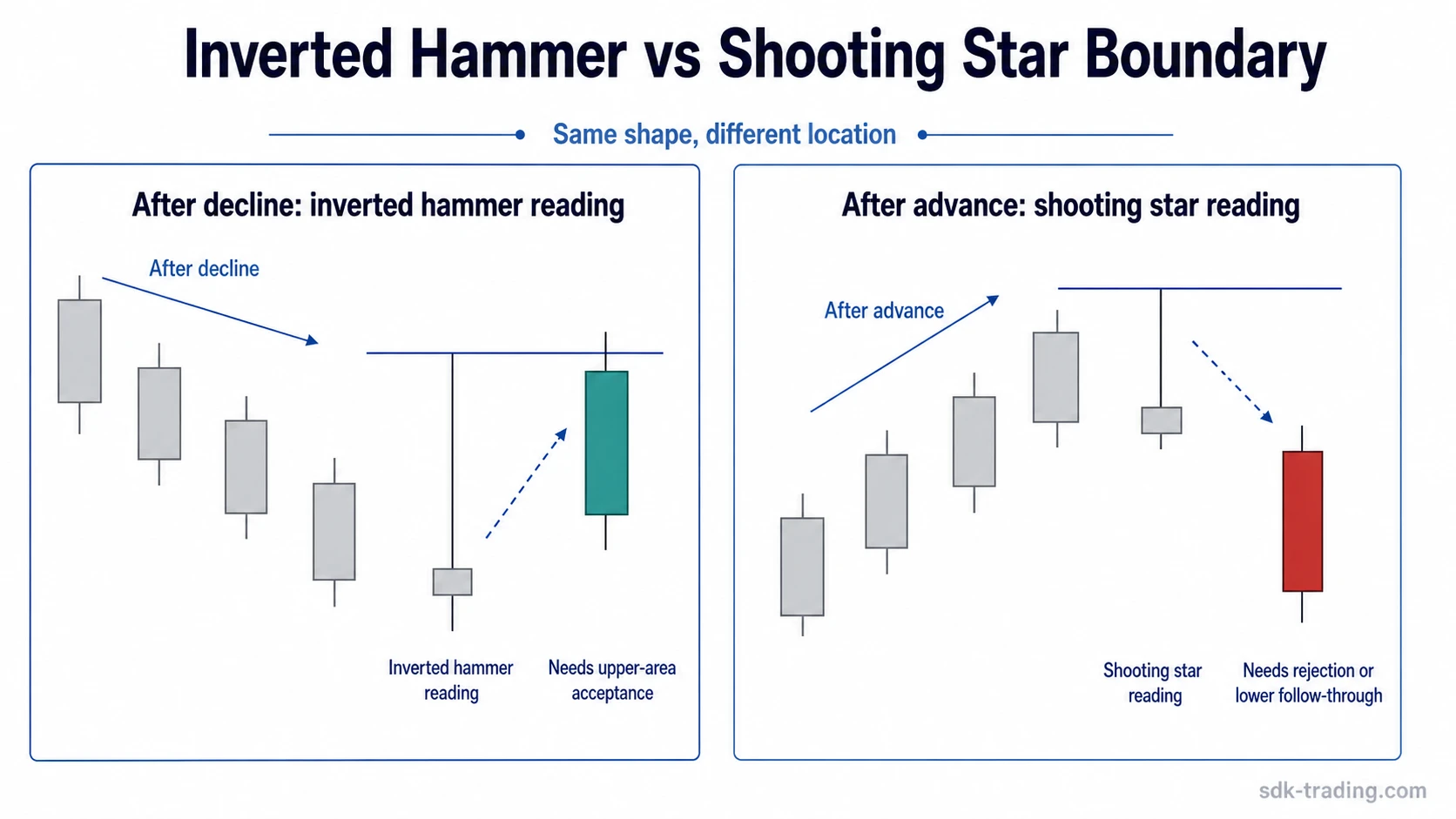
Inverted Hammer vs Shooting Star Boundary
An inverted hammer and a shooting star can look similar because both have a long upper shadow and a small real body. The difference is location and directional meaning. An inverted hammer is usually read after a decline as a possible early bullish response. A shooting star is usually read after an advance as a possible failed upside attempt.
The confirmation logic changes with location. For an inverted hammer, the bullish case needs later acceptance above the upper area. For a shooting star reading, the bearish case usually depends on later rejection or downside follow-through after the upper wick fails.
Inverted Hammer Confirmation Example in Context
Price declines into a prior support area and prints an inverted hammer. During the candle, price pushes higher, but the close remains near the lower part of the range. The shape suggests that buyers tested higher prices, but the close does not confirm that the test was accepted.
The next candle rises slightly and closes green, but it stays inside the inverted hammer range. That response remains weak because price has not reclaimed the upper area. A stronger case needs later candles to close above that area and hold it without immediate rejection.
If price reclaims the upper area, pauses above it, and continues higher, the bullish interpretation has better support. If the reclaim fails and price falls back through the candle range, the earlier warning loses quality and the setup remains unresolved or failed.
FAQ
What confirms an inverted hammer?
An inverted hammer reading is supported more strongly when later price action accepts the candle’s upper area or high. A bullish close, successful reclaim, and follow-through can support the interpretation. The candle alone does not confirm a reversal.
Is a green candle after an inverted hammer enough confirmation?
A green candle can help, but it is not enough by itself. If the green candle remains inside the inverted hammer range and does not reclaim the upper area, confirmation is still weak.
Does volume confirm an inverted hammer?
Volume can support the reading, but it does not confirm the pattern alone. Volume matters more when later price action shows upward result, acceptance, or follow-through.
Can an inverted hammer fail after confirmation?
Yes. A breakout or bullish close can fail if price quickly falls back into the candle’s range or loses the reclaimed area. Confirmation improves the reading, but it does not guarantee continuation.
How is inverted hammer confirmation different from a shooting star reading?
An inverted hammer is usually assessed after a decline, where later bullish acceptance supports the reading. A shooting star is usually assessed after an advance, where later rejection or downside follow-through supports the bearish reading.