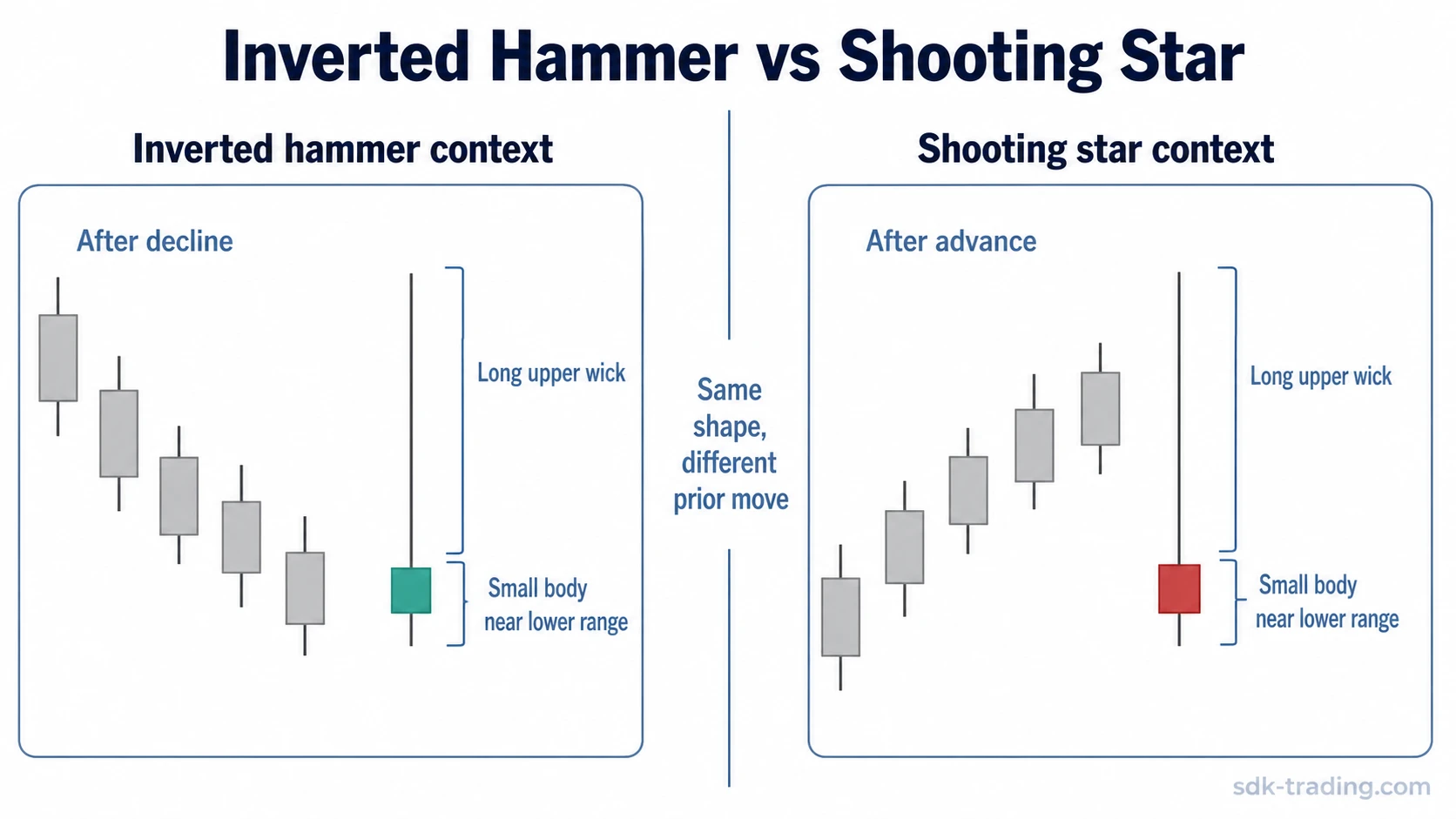
The key difference between an inverted hammer and a shooting star is prior direction. Both candles can share a small real body near the lower part of the candle range with a long upper wick, but the inverted hammer appears after downside pressure and the shooting star appears after upside pressure. Later candles affect confidence in the interpretation, not the original label.
An inverted hammer belongs after a decline or downward pressure.
A shooting star belongs after an advance or upward pressure.
Key Points
- The same long-upper-wick structure can appear in both patterns.
- Prior direction is the first classification cue.
- Later response affects confidence, not the original label.
Why Inverted Hammer and Shooting Star Candles Look Alike
Both candles are upper-shadow-dominant. Price moves higher during the candle, but the close does not hold near the high. That creates a small body below a long upper wick, which is why the two names are often confused on shape alone.
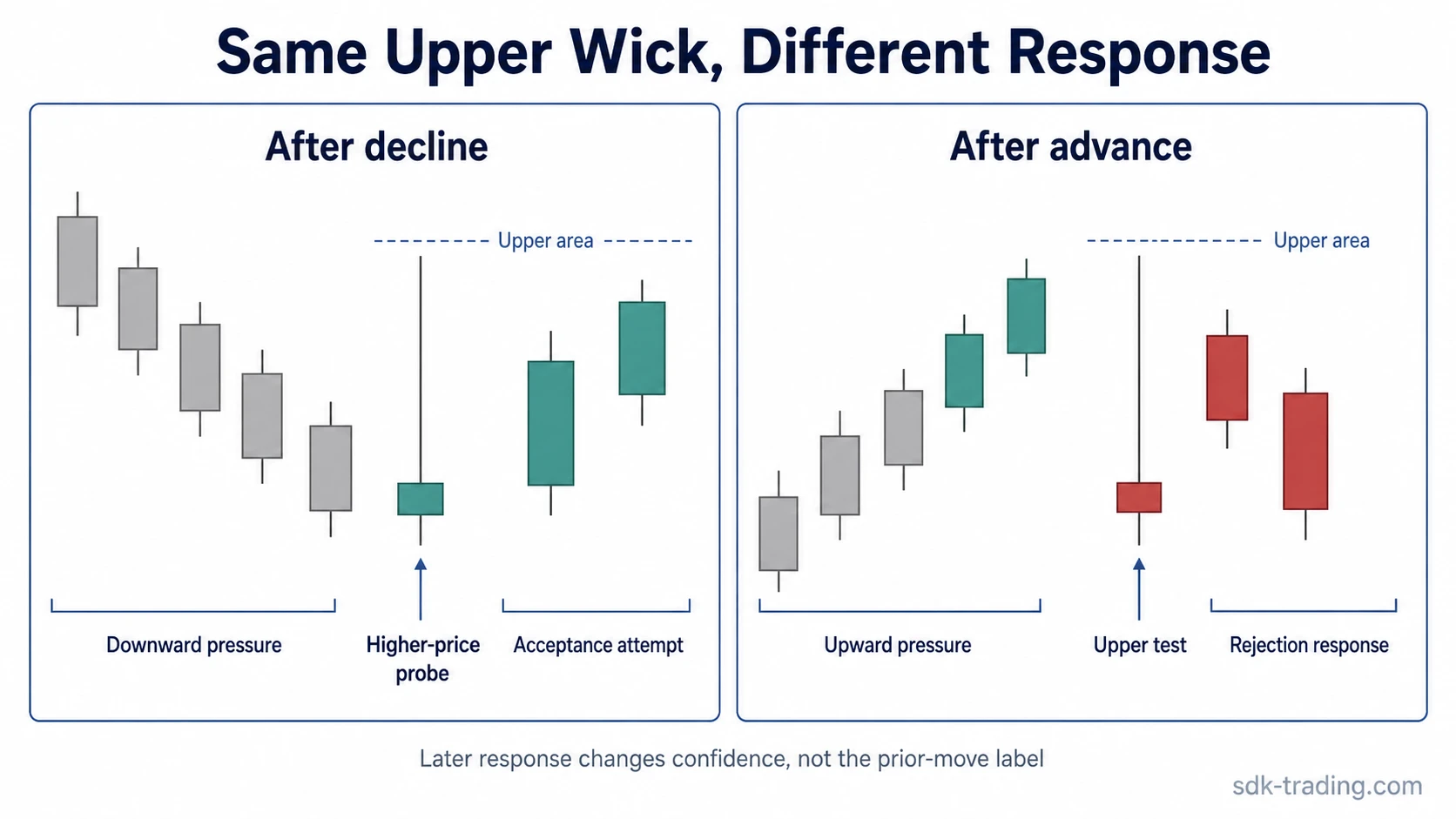
The shared anatomy tells only part of the story. The candle shows that higher prices were tested and not fully accepted during that period. Whether that failed upper test is read as a possible demand probe or a rejection attempt depends on what price was doing before the candle formed.
Inverted Hammer vs Shooting Star Comparison Table
| Criteria | Inverted Hammer | Shooting Star |
|---|---|---|
| Basic shape | Small real body near the lower part of the candle range with a long upper wick. | Small real body near the lower part of the candle range with a long upper wick. |
| Prior move | Appears after a decline, pullback, or downward pressure. | Appears after an advance, rally, or upward pressure. |
| Location logic | The upper wick can show a first attempt to probe higher after selling pressure. | The upper wick can show rejection after buyers pushed into higher prices. |
| Candle color | Color can modify the reading, but it does not decide the label by itself. | Color can modify the reading, but it does not decide the label by itself. |
| Later response | More supported when later candles reclaim and hold higher prices instead of rejecting the upper part of the candle range. | More supported when later candles reject higher prices or fail to hold above the upper part of the candle range. |
| Weak case | Weak when price remains trapped inside the candle range or quickly rejects the upper test. | Weak when price quickly recovers above the upper test and holds there. |
| Classification context | Use the inverted hammer lens when the candle appears after downside pressure. | Use the shooting star lens when the candle appears after upside pressure. |
Same Candle Shape, Different Context
Price declines into a lower area, then prints a candle with a small body near the lower range and a long upper wick. In that context, the candle is read through the inverted hammer lens because it appears after selling pressure and shows a failed but visible attempt to trade higher.
The same candle geometry after an advance has a different classification. Price rallies into a higher area, tests above it during the candle, then closes well below the high. In that context, the candle is read through the shooting star lens because it appears after buying pressure and shows rejection from the upper part of the range.
The chart context changes the name before any later confirmation is considered. The later candles can support, weaken, or leave the reading unresolved, but they do not turn an after-decline candle into an after-advance candle.
Confirmation Does Not Rename the Candle
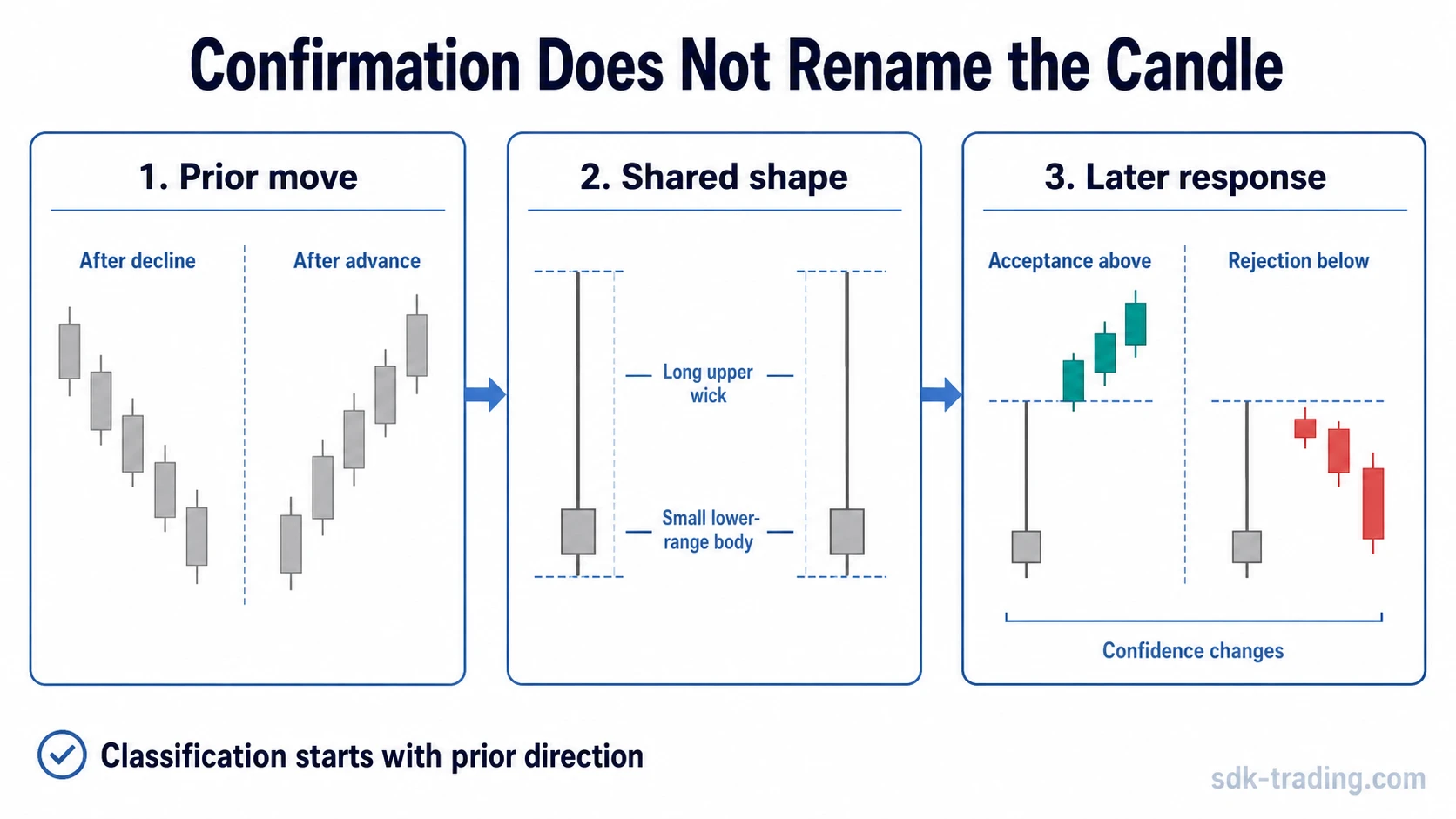
Confirmation is later evidence. It helps judge whether the initial interpretation deserves attention, but it does not replace the prior-direction cue used to classify the candle.
After an inverted hammer, later acceptance above the candle’s upper part can make the inverted hammer reading more defensible. If that area is rejected and price falls back into the prior range, the reading remains weak or failed.
After a shooting star, later rejection of the upper part can make the shooting star reading more defensible. If price quickly recovers above the candle’s high-side test and holds there, the rejection reading loses force.
Sideways or Unclear Context
Sideways price action makes both labels less reliable. If the candle forms inside a choppy range without a clear prior decline or advance, the upper wick may only show intrarange rejection rather than a clean inverted hammer or shooting star context.
In that situation, forcing a label can create false confidence. A more precise description is that price tested higher, failed to hold the high, and left the next response to decide whether the range accepts or rejects that high-side test.
Common Mistakes
- Naming the candle from shape alone. The long upper wick and small lower body explain the visual overlap, but the prior move decides the classification.
- Treating candle color as the main test. A green shooting star context can still be a rejection candle, and a red inverted hammer context can still show a higher-price probe after a decline.
- Reading confirmation as a rename. Later candles can validate or weaken the interpretation, but they do not change the original market context.
- Forcing a label in a flat range. Without a clear prior direction, the candle is often better treated as an unresolved upper-wick rejection inside the range.
FAQ
Can an inverted hammer and a shooting star have the same shape?
Yes. Both can have a small real body near the lower part of the candle range and a long upper wick. The difference comes from the prior move, not from shape alone.
Does candle color decide whether it is an inverted hammer or shooting star?
No. Candle color can affect confidence, but it does not decide the label by itself. Prior direction is the first classification cue.
What happens if the candle appears in sideways price action?
Sideways context weakens both labels. Without a clear prior decline or advance, the candle is usually better treated as an unresolved upper-wick rejection inside a range.
Does confirmation change an inverted hammer into a shooting star?
No. Confirmation affects the support behind the reading, not the original classification. The prior move still controls whether the candle belongs to an inverted hammer or shooting star context.