A single candlestick pattern inside a trend changes meaning depending on whether it extends the active swing, rejects a pullback, pauses the move, or fails near a stretched edge.
Candle shape is only the first observation. The practical reading comes from whether the candle forms during active continuation, a pullback test, a pause, or a stretched extension, then from the close and later acceptance or rejection around the tested area.
Core idea: candles can warn, but structure decides. A strong-looking candle in the middle of an orderly trend is not the same as the same candle after a stretched move, near a failed breakout, or during a pullback into a tested area.
Key Points
- Single-candle readings improve when the candle is judged against trend placement, not shape alone.
- A large real body can support continuation if it extends the active swing and closes near the active extreme.
- A lower-wick rejection during a pullback is stronger when downside acceptance fails and later candles hold above the tested area.
- Doji-type candles inside trends often show pause, friction, or reduced urgency before they show reversal pressure.
How trend placement changes a single-candle reading
Inside an active trend, a single candle is read against the swing that already exists. The same candle can support continuation, warn of exhaustion, or show temporary balance depending on where it forms.
A candle that appears after a clean pullback into a tested area has a different job from a candle that appears after several extended bars in the same direction. One is testing whether the trend can resume. The other is testing whether the move is becoming stretched.
Close location is usually more useful than the label attached to the candle. A candle that closes near the active extreme can show stronger acceptance in the trend direction. A candle that tests beyond the recent range but closes back inside it can show failed acceptance instead.
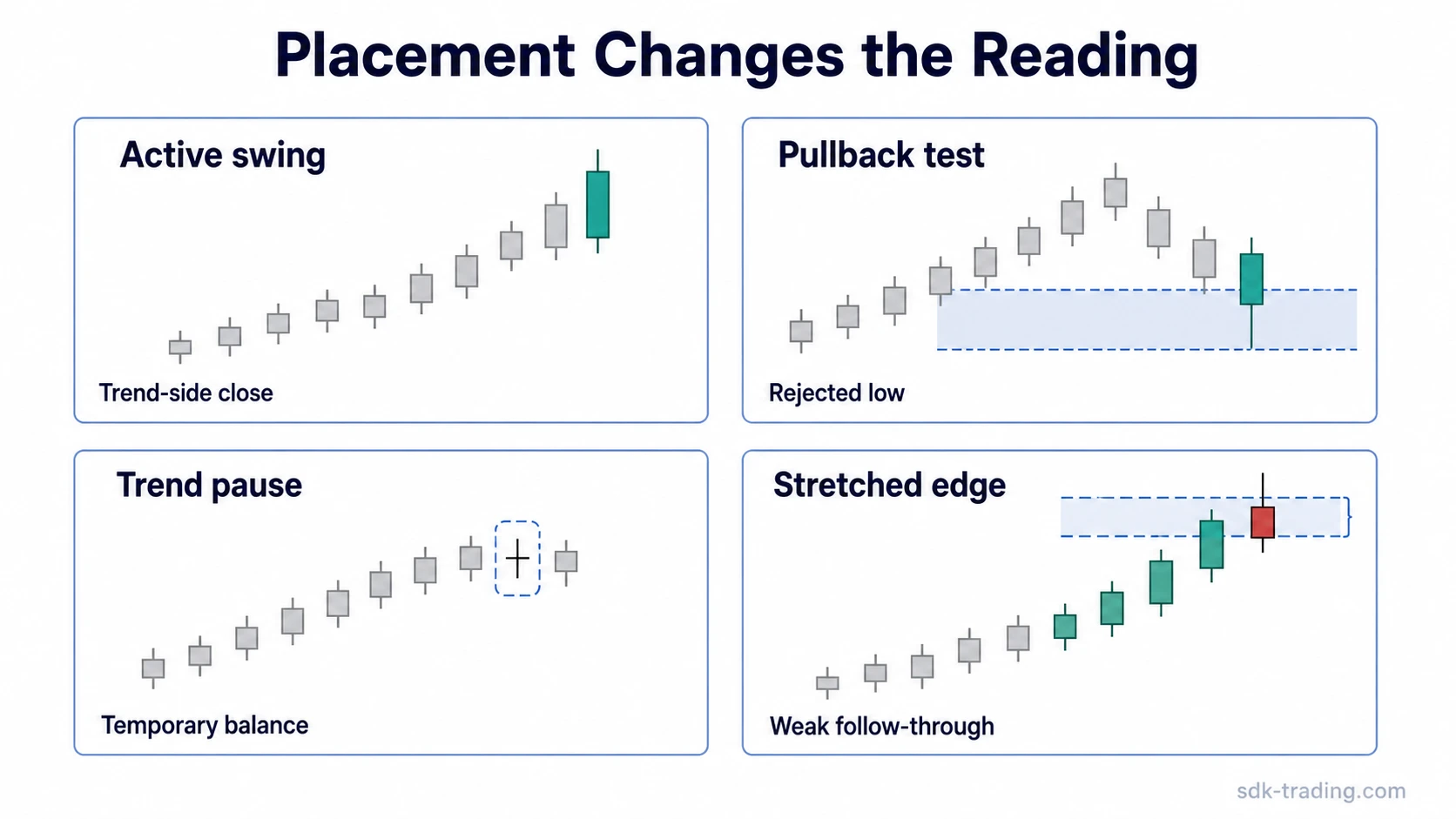
The edge case: continuation, pause, or failed extension
The difficult part of reading single candlestick patterns in trending markets is that the candle does not carry one fixed meaning. A small-bodied candle can be a pause during a healthy trend, not an immediate reversal warning. A large candle can be an expansion candle, not automatic proof that the trend will continue. A long wick can be rejection, exhaustion, or a failed probe depending on where it forms.
Boundary condition: orderly trends usually show controlled pullbacks, accepted trend-side closes, and limited overlap. Stretched trends become more vulnerable when candles push beyond the active swing, close back inside the prior area, and fail to attract follow-through.
The more defensible interpretation comes from the sequence: trend condition first, candle placement second, close location third, and later acceptance or rejection last.
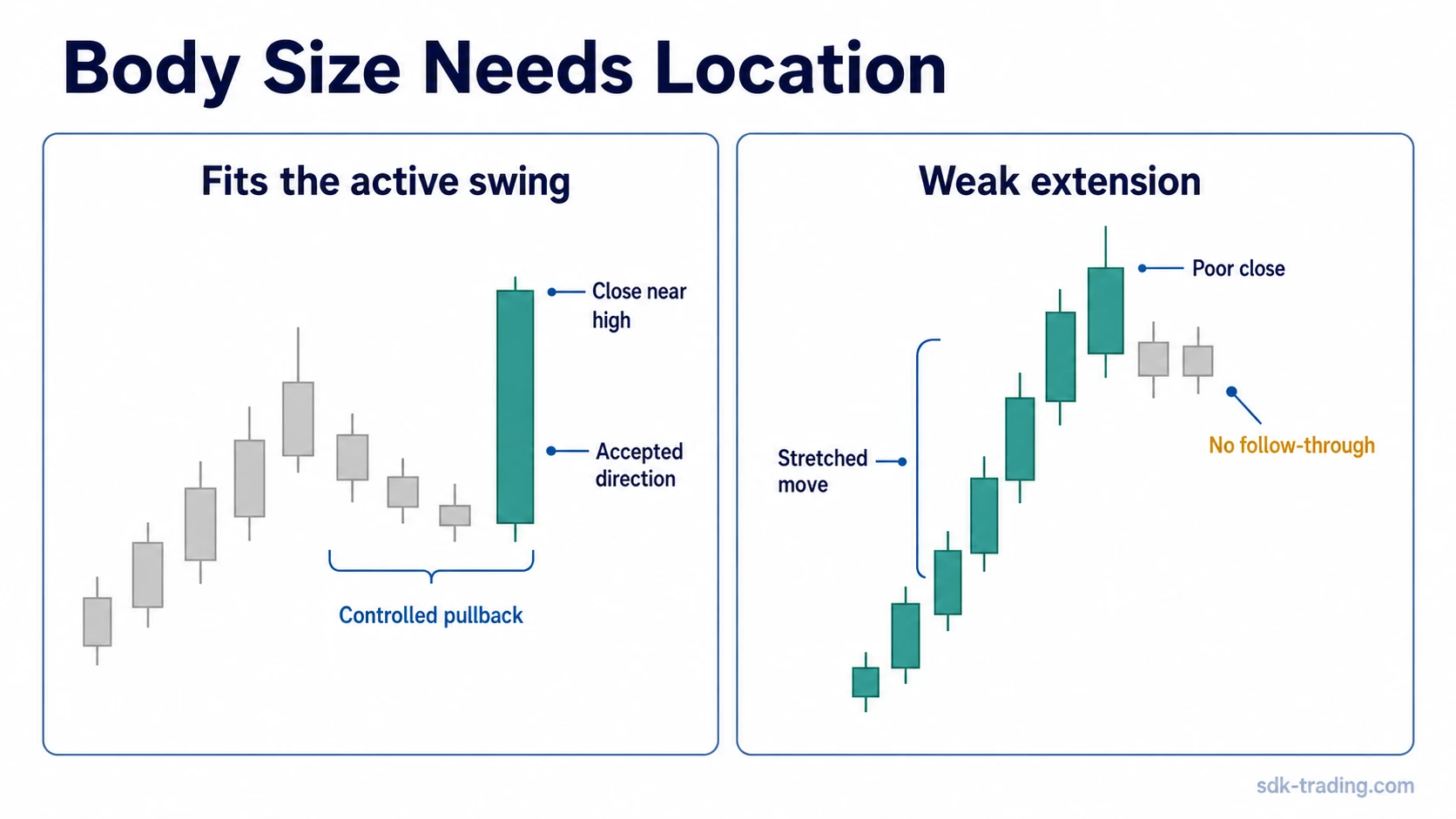
Expansion candles that fit the active swing
A large real body can fit the active trend when it expands from a controlled area and closes near the trend-side extreme. The body shows directional effort, but the close shows whether that effort held into the end of the candle.
For example, a bullish expansion candle after a shallow pullback in an uptrend can be more constructive if it closes near the high and moves away from the pullback area. The same large body is weaker if it appears after a long one-sided advance and leaves price extended into an area where later candles fail to continue.
Limitation: body size alone is not enough. A large candle that closes poorly, appears after an overextended swing, or receives no later acceptance can become a weak continuation reading.
Pullback rejection inside a trend
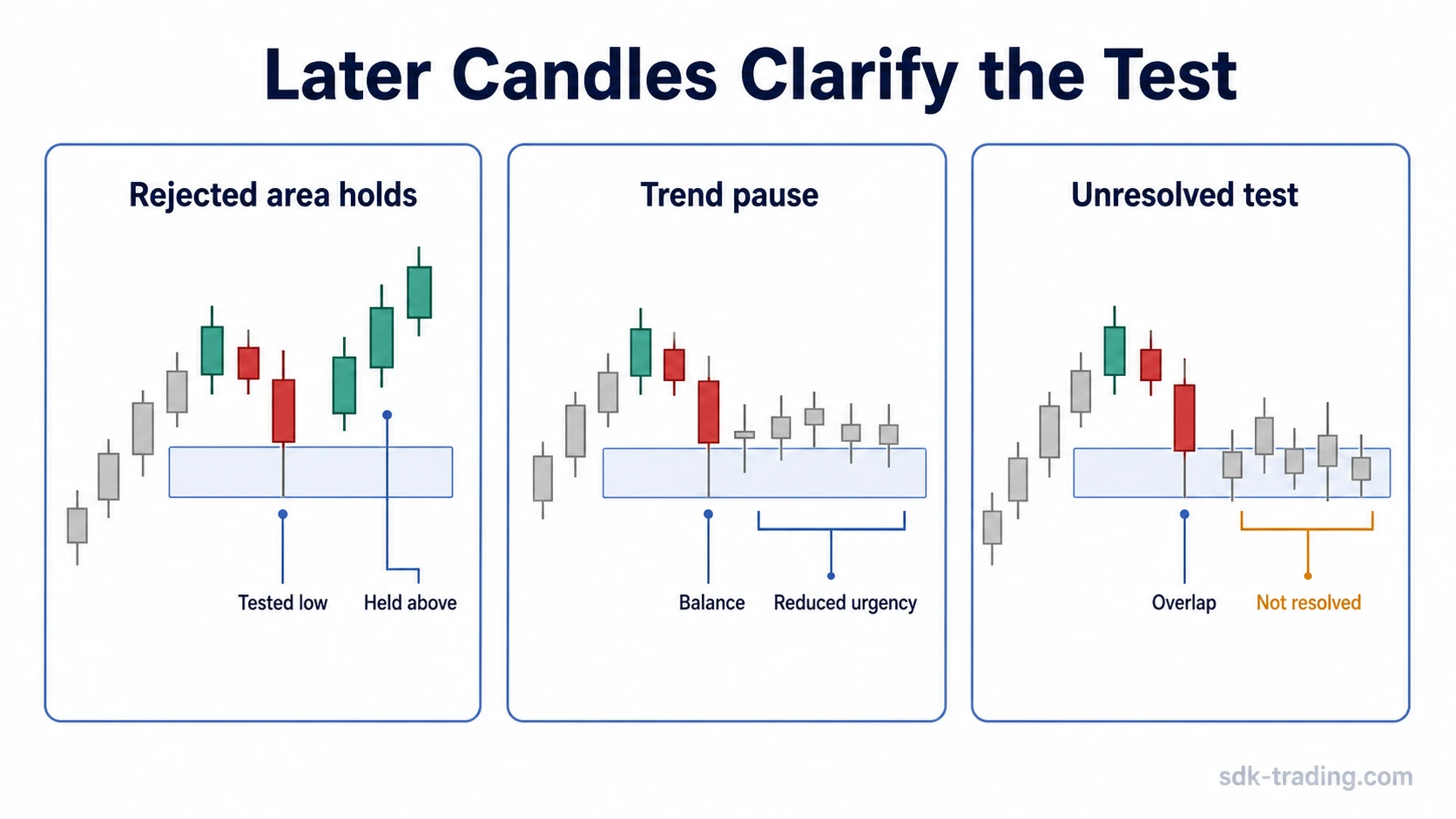
A pullback rejection candle inside a trend carries stronger information when it shows a failed attempt to accept lower prices during the correction. The lower wick marks the tested area; the close away from that area shows that the test did not hold by the end of the candle.
A hammer candlestick can appear in this role during an uptrend pullback, but the label is not enough. The reading improves when the broader trend remains orderly, the lower area is tested and rejected, and later candles hold above the tested low.
Example scenario: price pulls back within an uptrend and briefly trades below the recent pullback area. A lower-wick candle closes back above that area. The rejection reading becomes clearer if later candles stay above the tested zone instead of accepting lower prices again.
Indecision candles during trend pauses
Indecision candles inside trends often represent compression, friction, or reduced urgency. They do not automatically mean the trend is ending.
A doji candle can show that the open and close finished near the same level, but trend placement changes the reading. Mid-trend, it may simply show a pause before continuation. Near a stretched edge, it can warn that the trend-side push is losing efficiency.
The distinction depends on what happens around the candle. If price remains accepted in the direction of the trend, the pause may be absorbed. If later candles reject the trend-side area and close back through the prior range, the same indecision candle becomes more meaningful as a warning.
Quick reading filter
A fast filter starts with where the candle forms, then checks whether the close and later candles confirm acceptance, rejection, or unresolved balance.
| Filter | What to check | Why it changes the reading |
|---|---|---|
| Trend placement | Mid-swing, pullback, range edge, or stretched extension | The same candle can support continuation, pause, or failed extension depending on location. |
| Trend condition | Orderly sequence or overextended move | Orderly trends can absorb pauses more easily than stretched trends. |
| Close location | Near active extreme, back inside range, or near the candle midpoint | The close shows whether the tested area was accepted or rejected by the end of the candle. |
| Wick behavior | Failed probe above or below a relevant area | A wick becomes more meaningful when it tests an area and price cannot hold beyond it. |
| Later candles | Acceptance, rejection, or unresolved balance after the pattern | Later behavior decides whether the first candle was absorbed, rejected, or left unresolved. |
Common misreads in trending markets
The most common error is treating a named candle as if it overrides trend structure. A safer reading starts with where the candle forms and what the close confirms or fails to confirm.
| Condition | Common misread | Safer reading |
|---|---|---|
| Large real body appears mid-trend | Any strong candle confirms continuation | Stronger only if it extends the active swing and closes near the active extreme. |
| Long lower wick appears during an uptrend pullback | Hammer means reversal by itself | Stronger as failed downside acceptance if later candles hold above the tested area. |
| Small-bodied candle appears in the middle of a trend | Indecision means the trend is ending | Often a pause or compression unless later candles reject the trend-side area. |
| Upper wick appears after an extended advance | Any upper wick means immediate reversal | More meaningful when price tests higher, fails to accept, and later candles close back through the tested area. |
| Candle forms near a stretched trend edge | The trend remains strong because the prior direction is still intact | Stretched placement requires stricter follow-through because weak acceptance can turn the candle into a failed extension. |
FAQ
Do single candlestick patterns matter during trends?
Yes, but they matter most as part of the trend sequence. A single candle gains meaning when its placement, close location, and later acceptance or rejection fit the active market structure.
Why can a doji be a pause instead of a reversal?
A doji can show temporary balance between buyers and sellers. In the middle of an orderly trend, that balance may only mark compression or reduced urgency. It becomes more meaningful as a reversal warning if later candles reject the trend-side area.
When does a hammer-like candle matter during a pullback?
A hammer-like candle matters more when it tests lower prices during a pullback, closes away from the tested low, and later candles hold above that area. Without failed downside acceptance, the shape alone is not enough.
What separates continuation-friendly candles from weak trend candles?
Continuation-friendly candles usually extend the active swing, close near the active extreme, and receive later acceptance. Weak trend candles often appear after stretched movement, close poorly, or fail to attract follow-through.