A doji candlestick has a nearly eliminated real body because the open and close are almost equal.
A spinning top candlestick keeps a small but visible real body, so the open and close are close, but not nearly identical.
The main difference is body compression. Wick length, total range, and later price behavior can affect interpretation, but they do not decide the candle label. The first classification question is simple: did the candle close so close to its open that the real body nearly disappeared, or is there still a small visible body?
Key Points
- A doji is defined by near-equal open and close prices.
- A spinning top has a small visible body between the open and close.
- Long wicks can appear on both candles, so wick length is not the deciding feature.
- A wide range does not automatically prevent a candle from being classified as a doji.
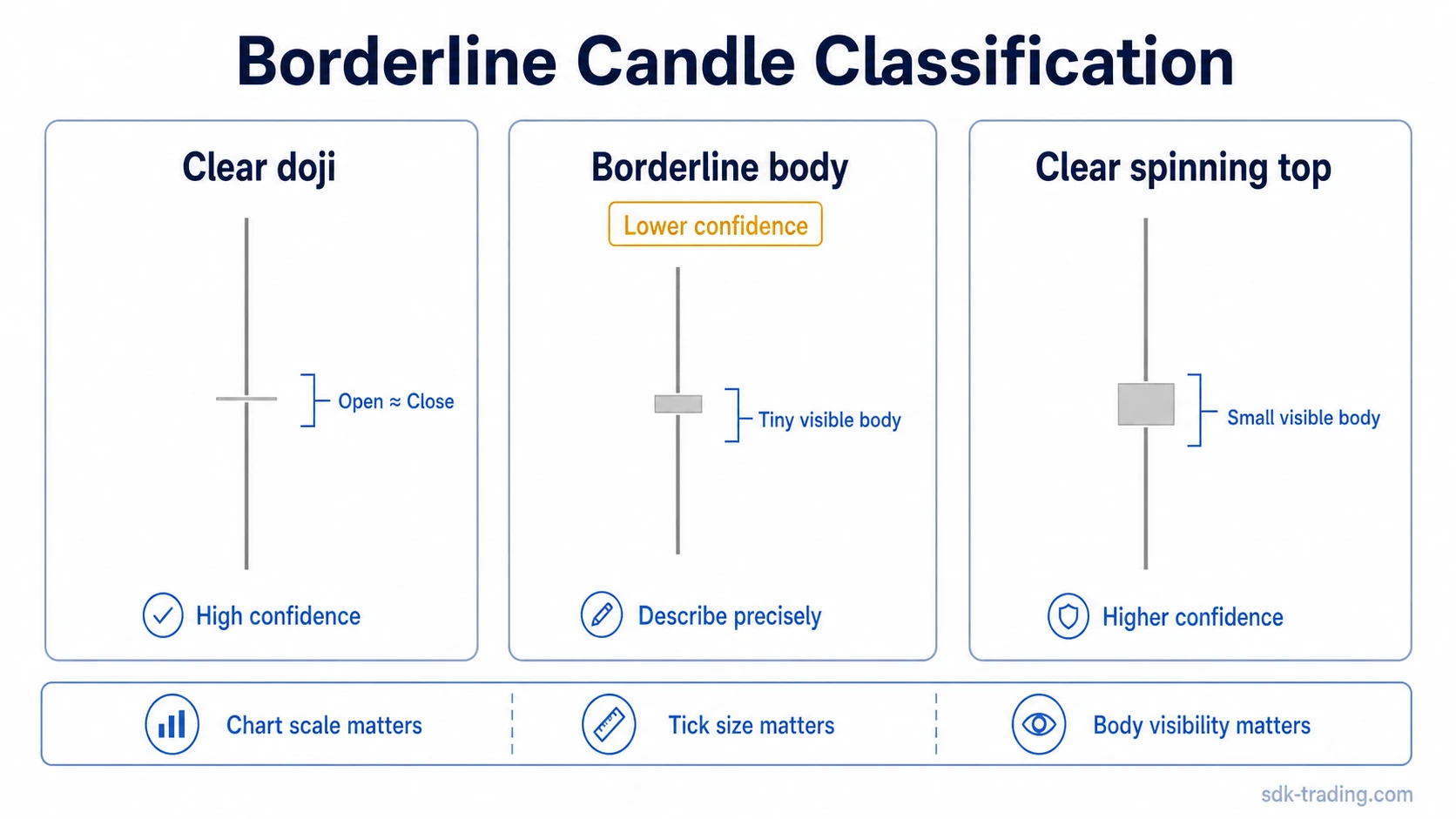
- Borderline candles can remain ambiguous when the body is tiny but still visible.
The Core Difference Is Real Body Compression
The real body is the distance between the open and close. In a doji, that distance is compressed so tightly that the body has little or no visual dominance. In a spinning top, the body is still small relative to the full candle range, but it remains visible enough to show that the close did not settle almost exactly at the open.
That proportional relationship matters more than the candle’s absolute size. A small candle can be a spinning top if the body is clearly visible. A large-range candle can still be a doji if the open and close are nearly equal. Classification depends on the open-close relationship inside the candle, not on whether the candle looks quiet or volatile.
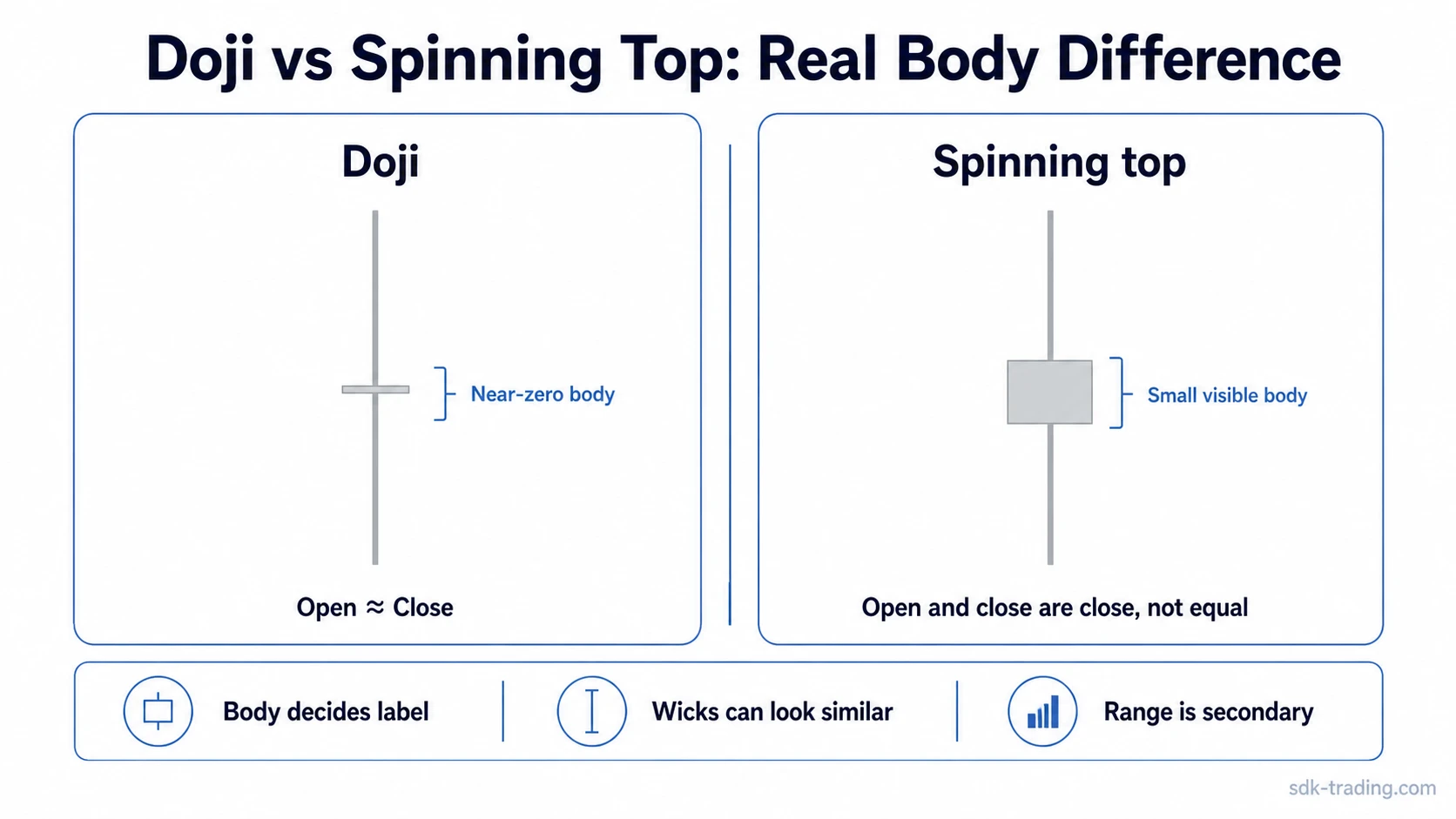
Doji vs Spinning Top Decision Table
| Criterion | Doji | Spinning Top |
|---|---|---|
| Open-close relationship | Open and close are nearly equal. | Open and close are close, but visibly separated. |
| Real body | Nearly absent or visually compressed to a minimal body. | Small, but still visible. |
| Body-to-range relationship | The body is so compressed that the wicks dominate the candle shape. | The body is small compared with the full range, but not eliminated. |
| Wick role | Wicks shape the subtype or visual character, but do not define the doji label by themselves. | Upper and lower wicks are common, but they do not override the visible body. |
| Total range | The range can be narrow or wide as long as the open-close body remains nearly eliminated. | The range can also vary, but the body must remain small and visible. |
| Classification confidence | Higher when the body is visually near-zero across normal chart scaling. | Higher when the body remains clearly visible despite being small. |
| Best classification lens | Use the doji label when settlement returns almost exactly to the opening price. | Use the spinning top label when settlement stays slightly away from the opening price. |
| Common mistake | Calling any long-wick candle a doji even when the body is clearly visible. | Calling every small-bodied candle a spinning top even when the open and close are almost identical. |
Same Move, Different Candle Label
Consider two candles that both trade above and below their opening price during the session. Both leave upper and lower wicks, and both can look like hesitation at first glance. The difference appears at settlement.
In the first candle, price closes almost exactly where it opened. The real body nearly disappears, so the candle is classified as a doji. In the second candle, price also closes near the open, but not close enough for the body to disappear. The body remains small and visible, so the candle is classified as a spinning top.
The wick pattern may look similar in both cases. The label changes because the close settled differently relative to the open, not because one candle had longer shadows or a larger intraperiod range.
Why Wick Length Does Not Decide the Difference
Wicks show how far price moved away from the open-close area before settling. They can reveal rejection, probing, volatility, or two-sided activity, but they are not the first criterion for separating a doji from a spinning top.
A candle with long upper and lower wicks can be a doji if the open and close are nearly identical. The same wick structure can belong to a spinning top if the open and close remain visibly separated. Wick structure refines the reading after the candle family is identified.
Why Range Size Can Be Misleading
Total range can make the candle look more important, but it does not change the classification rule. A wide-range candle with a nearly invisible body can still be a doji because the close returned almost exactly to the open. A narrow-range candle with a small visible body can still be a spinning top.
The more useful question is not whether the candle was large or small. The useful question is whether the real body was nearly eliminated or merely reduced.
When the Difference Becomes Ambiguous
The distinction becomes less clean when the real body is extremely small but still visible. Chart scaling, instrument tick size, and platform rendering can make the same candle appear slightly different across charts.
There is no universal visual threshold that works across every market, timeframe, and chart setting. When the body is borderline, classification confidence should be lower. The safer reading is to describe the candle precisely: near-doji compression, tiny visible body, or small-bodied candle with long wicks.
Later candles can change the interpretation of the setup, but they do not retroactively decide whether the original candle was a doji or a spinning top. Later behavior answers a different question: whether the market accepted, rejected, or ignored the area around that candle.
FAQ
What is the main difference between a doji and a spinning top candlestick?
A doji has a nearly eliminated real body because the open and close are almost equal. A spinning top has a small but visible real body, so the open and close are close but not nearly identical.
Does wick length decide whether a candle is a doji or spinning top?
No. Wick length can affect interpretation, but the classification depends first on the open-close body. Long wicks can appear on both doji and spinning top candles.
Can a high-volatility candle still be a doji?
Yes. A candle can have a wide high-low range and still be a doji if the open and close are nearly equal. Total range does not override the open-close relationship.
When does the doji vs spinning top distinction become unclear?
The distinction becomes unclear when the body is tiny but still visible. Tick size, chart scaling, and platform rendering can make borderline candles harder to classify with confidence.
Can later candles change the interpretation without changing the candle classification?
No. Later candles can change the market interpretation, but they do not decide the original candle’s classification. The label comes from the original candle’s open, close, body, wicks, and range.