Donchian Channels plot the highest high and lowest low over a rolling lookback period. Their width is the distance between those two boundaries, so the channel can remain wide even after current price action becomes quieter if an older extreme is still inside the window.
Definition: A Donchian Channel uses the highest high over N periods as its upper boundary and the lowest low over N periods as its lower boundary. An optional middle line is the midpoint between the two. The boundaries change when a new extreme appears or when an old extreme leaves the rolling lookback window.
This makes Donchian Channels different from volatility tools built around an average or statistical dispersion. The channel is defined by observed price extremes rather than by distance from a mean.
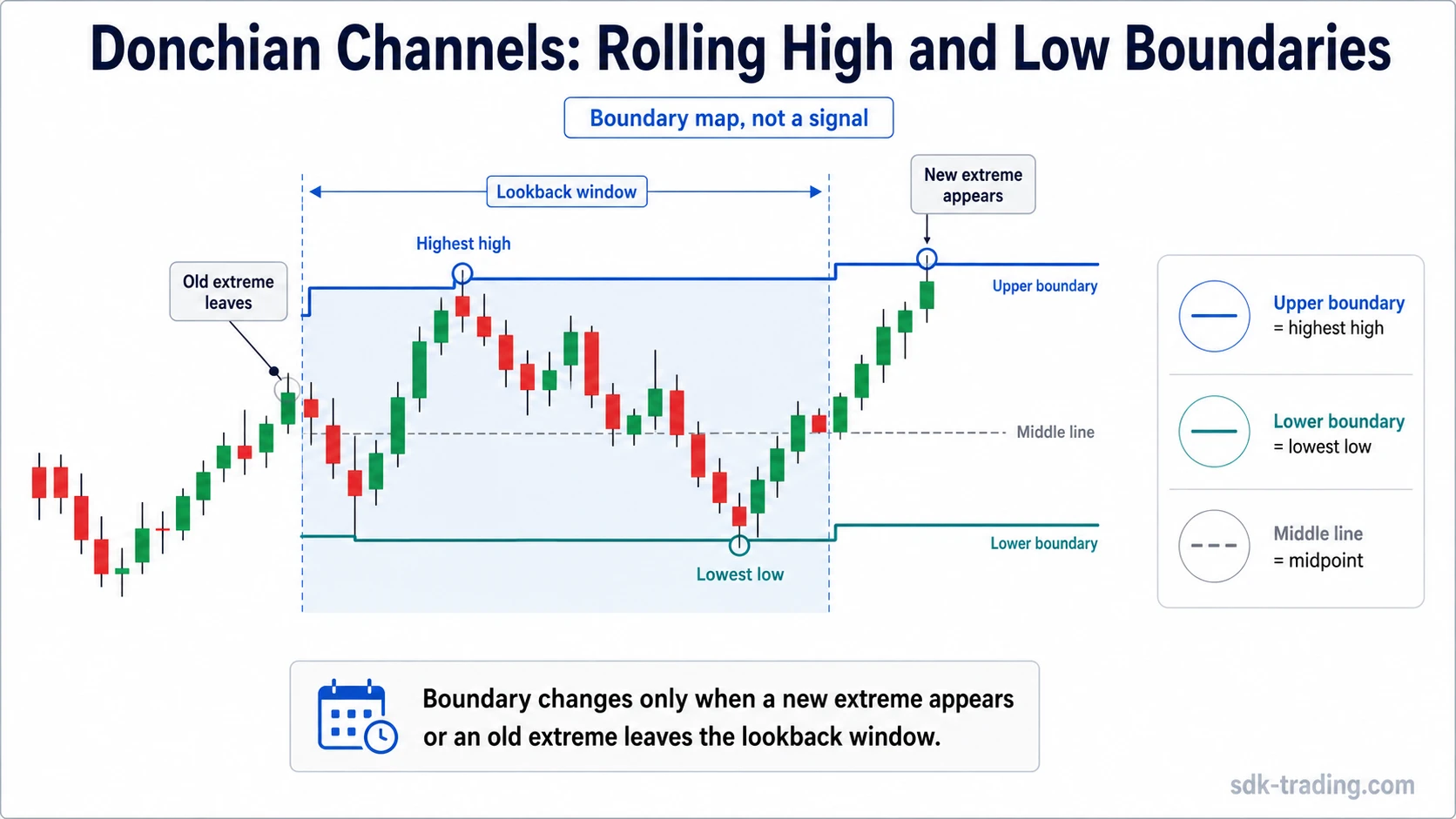
How Donchian Channels Are Calculated
The calculation uses a configurable lookback period, usually written as N. A 20-period setting is a common reference, but the method itself does not require one universal period.
| Line | Calculation | What it represents |
|---|---|---|
| Upper channel | Highest high over N periods | The highest price extreme inside the rolling window. |
| Lower channel | Lowest low over N periods | The lowest price extreme inside the rolling window. |
| Middle channel | (Upper channel + lower channel) / 2 | The midpoint between the two rolling extremes. |
| Channel width | Upper channel – lower channel | The total high-low range contained by the current lookback window. |
The calculation is mechanically simple, but one implementation detail matters. Platforms and trading rules can differ in whether the current developing bar is included in the boundary calculation. For chart analysis or backtesting, that convention should be defined explicitly before interpreting a boundary break.
Why Donchian Channel Width Can Stay Wide
Donchian width does not have to contract immediately when recent candles become smaller. The channel remembers the highest high and lowest low for as long as those extremes remain inside the selected lookback window.
Rolling-window example: Assume a 20-period channel. A sharp high occurred 12 periods ago, followed by much quieter trading. The upper boundary can remain fixed at that old high for another eight periods. If the lower boundary also remains unchanged, the channel stays wide even though the most recent candles are moving through a much smaller range.
When the old high finally exits the window, the upper boundary can move down to the next-highest value. The channel may then contract without the current bar making any unusual move.
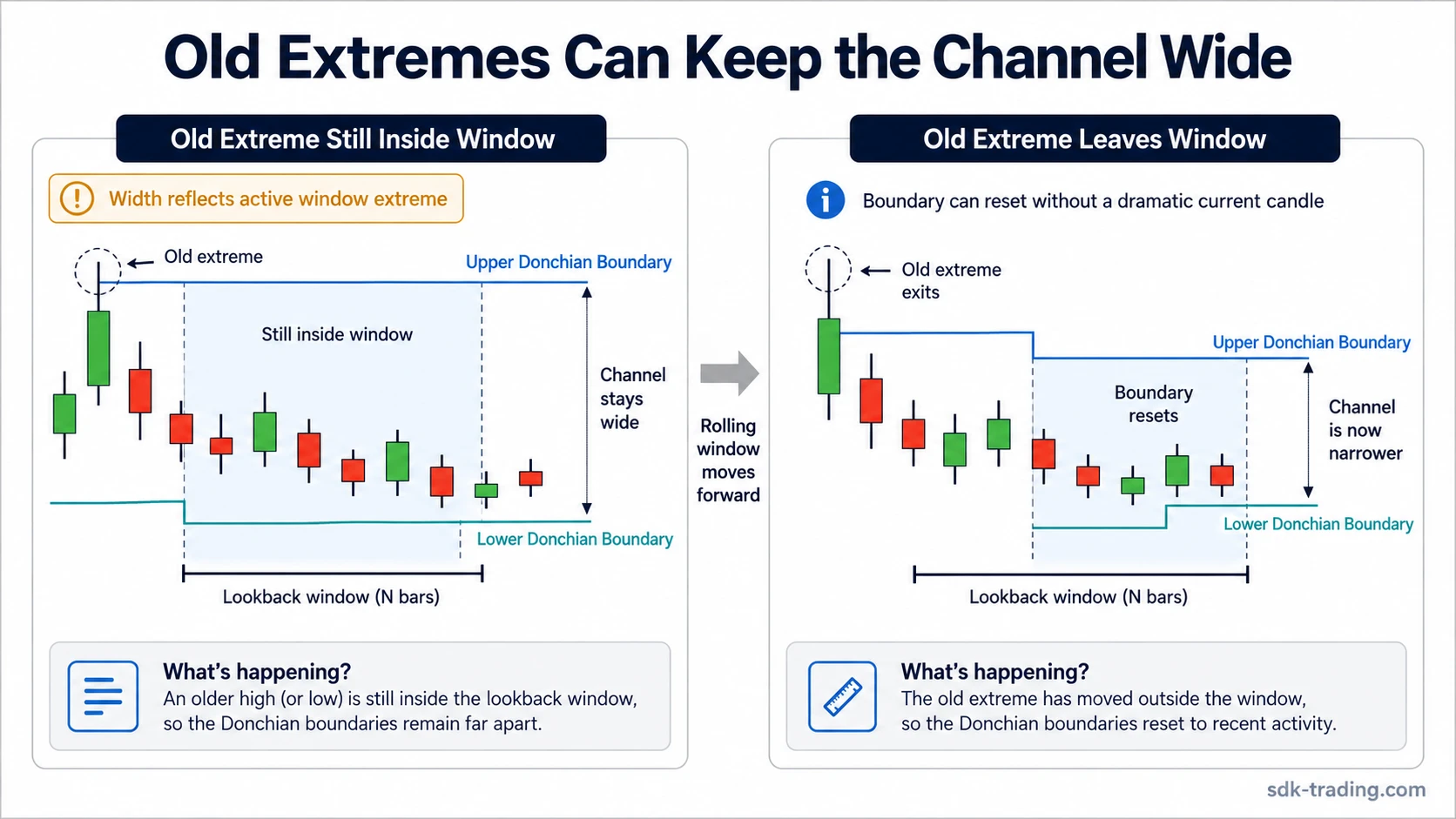
Donchian Channel Width: What It Actually Measures
Raw Donchian width is simply the distance between the current upper and lower channel boundaries. It describes the total price range contained inside the selected lookback window.
This is different from a statistical volatility measure. Standard deviation estimates dispersion around an average. ATR summarizes true-range behavior across periods. Donchian width records the distance between two rolling extremes.
| Window change | Boundary effect | Width effect |
|---|---|---|
| New higher high, lower extreme unchanged | Upper channel rises | Width expands |
| New lower low, upper extreme unchanged | Lower channel falls | Width expands |
| No new extreme | Both boundaries can remain flat | Width can remain unchanged |
| Old upper extreme leaves the window | Upper channel can step lower | Width can contract |
| Old lower extreme leaves the window | Lower channel can step higher | Width can contract |
Width boundary: a wide channel tells you that the rolling window still contains widely separated price extremes. It does not tell you when those extremes occurred or whether current candles are still moving with the same intensity.
Some platforms also display a normalized or percentage-based Donchian width indicator. That is a derived calculation rather than the raw channel width, and the normalization formula can vary by implementation.
How Lookback Length Changes the Channel
The lookback period controls how long old extremes remain eligible to define the channel. Shorter windows discard historical highs and lows sooner. Longer windows preserve them for more periods.
| Lookback | Boundary behavior | Practical consequence |
|---|---|---|
| Shorter | Old extremes leave the calculation sooner. | The channel adapts more quickly to recent price ranges. |
| Longer | Historical extremes remain active for more periods. | The channel changes less frequently and can preserve older range information longer. |
Changing the lookback therefore changes the question being asked. A short channel describes a more recent set of extremes. A long channel describes a broader rolling price envelope.
How Upper and Lower Donchian Boundaries Behave
The upper channel rises only when the rolling window contains a higher high than before. It can remain flat while price trades below that extreme, and it can step lower when the extreme that defined it eventually leaves the window.
The lower channel behaves symmetrically. It falls when a new lower low enters the window, remains flat while that low stays dominant, and can step higher when the old low expires from the calculation.
This staircase behavior is part of the indicator’s design. The boundaries are records of rolling extremes, not continuously smoothed estimates.
What a Donchian Boundary Touch Means
An upper-channel touch means price has reached the highest level represented by the current lookback calculation. A lower-channel touch means price has reached the corresponding lowest level.
What happens next is a separate question. Price can continue producing new extremes, move back inside the established range, or remain below an unchanged historical boundary. The channel records the boundary event but does not classify the quality of the subsequent move.
This distinction becomes especially important when the current bar is included in the calculation. A new high can move the upper boundary upward at the same time price reaches it, so chart construction and breakout rules should not be treated as interchangeable.
Donchian Channels vs Bollinger Bands
Donchian Channels and Bollinger Bands can look similar because both place upper and lower lines around price. Their calculations are fundamentally different.
| Indicator | Boundary source | What changes the envelope |
|---|---|---|
| Donchian Channels | Rolling highest high and lowest low | New extremes entering the window or old extremes leaving it |
| Bollinger Bands | Standard deviation around a moving average | Changes in the moving average and statistical dispersion |
A Donchian channel can therefore stay wide because one old extreme remains in the window. Bollinger Band width can change even without a new rolling high or low because the dispersion of the underlying observations has changed.
Donchian Channels and Keltner Channels
Donchian Channels are also different from Keltner Channels. Donchian boundaries come directly from rolling highs and lows. Keltner Channels are built around a central average with a range-based envelope, so their boundaries can move even when no new rolling extreme appears.
Common Donchian Channel Misreadings
| Misreading | More precise interpretation |
|---|---|
| A wide channel means current candles are highly volatile. | The width may still be dominated by an older high or low that remains inside the window. |
| A narrow channel predicts an imminent breakout. | It only shows that the current rolling high-low range has contracted. |
| The middle line is a moving average. | It is the midpoint between the current upper and lower Donchian boundaries. |
| An upper-channel touch and a breakout rule are the same thing. | The answer depends on whether the calculation includes the current bar and how the trading rule defines the reference boundary. |
| Channel width measures statistical dispersion. | Raw width is simply upper boundary minus lower boundary. |