A day trading strategy is a same-session decision framework that defines how a trader reads the current session, chooses a strategy family, controls risk, accounts for execution friction, and reviews whether the idea still fits before the session ends.
The same-day boundary changes the whole process. A setup that looks clear on a chart can weaken if volatility changes, liquidity thins, spreads widen, or repeated decisions start pushing the trader away from the original plan.
Framework Summary
- A day trading strategy is constrained by the same session, not by a multi-day holding plan.
- Strategy families need to fit current session conditions instead of being applied mechanically.
- Risk filters come before execution details because faster decisions can create faster process errors.
- Spread, speed, slippage, and overtrading pressure can weaken a plan even when the market is active.
- Review matters because a valid idea can become a poor intraday decision if conditions change.
What a Day Trading Strategy Means
A day trading strategy is a structured way to make trading decisions inside one market session. It does not mean that every signal must be traded, that one method is always superior, or that a fast market automatically creates better opportunity.
The strategy defines the conditions that must exist before a decision is considered. Those conditions can include session direction, volatility, liquidity, market structure, risk limits, execution quality, and the point where the idea no longer fits the session.
The useful distinction is between a strategy family and a complete decision process. A family such as momentum, mean reversion, breakout, or range trading describes the type of behavior being evaluated. The complete process decides whether that family fits the current session and whether the risk remains acceptable.
The Same-Day Decision Limit
Day trading compresses analysis, execution, and review into the same session. That makes the time boundary part of the strategy itself, not a minor detail.
Unlike swing trading, day trading does not normally depend on holding a position across several sessions. The decision framework has to account for intraday changes in volatility, liquidity, news reaction, and order flow before the session closes.
Time compression also changes risk. A trader may face more frequent decisions, faster feedback, and more temptation to adjust the plan after every price movement. The shorter decision cycle does not remove risk; it makes the risk budget more explicit.
Account and rule boundary: Account type, market, jurisdiction, broker rules, and applicable regulation can affect what a trader is allowed to do. Specific requirements depend on the relevant official source, so this point should remain a general boundary rather than a detailed regulatory guide.
Day Trading Strategy Sequence Map
The process is clearer when it is treated as a sequence. Each step narrows the decision before execution pressure appears.
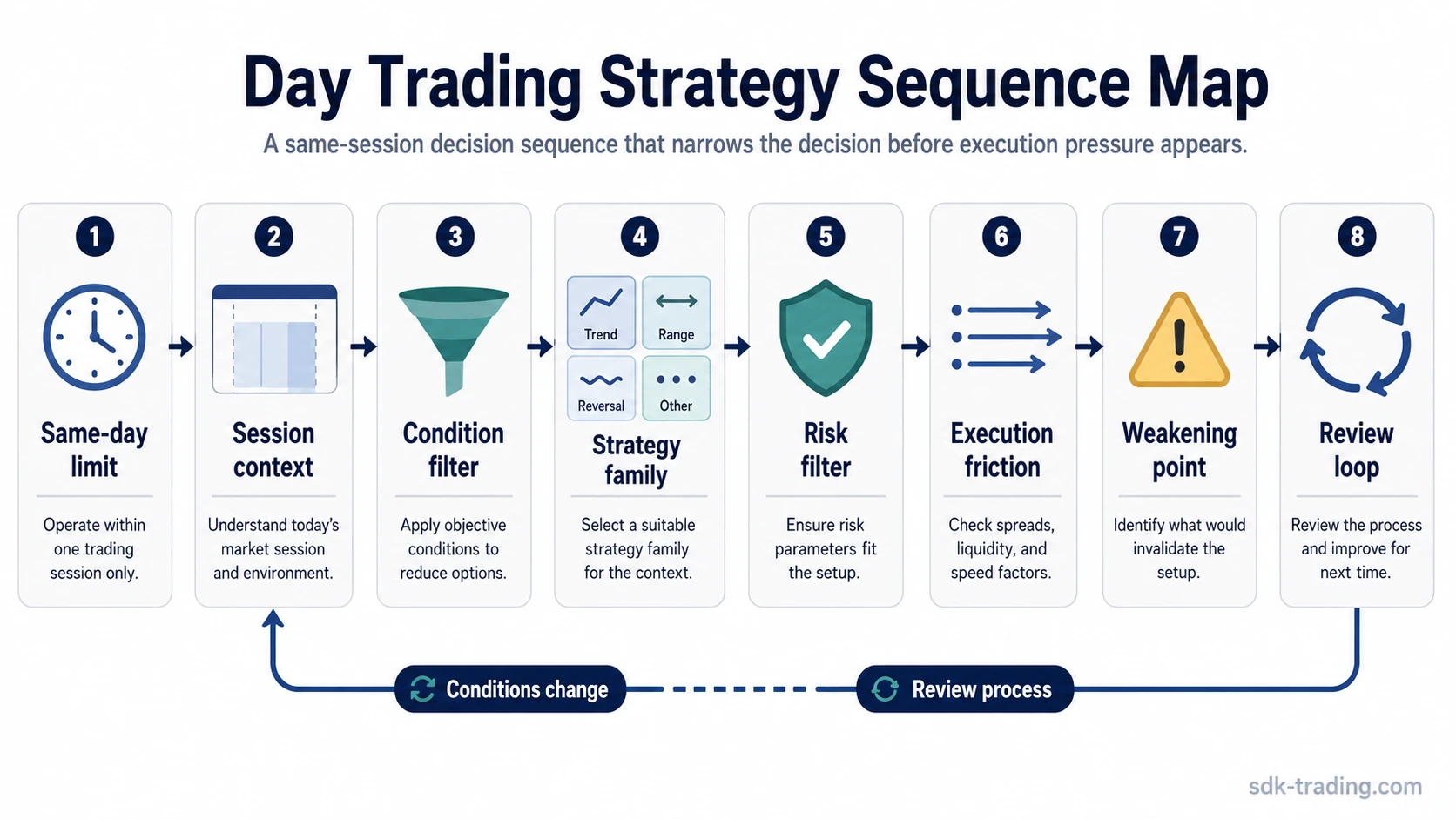
| Sequence step | Main question | What it controls | Weakens if |
|---|---|---|---|
| Session context | What type of session is forming? | Direction, volatility, liquidity, and timing | The session changes character faster than the plan adjusts |
| Condition filter | Does the current environment fit the strategy family? | Prevents forcing one method into every session | The method is used because it is familiar, not because conditions fit |
| Strategy family | Which behavior is being evaluated? | Separates momentum, range, breakout, reaction, and pattern-based logic | The family conflicts with volatility or liquidity conditions |
| Risk filter | Is the risk boundary clear before execution pressure appears? | Defines whether the idea is still controlled | The downside, size, or invalidation point becomes vague |
| Execution friction | Can the idea be executed without distorting the plan? | Accounts for spread, speed, order handling, and slippage | Costs or speed change the practical meaning of the idea |
| Failure condition | What would show that the idea no longer fits? | Prevents a plan from becoming a reaction loop | The trader keeps adjusting after the original condition disappears |
| Review loop | Was the decision process followed? | Separates plan quality from one outcome | Review focuses only on result instead of process quality |
Strategy Families and Market Conditions
Day trading strategies are usually discussed as named methods, but the safer reading is family-first. A family describes what kind of intraday behavior is being evaluated; it does not create a trade instruction by itself.
| Strategy family | Typical condition focus | What the framework checks | Common weakness |
|---|---|---|---|
| Trend or momentum | Directional movement during the session | Whether movement is supported by participation, timing, and risk control | Late participation after the strongest movement has already passed |
| Mean reversion or range | Price returning toward a prior intraday area | Whether the session is actually range-bound rather than expanding | Using range logic in a session that is starting to trend |
| Breakout or range expansion | Price moving beyond a prior intraday boundary | Whether acceptance, liquidity, and follow-through support the reading | False breakout behavior or quick return into the prior range |
| News or reaction | Fast repricing after a catalyst or data release | Whether volatility, spread, and order handling remain manageable | The event creates movement but not controlled decision quality |
| Scalping or short-cycle logic | Very short holding periods inside the session | Whether execution costs and decision frequency are realistic | Small frictions becoming large relative to the intended decision |
| Pattern-based intraday logic | Recognizable chart structure inside the session | Whether the pattern fits context, liquidity, and risk limits | Treating the pattern label as a complete strategy |
Indicators can support this process, but they should stay in the input layer. A moving average, oscillator, volume measure, or volatility tool may help describe conditions, but it does not replace the need to define session context, risk, execution friction, and failure conditions.
Risk Filters and Execution Friction
The risk filter decides whether a day trading idea is still controlled before execution pressure appears. It should be clear enough that the trader can identify what changes the idea, what limits the exposure, and what makes the decision no longer fit the session.
Risk management in trading is especially important in a same-session framework because fast feedback can create fast repetition. A plan that controls one decision can still fail as a process if repeated decisions expand the total risk.
Position sizing in trading keeps the decision connected to the account and risk budget. Shorter timeframes do not make larger risk more acceptable; they usually make discipline more visible because mistakes repeat faster.
A risk-reward ratio can help frame whether the potential trade structure is worth considering, but it should not be treated as a promise. It is only meaningful when the assumptions behind the risk boundary and expected movement are realistic.
A stop-loss can define a risk boundary, but the day trading framework should not rely only on stop placement. The broader question is whether the idea remains valid when price behavior, liquidity, or session conditions change.
Slippage, spread changes, order speed, and thin liquidity can turn a clean chart idea into a weaker decision. Execution friction matters because the same visual setup can behave differently when the market is fast, crowded, or illiquid.
When a Day Trading Strategy Weakens
A day trading strategy weakens when the conditions behind the decision no longer support the original reading. That does not automatically create the opposite idea. It means the framework has less support and should be reviewed as a process problem.
| Weakening condition | What changes | Why it matters |
|---|---|---|
| Volatility changes quickly | The session stops behaving like the original filter expected | The strategy family may no longer fit the current environment |
| Liquidity thins | Spreads widen or fills become less stable | Execution friction can distort the planned decision |
| Breakout acceptance fails | Price returns quickly into the prior area | The structure may still be visible, but the reading becomes weaker |
| Risk boundary becomes unclear | The trader can no longer define what invalidates the idea | The decision can turn into reaction instead of process |
| Repeated losses accelerate | Frequency increases after the original plan weakens | The problem shifts from one decision to process control |
| Indicators conflict with context | Tools show mixed readings while session conditions change | The indicator layer should not override the broader framework |
Practical Scenario: Same Family, Weaker Conditions
A breakout-family idea may look reasonable early in a session when participation is active and spreads are stable. Later, liquidity can thin, spreads can widen, and the market can begin returning quickly into prior ranges. The same family label remains possible, but the decision quality changes because execution friction and failed acceptance now matter more than the initial breakout shape.
Review Loop and Process Control
The review loop separates a decision process from a single result. A day trading strategy can only be evaluated sensibly if the trader can see whether the session context, condition filter, risk budget, execution friction, and failure condition were handled consistently.
Review should also control the pace of losses. A strategy that limits one decision but allows repeated impulsive decisions has not solved the intraday pressure problem.
Backtesting and journaling can support the review loop, but they do different jobs. Backtesting checks assumptions under defined conditions, while journaling records whether the live process matched the plan. Neither one turns a strategy into a guarantee.
Review Questions
- Was the session context identified before the decision?
- Did the strategy family match current conditions?
- Was the risk budget explicit before execution pressure appeared?
- Did spread, speed, liquidity, or slippage change the plan quality?
- Was there a clear condition that weakened or invalidated the idea?
- Did repeated decisions change size, frequency, or discipline?
- Did the review separate process quality from one result?
FAQ
What is a day trading strategy?
A day trading strategy is a same-session framework for filtering market conditions, choosing a strategy family, defining risk, accounting for execution friction, and reviewing whether the idea still fits before the session ends.
Is there a best day trading strategy?
No single day trading strategy is best in all conditions. A strategy family only becomes useful when it matches the session environment, risk limits, execution quality, and the trader’s process discipline.
How is day trading different from swing trading?
Day trading compresses the decision process into one session, while swing trading usually evaluates movement across multiple sessions. That difference changes the role of time, volatility, liquidity, and overnight exposure.
Do indicators matter in day trading strategies?
Indicators can matter as input layers, but they do not replace the strategy framework. They are more useful when they help describe conditions, timing, volatility, or confirmation rather than acting as standalone instructions.
Why can a day trading strategy fail?
A day trading strategy can fail when session conditions change, volatility expands, liquidity thins, execution costs increase, the risk boundary becomes unclear, or the trader keeps adjusting after the original idea no longer fits.
How should risk be treated in a day trading strategy?
Risk should be treated as a filter before execution, not as a detail added afterward. The framework should define size, invalidation, execution friction, and the point where repeated decisions become a process problem.