A position trading strategy is a longer-horizon trading framework that holds a market view across weeks, months, or sometimes longer while the trader monitors whether the original thesis still has enough evidence to remain valid. The strategy is slower than day trading or short-term swing trading, but it is not the same as passive investing because the position still depends on defined thesis duration, drawdown tolerance, risk boundary, evidence quality, and reassessment conditions.
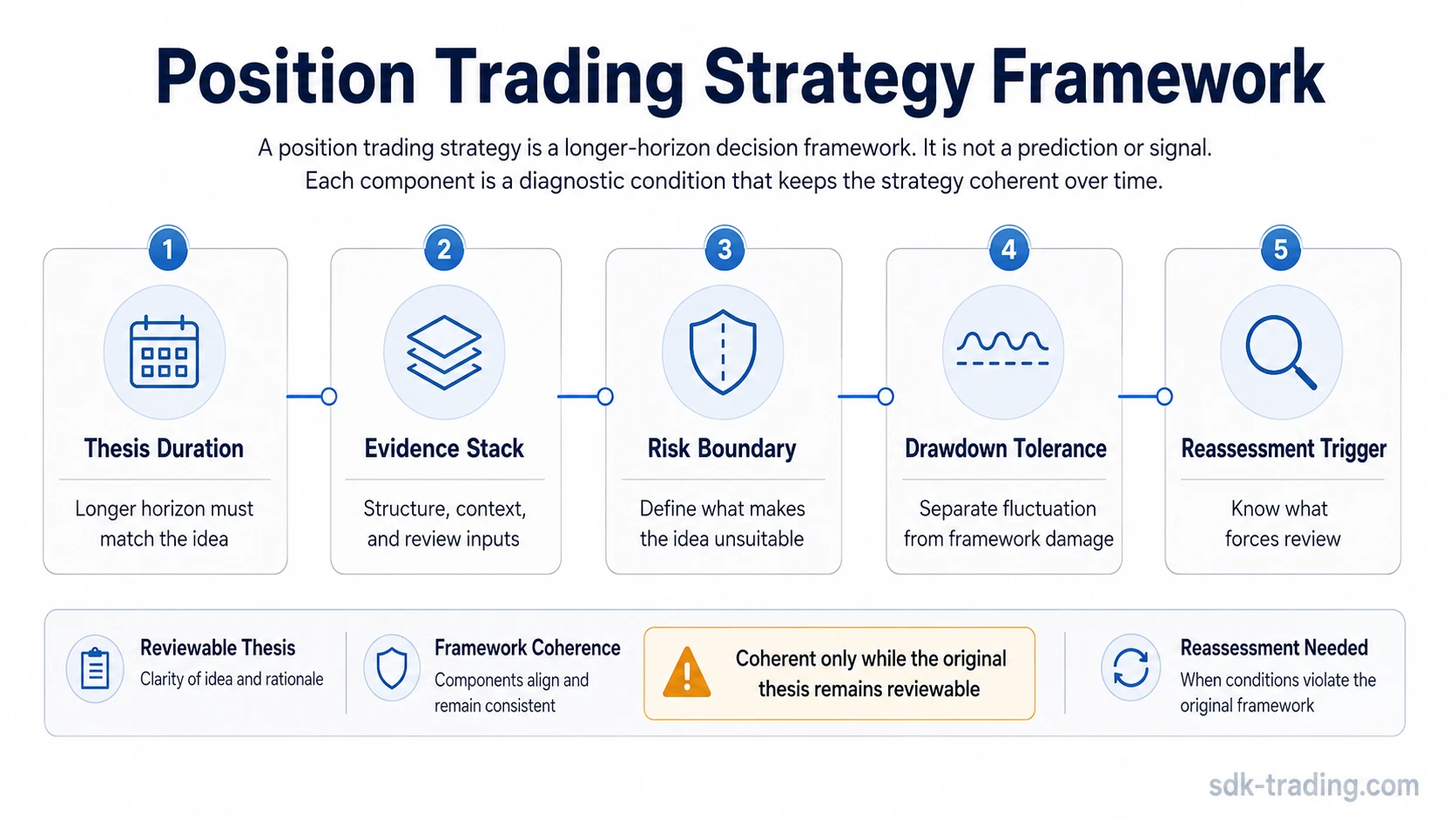
The core idea is sequence-based: define why the market view exists, decide what kind of adverse movement the framework can tolerate, check whether the evidence stack still supports the view, and identify what would force reassessment. Without those boundaries, a longer holding period can become an undefined bet rather than a structured trading strategy.
Key Points
- A position trading strategy is built around a longer thesis window, not around frequent intraday decisions.
- The framework needs a defined reason for holding, a risk boundary, and a reassessment process.
- Drawdown tolerance matters because a longer horizon can expose the trader to larger price swings before the thesis is resolved.
- Technical and fundamental evidence can both be used, but neither one confirms the outcome by itself.
- The strategy weakens when the evidence stack breaks, market structure changes, or the risk boundary is no longer acceptable.
What Is a Position Trading Strategy?
A position trading strategy is a structured way to participate in a larger market move while ignoring some short-term noise. The position may be based on trend persistence, market structure, macro conditions, earnings expectations, sector leadership, or a combination of technical and fundamental evidence. The key requirement is that the reason for holding must be clear before the position is taken and reviewable while it is still open.
The strategy is not defined only by holding for a long time. A trader can hold a position for weeks and still have no coherent framework if the thesis, risk, and reassessment trigger are unclear. A position trading strategy becomes more defensible when the holding period matches the evidence being used.
For example, a trader using a multi-month trend thesis should not judge the position only from one intraday candle. The evidence should match the horizon: broader market structure, trend behavior, leadership, volatility, liquidity conditions, or fundamental developments may matter more than small short-term fluctuations.
Position Trading Strategy vs Swing Trading, Day Trading and Investing
Position trading sits between active trading and longer-term investing. It is usually slower than swing trading, but more actively monitored than a passive buy-and-hold investment approach.
| Approach | Typical focus | Main evidence | Review style | Main risk if misused |
|---|---|---|---|---|
| Day trading | Intraday movement | Short-term order flow, volatility, levels, execution quality | Frequent review within the same session | Overreacting to noise or execution friction |
| Swing trading | Multi-day to multi-week price swings | Trend legs, pullbacks, pattern structure, momentum shifts | Regular review around swing structure | Confusing a normal pullback with a broken thesis |
| Position trading | Weeks, months, or longer trend participation | Trend persistence, structure, fundamental or macro context, leadership, risk boundary | Periodic reassessment against the original thesis | Holding through structural failure because the horizon is vague |
| Investing | Long-term ownership or allocation | Business quality, valuation, cash flows, portfolio objectives, long-term risk | Review around thesis, valuation, and portfolio fit | Treating every market fluctuation as a trading decision |
The boundary is not perfect. A position trader can use fundamental context, and an investor can review technical structure. The difference is the decision frame: position trading still treats the holding as an active market thesis with conditions that can weaken, improve, or fail.
The Core Framework Behind Position Trading
The useful version of position trading starts with a framework, not with a preferred indicator or a vague belief that a market should move higher or lower. The framework should connect thesis, horizon, risk, and evidence in a way that can be reviewed without changing the rules every time price moves.
| Framework step | Question to answer | What makes it stronger | What weakens it |
|---|---|---|---|
| Thesis duration | How long should the idea reasonably need to develop? | The evidence matches a multi-week or multi-month process | The trader uses a long horizon only to avoid making a decision |
| Evidence stack | What supports the view? | Trend, structure, leadership, volatility, or fundamental context point in the same broad direction | One isolated signal carries the entire thesis |
| Risk boundary | What would make the position no longer acceptable? | The boundary is defined before emotional pressure increases | The boundary moves only because the position is uncomfortable |
| Drawdown tolerance | How much adverse movement can the framework tolerate? | The framework accepts that larger horizons can involve wider fluctuations | Normal volatility and structural failure are treated the same way |
| Reassessment trigger | What evidence would require a fresh review? | Specific conditions are named in advance | The position is reviewed only after it has already become stressful |
This is where risk management in trading becomes part of the strategy rather than a separate afterthought. The longer the holding window, the more important it becomes to define what risk is being accepted and why.
Evidence Used in a Position Trading Strategy
Position trading can use technical analysis, fundamental context, macro conditions, or a blended evidence stack. The number of inputs matters less than their alignment with the thesis and the intended holding period.
Technical Evidence
Technical evidence may include trend direction, market structure, moving averages, support and resistance behavior, volatility contraction or expansion, relative strength, and leadership changes. A moving-average pattern such as a golden cross can be part of a position trading review, but it should not be treated as a standalone confirmation. It is more useful when it aligns with structure, participation, and the broader thesis.
Fundamental or Macro Evidence
Fundamental or macro evidence may include earnings expectations, rate conditions, sector rotation, liquidity conditions, commodity trends, currency pressure, or broader risk appetite. These inputs can help explain why a larger move may persist, but they do not remove the need for risk control. A strong narrative can still fail if price structure deteriorates or if new information changes the thesis.
Evidence Alignment
The evidence stack is strongest when different inputs support the same interpretation without becoming redundant. A trend, improving leadership, stable volatility, and a coherent macro or fundamental backdrop can reinforce one another. The interpretation weakens when the inputs conflict or when the review keeps only the evidence that supports the preferred outcome.
Risk Boundaries and Drawdown Tolerance
Position trading requires a clear risk boundary because wider time horizons often involve wider price movement. A position may remain inside the original thesis while moving against the trader for a period, but that does not mean every adverse move should be tolerated.
Maximum drawdown explained is relevant because a position trading framework must distinguish between tolerable fluctuation and damage that makes the strategy unsuitable. The issue is not only whether the market can recover. The issue is whether the position can remain manageable under the framework while waiting for the thesis to resolve.
| Risk area | Why it matters | Safe interpretation |
|---|---|---|
| Drawdown | Larger holding windows can include deeper temporary declines | Define what is tolerable before the decline happens |
| Gap or overnight risk | News can change price before the trader can react | Avoid assuming that review can always happen at a preferred price |
| Capital tie-up | Longer positions use capital that could be used elsewhere | Opportunity cost should be part of the decision |
| Liquidity risk | Thin markets can make adjustment harder during stress | Market access and execution conditions should fit the position size |
| Thesis drift | A trader may keep changing the reason for holding | The original thesis should remain visible and reviewable |
Position sizing in trading is part of this boundary because a position can be analytically sound and still too large for the volatility, liquidity, or drawdown it may require.
Scenario Tree for Reassessment
A scenario tree helps prevent a position trading strategy from becoming an all-or-nothing belief. The decision process does not need to predict the exact path. The framework only needs to define what the primary path looks like, what an alternative path would mean, and what kind of evidence would require reassessment.
| Scenario path | What it means | What to monitor | Framework response |
|---|---|---|---|
| Primary thesis path | The market continues to support the longer-horizon view | Trend structure, leadership, volatility behavior, evidence alignment | Continue reviewing against the original thesis |
| Alternative path | The market slows, consolidates, or becomes less clear without fully breaking the thesis | Range behavior, failed continuation, weakening leadership, mixed evidence | Reduce certainty and reassess whether the thesis still has enough support |
| Reassessment path | The evidence that justified the position is no longer intact | Structural failure, risk boundary breach, adverse regime change, unacceptable drawdown | Review the position as a new decision, not as a continuation of the old thesis |
The scenario tree is not a prediction tool. It is a discipline tool. It keeps the trader from treating every pullback as failure or every recovery attempt as confirmation.
Position Trading Strategy Example in Context
Consider a generic market that has been forming higher highs and higher lows over several months while leadership remains steady and volatility is not expanding sharply. A position trader may build a thesis that the trend remains intact as long as broader structure continues to support that view.
The thesis remains coherent if the market pauses but holds its broader structure, leadership does not deteriorate, and the risk boundary remains acceptable. The thesis weakens if price begins making lower highs, leadership narrows, volatility expands against the position, or the evidence stack becomes mixed. The thesis requires reassessment if the original structure fails and the position now depends only on the hope that the market will recover.
This type of example is intentionally generic. The value is not in the asset name or the exact path. The value is in separating thesis, evidence, risk boundary, and reassessment before the market forces the decision emotionally.
How Risk and Reward Fit the Framework
A position trading strategy still needs a risk and reward framework, but the concept should not be reduced to a fixed target or a mechanical formula. The decision process needs to show whether the potential thesis is large enough to justify the time, capital, drawdown, and uncertainty involved.
The risk reward ratio can help frame this trade-off, but it should not be used as a promise that the market will deliver a specific outcome. It is a planning concept, not a prediction.
A longer-horizon position can look attractive because the potential move appears larger, but that potential must be weighed against time risk, adverse movement, opportunity cost, changing evidence, and the ability to follow the framework consistently.
Common Failure Conditions
A position trading strategy usually fails less from one bad candle and more from a broken process. The most common failure is allowing the thesis to change after the position becomes uncomfortable.
- Undefined thesis: the reason for holding cannot be clearly explained.
- Horizon mismatch: short-term signals are used to justify a long-term position, or long-term arguments are used to ignore short-term structural failure.
- Drawdown denial: adverse movement is dismissed without checking whether the evidence has changed.
- Indicator overconfidence: a moving average, breakout, or momentum reading is treated as enough by itself.
- No reassessment trigger: the position is reviewed only after stress has already increased.
- Capital lock-up: the position absorbs capital while the thesis becomes less attractive than other available opportunities.
The safer interpretation is that position trading needs fewer decisions than faster trading styles, but each decision must be better defined. A slower strategy is not automatically a lower-risk strategy.
When a Position Trading Strategy Is Coherent
A position trading strategy is coherent when six questions can be answered without changing the rules midstream.
| Criteria | Coherent answer | Warning sign |
|---|---|---|
| Thesis duration | The expected holding window matches the evidence being used | The horizon changes whenever price moves against the position |
| Evidence quality | The thesis is supported by more than one isolated signal | One indicator is treated as complete confirmation |
| Risk boundary | The unacceptable condition is defined before the position is stressed | The boundary is vague or constantly moved |
| Drawdown tolerance | The framework identifies what level of fluctuation it can absorb | Drawdown is ignored until it becomes emotionally difficult |
| Reassessment trigger | Specific evidence will cause the thesis to be reviewed | The decision process waits for certainty that may never arrive |
| Position fit | Size, liquidity, and time horizon fit the trader’s constraints | The idea is good, but the exposure is too large or too hard to manage |
If those answers are missing, the label “position trading” does not solve the problem. The strategy needs a decision framework before the holding period can mean anything.
FAQ
What is a position trading strategy?
A position trading strategy is a longer-horizon trading framework that holds a market view across weeks, months, or sometimes longer while monitoring whether the original thesis, evidence, risk boundary, and reassessment conditions remain valid.
How is position trading different from swing trading?
Position trading usually works with a longer thesis window than swing trading. Swing trading often focuses on multi-day or multi-week swings, while position trading is more concerned with whether a larger trend or market thesis remains intact over a broader period.
Is position trading the same as investing?
No. Position trading can use longer-horizon evidence, but it remains an active trading framework. Investing usually focuses more on ownership, valuation, portfolio objectives, and long-term asset allocation.
Can a golden cross be part of a position trading strategy?
Yes, a golden cross can be part of the evidence stack, but it should not be treated as confirmation by itself. It is more useful when it aligns with market structure, participation, risk conditions, and the broader thesis.