Technical analysis can work, but not as proof, a guarantee, or a standalone decision system. I treat it as one layer in the broader analysis process: it studies chart behavior, including price structure, trend, levels, volatility, volume, candles, indicators, and recurring patterns, to build conditional scenarios.
The key word is probability. Technical analysis does not tell a trader where price must go; it helps organize how price could move if certain conditions are confirmed. A pattern, trendline, support area, resistance area, indicator reading, or Elliott Wave count creates a hypothesis that later price behavior can confirm, weaken, invalidate, or reclassify.
That is why technical analysis is strongest as scenario work. A primary, secondary, and lower-probability path can all exist at the same time, but each remains open to change as new chart evidence appears.
For the core definition, see what is technical analysis. The reliability question is narrower: technical analysis is useful only when its signals are read with context, confirmation, probability, and clear limits.
Working definition: Technical analysis works best as conditional scenario mapping. It uses chart-based evidence to form hypotheses about possible price paths, then updates those hypotheses as new structure, confirmation, failure, or reclassification appears.
Key Points
- Technical analysis is one analytical layer, not a complete decision system by itself.
- It can help organize evidence from price structure, trend, levels, candles, volume, volatility, indicators, recurring patterns, and conflicting tool readings when they are placed inside a clear process.
- It does not prove that price must move in one specific direction.
- Its reliability weakens when traders overfit patterns, ignore context, rely on hindsight, or treat indicators as automatic signals.
- False signals are part of chart analysis because markets adapt, liquidity shifts, and similar patterns can lead to different outcomes.
- Risk management remains separate from chart interpretation. A chart can frame a scenario, but it does not decide whether risk is acceptable.
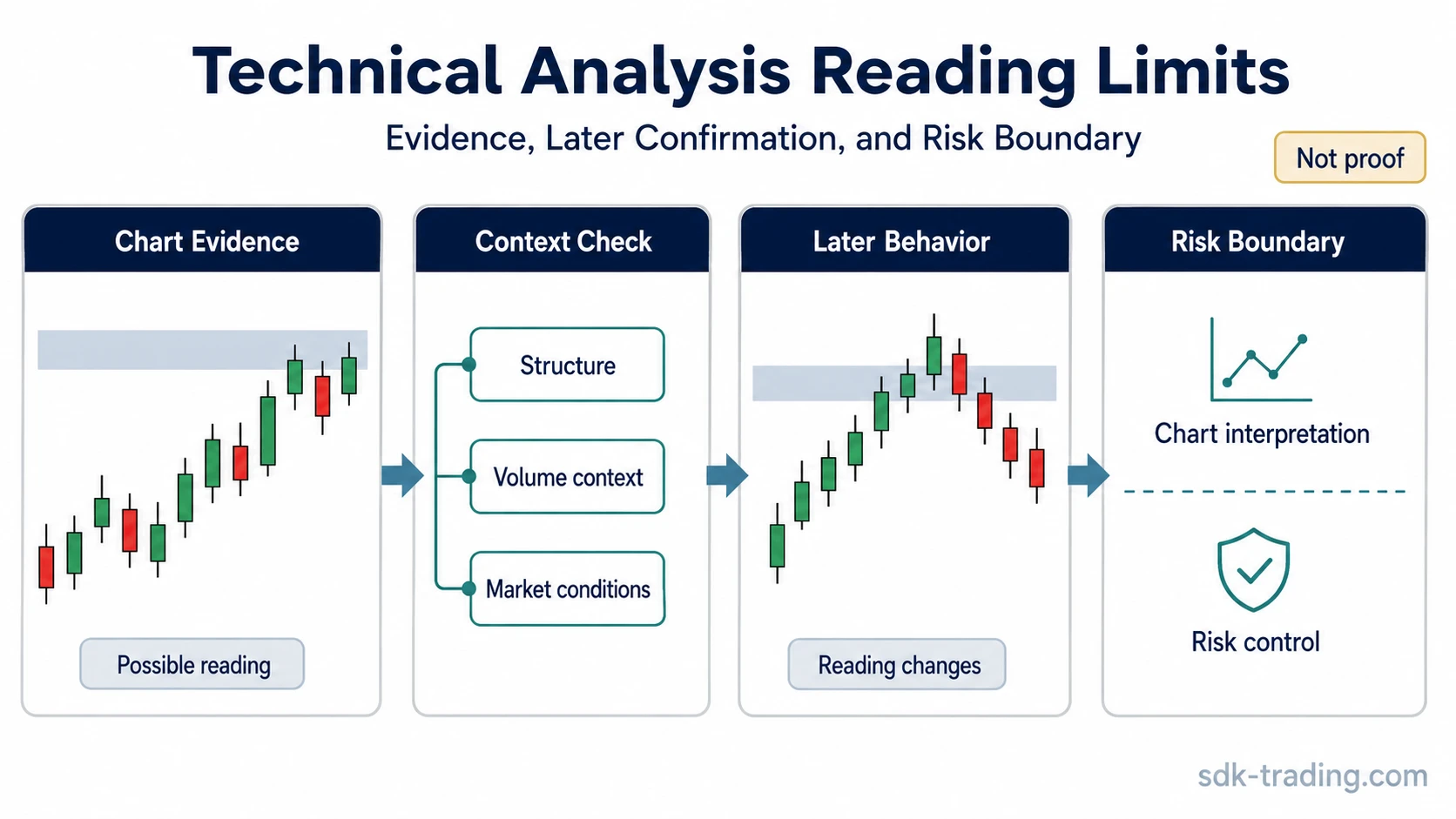
What Technical Analysis Can and Cannot Do
A chart can help describe how price is behaving. It can show whether a market is trending, compressing, rejecting an area, accepting a breakout, losing momentum, or moving through a corrective structure. That makes technical analysis useful when a trader needs a repeatable way to read structure instead of reacting to every price movement emotionally.
Technical analysis cannot prove what will happen next. A chart pattern that appears clear after the fact may have been incomplete in real time. The context may have been mixed, the tools may have conflicted, and the next move may still have been capable of invalidating the reading.
The practical value comes from ranking and updating scenarios. A chart may support a bullish continuation, bearish breakdown, and false-break recovery scenario at the same time; the analyst’s job is to identify which path currently has the strongest evidence and what would change that ranking.
Process boundary: Technical analysis can help form a probability-weighted view of possible price paths. It cannot turn those paths into certainty, and it cannot replace fundamental context, risk control, position sizing, or uncertainty management.
Misread vs Conditional Interpretation
The most common mistake is treating a chart reading as a conclusion. A better standard is to treat it as a scenario that must remain open to confirmation, failure, or reclassification.
| Situation | Common misread | Conditional interpretation | What can change it |
|---|---|---|---|
| A familiar pattern appears on the chart | The pattern means the market should move in the expected direction. | The pattern creates a possible scenario, but later price behavior must support it. | Similar-looking patterns can fail, extend, truncate, or become part of a more complex structure. |
| An indicator gives a strong reading | The indicator is a complete signal by itself. | The indicator is one layer of evidence that should be checked against structure, timeframe, and context. | Indicators can lag, conflict, or overreact during unusual volatility. |
| A breakout occurs above a visible level | The breakout confirms continuation immediately. | The breakout becomes more meaningful only if price accepts the new area instead of quickly failing back inside the prior range. | A wick or brief push beyond a level can become a false signal. |
| A trendline is tested | The trendline must hold or break in one obvious way. | The trendline is a decision boundary. Price can hold it, break it and retest from below, or create a false break and reclaim it. | The interpretation changes after acceptance, rejection, reclaim, or failed retest behavior. |
| A past chart example looks obvious | The same setup would have been easy to identify in real time. | Hindsight can make incomplete real-time information look cleaner than it was. | Backfilled pattern recognition can create false confidence. |
| Several traders see the same level | The level must work because it is obvious. | A visible level can matter, but the reaction around it decides whether it is accepted, rejected, or ignored. | Crowded interpretations can fail when market conditions change. |
When Technical Analysis Helps
Technical analysis is more useful when it reduces noise without pretending to eliminate risk. It can help separate trend from range, continuation from exhaustion, acceptance from rejection, and a clean structure from a weak or unresolved one.
Its value depends less on the number of tools and more on whether each tool has a clear role. One trader may focus on Elliott Wave, moving averages, and volume; another may use support and resistance, candlestick behavior, RSI, and trendlines. In either case, the reading becomes stronger only when several layers support the same conditional interpretation instead of creating disconnected signals.
Useful condition: A chart reading becomes more defensible when structure, context, indicator evidence, volume behavior, and later confirmation support the same scenario. It becomes weaker when the entire case depends on one pattern, one indicator, or one hindsight example.
Where Technical Analysis Fails
Technical analysis fails most often when it is used as a prediction shortcut. A trader may see a pattern, search for examples where that pattern worked, and ignore cases where similar structures failed. That creates a confidence problem rather than an analysis edge.
Overfitting is another failure mode. A pattern can be adjusted until it appears to explain past movement, but that does not mean the same rule will hold in future conditions. Data snooping works the same way: repeated testing can find patterns that look meaningful in old data but have little practical value when conditions change.
Subjectivity also matters. Two traders can draw different trendlines, identify different support zones, choose different indicator settings, or label the same Elliott Wave structure differently. That does not make chart analysis useless, but it does mean that technical interpretation needs boundaries rather than absolute claims.
Tool conflict becomes a failure mode when the analyst has no hierarchy for resolving disagreement between indicators, moving averages, price patterns, and wave counts.
Reliability limit: Technical analysis becomes fragile when it depends on hindsight, selective examples, overloaded indicators, conflicting tools, or a belief that one chart structure must produce one outcome.
Why People Disagree About Technical Analysis
People often disagree because they judge technical analysis by different standards. As proof of the next move, it fails. As a structured process for reading price behavior, defining scenarios, identifying failed moves, and managing uncertainty, it can still be useful.
Some criticism comes from the view that known information is already reflected in prices and that chart patterns should not create a reliable advantage by themselves. That criticism is important because it prevents technical analysis from being treated as a magic forecasting system.
The practical defense of technical analysis is different. It does not need to be a perfect prediction engine to have value. It can still help an analyst organize possible paths, define what confirmation would look like, recognize when a scenario is failing, and avoid treating every price movement as random noise.
Balanced view: Technical analysis is weak when it claims certainty. It is more useful when it is treated as a probability framework for scenario building, confirmation, failure, and reclassification.
False Signals and Market Adaptation
False signals are not an exception to technical analysis. They are part of the environment. Breakouts fail, support breaks and recovers, resistance clears and then rejects, and indicators can remain overbought or oversold longer than expected.
Markets also adapt. A pattern that once attracted a clean reaction may become crowded, less reliable, or more vulnerable to failure as more participants watch it. This is why technical analysis should not be treated as a fixed rulebook. It is better understood as a way to observe changing behavior under uncertainty.
Practical scenario: A stock breaks above a widely watched resistance area and the move looks strong at first. If price quickly falls back below the breakout area and cannot reclaim it, the first reading weakens. The first break was incomplete evidence until later price behavior showed whether the market accepted the new area.
Real Chart Example: Technical Analysis as Scenario Mapping
The LYFT weekly chart is useful because the same structure can support more than one scenario. The main technical boundary is the multi-year rising support line. If price holds it, the range or recovery scenario remains alive. If price breaks it and fails a retest from below, the bearish breakdown scenario becomes stronger. If price breaks it briefly and then reclaims it, the same move can be reclassified as a false break.
| Scenario | Condition | Interpretation | What would weaken it |
|---|---|---|---|
| Support holds | Price respects the rising trendline and continues to build above it. | The chart remains unresolved or constructive inside the broader range. | A clean break below the trendline with acceptance underneath. |
| Breakdown and failed retest | Price breaks the trendline, retests it from below, and fails to reclaim it. | The downside scenario becomes stronger, with the lower reference zone becoming more relevant. | A quick reclaim back above the trendline. |
| False break and reclaim | Price breaks the line, then moves back above it and holds it as support. | The breakdown reading is reclassified, and a recovery scenario becomes more relevant. | Failure to hold above the reclaimed trendline. |
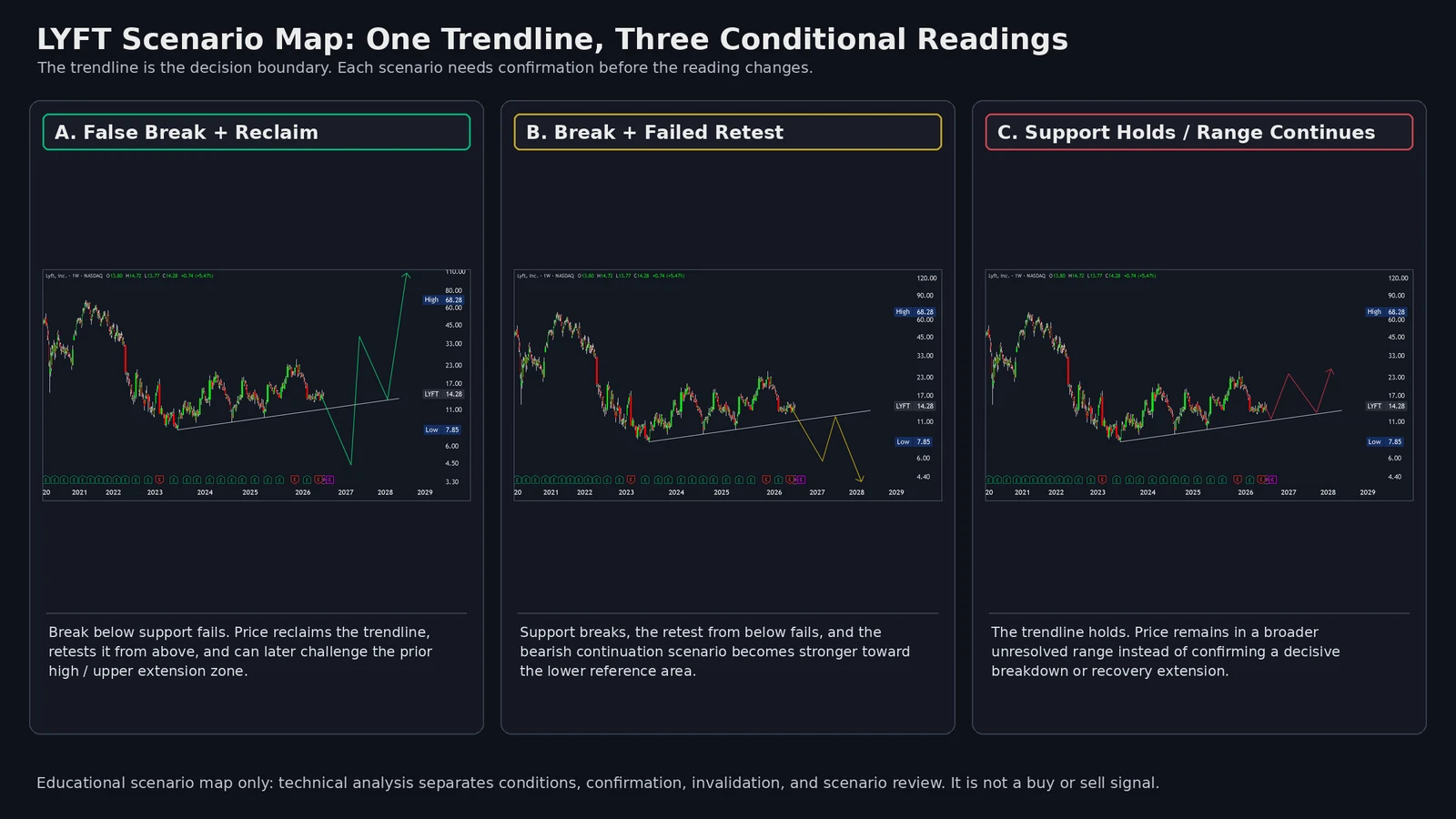
The point is not to predict which path must happen. The point is to keep scenarios organized and update them when price confirms, rejects, reclaims, or invalidates the key boundary.
Why Risk Management Is Separate
A chart can help frame a possible market scenario, but it cannot decide whether risk is acceptable. A chart may identify a level, structure, or condition worth monitoring, yet that is different from position sizing, portfolio exposure, time horizon, liquidity, or personal risk limits.
A technically interesting setup can still be unusable if risk conditions are poor, invalidation is unclear, or the idea conflicts with broader portfolio exposure.
For a separate framework, see risk management in trading. Technical analysis can describe structure. Risk management decides whether the exposure is acceptable.
Boundary: Technical analysis can describe market structure and possible scenarios. It does not grant trade permission, guarantee a result, or replace risk control.
Does Stock Technical Analysis Work Differently?
Stock technical analysis uses the same basic logic of structure, trend, support, resistance, volume, volatility, indicators, and pattern interpretation. The reliability issue does not disappear because the instrument is a stock.
Individual equities can be affected by earnings, news, sector rotation, liquidity, index flows, dilution, company-specific risk, and fundamental changes. That means chart structure is only one layer of interpretation. A technical pattern may show that buyers or sellers are active around a level, but it does not prove the reason behind the move or guarantee continuation.
This is why technical analysis is often more useful when it is combined with broader context. For company analysis, fundamental information may define the reason to care. Technical analysis may help organize timing, structure, confirmation, and invalidation. Neither layer removes uncertainty by itself.
FAQ
Does technical analysis actually work?
Technical analysis can be useful as a conditional framework for reading chart behavior, building scenarios, and updating those scenarios as price confirms or invalidates them. It does not provide certainty, proof, or a guaranteed edge by itself.
Why does technical analysis fail?
Technical analysis often fails because of false signals, overfitting, hindsight bias, subjective pattern reading, indicator misuse, changing market conditions, ignored context, and poor risk control. A chart signal can look clear after the fact while remaining uncertain in real time.
Is technical analysis enough by itself?
No. Technical analysis is one layer of analysis, not a complete decision system. It may help frame market structure and possible scenarios, but it does not replace risk management, position control, fundamental context, or uncertainty management.
Does technical analysis predict the future?
No. Technical analysis does not predict the future with certainty. It can identify possible price paths from current and past chart behavior, but every reading remains conditional until later price action supports, weakens, invalidates, or reclassifies it.