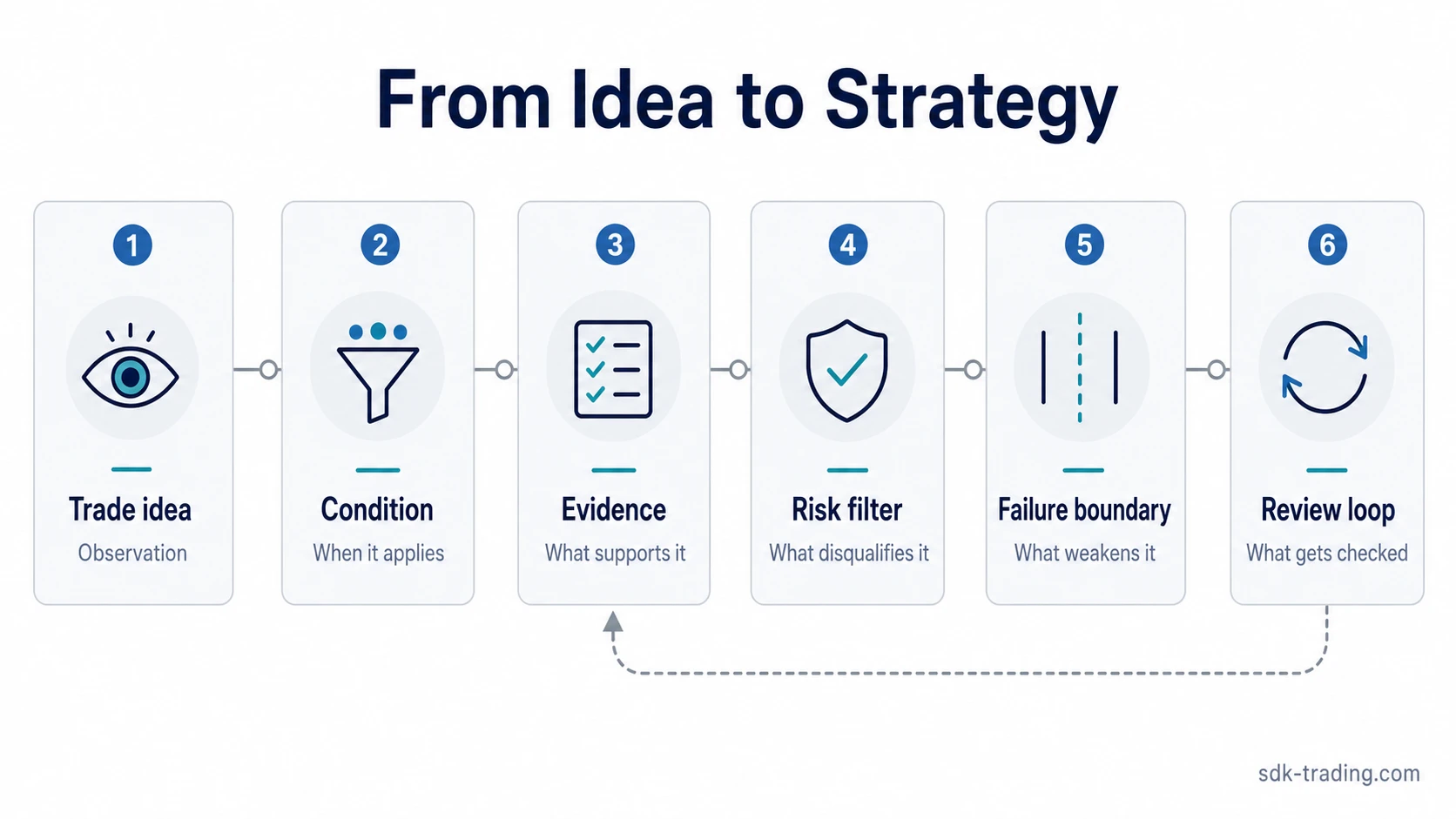
A trading strategy is a conditional decision framework, not just a named setup, copied method, or market opinion. It defines what must be true before a trading decision is considered, what evidence supports the idea, what risk filter applies, what would make the idea fail, and how the result will be reviewed.
A setup can point to something worth studying. A strategy goes further by turning the observation into a repeatable process with rules, criteria, boundaries, and review conditions. Without those parts, the trader may only be reacting to price movement rather than following a defined framework.
Key point: A trading strategy becomes usable only when the decision process is defined before pressure appears. The name of the setup is less important than the rules, evidence checks, disqualifying conditions, and review process around it.
What Makes a Trading Strategy More Than a Trade Idea?
A trade idea is an observation. A trading strategy is the rule set used to evaluate that observation. For example, a trader may notice price moving beyond a prior range. That observation is not yet a strategy. It becomes part of a strategy only when the framework defines which condition matters, what evidence is required, what would weaken the interpretation, and how the decision will be reviewed later.
Random or emotional trading usually begins with movement: price rises, price falls, volatility expands, or a chart looks active. A strategy begins with conditions. It asks whether the market behavior matches a defined framework before any decision is treated as valid.
| Concept | What it describes | What is still missing |
|---|---|---|
| Trade idea | A possible market observation or scenario. | Rules, evidence, risk filter, and review process. |
| Trading style | The trader’s participation profile, such as holding period and pace. | The decision logic for a specific setup. |
| Trading strategy | A defined framework for evaluating conditions, evidence, risk, failure, and review. | Execution details may still need separate process rules. |
| Trading system | A broader operating structure that may include strategy rules, execution process, tracking, and review. | Quality still depends on whether the rules are clear and reviewed honestly. |
The Evidence a Strategy Needs Before It Can Be Trusted
A trading strategy needs more than a label. A named breakout, reversal, trend, range, or pullback idea can still be incomplete if the framework does not define the evidence required before the idea is considered usable.
| Framework part | Question it should answer | Incomplete version |
|---|---|---|
| Market condition | What type of environment is being evaluated? | The same rule is applied in every market condition. |
| Timeframe | Which holding period and chart context does the framework belong to? | The idea changes timeframe whenever the chart becomes uncomfortable. |
| Market or instrument | Where is the framework intended to be studied? | The method is copied across markets without checking behavior, liquidity, or structure. |
| Setup condition | What must appear before the idea is even considered? | A label is used without a clear condition. |
| Evidence | What confirms that the condition is meaningful enough to evaluate? | One candle, one indicator, or one price move carries the whole decision. |
| Risk filter | What would make the idea unacceptable even if the setup appears? | The setup is treated as valid without a risk boundary. |
| Failure condition | What would show that the idea is no longer behaving as expected? | The interpretation keeps changing to defend the original idea. |
| Review loop | How will the framework be checked after repeated use? | Outcomes are remembered selectively instead of reviewed consistently. |
The strongest part of the framework is often the failure condition. A strategy that cannot define what would make its idea wrong is usually still a loose opinion, even if it uses technical language.
Evidence Needed vs Not Enough Evidence
A common mistake is treating the first visible trigger as the full strategy. The trigger may only start the evaluation.
| Trigger condition | Common misread | Safer interpretation | Evidence needed | Still incomplete if |
|---|---|---|---|---|
| Price moves beyond a prior range. | The breakout name alone means a strategy exists. | The breakout is only a condition to evaluate. | Acceptance, timeframe fit, market context, risk filter, failure boundary, and review rule. | No rule defines what invalidates the idea or how repeated outcomes will be reviewed. |
| An indicator reaches a threshold. | The indicator reading is treated as the decision. | The reading is one condition inside a broader framework. | Clear market context, separate confirmation logic, and a defined limitation. | The same reading is used in every environment without checking whether the context changed. |
| A familiar pattern appears on the chart. | The pattern name is treated as enough evidence. | The pattern matters only if location, structure, and later behavior support the reading. | Defined context, condition sequence, risk filter, and failure behavior. | The pattern is renamed after the fact to keep the original idea alive. |
The useful boundary is simple: a trigger can create something to study, but it does not create a complete strategy by itself.
Trading Strategy vs Trading Style vs Trading System
A trading style describes how a trader participates in the market. Holding period, pace, and exposure profile belong to the style layer. For example, swing trading describes a multi-session participation profile, but it does not automatically define the decision rules for a specific setup.
A trading strategy describes decision logic. It defines the setup condition, confirming evidence, invalidation logic, and review process around a specific method. Two traders may share the same style but use very different strategies because their decision rules are not the same.
A trading system is broader. It may include one or more strategies, execution rules, journaling, review process, market selection, and operational constraints. A system can contain a strategy, but the strategy itself is the decision framework inside that larger process.
What Makes a Strategy Incomplete?
A strategy is incomplete when it cannot define its own boundaries. The problem is not always the idea itself. The problem is often that the idea has no rule for when it applies, when it does not apply, and what evidence would weaken it.
A copied method can create the same problem. It may use familiar terminology, but the trader still needs to know the market condition, timeframe, evidence checks, risk filter, failure behavior, and review process. Without those parts, the copied method may only be a template with missing decision rules.
Incomplete strategy signs:
- The setup name carries the decision by itself.
- The rule changes after each outcome.
- No condition defines when the idea should be ignored.
- No failure behavior is defined before the decision is evaluated.
- Review depends on memory rather than a consistent process.
Why Backtesting Does Not Automatically Make a Strategy Reliable
Backtesting can help evaluate whether a rule set behaved consistently across a sample, but it does not prove that a strategy is reliable in every future condition. The assumptions, sample, market condition, rule clarity, and later review process still matter.
A named or backtested strategy can still be weak if the rules were adjusted after the result was known. A framework that only looks good after repeated adjustments may be describing the past more than defining a stable process.
How Testing and Review Fit Into the Framework
Testing and review are evidence checks, not guarantees. Backtesting trading strategies can help check whether a rule set behaved consistently across a sample, but the result still depends on how clearly the rules were defined and whether the test avoided selective interpretation.
Forward review adds another layer because it observes how the framework behaves after the rules are written down. The review loop should check whether the original condition sequence, limitation, and review rule remain clear when real-time uncertainty appears.
The interpretation weakens when the framework changes after every outcome. A strategy can adapt over time, but adaptation should come from review, not from defending an unclear decision after the fact.
A Practical Boundary Example
A trader sees price move beyond a prior range. The move may be interesting, but it is still only an observation. A complete framework would define the market condition being studied, the timeframe, the evidence required for acceptance, the risk filter that could disqualify the idea, the behavior that would make the idea fail, and the review rule used after repeated examples.
The tempting shortcut is to name the setup and treat the name as the strategy. The stronger process is to separate the trigger from the framework. The trigger only identifies something to evaluate; the strategy defines the conditions used to evaluate it.
FAQ
What is a trading strategy?
A trading strategy is a conditional decision framework that defines the rules, evidence, risk filter, failure boundary, and review process used to evaluate a market idea.
Is a setup the same as a strategy?
No. A setup is a condition or pattern that may be studied. A strategy defines how that setup is evaluated, what evidence is required, what would make it fail, and how it will be reviewed.
What is the difference between a trading strategy and a trading style?
A trading style describes participation profile, such as pace and holding period. A trading strategy describes the decision logic used to evaluate a specific market condition.
Does backtesting prove that a trading strategy works?
No. Backtesting can help evaluate a rule set, but it does not guarantee reliability. Rule clarity, assumptions, market conditions, and forward review still matter.