Types of trading styles are categories that organize trading activity by time horizon, trade frequency, monitoring burden, liquidity sensitivity, and risk exposure. A trading style does not define a complete trading strategy by itself, because it does not specify setup rules, confirmation conditions, risk boundaries, or invalidation.
The main trading styles are usually grouped as scalping, day trading, swing trading, and position trading. The useful distinction is not which label sounds more advanced, but how each label changes the operating conditions a trader must account for. A short-horizon style usually places more pressure on costs, liquidity, execution quality, and constant monitoring. A longer-horizon style usually places more pressure on overnight exposure, patience, thesis consistency, and reassessment discipline.
Key Points
- Trading styles classify how trading activity is organized, not whether a trade idea is valid.
- The most common style labels are scalping, day trading, swing trading, and position trading.
- The main differences come from timeframe, frequency, monitoring burden, liquidity needs, cost sensitivity, and exposure type.
- A style label still needs strategy rules, confirmation logic, a risk boundary, and invalidation conditions before it becomes usable.
What Are the Main Types of Trading Styles?
The main types of trading styles are scalping, day trading, swing trading, and position trading. These labels describe the typical rhythm of market participation. They do not automatically define the method used to select markets, read structure, confirm a setup, or manage risk.
Scalping
Scalping is the shortest-horizon style. It focuses on very brief price movements and usually requires tight attention to spread, transaction costs, liquidity, and execution conditions. Because the expected movement is small, friction can matter as much as the price movement itself.
Day Trading
Day trading usually keeps decisions inside a single trading session. The main constraint is intraday monitoring. The style reduces overnight exposure, but it still requires a clear decision process because frequent activity can make weak signals look more meaningful than they are.
Swing Trading
Swing trading usually works across several days or weeks. The swing trading style gives price structure more time to develop, but it also introduces more overnight and event exposure than intraday approaches.
Position Trading
Position trading uses the longest horizon of the common style categories. It is usually connected to broader market context, longer thesis duration, and fewer decisions. Its main challenge is maintaining a clear reassessment process as market conditions change over time.
Trading Style vs Trading Strategy
A trading style describes the operating environment. It answers questions such as how long decisions usually last, how often the market must be monitored, and how sensitive the approach is to costs and liquidity.
A trading strategy defines the decision rules. It explains what conditions must exist, what confirms or weakens the idea, where the risk boundary is, and when the idea should be reassessed. A scalping label alone does not create a scalping trading strategy; it only describes the short-horizon environment where the strategy would operate.
Simple distinction: style defines the trading horizon and operating constraints; strategy defines the rules, evidence, confirmation, risk boundary, and invalidation process.
Trading Styles Compared by Timeframe and Constraints
| Trading style | Typical horizon | Monitoring burden | Cost and liquidity sensitivity | Exposure type | What the label does not define |
|---|---|---|---|---|---|
| Scalping | Seconds to minutes | Very high | Very high, because spread and friction can dominate small movements | Mostly immediate execution exposure | Setup quality, confirmation, risk boundary, and invalidation |
| Day trading | Same session | High | High, especially in fast or thin markets | Intraday volatility and session behavior | Market selection, signal rules, risk process, and reassessment logic |
| Swing trading | Several days to several weeks | Moderate | Moderate, with more attention to gaps and event risk | Overnight and multi-session exposure | Setup rules, confirmation conditions, position logic, and invalidation |
| Position trading | Weeks to months or longer | Lower day-to-day, but higher thesis discipline | Varies by market, instrument, and liquidity depth | Longer market-cycle and event exposure | Evidence stack, risk boundary, reassessment trigger, and thesis limits |
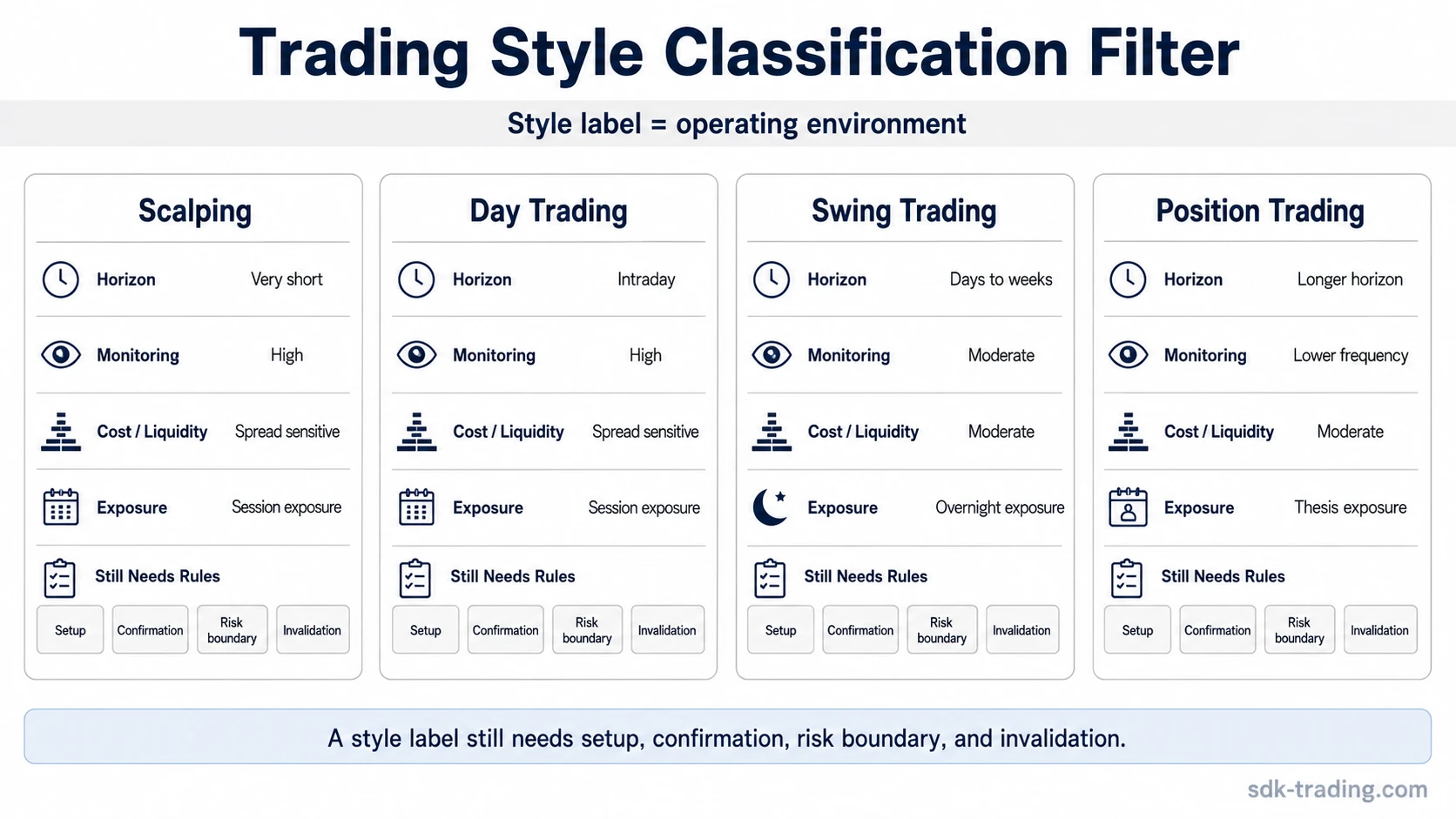
How Trading Styles Differ by Timeframe and Monitoring
Timeframe is the most visible difference between trading styles, but it is not the only one. Two traders can both use a short-term label while facing very different constraints if one trades highly liquid markets and the other trades thinner instruments with wider spreads.
Style Classification Filter
- Holding period: how long the idea usually remains active.
- Trade frequency: how often decisions are expected to occur.
- Market monitoring: how closely price behavior must be watched.
- Liquidity and costs: how much spread, fees, and depth affect the approach.
- Event exposure: whether the style carries overnight, weekend, earnings, macro, or session-change risk.
- Decision speed: how quickly conditions must be interpreted.
- Risk boundary fit: whether the expected holding period matches a definable invalidation condition.
The style label becomes more useful when these filters fit together. A short-horizon approach with slow decision-making is internally inconsistent. A longer-horizon approach with no reassessment process can become attachment to an old idea rather than structured analysis.
Common Trading Style Mistake
A common mistake is choosing the label before defining the process. A trader may describe an approach as swing trading, but if the holding period, monitoring routine, confirmation condition, and invalidation boundary are not defined, the label does not create a usable framework.
Failure mode: the category name can create false clarity. “Day trading” or “position trading” sounds specific, but the label alone does not explain which market conditions matter, what evidence is required, or when the idea should be reassessed.
The safer sequence is to classify the horizon first, then check whether the monitoring burden, cost sensitivity, liquidity requirement, and risk boundary match that horizon. Only after those conditions are coherent can the strategy rules be evaluated.
Limits of Trading Style Labels
Trading style labels are useful shortcuts, but they are not precise enough to stand alone. The same label can behave differently across markets, instruments, liquidity conditions, volatility regimes, and rule sets.
Scalping in a highly liquid market is not the same as scalping in a thin market. Swing trading a stable large-cap instrument is not the same as swing trading a volatile crypto asset. Position trading can depend heavily on how often the thesis is reassessed and how clearly the risk boundary is defined.
No trading style is inherently complete, safer, or more advanced. Each style creates a different set of constraints. The practical question is whether those constraints match the trader’s horizon, monitoring capacity, market access, and decision process.
FAQ
What are the main types of trading styles?
The main types of trading styles are scalping, day trading, swing trading, and position trading. They are usually separated by time horizon, trade frequency, monitoring intensity, and exposure type.
Is a trading style the same as a trading strategy?
No. A trading style describes the operating horizon and constraints. A trading strategy defines the rules, confirmation logic, risk boundary, and invalidation conditions.
How do trading styles differ by timeframe?
Scalping usually uses the shortest horizon, day trading usually stays inside one session, swing trading usually lasts several days or weeks, and position trading usually uses the longest horizon.
Can one trader use more than one trading style?
Yes, but each style needs its own rules and constraints. Mixing styles without separating horizon, monitoring routine, and risk boundaries can create conflicting decisions.