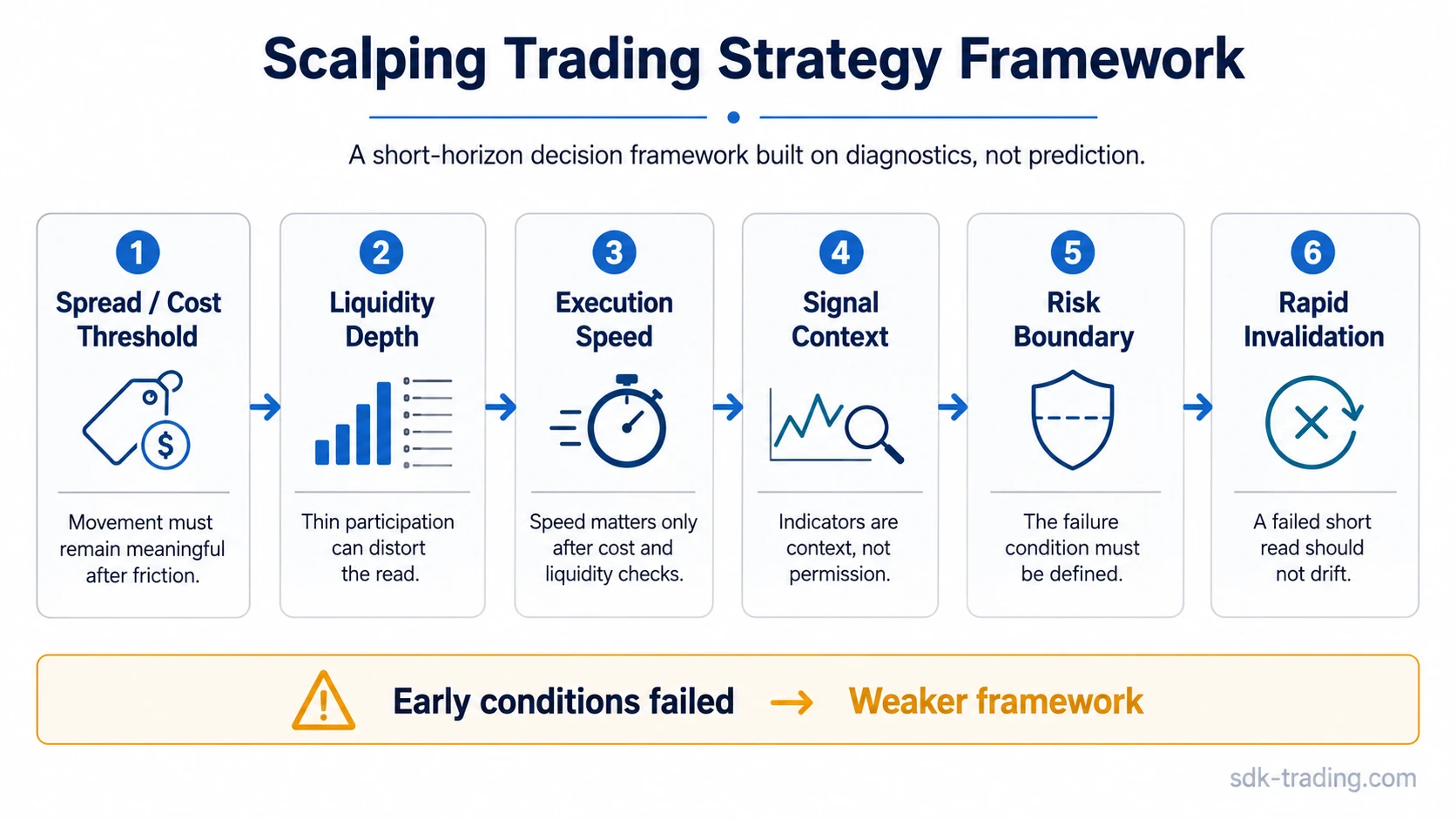
Scalping trading strategy is a short-horizon framework built around very small tradable movements. Because the holding window is compressed, the key question is not only whether price moved, but whether enough executable movement remains after spread, cost, liquidity friction, and rapid reassessment.
That is what makes scalping structurally different from simply reacting quickly. On very short horizons, a visible chart move and a usable move can be two different things.
Definition: A scalping trading strategy is a very short-term trading framework for interpreting brief price movement while controlling spread, liquidity, execution quality, risk boundaries, and rapid invalidation.
How a Scalping Trading Strategy Works
- Scalping focuses on very short holding windows and small price movements.
- Execution friction matters more because the intended move is small.
- A chart setup can look clean while executable conditions make it much weaker.
- Risk boundaries have to be defined quickly because the framework decays fast.
- Speed helps only after spread, liquidity, and execution conditions are acceptable.
What Is a Scalping Trading Strategy?
A scalping trading strategy is a trading framework designed for very brief market movement. The trader is not waiting for a broad multi-session development. The idea is reviewed over a much shorter horizon, so small changes in execution conditions can have an outsized effect on the result.
That short horizon changes the entire structure of the decision. When the expected movement is small, cost and execution quality stop being secondary details. They become part of the core logic of the strategy.
This is why scalping should not be reduced to speed alone. Fast reaction matters, but only after the market offers enough liquidity, enough executable room, and a clear enough failure condition for the short-horizon read to remain coherent.
Why Scalping Starts With Executable Movement
On a longer trading horizon, the market may move far enough that moderate execution friction does not dominate the whole idea. In scalping, the intended move is smaller, so the relationship changes. A visible movement on the chart may not translate into an equally usable movement once spread, fill quality, and exit friction are included.
That distinction is important. Scalping does not begin with the question, “Did price move?” It begins with the question, “How much of that move remains tradable after execution friction?”
A setup may therefore look attractive on the chart and still be structurally weak for a scalping framework. The chart can show movement, while the executable version of that same movement offers much less usable room.
Scalping Execution Distortion
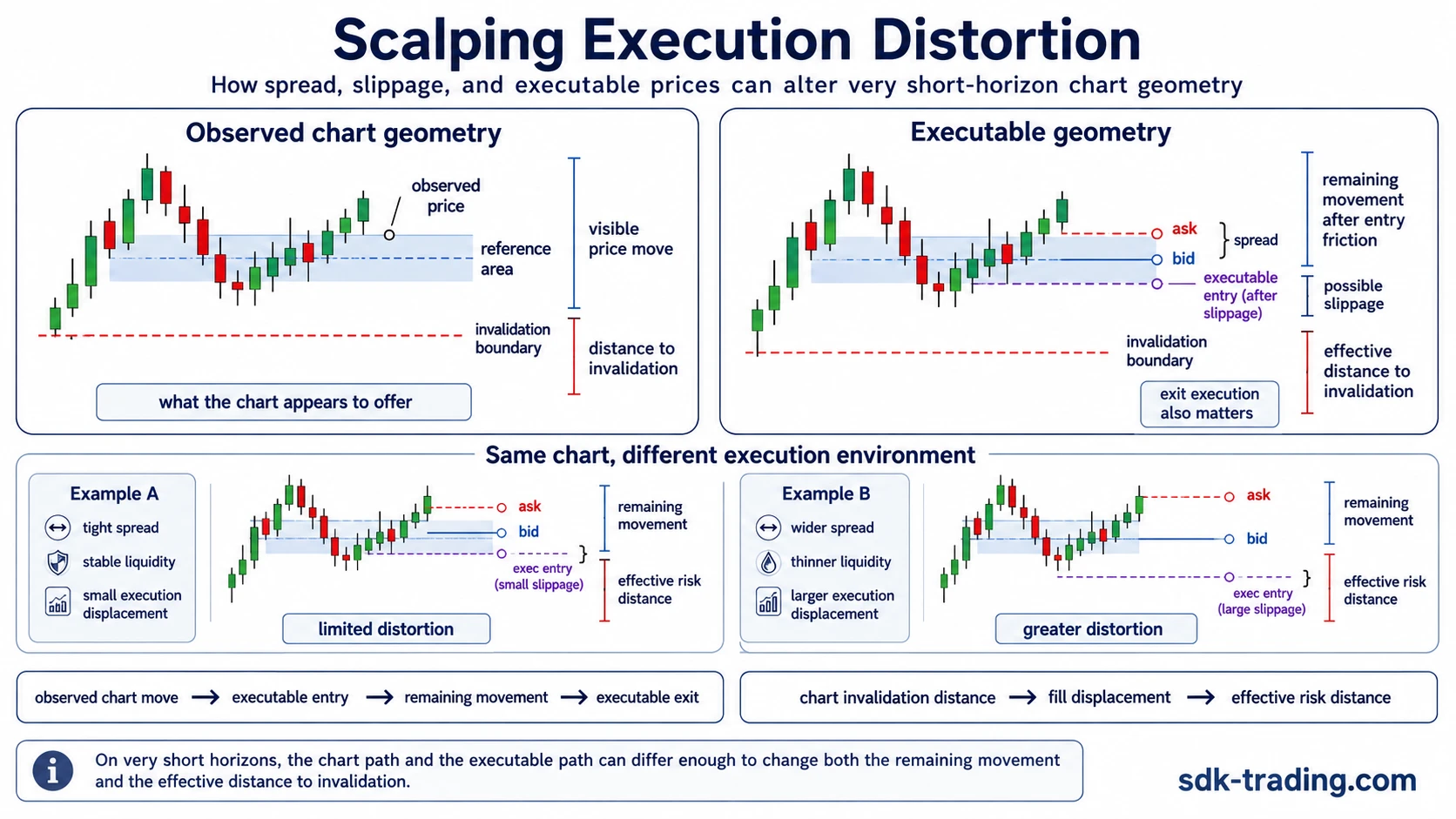
A practical way to read a scalping setup is to separate observed chart geometry from executable geometry. The chart shows the movement as it appears visually. Execution conditions determine how that movement is actually experienced when a position is opened and later closed.
| Layer | What is being observed | Why it matters in scalping |
|---|---|---|
| Observed chart geometry | The visible move, the nearby price structure, and the apparent distance to the failure area. | This is what the trader sees first, but it is not yet the full execution picture. |
| Executable entry | The actual fill can begin away from the visually observed reference because of spread and slippage. | The usable part of the move can shrink immediately once execution begins. |
| Effective risk distance | The real distance to invalidation changes once entry displacement is included. | The setup may carry more practical exposure than the chart seemed to show. |
| Executable exit | The final result depends on how the position is later closed, not only on the initial chart move. | Exit friction can further reduce the usable outcome of a small move. |
The same visible setup can therefore have very different practical quality under different spread and liquidity conditions. That is one of the main reasons scalping is so sensitive to execution environment.
Spread, Cost, and Liquidity Come First
In a scalping framework, spread and direct trading cost come before any confidence in the setup. That is not because the setup is unimportant. It is because a very small target zone can be damaged quickly when the market itself is costly to access.
Liquidity matters for the same reason. A chart may appear orderly, but thin liquidity can produce unstable quotes, irregular fills, and abrupt short-horizon price movement. These distortions matter more when the idea depends on a small movement being interpreted and acted on quickly.
A clean chart in a poor execution environment is still a weak scalping environment. The underlying question is not how attractive the pattern looks in isolation, but whether the market conditions allow that pattern to be used coherently on a short horizon.
Execution Speed Matters Only After Friction Is Acceptable
Execution speed still matters in scalping because the review window is short. A delayed fill or delayed reaction can change the setup materially by the time the trade is being executed.
But speed does not repair structural friction. If the spread is already wide or the market is too thin, faster interaction with that same environment does not solve the underlying problem. It only accelerates participation in a weak setup.
That is why speed belongs later in the framework. First the market has to offer sufficiently stable conditions. Only then does the question of quick execution become truly relevant.
Signal Context Still Matters, but It Comes Later
Indicators, patterns, and short-horizon price behavior can help organize the read, but they operate downstream from execution conditions. A scalping framework becomes less reliable when the signal is treated as the permission by itself.
A momentum shift, a local breakout, or a short-term pattern can all look meaningful on the chart. The real question is whether the movement remains structurally usable after spread, cost, fill quality, and the short invalidation window are taken into account.
In other words, a signal may explain why the trader is paying attention. It does not remove the need to judge whether the setup is executable on the terms required by scalping.
Risk Boundary and Rapid Invalidation
Scalping also requires a clearly defined failure condition because the strategy depends on a compressed review horizon. If that failure condition is vague or slow to evaluate, the framework stops behaving like scalping and starts drifting into unmanaged exposure.
This is where Position sizing becomes important. Size has to match the fact that the strategy is reacting to small movements and tight reassessment windows. Oversized exposure makes the framework more fragile because a short-horizon read has less room to absorb error.
A stop-loss reference belongs here as the practical expression of a failure boundary. A take-profit reference can also help define when enough of the move has been captured, but target logic does not rescue a setup whose execution conditions were weak from the start.
Simple Example of Execution Distortion
Suppose a chart shows a brief move away from a local intraday level. Visually, the move appears to offer enough room for a short-horizon trade.
Now add spread, possible entry displacement, and exit friction. The usable room can become noticeably smaller than the chart first suggested. At the same time, the practical distance back to the failure area may be less favorable than it looked before execution conditions were considered.
The chart has not changed. What changed is the executable geometry of the idea. That is the central distortion a scalping strategy has to control.
How Scalping Differs From Other Trading Styles
Scalping differs from broader day trading because it compresses the holding window further and gives execution friction a larger relative role. The movement being interpreted is usually smaller, so the framework becomes more sensitive to spread, liquidity, and fast invalidation.
It also differs from longer holding-window styles such as swing trading because those styles usually allow more time for the idea to develop and for broader structure to matter. Scalping places much more pressure on immediate market conditions and fast reassessment.
That is why scalping is not just a faster version of every other strategy. The logic changes because the executable margin for error is smaller.
When a Scalping Framework Breaks Down
A scalping framework breaks down when short-horizon execution conditions stop supporting the setup. The chart may still show movement, but the practical structure can weaken quickly.
Common breakdown conditions
- Spread too wide: too much of the movement is lost before the setup becomes usable.
- Liquidity too thin: unstable quotes and erratic fills distort the read.
- Execution displacement too large: the observed setup and the actual fill diverge too much.
- Volatility too erratic: the short-horizon move becomes harder to interpret cleanly.
- Signal context too weak: the setup depends on a brief flicker rather than a coherent short-horizon structure.
- Invalidation too slow: the trade stops behaving like a true scalp.
The framework is most fragile when several of these conditions appear together. A setup can fail not because the chart was unreadable, but because the executable version of the setup was much weaker than the chart suggested.
FAQ
What is a scalping trading strategy?
A scalping trading strategy is a short-horizon framework for interpreting very brief market movement. It depends on spread control, liquidity, execution quality, risk boundaries, and rapid invalidation.
How does a scalping strategy work?
Scalping trading works by compressing the holding window and reviewing small price movements quickly. The framework becomes weaker when costs, spread, slippage, or thin liquidity dominate the move being interpreted.
Is scalping good for beginners?
Scalping is usually difficult for beginners because the holding window is short and small errors in cost, execution, or invalidation can matter quickly. It requires strong process control and risk awareness.
Is scalping automatically profitable?
No. Scalping cannot be judged from the strategy label alone. Costs, liquidity, execution quality, risk control, discipline, and market conditions can all change the outcome.
How is scalping different from day trading?
Scalping is usually more compressed than broader day trading. Day trading can cover wider intraday movement, while scalping focuses on very brief moves where spread, cost, and execution quality have a larger impact.
Which conditions make a scalping strategy weaker?
A scalping strategy becomes weaker when spreads are wide, liquidity is thin, slippage is large, volatility is erratic, signal context is weak, or invalidation is delayed.