A rounding bottom is a U-shaped or saucer-like reversal chart pattern that develops after a decline as selling pressure slows, price forms a broad base, and the right side gradually recovers.
The rounded shape alone does not complete the reading. A stronger rounding bottom needs right-side development, a clear upper boundary, and later acceptance above that boundary rather than an immediate failure back into the base.
Definition: A rounding bottom is a gradual bottoming structure in technical analysis where price shifts from decline, to stabilization, to recovery in a curved formation. It is also called a saucer bottom when the base is especially broad and smooth.
Key Points
- A rounding bottom is a gradual U-shaped reversal structure, not a sharp one-candle turn.
- The pattern usually begins after a decline and develops through slowing downside pressure, basing, and gradual recovery.
- Volume can support the interpretation, but volume alone does not complete the pattern.
- Upper-boundary acceptance makes the structure easier to classify as complete; failed acceptance weakens it.
- Similar reversal patterns need separate criteria because a rounded basin is different from two or three reaction lows.
What Is a Rounding Bottom?
A rounding bottom is a reversal chart pattern built around a slow transition from supply pressure to demand recovery. The left side reflects the prior decline, the middle reflects a broad basing area, and the right side reflects a gradual recovery toward the earlier reaction-high area.
The pattern is usually interpreted as a potential shift in market structure rather than proof that a new uptrend has started. The classification becomes more stable when the market stops accepting lower prices, recovers through the right side, and later holds above the upper boundary.
The term saucer bottom describes the same general idea when the base is wide and smooth. The useful distinction is structural: price does not reverse abruptly, and the bottoming process takes enough time to show a rounded transition.
How a Rounding Bottom Forms
A rounding bottom starts with a prior decline. Selling pressure may still be visible on the left side, but the rate of decline begins to slow. Instead of continuing lower in a straight move, price starts spending more time near the lower area.
The middle of the structure is the basin. Price may move sideways or drift gradually, but the important feature is a broad curve rather than a sharp spike. A clean basin suggests that the market is no longer moving lower with the same force, although that does not prove demand has taken control.
The right side develops when price recovers gradually from the basin and begins to approach the reaction-high area that capped the earlier structure. That upper area becomes the boundary between an incomplete rounded base and a more defensible reversal reading.
Diagnostic boundary: Curve shape starts the observation, but acceptance above the upper boundary completes the stronger reading. If price reaches the boundary and fails back into the base, the structure remains weak or unresolved.
How to Identify a Rounding Bottom
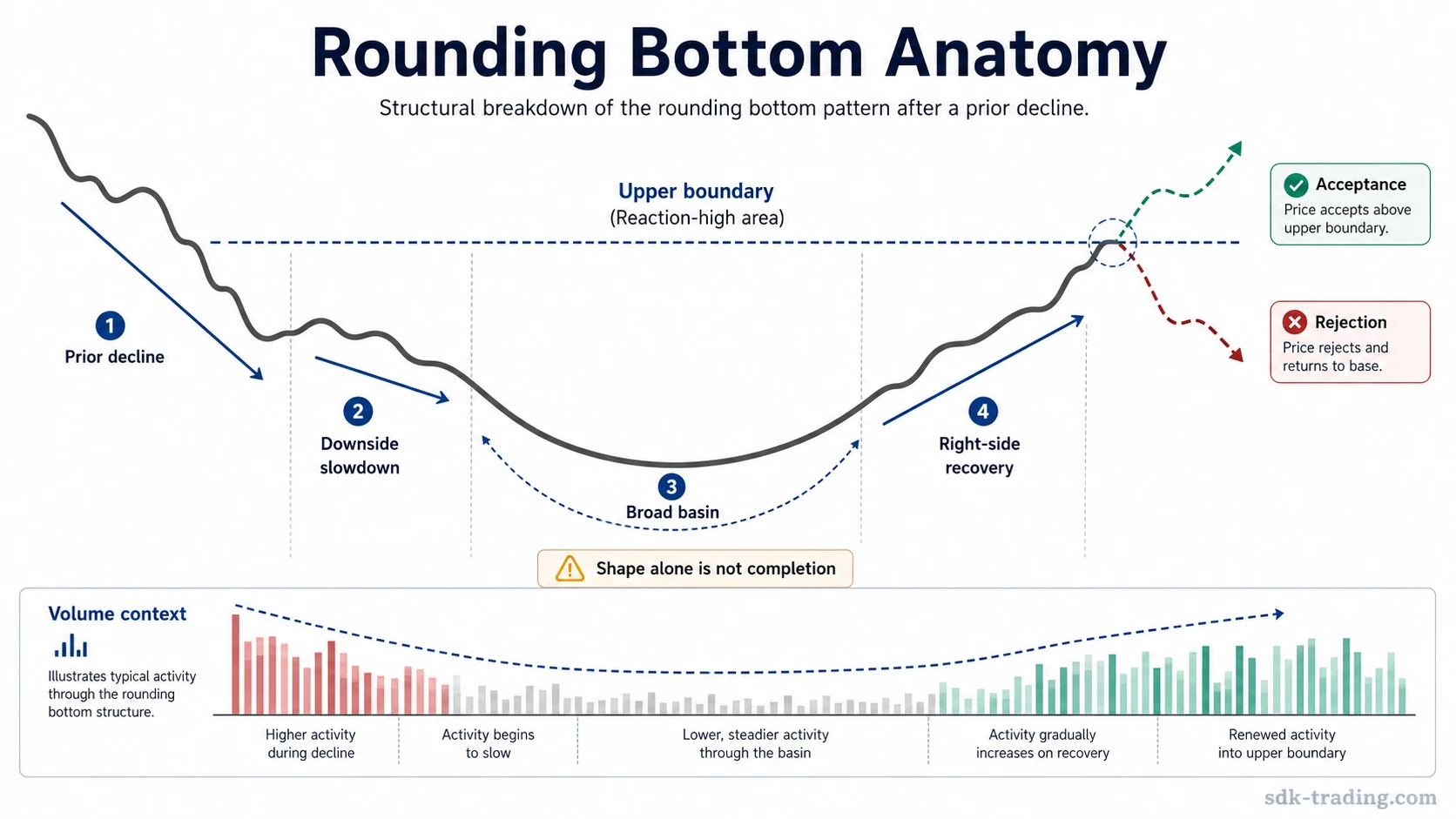
A rounding bottom is easier to identify when each part of the structure is visible. The pattern should not be reduced to any curved price path. The prior decline, broad basin, gradual right-side recovery, and upper boundary all matter.
| Feature | What to Look For | Why It Matters |
|---|---|---|
| Prior decline | Price moves lower before the base begins. | The pattern is a reversal structure, so it needs a prior move to reverse. |
| Downside slowdown | Lower movement becomes less forceful or less direct. | The left side should show pressure fading, not only a random pause. |
| Broad basin | Price spends time forming a curved lower area. | A rounded base separates the pattern from a sharp V-shaped rebound. |
| Right-side recovery | Price rises gradually from the basin toward the upper boundary. | The recovery side shows whether demand is returning with enough structure. |
| Upper boundary | Price tests the reaction-high or resistance area above the basin. | The boundary helps separate an incomplete base from a stronger reversal reading. |
| Volume behavior | Activity may fade near the base and expand during recovery. | Volume can support the reading, but it is not proof by itself. |
Volume in a Rounding Bottom
Volume often adds useful context to a rounding bottom. Selling activity can be heavier on the left side, quieter near the basin, and more active during the right-side recovery. That arc can support the idea that pressure is shifting, but it should not be treated as a standalone confirmation.
A quiet base without recovery may still be only a range. Rising volume during the right side is more useful when it appears alongside higher closes, improving structure, and acceptance above the upper boundary. If volume expands while price fails at the boundary, the result is less supportive because effort is not producing acceptance.
What Confirms or Weakens a Rounding Bottom?
A rounding bottom reading becomes more defensible when price completes the right side and accepts above the upper boundary. The word acceptance matters because a brief move above resistance can still fail if price quickly returns into the base.
The structure loses support when the market cannot hold the recovery, when the basin breaks down, or when the turn is too sharp to show a rounded transition. That distinction classifies chart structure rather than directing a trade.
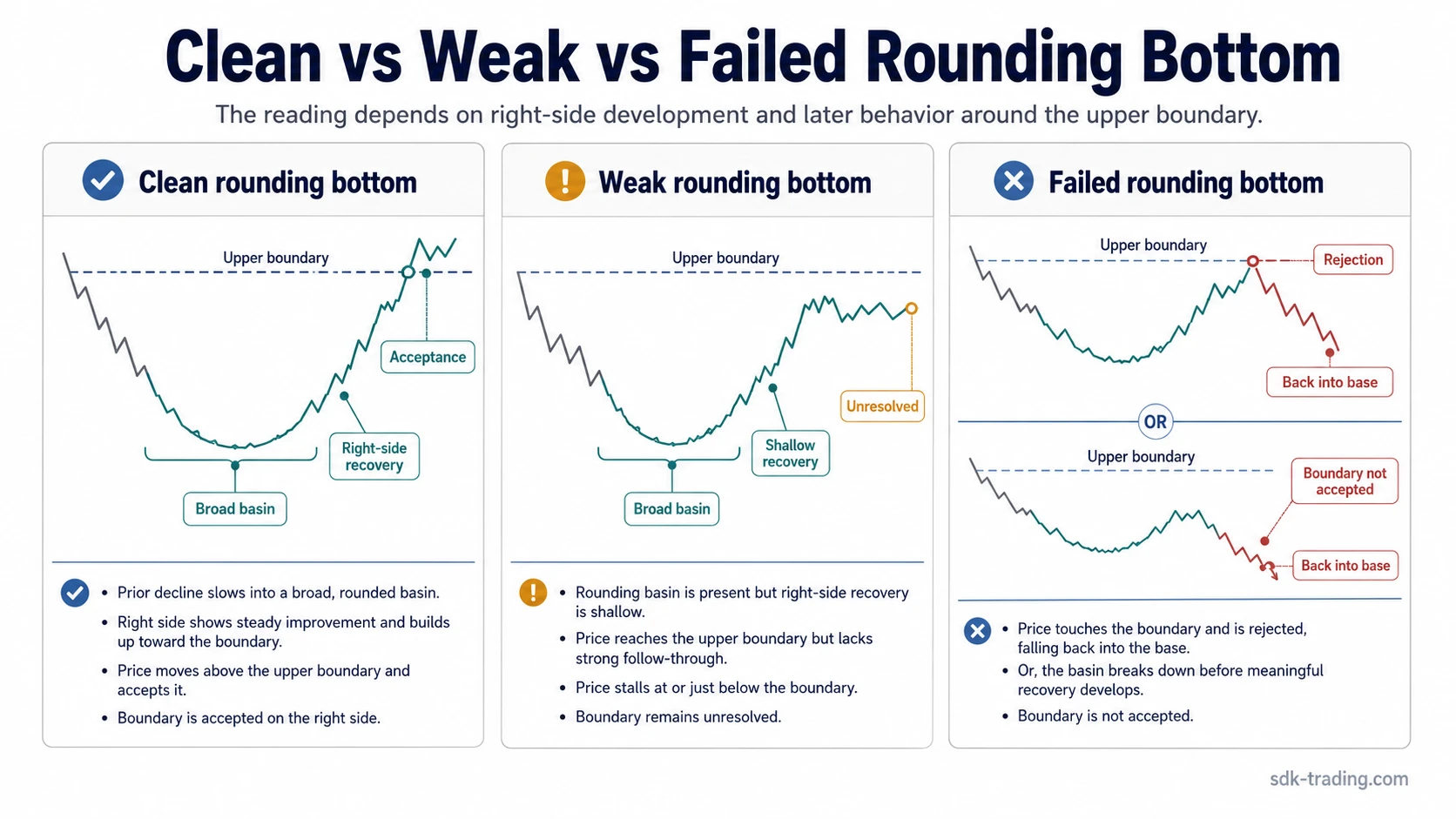
| Reading | Typical Behavior | Interpretation |
|---|---|---|
| Clean rounding bottom | Prior decline slows, a broad basin forms, the right side recovers, and price accepts above the upper boundary. | The reversal reading is more defensible because the structure shows both recovery and acceptance. |
| Weak rounding bottom | The curve is visible, but the right side is shallow, volume is unclear, or price stalls below the upper boundary. | The pattern remains incomplete because the market has not shown enough acceptance. |
| Failed rounding bottom | Price reaches the upper boundary and falls back into the base, or the basin breaks down before recovery develops. | The rounded-base idea loses strength because the market has rejected the recovery path. |
Rounding Bottom Example in Context
Price declines for an extended period, but each push lower becomes less direct. The market then spends time near the lower area, with candles overlapping rather than extending the decline. The first recovery attempt approaches a prior reaction-high area but does not yet prove a reversal.
The stronger case develops only if price builds the right side and accepts above that upper boundary. If price rejects the boundary and falls back into the basin, the same rounded shape remains unresolved. If the recovery is immediate and vertical, the structure fits a V-shaped rebound more than a rounding bottom.
Rounding Bottom vs Similar Reversal Patterns
A rounding bottom is defined by a gradual curved basin. A double bottom uses two separate reaction lows rather than one broad rounded base.
The opposite rounded top structure develops after an advance and reflects a gradual transition from demand strength toward supply pressure, so it is the directional counterpart rather than a variation of the same bottoming formation.
A triple bottom depends on three reaction lows near a similar area. A rounding bottom does not need three clear troughs; it needs a smoother basing arc, a right-side recovery, and an upper boundary that can be accepted or rejected.
| Pattern | Main Structure | Common Confusion |
|---|---|---|
| Rounding bottom | Gradual U-shaped basin after a decline. | Any curved recovery is treated as complete before the upper boundary is accepted. |
| V-bottom | Sharp decline followed by sharp recovery. | A fast reversal is mistaken for a rounded base. |
| Double bottom | Two reaction lows near a similar area. | Two clear troughs are forced into a saucer-bottom reading. |
| Triple bottom | Three reaction lows near a similar area. | Repeated tests are confused with a smooth accumulation arc. |
| Rounding top | Gradual inverted U-shaped structure after an advance. | The opposite directional structure is treated as the same pattern. |
Common Mistakes When Reading a Rounding Bottom
A common mistake is labeling the curve before the right side develops. A lower area can look rounded while the market is still building a range or preparing for another breakdown.
Another mistake is treating the first move above the upper boundary as proof. A brief move can fail if price returns into the base and cannot hold acceptance. The better classification question is whether the market accepts the recovered area or rejects it.
Volume can also be overread. Rising volume during recovery is more useful when price also improves structurally. If volume expands without acceptance, the reading remains uncertain.
The sharpness of the turn matters. A fast V-shaped rebound may be meaningful, but it is not the same structure as a rounding bottom. The rounded pattern depends on gradual transition, time spent near the basin, and a right side that develops before the boundary test.
Limitation: A rounding bottom is a classification of chart structure, not a forecast. Failed acceptance, weak right-side recovery, or basin breakdown can change the interpretation.
FAQ
What does a rounding bottom mean in trading?
A rounding bottom means price has formed a gradual U-shaped base after a decline. It can suggest a potential shift from selling pressure toward recovery, but the reading is stronger only when the right side develops and the upper boundary is accepted.
Is a rounding bottom the same as a saucer bottom?
Rounding bottom and saucer bottom usually describe the same type of gradual bottoming structure. Saucer bottom often emphasizes a wider and smoother base.
How is a rounding bottom confirmed?
A rounding bottom is more defensible when price completes the right side and accepts above the upper boundary or reaction-high area. A brief move above that area is weaker if price quickly falls back into the base.
What makes a rounding bottom fail?
The reading weakens if price breaks down through the basin, fails to develop the right side, or rejects the upper boundary after a short-lived recovery attempt.
Why is volume important in a rounding bottom?
Volume can support the reading when activity fades near the base and expands during recovery. It should still be read with price structure because volume alone does not complete the pattern.