A rounding top is a broad topping structure that develops gradually after an advance as upward progress slows and the right side begins to roll over. The rounded shape alone leaves the classification provisional; lower-boundary behavior helps show whether the transition is actually developing.
Definition: A rounding top is a reversal chart pattern with an inverted-U or dome-like transition in which an earlier advance loses slope, becomes more overlapping, and begins moving back toward a lower structural boundary.
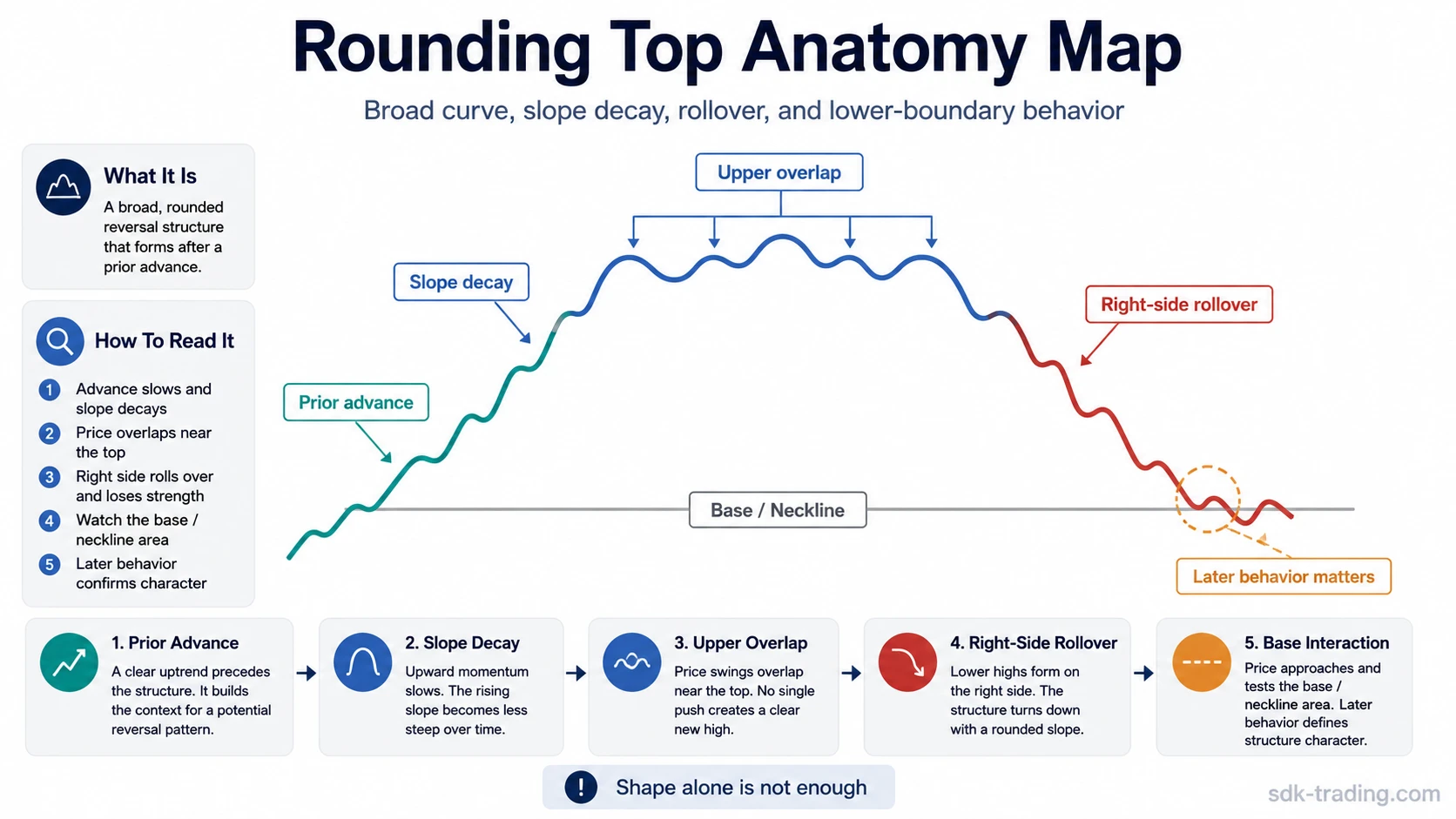
Interpretation boundary: the curve starts the classification, but it does not complete it. The reading remains provisional until the right-side rollover and lower-boundary response support the same structural transition.
How a Rounding Top Develops
The pattern begins with a visible advance. That prior move matters because a rounded structure without something meaningful to reverse can simply be a range, consolidation, or irregular sideways movement.
As the top develops, the character of the advance changes. Higher prices become harder to extend, the slope becomes flatter, and price begins spending more time overlapping around the upper portion of the structure.
The right side then becomes important. A rounding top is more than a market that stops rising. Price needs to begin moving away from the upper curve in a way that shows the earlier upward progression is no longer being maintained.
The mechanism develops through the transition from persistent upward progress into slope decay, overlap, rollover, and a later test of the lower structure.
Why the Lower Boundary Matters
The lower part of the formation can be described as a base, support area, or neckline. Its function is structural: it provides a reference for judging whether the rollover is beginning to change the larger pattern or whether price is still contained inside the rounded structure.
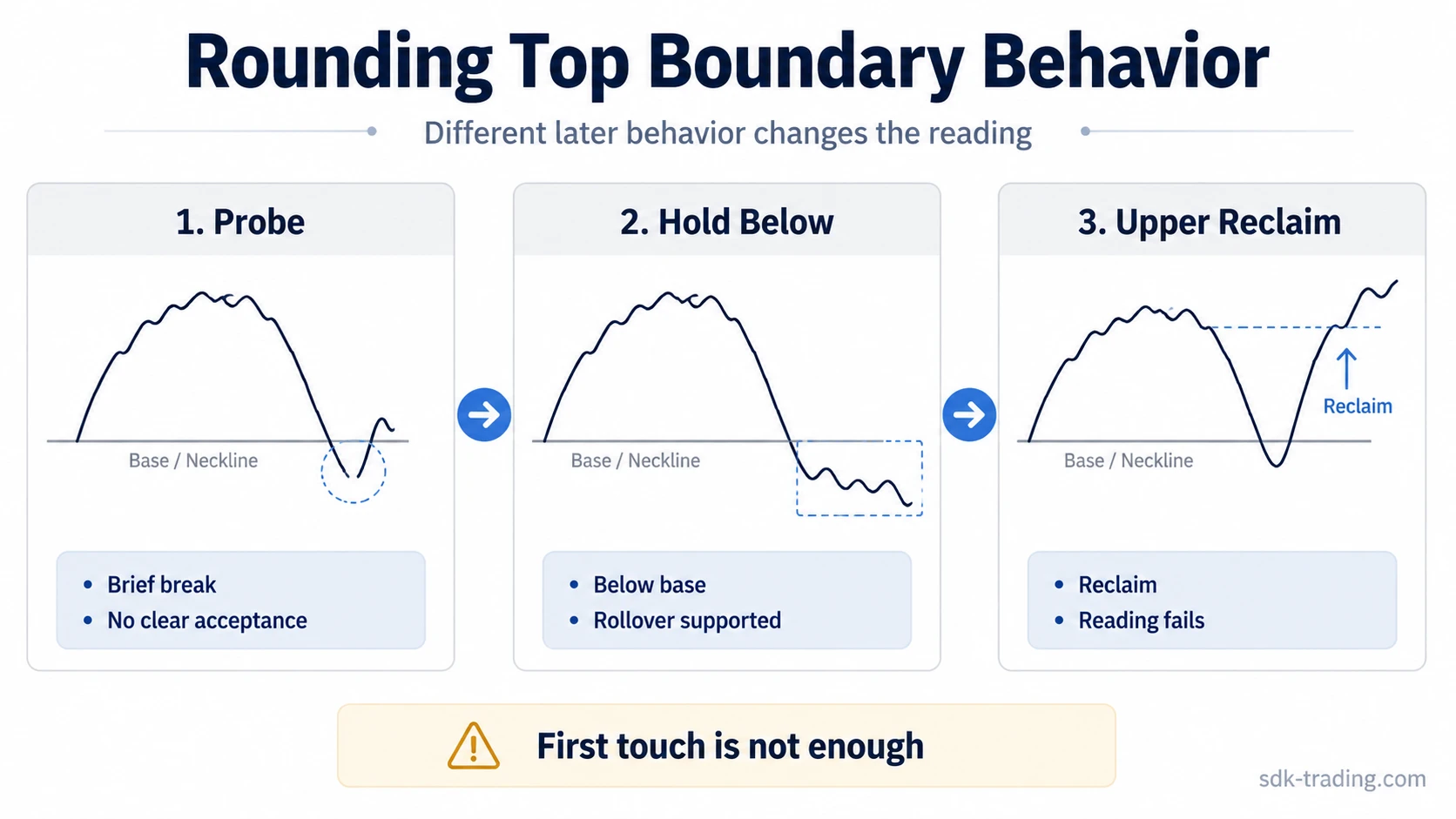
A first probe below that area does not settle the classification. Price can move below the boundary briefly and then recover into the formation.
A more developed reading appears when price moves through the lower area and remains below it rather than immediately reclaiming the structure. The opposite case is equally important: a quick recovery back into the range weakens the idea that the rollover has produced a lasting structural transition.
When the Rounding Top Reading Is Stronger, Unresolved, or Invalid
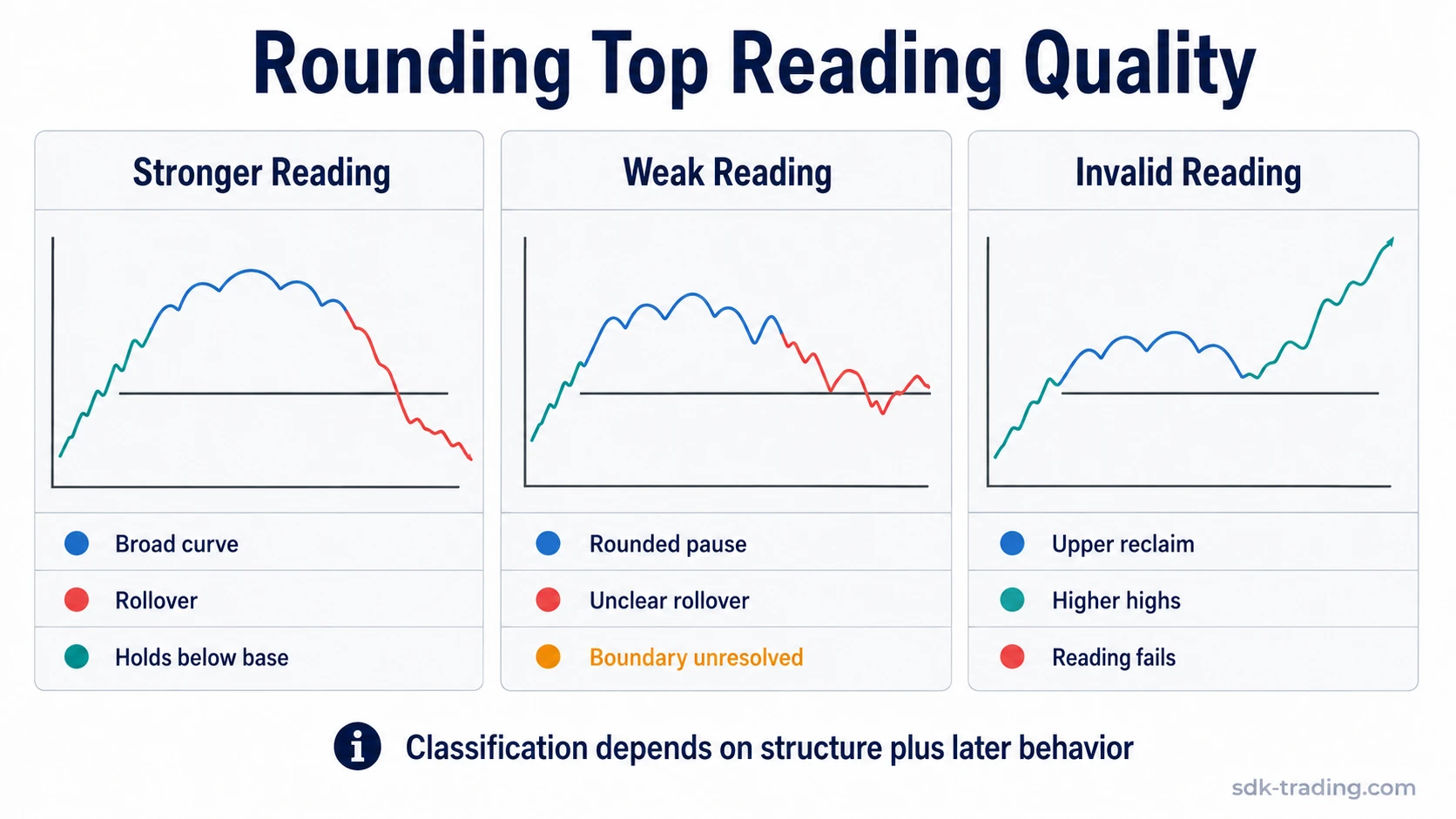
A cleaner rounding top has several elements working together: a prior advance, visible slope decay, a broad upper transition, a developed right-side rollover, and a lower-boundary response that does not immediately restore the earlier structure.
The reading remains unresolved when price has curved and slowed but still moves through the middle of the formation without a convincing rollover or lower-boundary resolution. In that state, the chart may still be consolidating rather than reversing.
The topping interpretation becomes difficult to defend when price recovers the upper structure and resumes clean higher highs. At that point, the market is no longer behaving like the gradual transition that defined the original reading.
Rounding Top vs Nearby Reversal Patterns
A rounding top is distinguished by continuous curvature and gradual loss of upward progress. A double top is built around two more distinct upper tests rather than one broad dome-like transition.
A rounding bottom uses a similar gradual transition in the opposite direction. Instead of upside progress fading after an advance, the structure develops through a basing process where downside pressure gradually weakens.
A triple top depends on three distinguishable tests near a similar upper area. A rounding top depends less on the number of peaks and more on the broader change in slope and the development of the right-side rollover.
Short Rounding Top Example
Suppose price has been advancing steadily, but each new push begins covering less distance. The upper portion of the chart becomes broader and more overlapping, then price starts drifting away from the top toward a visible lower boundary.
The rounded curve alone still leaves two interpretations open. The market may be completing a topping transition, or it may simply be moving through a broad consolidation.
If price tests the lower boundary, briefly trades below it, and immediately recovers, the rounding top remains a weaker reading. If price rolls over, loses the boundary, and later remains below the former base, the structure has more evidence supporting the topping interpretation.
What Can Weaken or Invalidate the Pattern
The structure weakens when the apparent curve depends on selective boundary drawing, when the prior advance was not clear enough to provide reversal context, or when the right side never develops a meaningful rollover.
A break below the lower boundary can also be misleading when price quickly returns above it. That behavior shows that the lower area was tested, but it does not establish sustained acceptance below the formation.
The clearest invalidation is a return to clean upward progression. If price reclaims the upper portion of the structure and begins extending through new highs, the rounded topping interpretation has lost the mechanism that originally supported it.
Volume Is Supporting Context
Volume can add information to a rounding top, but it is not required to define the pattern. Some examples show declining participation near the upper curve and stronger activity during the rollover. Others do not produce such a clean sequence.
The price structure should therefore carry the primary classification. Volume is most useful when it reinforces what the advance, curve, rollover, and lower-boundary behavior are already showing.
Limits of the Rounding Top Pattern
Rounding tops develop slowly and can remain ambiguous for a long time. Partial curves are common, and a chart can look persuasive before either recovering into the prior trend or expanding into a wider range.
The pattern should therefore be treated as a structural transition rather than a prediction. It can describe a gradual loss of upward control, but it does not determine the size, speed, or certainty of any later move.