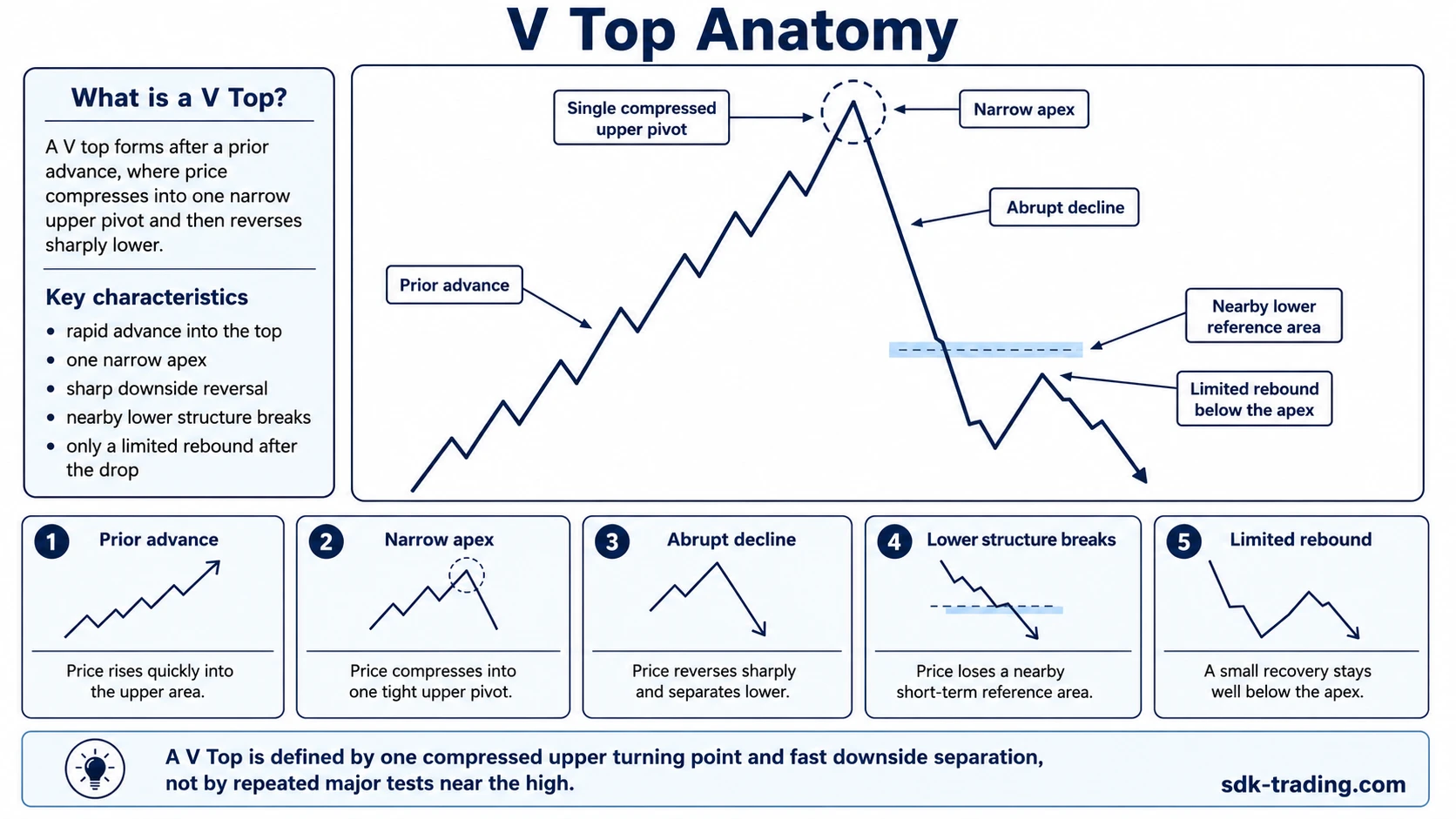
A V top pattern is a sharp reversal structure where a fast advance reaches a narrow apex and then turns down quickly. The main reading question is not whether price made a high, but whether the market spent very little time near that high before downside pressure took over.
Definition: A V top pattern is a reversal chart pattern built around one compressed upper pivot, a rapid loss of upside progress, and a fast downside move away from the high. It becomes easier to classify when the apex stays narrow and later price does not rebuild acceptance near the top.
Key Points
- A V top pattern depends on one narrow apex rather than repeated resistance tests.
- The sharp transition from advance to decline matters more than the shape alone.
- A cleaner reading usually spends little time near the high before downside separation begins.
- The pattern becomes weaker when the apex broadens, retests multiply, or price rebuilds acceptance near the top.
What Is a V Top Pattern?
A V top pattern describes a fast reversal after an advance. Price pushes up quickly, reaches a tight upper turning area, and then drops with little hesitation. The pattern is called a V top because the transition from the rise to the decline can look sharp and compressed.
The key classification issue is not the letter shape by itself. A useful reading also asks how much time price spent near the high, whether the upper pivot stayed narrow, and whether the decline separated cleanly from that area.
How to Identify a V Top Pattern
Start with the prior advance. Then check whether the upper turning area forms one narrow apex rather than a broad topping zone. After that, look at the first decline. A cleaner V top usually shows fast downside movement and limited retesting near the high.
If the upper area becomes wide, overlapping, or repeatedly retested, the structure becomes harder to classify as a V top. In those cases the pattern may belong to another reversal family or may still be unresolved.
Identification check: Prior advance, one compressed apex, fast downside separation, and limited rebuilding near the high.
Stronger, Weak, and Invalid V Top Readings
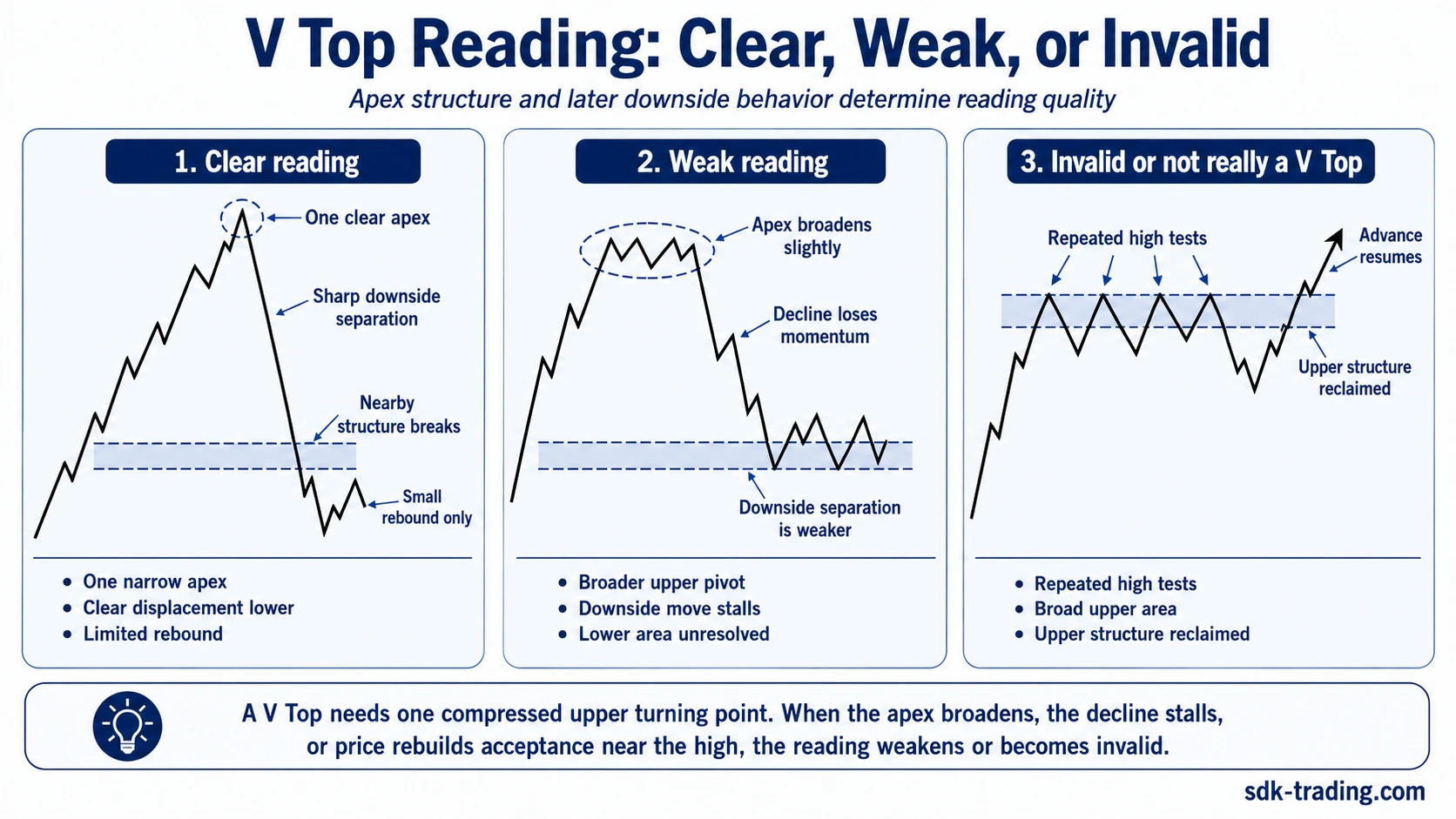
A stronger reading usually has one clean apex and a quick downside move that removes nearby short-term structure. The market does not spend much time rebuilding near the top, so the reversal remains compact and clear.
A weak reading often keeps some V-top features but loses structural clarity. The apex may widen, the decline may stall, or price may retest the upper area too often. That does not always invalidate the idea immediately, but it makes the classification less clean.
An invalid reading appears when price rebuilds acceptance near the high or continues upward in a way that destroys the fast-reversal structure. At that point the original V-top label stops being the best description.
V Top vs Nearby Reversal Patterns
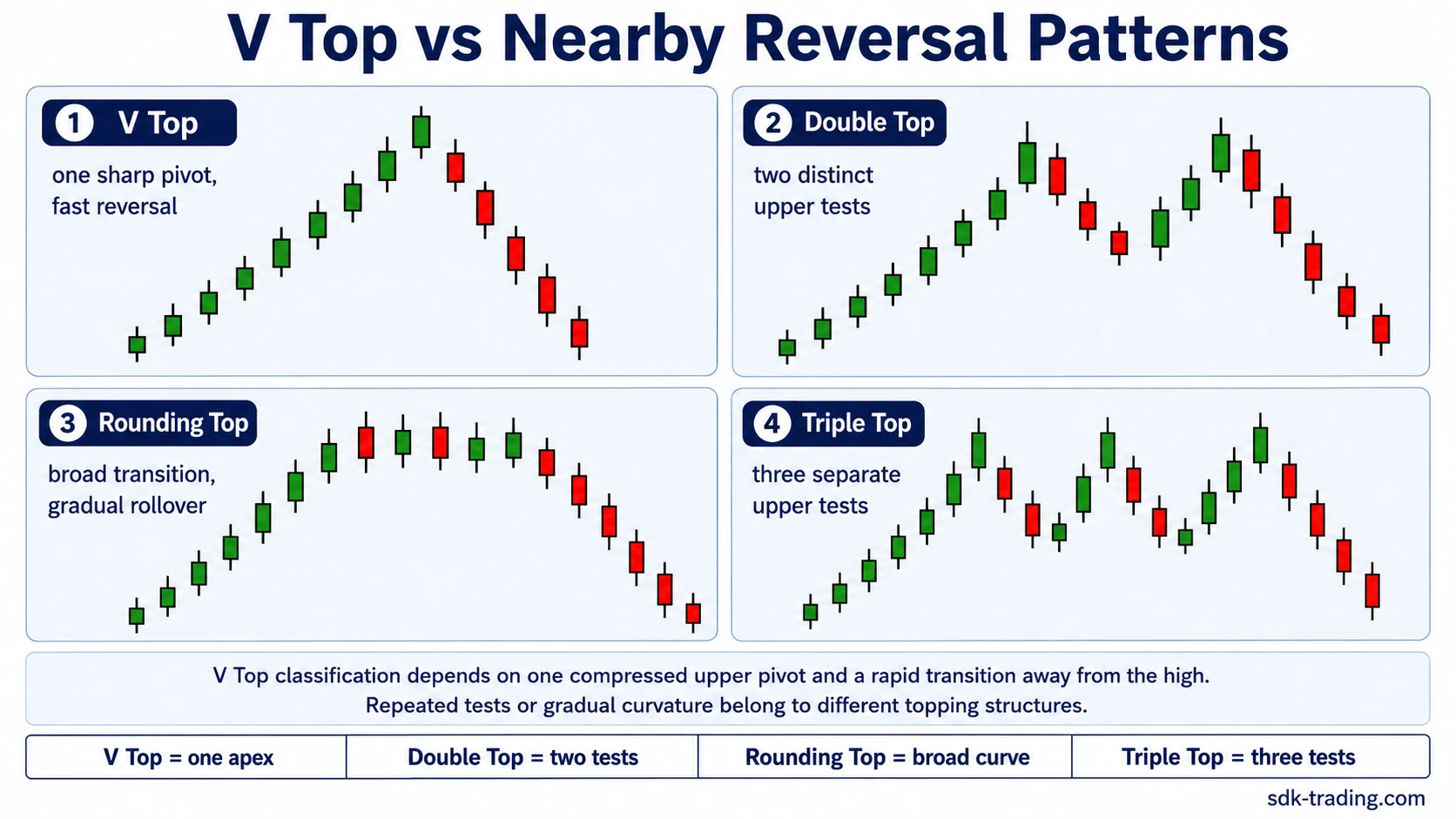
V tops are easiest to read when they are separated from similar reversal structures. If the upper area shows two distinct tests, the chart may fit a double top better. If the turn develops through a broad curved rollover, rounding top is usually the better classification. If price tests the upper area three times, the structure is closer to a triple top.
| Pattern | Upper-area structure | Main distinction |
|---|---|---|
| V top | One narrow apex | Fast reversal with very little time spent near the high. |
| Double top | Two distinct upper tests | Repeated resistance matters more than a single compressed pivot. |
| Rounding top | Broad curved rollover | The transition is gradual rather than abrupt. |
| Triple top | Three separate upper tests | The structure depends on repeated failures near resistance. |
Why V Top Readings Become Difficult
A V top becomes harder to classify when traders focus only on the first drop and ignore the structure around the high. A fast decline alone is not enough if the market first spent too much time building a broad top or if the upper area contains several separate tests.
Limitation: A V top is a structural reading, not a predictive guarantee. Even a sharp reversal shape still needs context, nearby structure review, and later behavior to confirm that the upper area is not being rebuilt.
The safest approach is to keep the pattern narrow. One apex, quick downside separation, and limited recovery near the high make the reading cleaner. Broader or more repetitive topping behavior usually belongs to another category.
FAQ
What is a V top pattern in trading?
A V top pattern is a reversal chart pattern where a fast advance forms one narrow upper pivot and then turns into a fast decline. The pattern depends on compression, rejection near the high, and downside displacement.
How do you identify a V top pattern?
Look for a prior advance, a narrow apex, a fast decline from the high, limited retesting, and a move that removes nearby short-term structure. The shape alone is not enough.
When is a V top reading weak?
A V top reading is weak when the apex broadens, the decline stalls, price repeatedly retests the high, or the market starts rebuilding acceptance near the upper area.
Is a V top the same as a double top?
No. A V top is built around one compressed upper pivot, while a double top depends on two major tests of a similar resistance area.