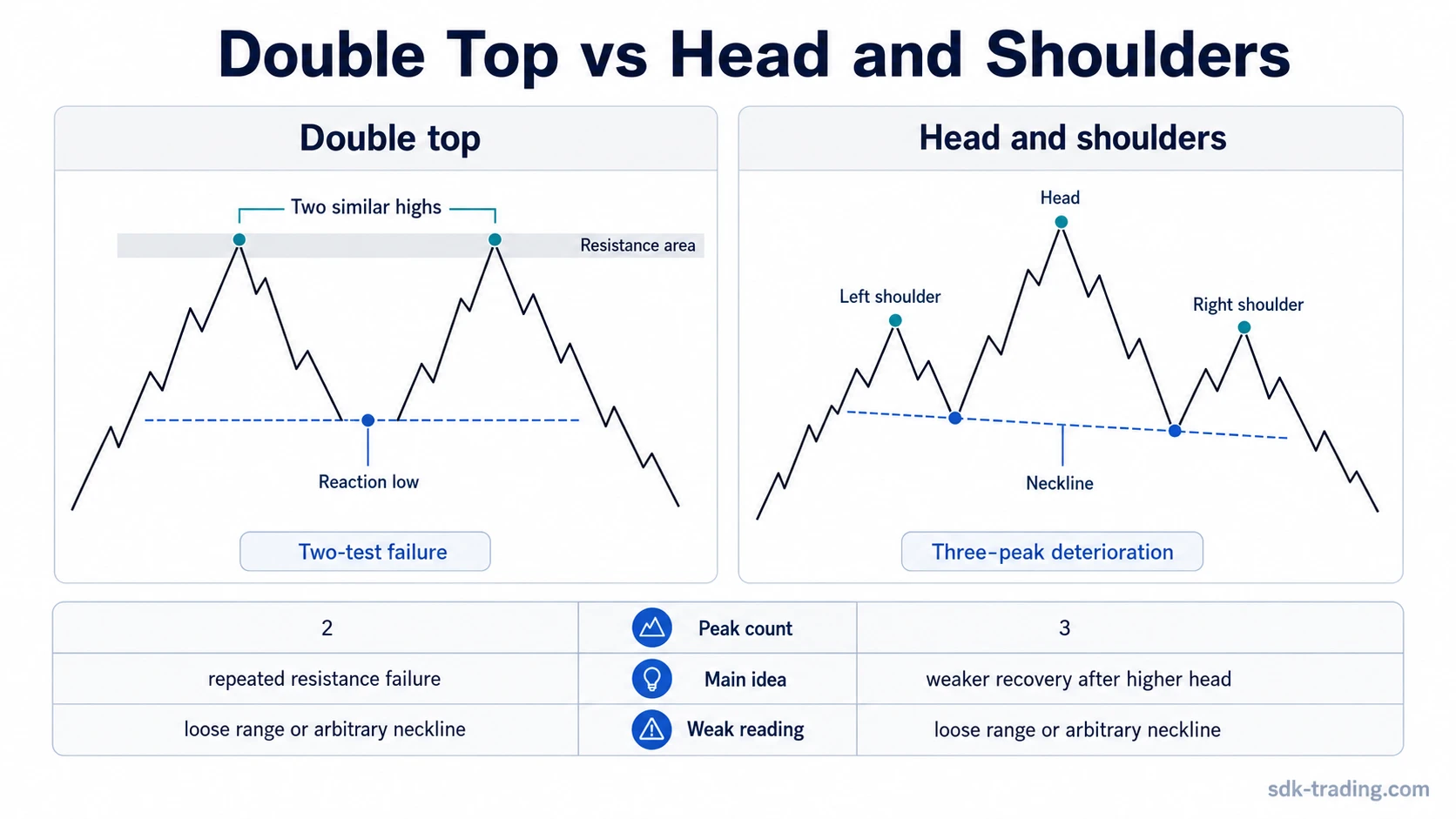
Double top vs head and shoulders is a comparison between two bearish reversal chart patterns that can form near an upper resistance area. A double top is a two-test resistance failure around comparable highs. A head and shoulders pattern is a three-peak deterioration sequence with a higher middle peak and a right shoulder that fails below the head.
Both patterns can appear after an advance, and both can involve a neckline or reaction-low reference. The distinction is structural. A double top asks whether the market rejected a similar upper area twice. A head and shoulders reading asks whether the market built a left shoulder, pushed to a higher head, then failed to recover that same strength on the right shoulder.
Core distinction: double top vs head and shoulders separates repeated resistance failure from three-peak deterioration. The first reading depends on two comparable highs; the second depends on a shoulder-head-shoulder hierarchy with a weaker right shoulder.
Key Distinctions
- A double top uses two comparable highs; a head and shoulders pattern uses left shoulder, higher head, and right shoulder structure.
- A double top neckline usually comes from the intervening low; a head and shoulders neckline connects the reaction lows around the head.
- Premature labels remain weak when the third peak is missing, the neckline is unclear, or the market is still rotating inside a range.
Double Top vs Head and Shoulders: The Core Difference
The faster way to separate the two patterns is to look at hierarchy before naming the structure. If the upper area shows two similar tests into resistance with a meaningful reaction between them, a double top reading may be more defensible. If the upper area shows a left shoulder, a stronger push into a higher head, and a later right shoulder that cannot match the head, a head and shoulders reading may fit better.
The confusion usually appears when price makes two visible highs and then begins to build a third swing. At that stage, the chart may still be unresolved. The label should follow the structure rather than forcing the structure to fit the label.
Mechanism Comparison
The comparison is strongest when each pattern is judged by the way the structure is built, not by whether the chart simply looks bearish near the top of an advance.
| Criterion | Double Top | Head and Shoulders |
|---|---|---|
| Basic structure | Two major tests of a similar resistance area. | Three peaks: left shoulder, higher head, and right shoulder. |
| Peak hierarchy | The two highs are usually close enough to be treated as comparable tests. | The middle peak should stand out as the head, with the right shoulder failing below it. |
| Neckline reference | The key reference often comes from the low between the two highs. | The neckline connects the reaction lows around the head and may be horizontal or sloping. |
| Formation pacing | Usually simpler: first test, reaction, second test, then evaluation of acceptance or failure. | Usually more staged: shoulder, head, reaction, right shoulder, then evaluation of the neckline area. |
| What strengthens the label | The second high fails to gain acceptance above the first high and the intervening low becomes meaningful. | The right shoulder fails below the head and the reaction-low structure is clear enough to define a neckline. |
| What weakens the label | The highs are part of a loose range with no meaningful reaction low or rejection behavior. | The middle peak is not clearly higher, the right shoulder is missing, or the neckline is arbitrary. |
| Primary structural idea | Repeated resistance failure. | Progressive loss of upside strength across a three-peak sequence. |
How a Double Top Reading Forms
A double top reading starts with a prior advance into an upper area where price tests resistance, reacts lower, and later returns toward a similar high. Perfect equality between the highs matters less than failed acceptance beyond the first test and a meaningful reaction between the two highs.
The reading weakens when the two highs are only minor fluctuations inside a sideways range. It also weakens when the second high quickly turns into a broader multi-swing top with no clear two-test structure. In that case, the better classification may be unfinished rather than double top.
How a Head and Shoulders Reading Forms
A head and shoulders reading needs a three-part sequence. The left shoulder forms first, the head pushes to a higher high, and the right shoulder fails below the head. The right shoulder is the key deterioration point because it shows that the market could not repeat the strength of the middle peak.
The neckline should be drawn from reaction lows that belong to the structure. It does not need to be perfectly horizontal. A sloping neckline can still be valid when it connects meaningful reaction lows and does not distort the pattern. The reading becomes weaker when the neckline is drawn only to make the pattern look complete.
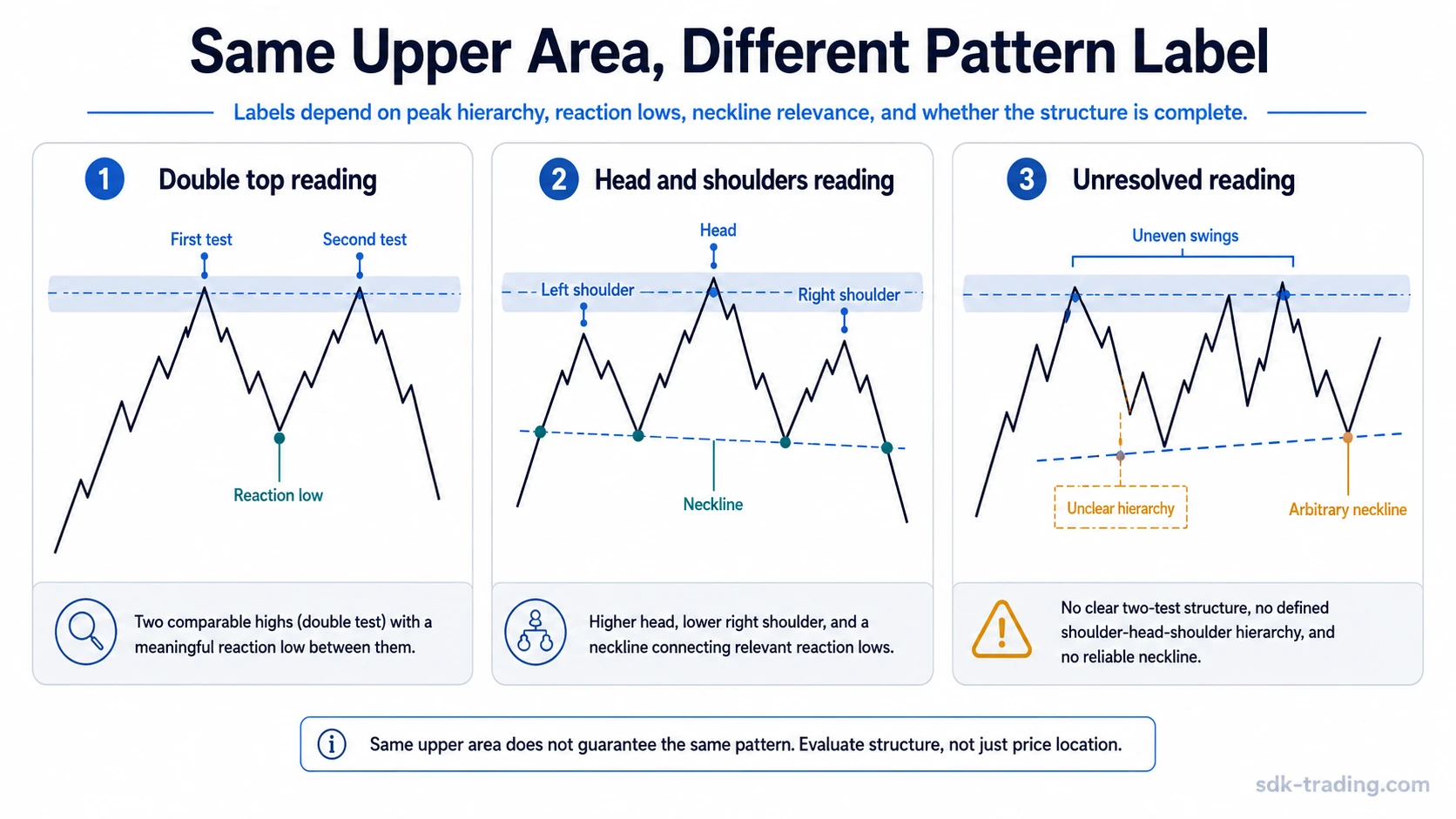
Same Chart Area, Different Label
Price advances into a prior resistance area, pulls back, and then returns toward the same upper zone. If the second test stalls near the first high and the market cannot hold above the tested area, the structure may support a double top reading.
The same upper zone can shift toward a head and shoulders reading if a later sequence adds a higher middle peak and then a weaker right shoulder. In that case, the focus changes from two similar resistance tests to a three-peak hierarchy. The middle peak becomes the head, and the right shoulder becomes the failed recovery attempt.
Same-scenario distinction: two similar highs near resistance can support a double top reading; a higher middle peak followed by a weaker right shoulder can support a head and shoulders reading; a loose range with uneven swings may leave both labels premature.
The unresolved case matters. A chart with one high, one pullback, and one lower recovery does not automatically create either pattern. A chart with several overlapping swings near resistance can remain a range until peak hierarchy, reaction lows, and later acceptance or rejection become clearer.
Clean, Weak, and Invalid Readings
Pattern labels are most useful when they describe reading quality: clean, weak, or premature.
| Reading | What the structure shows | Classification quality |
|---|---|---|
| Clean double top | Two comparable highs near resistance, a meaningful reaction low between them, and a second test that fails to hold above the upper area. | More defensible as repeated resistance failure. |
| Clean head and shoulders | Left shoulder, higher head, weaker right shoulder, and a neckline built from relevant reaction lows. | More defensible as three-peak deterioration. |
| Weak overlap | Two or three swings appear near the top, but peak hierarchy and reaction-low structure are unclear. | Possible, but not clean enough for a strong label. |
| Invalid or premature label | The structure is still a broad range, the third peak has not formed, or the neckline is drawn from unrelated lows. | Neither label is clean. |
Neckline and Structure Differences
In a double top, the neckline is usually tied to the low between the two highs. That low matters because it separates the first resistance test from the second resistance test. If price never creates a meaningful reaction between the highs, the structure may be too compressed or too range-like for a clean double top label.
In a head and shoulders pattern, the neckline is built from the reaction lows around the head. The line can slope upward or downward if it still connects the relevant lows. A neckline becomes less useful when it is forced through unrelated points or when the shoulders do not belong to the same deterioration sequence.
Neckline caution: the neckline is a structural reference, not a complete interpretation by itself. Peak hierarchy, reaction lows, and later behavior around the area all affect label quality.
Common Misreads
A common double top mistake is calling any two highs a pattern. Two highs matter more when they test a similar upper area, reject acceptance beyond it, and create a meaningful reaction low between the tests.
A common head and shoulders mistake is calling any three peaks the pattern. Three peaks are not enough unless the middle peak is the head and the right shoulder fails below it. Without that hierarchy, the structure may be a choppy range, a broad distribution area, or a different reversal structure.
Another mistake is treating an incomplete third peak as if the structure has already resolved. A possible right shoulder is still only a possible right shoulder until its relationship to the head, neckline, and surrounding structure becomes clearer.
Volume can support the classification when it aligns with weakening demand or failed acceptance, but it should not replace structure. A volume change near resistance does not decide the label unless the price structure also supports the reading.
Related Reversal Structures
Some reversal structures are confused because they all appear near exhaustion or failed continuation areas. A bump-and-run reversal uses a different mechanism: an accelerated trend boundary is lost after a steeper advance or decline. That is separate from both a two-test resistance failure and a shoulder-head-shoulder sequence.
Keeping the mechanism separate prevents one bearish label from absorbing every failed upper-area structure. Comparable highs, three-peak hierarchy, and acceleration failure are different structural ideas.
FAQ
Can a double top turn into a head and shoulders pattern?
A possible double top can later look more like a head and shoulders pattern if a higher middle peak and weaker right shoulder form. Until the three-peak hierarchy is clear, the more accurate classification is unresolved.
Are the two highs in a double top required to be exactly equal?
No. The highs usually need to be close enough to represent comparable resistance tests. Perfect equality is less important than failed acceptance above the upper area and a meaningful reaction between the tests.
Can the neckline in a head and shoulders pattern slope?
Yes. A neckline can slope if it connects relevant reaction lows within the structure. The reading weakens when the line is forced through unrelated lows only to make the pattern appear complete.
What if the third peak never forms?
Without a clear right shoulder, a head and shoulders label remains premature. The structure may still be a double top, a range, or an unfinished reversal attempt depending on the earlier highs and reaction-low behavior.
Can both labels be wrong?
Yes. Both labels can be wrong when price is only rotating inside a range, when the peaks have no clear hierarchy, or when the neckline reference is arbitrary.