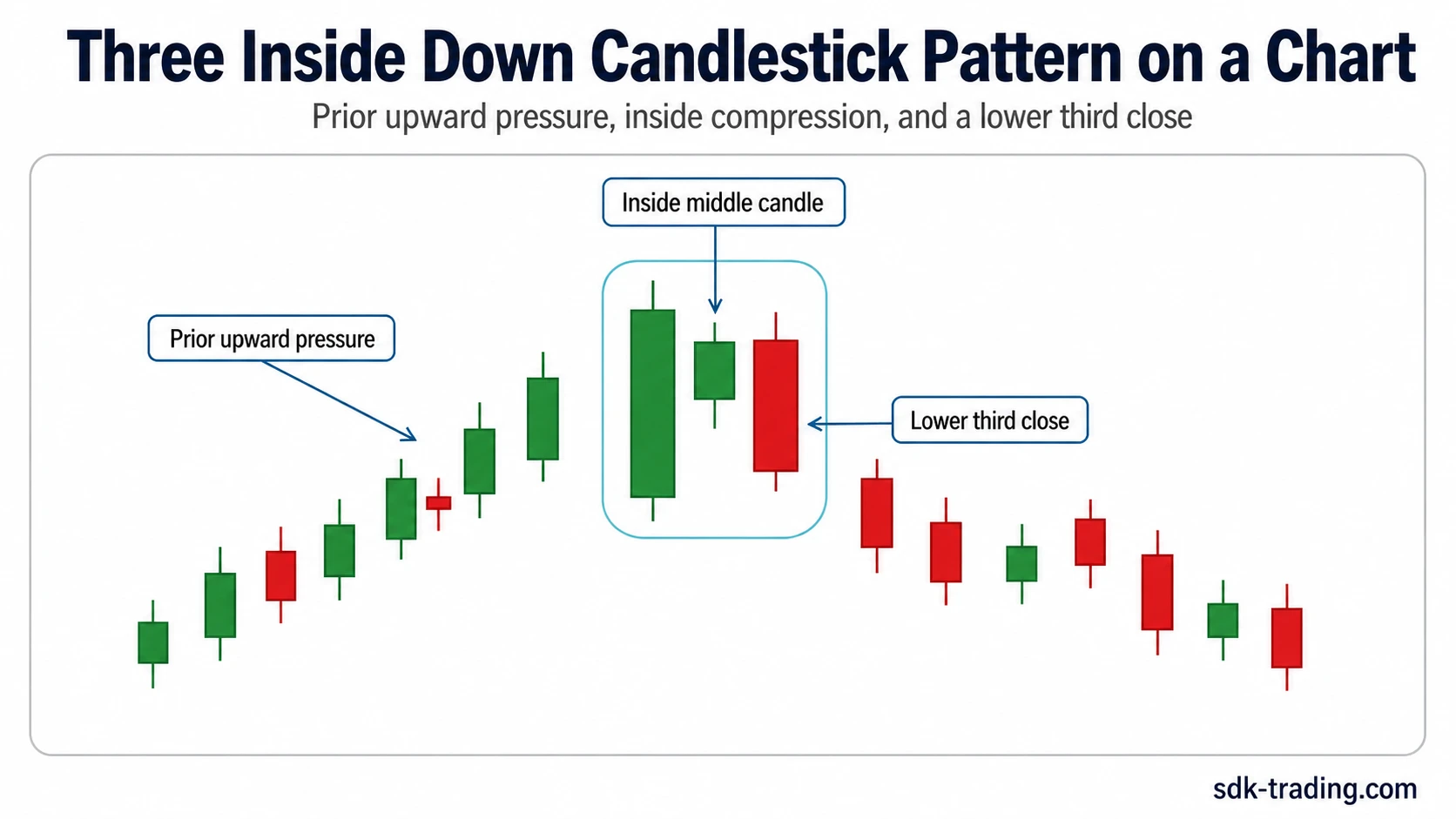
A Three Inside Down candlestick pattern is a three-candle bearish structure that appears after upward pressure: a bullish reference candle, a smaller candle contained inside that body, and a third candle that closes lower.
Definition: Three Inside Down is a triple candlestick pattern that turns a prior bullish body into an inside-compression structure, then adds a lower third close. It is best read as a structural warning that buying pressure has weakened, not as a complete trading instruction.
The middle candle shows compression after an advance. The third candle decides whether that compression has produced downside pressure or only a pause inside the prior candle’s range.
Key Points
- Three Inside Down depends on the relationship between the first candle body, the contained second candle, and the lower third close.
- It is closely related to Bearish Harami, but adds a third candle for downside resolution.
- The reading weakens when containment is unclear, the third close is shallow, or price quickly accepts higher again.
What Is the Three Inside Down Candlestick Pattern?
Three Inside Down shifts a prior advance into a three-step sequence: expansion, compression, and lower-close response. The first candle sets the body range, the second candle shows that the advance has stopped expanding, and the third candle tests whether sellers can push back into that range.
That sequence separates Three Inside Down from random three-candle noise. The pattern is incomplete without prior upward pressure, body containment, and a meaningful third close. If one of those parts is missing, the structure is better treated as a loose pullback, an inside-bar variation, or an unrelated candle group.
How to Identify Three Inside Down
The cleanest Three Inside Down reading starts with visible upward pressure. The first candle should have enough body strength to establish the reference range. The second candle should be smaller and contained inside the body of the first candle. The third candle should close below the second candle and preferably press back into the first candle’s body.
| Pattern part | What to observe | Why it matters |
|---|---|---|
| First candle | A bullish candle after upward pressure | Creates the reference body that the next candle must stay inside |
| Second candle | A smaller candle contained inside the first candle’s body | Shows compression after the prior advance |
| Third candle | A bearish candle that closes lower | Shows downside pressure after the compressed middle candle |
| Context | Prior upward pressure or an extended bullish leg | Separates the pattern from random three-candle noise |
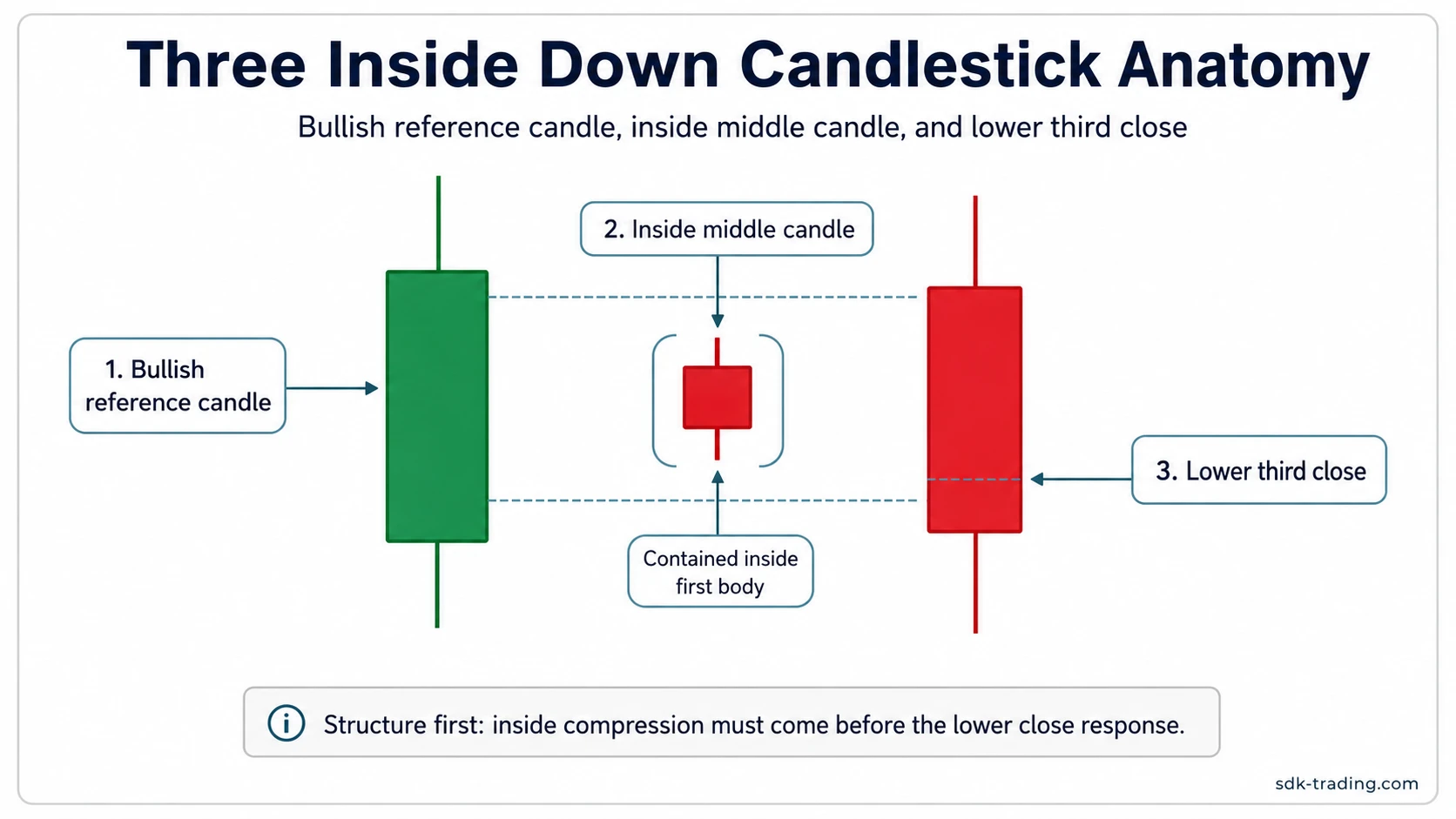
Some definitions allow the second candle to sit inside the range of the first candle. A stricter body-based definition is cleaner for classification: the second candle should be contained inside the real body of the first candle. That makes the pattern easier to separate from broader inside-bar structures and loose pullbacks.
Why the Middle Candle Matters
The middle candle is the compression point. It shows that the prior upward push has stopped expanding, but it does not complete the pattern by itself. A small candle inside the first body can mean hesitation, balance, or temporary absorption. The lower third close is what turns that pause into a downside-resolution reading.
A common mistake is treating the inside candle as the entire pattern. The inside candle only creates the setup condition. The third candle must show that sellers were able to press lower after the market compressed. If the third candle is shallow or closes back near the middle of the prior range, the sequence is weaker.
Three Inside Down and Bearish Harami
Three Inside Down is closely related to Bearish Harami. The first two candles resemble a Bearish Harami structure: a large bullish candle followed by a smaller candle contained inside the prior body. Three Inside Down adds a third candle that closes lower and gives the structure a clearer downside-response component.
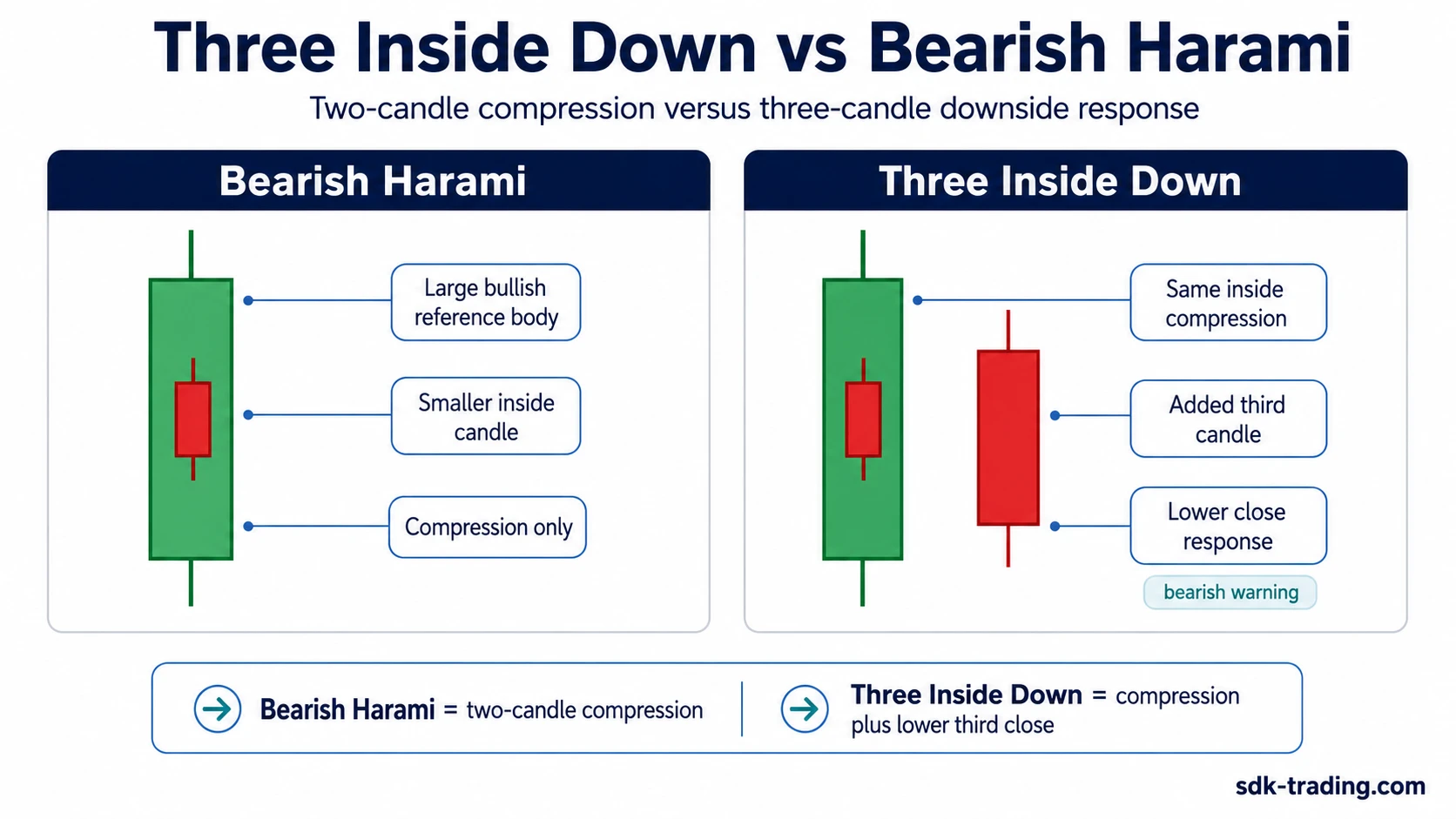
For classification, the useful question is whether the third candle changes the two-candle Harami condition into a broader three-candle structure. If the third candle does not close lower with enough depth, the better label may remain Bearish Harami or a weak inside-candle pause rather than a clean Three Inside Down.
Clean, Weak, and Invalid Three Inside Down Readings
A Three Inside Down reading is strongest when the three candles create a clear sequence: upward pressure, contained compression, then a lower close. The quality drops when the pattern has marginal containment, unclear context, or no real downside pressure after the middle candle.
| Criterion | Clean reading | Weak reading | Invalid reading |
|---|---|---|---|
| Prior pressure | Clear upward pressure before the first candle | Mixed or shallow prior pressure | No meaningful upward context |
| Second candle | Clearly contained inside the first candle body | Only marginally contained | Not truly inside the first candle body |
| Third candle | Closes lower with visible downside pressure | Lower close is shallow or indecisive | No lower-close pressure appears |
| After-pattern behavior | Price struggles to reclaim the prior body | Acceptance remains unclear | Price quickly accepts higher again |
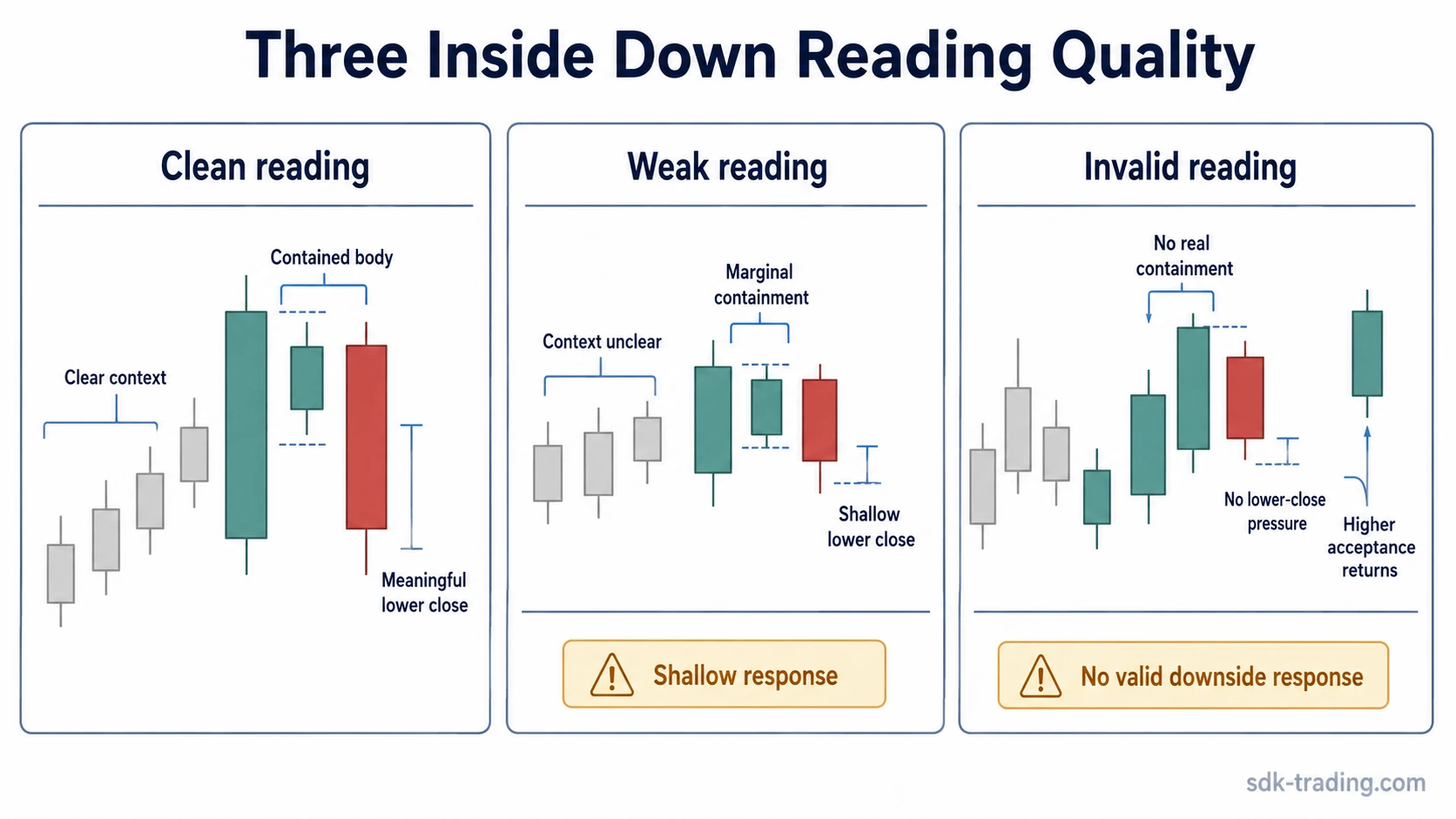
The after-pattern test is simple: does price respect the compressed area or reclaim it quickly? Holding below the prior body supports the warning. Fast acceptance back above the compressed area weakens it.
Three Inside Down vs Related Patterns
The pattern is easiest to classify when it is separated from nearby triple-candle structures. Three Inside Down uses an inside middle candle and a lower third close. Other patterns may share bearish pressure or three-candle structure, but they do not use the same anatomy.
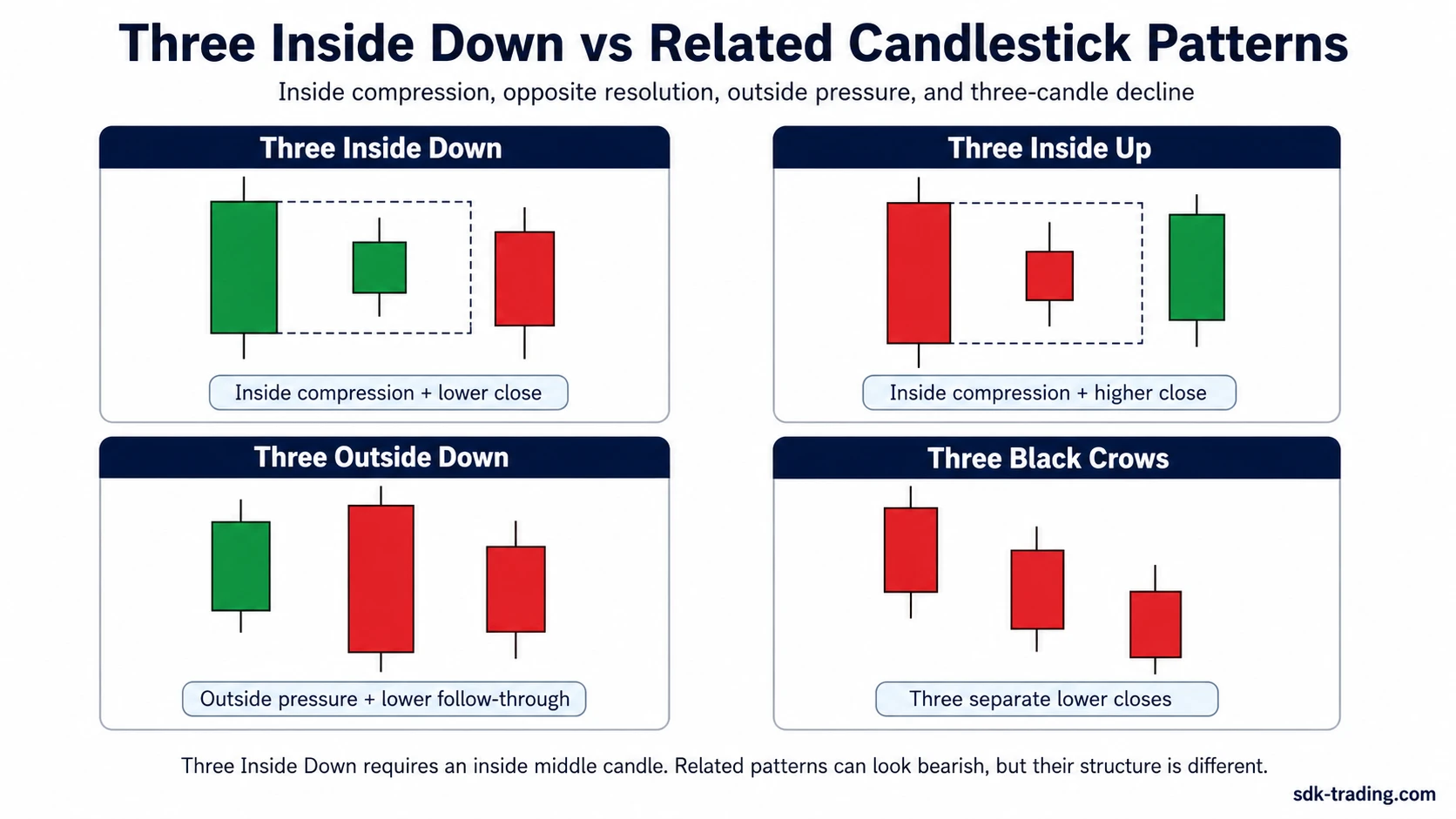
| Pattern | Core structure | Main distinction |
|---|---|---|
| Three Inside Up | Bearish pressure, contained middle candle, bullish third close | Opposite directional version of the inside structure |
| Three Outside Down | Bearish engulfing-type expansion followed by downside pressure | Uses outside expansion, not a contained middle candle |
| Three Black Crows | Three consecutive bearish candles | Does not require an inside middle candle or Bearish Harami relationship |
Morning Star and Evening Star can also appear in discussions of three-candle reversal structures, but their anatomy is different. They depend on a small middle candle between stronger outside candles, not on a second candle contained inside the first candle’s body.
What Three Inside Down Does Not Prove
Three Inside Down does not prove that a market has reversed. It only says that an advance stopped expanding, compressed inside the prior body, and then produced a lower close. That is a warning structure, not a completed trend-change claim.
The pattern also does not provide entry, exit, target, stop, or performance information. It remains a classification tool. Its reading should be judged by location, body containment, third-candle depth, and later price acceptance.
FAQ
What is a Three Inside Down candlestick pattern?
Three Inside Down is a three-candle bearish structure that appears after upward pressure. It starts with a bullish candle, forms a smaller candle contained inside that candle’s body, and then prints a lower-closing third candle.
Is Three Inside Down the same as Bearish Harami?
No. The first two candles are related to Bearish Harami, but Three Inside Down adds a third candle that closes lower. That third candle gives the structure its downside-resolution element.
What makes a Three Inside Down pattern weak?
The pattern is weak when prior upward pressure is unclear, the second candle is not cleanly contained, or the third candle closes only slightly lower. The reading also weakens if price quickly accepts back higher.
What is the opposite of Three Inside Down?
The opposite structure is Three Inside Up. It uses a similar inside-candle framework, but it appears after downward pressure and resolves with a bullish third candle.
Does Three Inside Down guarantee a reversal?
No. Three Inside Down can show weakening upward pressure, but it does not guarantee a reversal. Context, follow-through, and later price acceptance still matter.