Three Black Crows is a three-candle bearish candlestick pattern formed by three consecutive bearish candles after prior upside pressure. The important detail is not candle color alone. A valid reading needs progressive lower closes, meaningful bearish real bodies, and enough sequence integrity to show serial selling pressure rather than random red candles.
Definition: Three Black Crows is a triple candlestick pattern formed by three bearish candles after an advance, with each candle closing lower than the previous one. The pattern is best read as a structural warning that selling pressure has become more persistent across the sequence, not as a complete trading instruction.
The pattern can show that buyer control has weakened across the sequence, but it does not by itself define an entry, exit, target, or forecast. Its value comes from reading how the three candles relate to each other: where they open, where they close, whether sellers keep pressure into each close, and whether later price action rejects or accepts the sequence.
- Three Black Crows depends on three connected bearish candles with progressive lower closes.
- The structure is cleaner after prior upside pressure, where it can show a shift from buyer control to serial selling pressure.
- The interpretation weakens when bodies shrink, lower shadows expand, closes stop progressing lower, or price quickly recovers through the sequence.
What Is Three Black Crows?
Three Black Crows is a bearish three-candle formation that appears after a prior advance or upside pressure. It is usually read as a shift from buyer control toward sustained selling pressure because each candle adds another lower close to the sequence.
A clean version has three visible bearish bodies. The candles should not be tiny hesitation candles, and the sequence should not depend on one isolated selloff candle. The pattern is strongest when the pressure develops step by step: first rejection, then continuation, then a third candle that shows sellers remained active through the sequence.
The term “crows” refers to the three dark or bearish candles. In modern charting, the candle color depends on the platform, but the structure is the same: three declining bearish bodies after an advance.
How to Identify the Three Black Crows Pattern
The pattern starts with context. Without prior upside movement, three bearish candles may only be continuation selling or late weakness, not a clear Three Black Crows reversal reading.
A stronger Three Black Crows pattern usually has these features:
| Identification point | What to observe | Why it matters |
|---|---|---|
| Prior context | Price has advanced or pushed upward before the pattern | The sequence can then mark a possible pressure shift from buyers to sellers |
| Candle count | Three consecutive bearish candles | The pattern depends on a three-candle relationship, not one large candle |
| Real bodies | Each candle has a meaningful bearish body | Tiny bodies can show hesitation instead of sustained selling |
| Lower closes | Each candle closes below the prior candle’s close | Progressive lower closes create the serial-pressure reading |
| Opens | Each candle opens within or near the previous real body | Controlled overlap keeps the sequence connected |
| Lower shadows | Lower wicks are not excessively long | Long lower shadows can show sellers were absorbed before the close |
The third candle is especially important because it tests whether the sequence is still intact. If the third candle fails to close lower, turns into a small hesitation candle, or is quickly recovered by later price action, the pattern loses much of its diagnostic value.
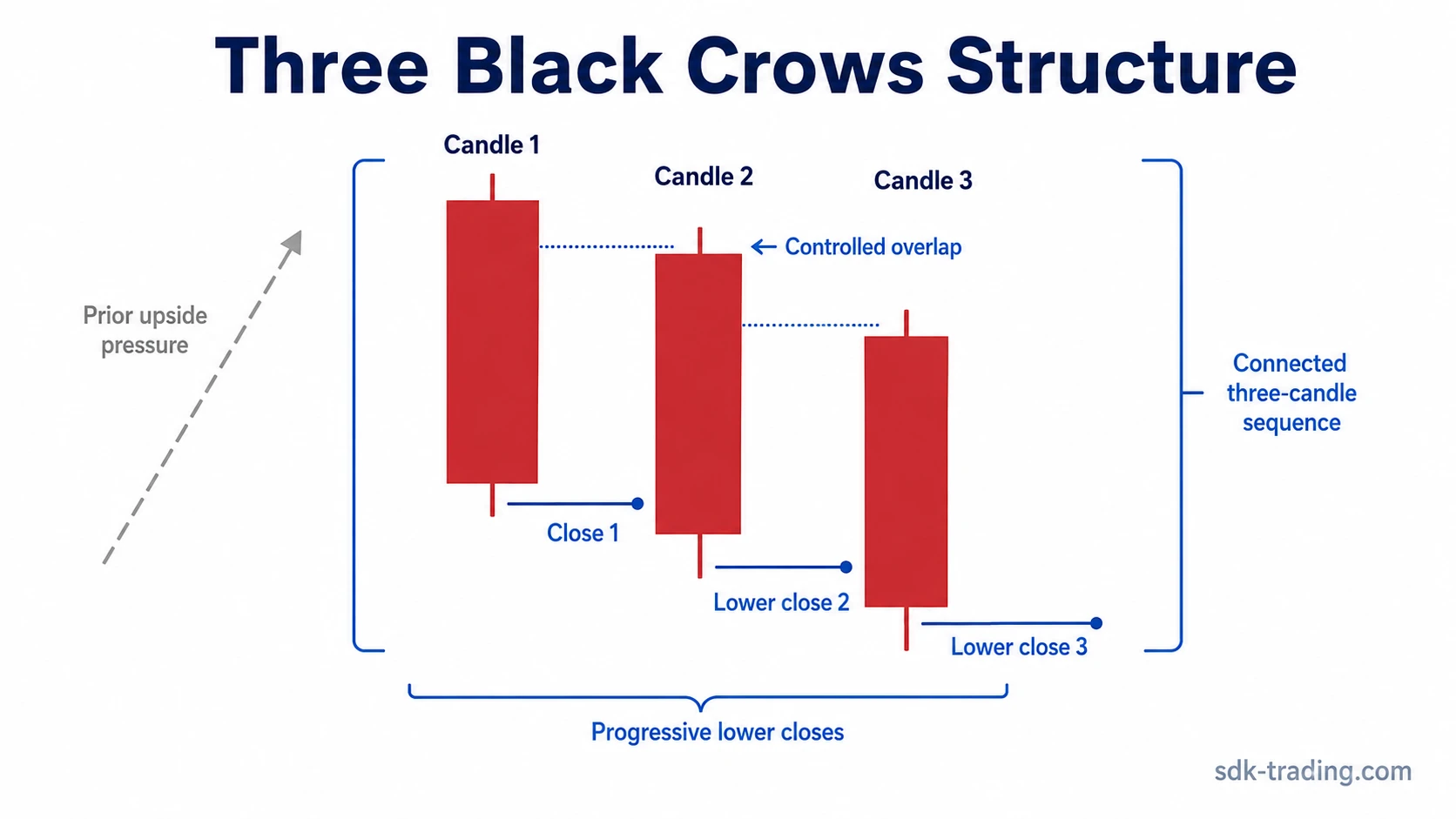
The Diagnostic Boundary: What Counts and What Does Not
Three Black Crows is best treated as a sequence-quality test. The question is not only whether there are three bearish candles. The question is whether the candles show connected, progressive pressure.
| Diagnostic question | Stronger structure | Weaker or invalid structure |
|---|---|---|
| Is there prior upside context? | The candles appear after an advance or upside pressure | The candles appear deep inside an existing decline with no fresh transition |
| Do closes progress lower? | Each candle closes below the prior close | The closes stall, overlap heavily, or fail to move lower |
| Are bodies meaningful? | Bodies show visible bearish control | Bodies shrink into doji-like or spinning-top candles |
| Is overlap controlled? | Opens stay within or near the prior real body while closes keep moving lower | Heavy overlap makes the sequence look more like sideways churn |
| Are lower shadows moderate? | Sellers keep enough pressure into the close | Long lower wicks show repeated absorption or rejection |
| Does later recovery reject the sequence? | Price remains below the pattern area after the third candle | A fast recovery back through the sequence weakens or cancels the interpretation |
A valid Three Black Crows structure is narrower than three red candles. Three red candles can appear in many conditions. Three Black Crows requires a connected decline with enough structure to show that sellers are repeatedly pressing the close lower.
Clean, Weak, and Invalid Three Black Crows Readings
A Three Black Crows sequence is strongest when the three candles create a clear progression: prior upside pressure, three bearish real bodies, and successive lower closes. The quality drops when the candles overlap heavily, bodies shrink, or lower shadows show repeated absorption.
| Criterion | Clean reading | Weak reading | Invalid reading |
|---|---|---|---|
| Prior pressure | Clear upside pressure before the first bearish candle | Mixed or shallow prior pressure | No meaningful upside context |
| Candle bodies | Three visible bearish real bodies | Bodies shrink or become uneven | One or more candles become doji-like hesitation candles |
| Close progression | Each candle closes below the previous close | Lower-close progression is shallow or inconsistent | Closes do not progress lower |
| Overlap and shadows | Overlap is controlled and lower shadows are moderate | Heavy overlap or long lower shadows reduce clarity | The structure becomes sideways churn rather than a three-step pressure sequence |
| After-pattern behavior | Price struggles to reclaim the pattern area | Acceptance remains unclear | Price quickly recovers through the sequence |
A clean version should look like a steady transfer of pressure across three candles, not a single panic candle followed by indecision. A weak version still shows selling pressure, but the candle relationship is less convincing because the bodies, shadows, or overlap reduce clarity. An invalid version breaks the core sequence through missing context, failed lower-close progression, hesitation bodies, or fast recovery through the pattern area.
A practical reading can appear when price advances into a previously active supply area, then forms three bearish candles with lower closes. If later price struggles to reclaim the pattern area, the sequence remains cleaner. If price quickly accepts back above the candles, the Three Black Crows interpretation loses quality.
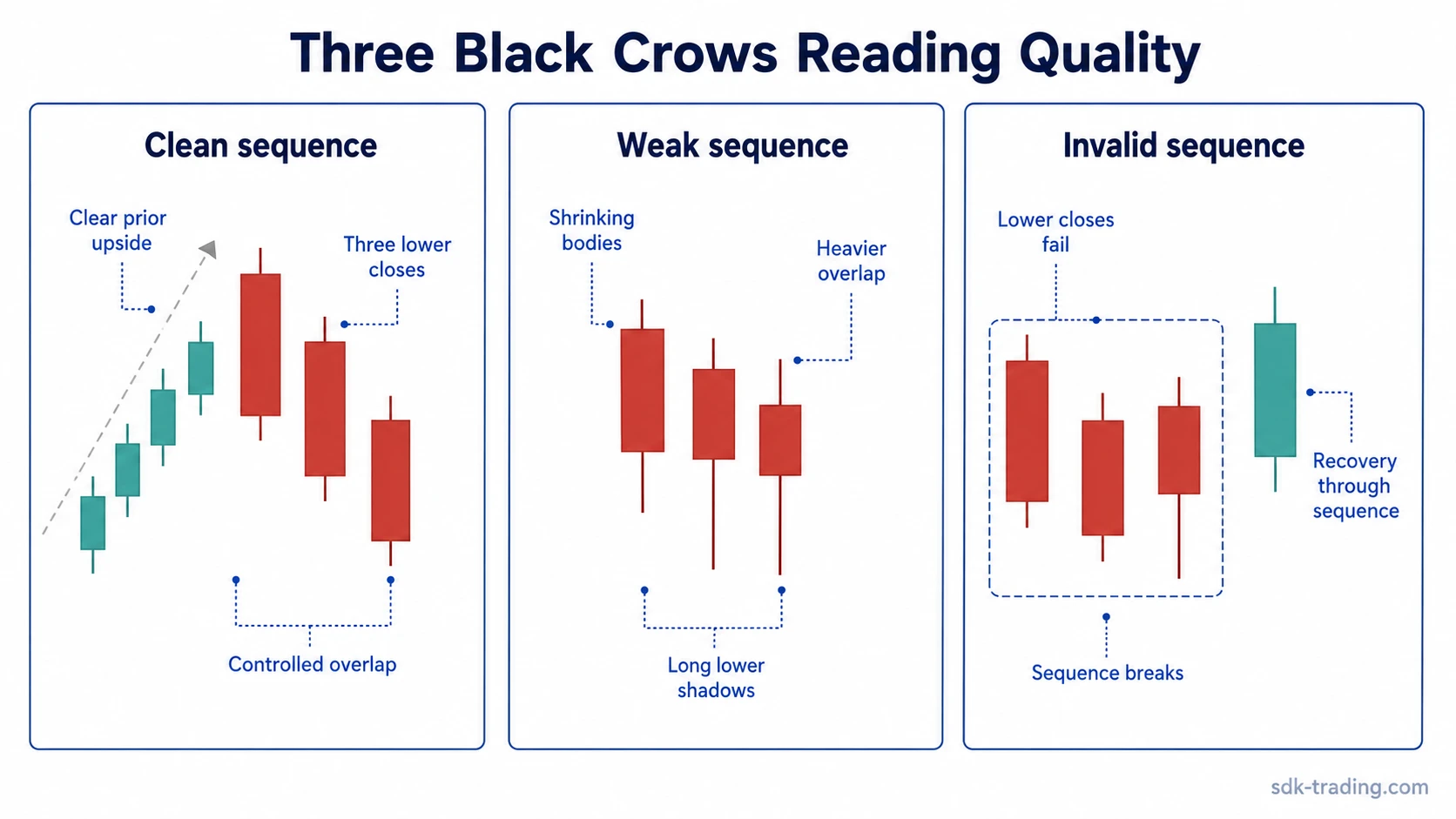
What Three Black Crows Can and Cannot Confirm
Three Black Crows can show that sellers applied pressure across three consecutive candles. After an advance, that can mark a shift in short-term control because buyers failed to regain the close for several candles in a row.
The pattern confirms sequence pressure only when the three candles stay connected: prior upside context, meaningful bearish bodies, progressive lower closes, and enough close control to avoid turning into lower-shadow absorption.
Support and resistance can change the interpretation. If the third candle closes directly into an important support area and leaves a long lower shadow, the sequence may show pressure, but also absorption. If the three candles appear after an already stretched decline, the pattern can arrive too late to add useful new information.
Volume can sometimes support the interpretation when it shows expanding participation during the sequence, but volume should remain secondary. The candle relationship itself is the first test: context, bodies, lower closes, overlap, and recovery behavior.
Three Black Crows vs Similar Candlestick Patterns
Three Black Crows belongs to the group of triple candlestick patterns, but it should not be mixed with every bearish three-candle structure. The pattern uses three connected bearish candles with progressive lower closes. Other patterns may share bearish pressure or three-candle structure, but they do not use the same anatomy.
| Pattern | Core structure | Main distinction |
|---|---|---|
| Three Black Crows | Three bearish candles with progressive lower closes after upside pressure | Focuses on serial bearish pressure across three connected candles |
| Three White Soldiers | Three bullish candles with progressive higher closes after downside pressure | Opposite directional version of the three-candle pressure sequence |
| Three Inside Down | Inside-candle compression followed by a lower third close | Uses an inside middle candle rather than three similar bearish bodies |
| Three Outside Down | Bearish outside or engulfing expansion followed by downside pressure | The outside candle defines the pattern more than a three-step lower-close sequence |
| Evening Star | Advance, small hesitation candle, then bearish rejection | The middle hesitation candle is central; Three Black Crows does not require a star-like pause |
The opposite bullish three-candle sequence, such as a three inside up structure, is useful as a contrast because it shows why direction alone is not enough. Three Black Crows depends on bearish sequence integrity; a bullish three-candle structure depends on a different recovery relationship and should not be read with the same boundary rules.
Common Mistakes When Reading Three Black Crows
The most common mistake is treating any three bearish candles as Three Black Crows. Three bearish candles are only the surface. The pattern needs prior upside context and lower-close progression.
Another mistake is ignoring candle quality. If each candle leaves a long lower shadow, sellers may be pushing price down intraday but failing to hold full control into the close. That does not erase the pressure, but it weakens the interpretation.
A third mistake is reading the pattern too late. If price has already fallen sharply before the three candles appear, the pattern may describe exhaustion or continuation pressure rather than a fresh reversal attempt.
The final mistake is turning the pattern into a trading instruction. Three Black Crows can describe pressure, but it does not define risk, invalidation, or broader market structure by itself.
FAQ
What does Three Black Crows mean?
Three Black Crows means that three consecutive bearish candles have formed after prior upside pressure, with each candle closing lower than the one before it. The pattern can show serial selling pressure, but it does not confirm an outcome by itself.
Is Three Black Crows always bearish?
Three Black Crows is bearish in structure, but its interpretation depends on context. It is cleaner after an advance and weaker when it appears late in an already extended decline or directly into support absorption.
How many candles are in the Three Black Crows pattern?
The Three Black Crows pattern has three candles. Each candle should be bearish, and each close should move lower than the previous close for the sequence to remain structurally valid.
What makes Three Black Crows invalid?
The reading becomes invalid if there is no prior upside context, if the candles do not close progressively lower, if the bodies shrink into hesitation candles, or if later price action quickly recovers through the sequence.
How is Three Black Crows different from Three White Soldiers?
Three Black Crows is a bearish three-candle pressure sequence after upside movement. Three White Soldiers is the opposite structure: a bullish three-candle recovery sequence after downside pressure.