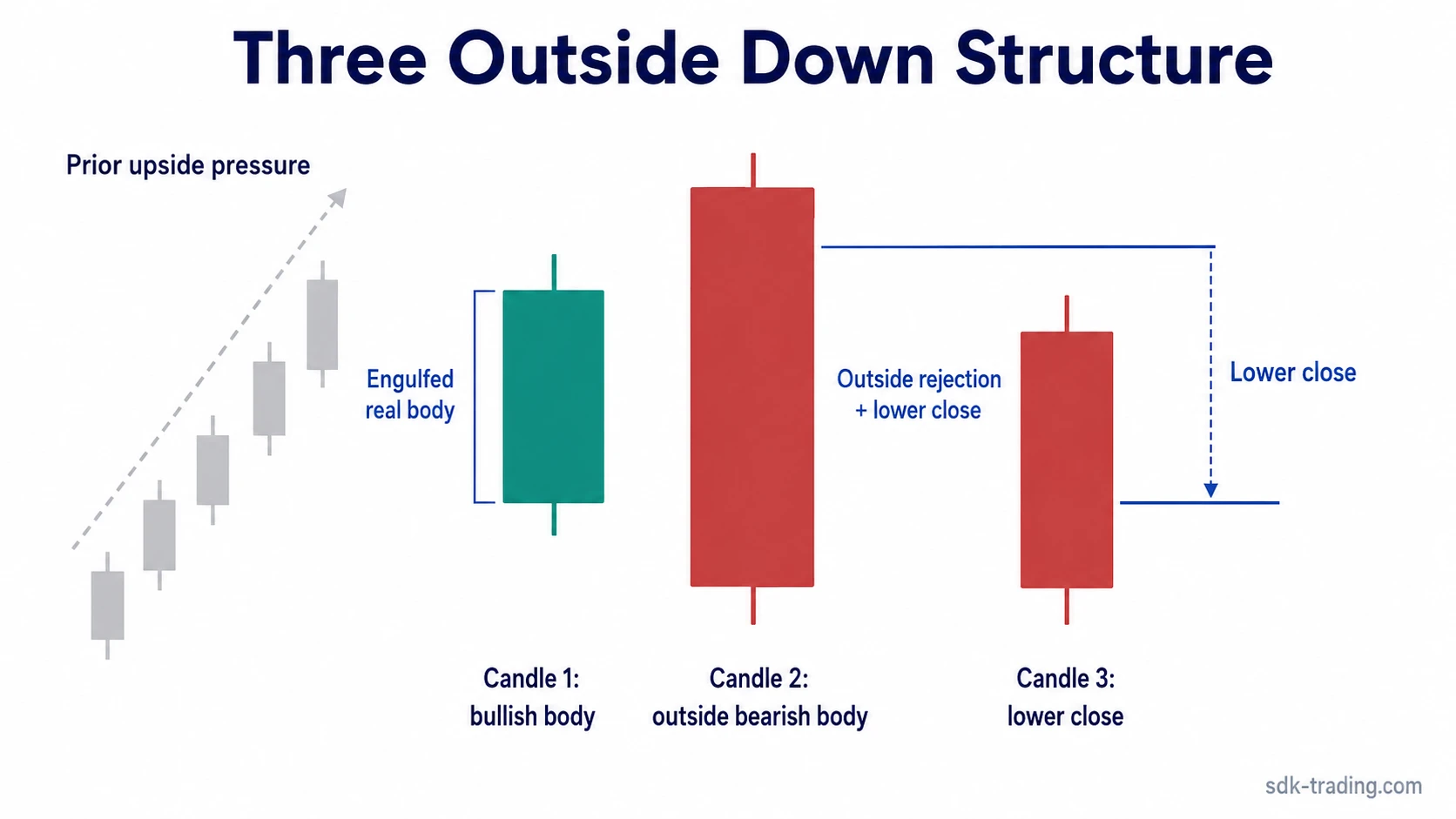
Three Outside Down is a three-candle bearish candlestick pattern that appears after upside pressure. It starts with a bullish candle, follows with a bearish outside candle that engulfs the first candle’s real body, and completes only when the third candle closes below the second candle’s close.
The useful reading is the structure itself: an outside bearish rejection followed by a lower close. It should not be treated as a forecast or a complete trading plan.
Definition: Three Outside Down is a three-candle bearish candlestick pattern formed by a bullish first candle, a bearish outside second candle that engulfs the first candle’s real body, and a third bearish candle that closes below the second candle’s close.
What Is Three Outside Down?
Three Outside Down is an outside-down three-candle supply sequence. Its main feature is the shift from a bullish first candle to a bearish outside candle, followed by a third candle that completes the sequence with a lower close.
The pattern is closely related to Bearish Engulfing because the first two candles create the engulfing relationship. Three Outside Down adds one more requirement: the third candle must close below the engulfing candle, showing that the rejection did not stop at a two-candle formation.
A weak reading usually comes from missing structure. If the second candle does not engulf the first real body, or if the third candle cannot close lower, the sequence is not a clean Three Outside Down structure.
Three Outside Down Candle Structure
The structure is easier to read when each candle has a specific job. The first candle shows the prior upside side of the sequence. The second candle creates the outside rejection. The third candle tests whether that rejection has enough follow-through to form downside resolution.
| Part of the pattern | What should appear | Why it matters |
|---|---|---|
| Prior context | Upside pressure before the three-candle group | The pattern needs something to reject; without prior upside pressure, the reading loses its main boundary. |
| Candle 1 | A bullish real body | It shows buyers were still present before the outside-down turn began. |
| Candle 2 | A bearish candle that engulfs Candle 1’s real body | This is the outside-down rejection and the Bearish Engulfing part of the sequence. |
| Candle 3 | A bearish candle closing below Candle 2’s close | It extends the rejection into lower-close pressure instead of leaving only a two-candle engulfing attempt. |
The second candle is the structural hinge. The third candle is the completion test. Without a lower third close, the chart may still show a bearish engulfing relationship, but it does not complete the Three Outside Down pattern.
How to Identify a Clean Three Outside Down
A clean Three Outside Down reading starts with observable candle relationships, not with a label. The sequence should show upside pressure first, then a bearish outside candle, then a third candle that extends the lower-close pressure.
| Identification check | Clean reading | Weak or incomplete reading |
|---|---|---|
| Prior pressure | The pattern appears after a visible upward push or upper-area test. | The candles appear in a flat, noisy range with no clear upside pressure to reject. |
| First candle | Candle 1 has a bullish real body. | Candle 1 is neutral, tiny, or already bearish, which breaks the outside-down relationship. |
| Second candle | Candle 2 is bearish and engulfs Candle 1’s real body. | Candle 2 closes lower but does not wrap the first real body clearly. |
| Third candle | Candle 3 closes below Candle 2’s close. | Candle 3 hesitates, closes inside Candle 2’s body, or recovers back through the sequence. |
| Sequence quality | The three candles form a connected outside-down progression. | The group looks like random red candles rather than a clear rejection and lower-close continuation. |
The cleanest version is not simply “red after green.” It is a specific bearish outside relationship followed by a lower third close. That third close separates the pattern from a basic Bearish Engulfing reading.
Three Outside Down Diagnostic Boundary
The diagnostic boundary separates a real Three Outside Down structure from nearby candle groups that only look similar. The pattern needs all three parts: prior upside pressure, a bearish outside second candle, and a lower third close.
| Boundary question | Three Outside Down answer |
|---|---|
| What it is | A three-candle outside-down supply sequence after upside pressure. |
| What it is not | It is not just any group of three bearish-looking candles and not just a two-candle Bearish Engulfing pattern. |
| What strengthens the reading | A clear bullish Candle 1, a decisive bearish outside Candle 2, and a third candle that closes below Candle 2. |
| What weakens the reading | A shallow engulfing candle, heavy overlap, a small third candle, or lower shadows that show selling pressure did not hold cleanly. |
| What invalidates the reading | No bearish outside Candle 2, no lower third close, or quick recovery back through the three-candle range. |
This boundary is especially useful when the chart has several red candles near the same area. Three Outside Down requires a defined outside-down relationship; without that relationship, the label becomes too broad to be useful.
Clean, Weak, and Invalid Three Outside Down Readings
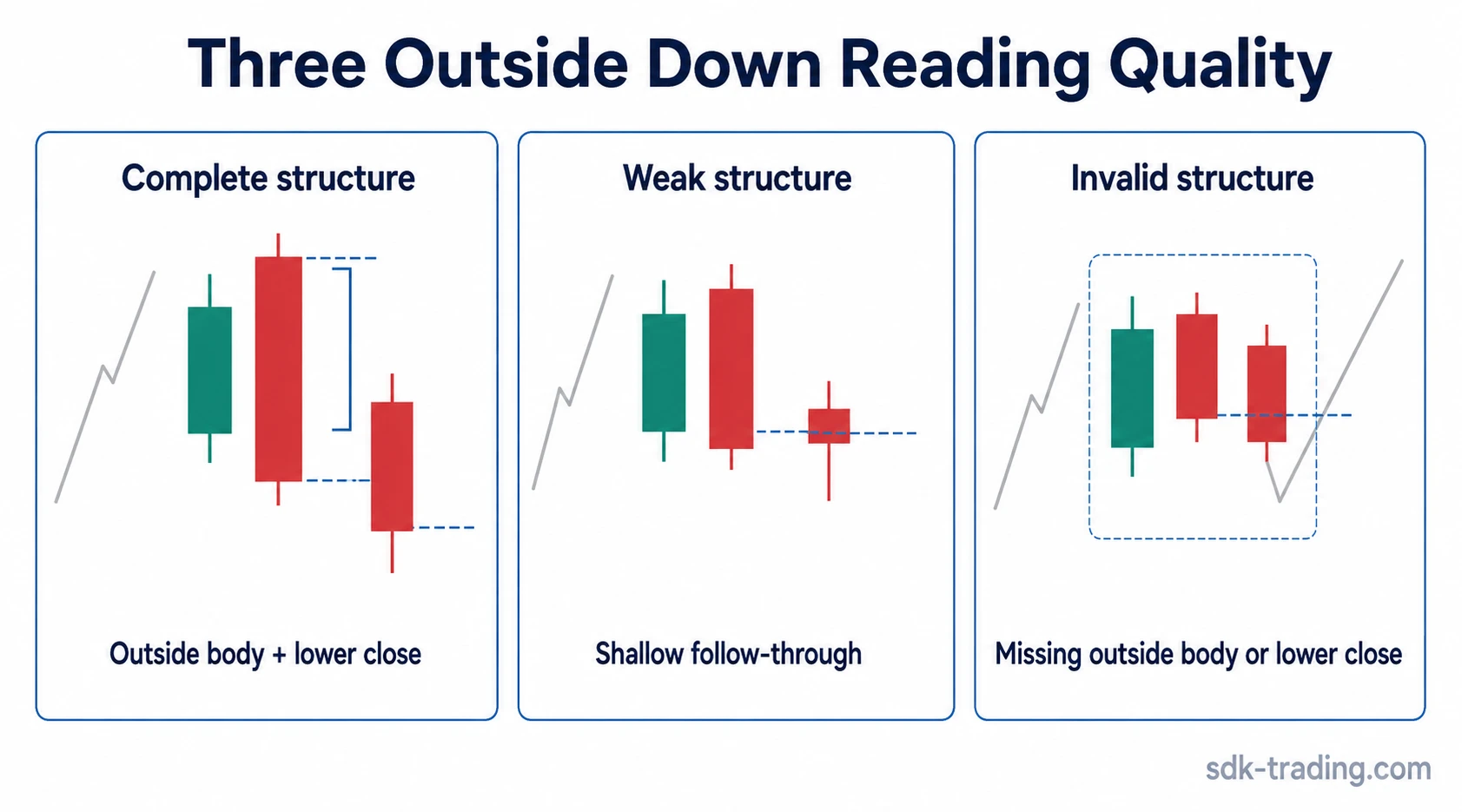
Similar three-candle groups can have different diagnostic quality. The difference usually comes from the second candle’s outside relationship, the third candle’s lower close, and whether the sequence holds below the rejected area.
| Reading quality | What the candles show | How to interpret the structure | Avoid calling it |
|---|---|---|---|
| Clean reading | Prior upside pressure, bullish Candle 1, bearish outside Candle 2, and Candle 3 closing below Candle 2. | The sequence completes as Three Outside Down because the outside rejection is followed by lower-close pressure. | A guaranteed reversal |
| Weak reading | Candle 2 barely engulfs Candle 1, Candle 3 closes only slightly lower, or the candles overlap heavily. | The structure exists, but the downside resolution is not very strong. | A decisive breakdown |
| Invalid reading | No real bearish outside candle, no lower third close, or immediate recovery through the pattern. | The pattern does not complete as Three Outside Down. | A valid Three Outside Down reading |
A clean reading does not require dramatic candle size. It requires the correct relationship between the three candles. A large red candle without a proper outside relationship can look forceful, but it still does not meet the Three Outside Down definition.
Example of a Basic Three Outside Down Reading
Price has been pressing upward into an area where earlier buying attempts already slowed. A bullish candle closes near the upper part of that move, which makes continuation look possible. The next candle opens near that area but turns down and closes below the first candle’s real body, creating the outside-down rejection.
The reading is still incomplete at that point. The third candle must close below the second candle’s close to show that the rejection extended into lower-close pressure. If the third candle instead closes inside the second candle’s body, or if price quickly recovers through the rejected area, the sequence becomes weaker or invalid rather than a clean Three Outside Down pattern.
This is why the third candle matters. It prevents the pattern from being reduced to a single bearish engulfing attempt and gives the three-candle structure its own diagnostic boundary.
Three Outside Down vs Nearby Patterns
Three Outside Down is often confused with other bearish or three-candle patterns. The clearest distinction is that it combines an outside bearish second candle with a lower third close.
| Pattern | Main structure | Difference from Three Outside Down |
|---|---|---|
| Three Outside Up | Bearish candle, bullish outside candle, higher third close | It is the opposite outside-up variant and uses demand-side recovery instead of downside resolution. |
| Three Inside Down | Large bullish candle, smaller inside candle, lower third close | It uses inside compression inside the first body, not an outside engulfing second candle. |
| Three Black Crows | Three bearish candles with progressive lower closes | It does not require a bullish first candle or a bearish engulfing second candle. |
| Bearish Engulfing | Two-candle pattern: bullish candle followed by bearish engulfing candle | Three Outside Down adds a third candle that closes below the engulfing candle. |
The comparison helps keep the label precise. Three Outside Down is not the same as every bearish three-candle group. It is defined by the outside second candle and the lower third close.
When Three Outside Down Becomes Misleading
Three Outside Down becomes less useful when the surrounding chart is noisy. A sideways range can create many overlapping candles that look like pattern fragments without showing a real rejection of prior upside pressure.
Low-liquidity candles can also distort the structure. Wide spreads, thin trading, or isolated wicks may create an engulfing shape that does not reflect a clean shift in pressure. In those cases, the candles may still form a similar shape, but the structure carries less diagnostic value.
A low-quality reading often shows one of three problems. Candle 2 may not truly engulf Candle 1’s real body. Candle 3 may fail to close below Candle 2. Or the next recovery attempt may move back through the full three-candle group, showing that the outside-down rejection did not hold.
The safest way to keep the pattern precise is to test the sequence before naming it: bullish first candle, bearish outside second candle, lower third close. If one part is missing, the better label may be weak continuation, incomplete Bearish Engulfing, or no valid Three Outside Down structure.
FAQ
What does Three Outside Down mean?
Three Outside Down means a three-candle bearish outside-down sequence after upside pressure. It starts with a bullish candle, forms a bearish outside candle around that first body, and completes when the third candle closes below the second candle.
Is Three Outside Down the same as Bearish Engulfing?
No. Bearish Engulfing uses two candles: a bullish candle followed by a bearish engulfing candle. Three Outside Down includes that engulfing relationship but adds a third candle that closes lower.
What makes a Three Outside Down reading weak?
A weak Three Outside Down reading usually has a shallow outside candle, heavy overlap, a small lower third close, or lower shadows that show the downside pressure did not hold cleanly.
Can Three Outside Down fail?
Yes. The structure can fail if the third candle does not close lower, if price quickly recovers through the three-candle range, or if the original candles appeared in a noisy sideways area rather than after clear upside pressure.
What is the opposite of Three Outside Down?
The opposite pattern is Three Outside Up. It uses a bearish first candle, a bullish outside second candle, and a third candle that closes higher.