A Morning Star candlestick pattern is a three-candle bullish reversal structure that appears after downside pressure. It starts with a larger bearish candle, pauses through a small hesitation candle, and becomes meaningful when the third candle recovers back into the first candle’s real body.
Definition: The Morning Star candlestick pattern shows a downside-to-recovery sequence: Candle 1 shows selling pressure, Candle 2 shows hesitation near the lower area, and Candle 3 challenges that selling pressure by closing back into Candle 1’s real body.
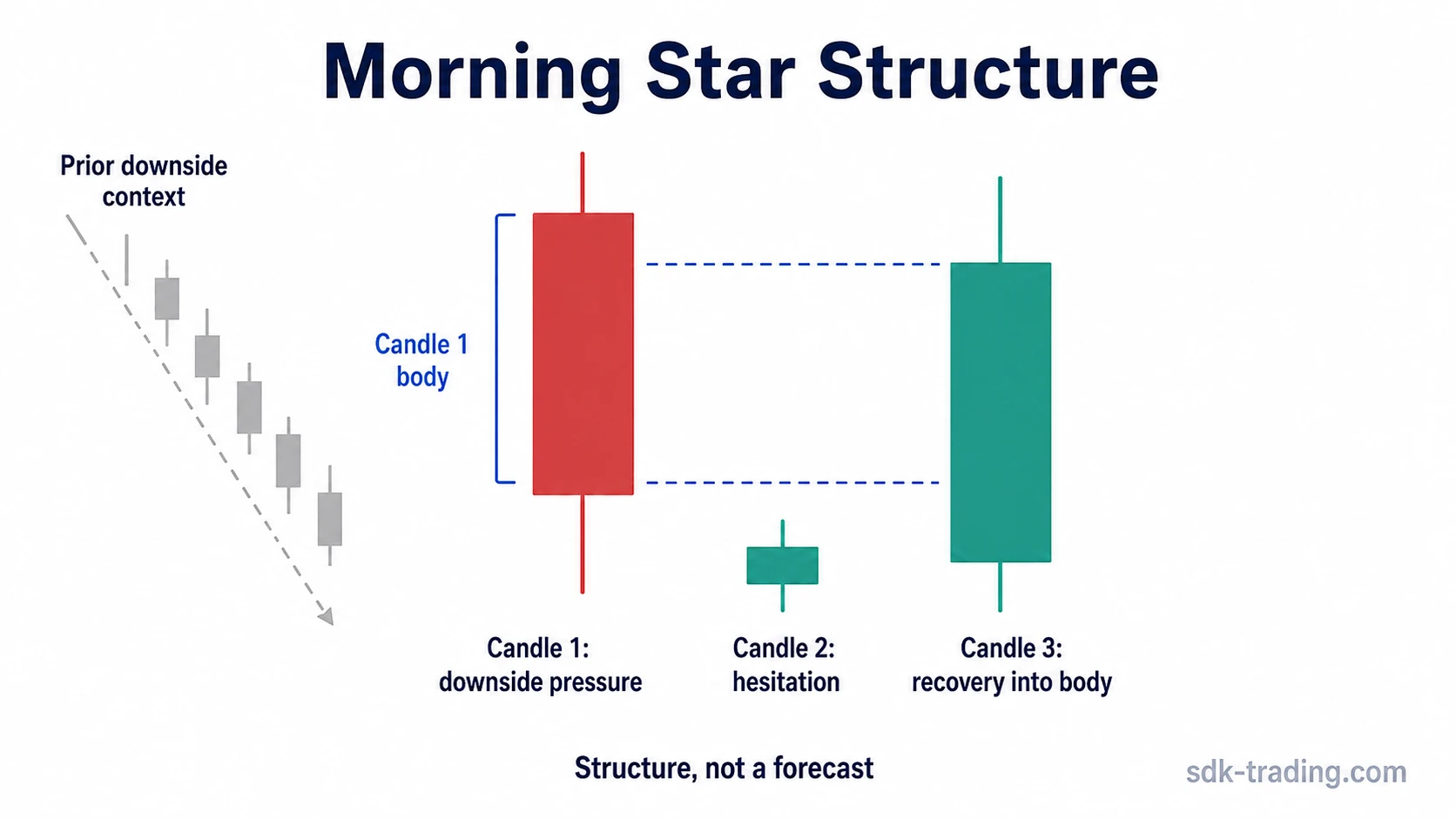
The key boundary is the third candle’s relationship to the first candle. A small middle candle alone is not enough, and a bullish third candle alone is not enough. The pattern becomes cleaner when downside pressure, hesitation, and meaningful body recovery appear together.
A stronger reading may recover near or above the midpoint of Candle 1’s real body, but the midpoint is a quality clue rather than a mechanical rule.
Key Points
- A Morning Star is a three-candle bullish reversal candlestick pattern that appears after downside pressure.
- The first candle shows selling pressure, the second candle shows hesitation, and the third candle shows recovery.
- The third candle should close meaningfully into the first candle’s real body, often near or above the midpoint in cleaner examples.
- The pattern is stronger when it appears near a relevant support area, with volume expansion or later bullish follow-through.
- A Morning Star remains conditional because weak context, shallow recovery, or failed follow-through can produce false readings.
Morning Star Candlestick Formation
The morning star formation is built from the relationship between three candles and the context around them. The sequence starts with downside pressure, pauses through a smaller hesitation candle, and then tests whether the third candle can recover into the first candle’s real body.
- Candle 1: a larger bearish or downside-pressure candle creates the body that later recovery is measured against.
- Candle 2: a smaller hesitation candle interrupts the decline near the lower area of the sequence.
- Candle 3: a bullish recovery candle closes back into Candle 1’s real body and challenges the prior downside candle.
The component table separates the candle role from the quality test.
| Component | Structural role | What it shows | What weakens the read |
|---|---|---|---|
| Candle 1: downside-pressure candle | Creates the body that later recovery is measured against | Sellers still control the immediate candle relationship | The candle is small, unclear, or not part of a prior decline |
| Candle 2: middle hesitation candle | Interrupts the downside move near the lower area | Downside pressure is slowing or becoming less one-sided | The candle is too large, too directional, or buried inside ordinary noise |
| Candle 3: recovery candle | Tests whether price can recover into Candle 1’s body | Demand is challenging the prior downside candle | The close is shallow, stalls at the body edge, or fails to recover meaningful body depth |
The third candle is the main diagnostic test. Without recovery into Candle 1’s real body, the formation may still show hesitation, but it does not form a strong morning star structure.
Morning Star Confirmation Factors
Confirmation does not turn a Morning Star into a guaranteed reversal. It helps separate a stronger recovery structure from a weak bounce or a mislabeled three-candle group.
| Confirmation factor | What it adds | What can still weaken the read |
|---|---|---|
| Prior downtrend or downside pressure | Shows that the pattern appears after real selling pressure. | Without downside context, the same candle group may be ordinary noise. |
| Third-candle recovery depth | Shows whether buyers challenged the first candle’s real body. | A shallow close near the lower edge of Candle 1 weakens the structure. |
| Support area | Adds structural context to the recovery attempt. | Support can fail if later candles reject the recovery area. |
| Volume expansion | Can show stronger participation on the recovery candle. | Volume alone does not validate the pattern without price acceptance. |
| Follow-through after Candle 3 | Shows whether the recovery area is accepted after the pattern forms. | Immediate rejection turns the pattern into a weaker or failed reading. |
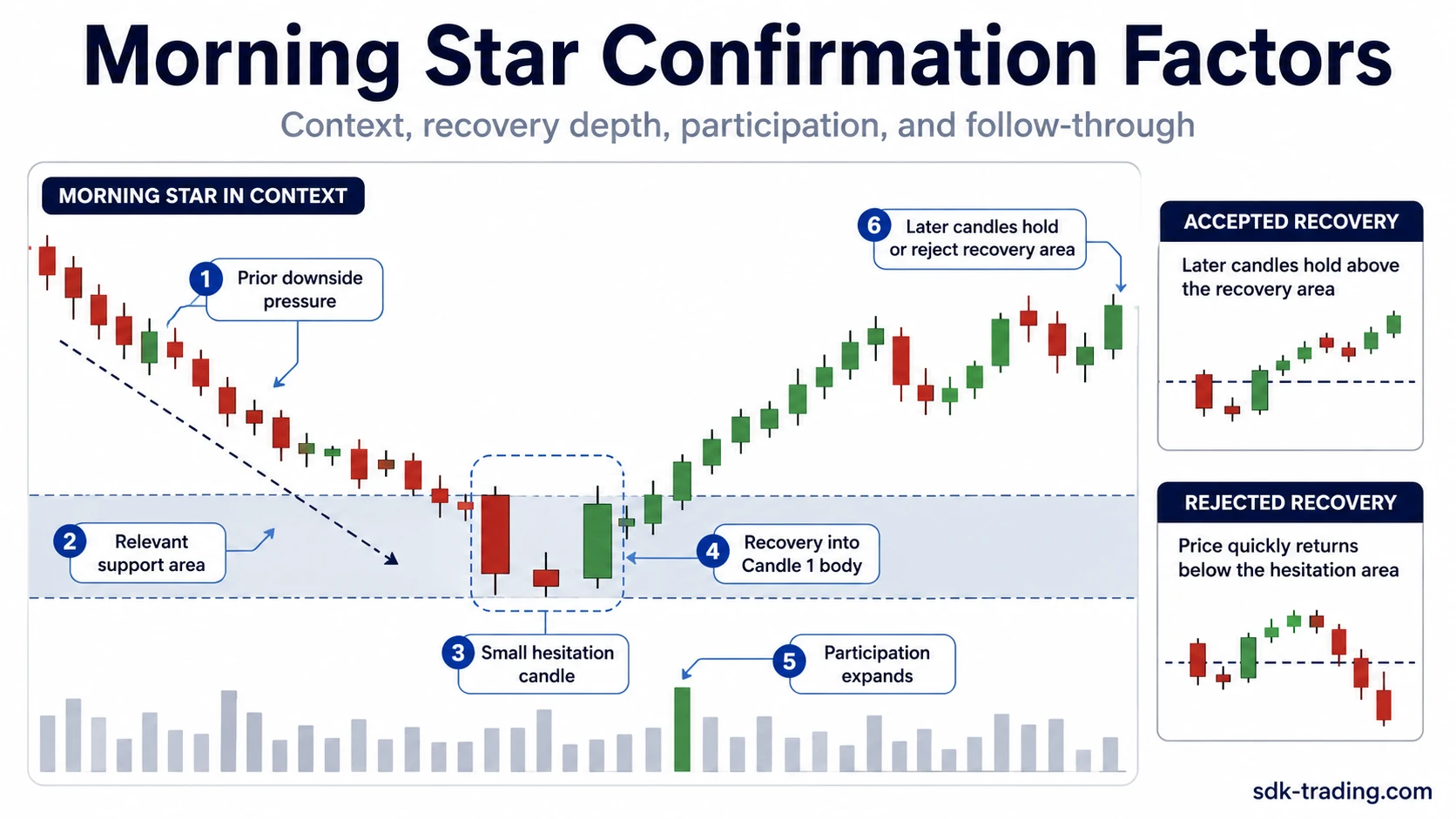
Candlestick analysis is strongest when it supports a broader chart structure. A candle pattern matters most when it appears where structure already expects a reaction.
Clean, Weak, and Invalid Morning Star Readings
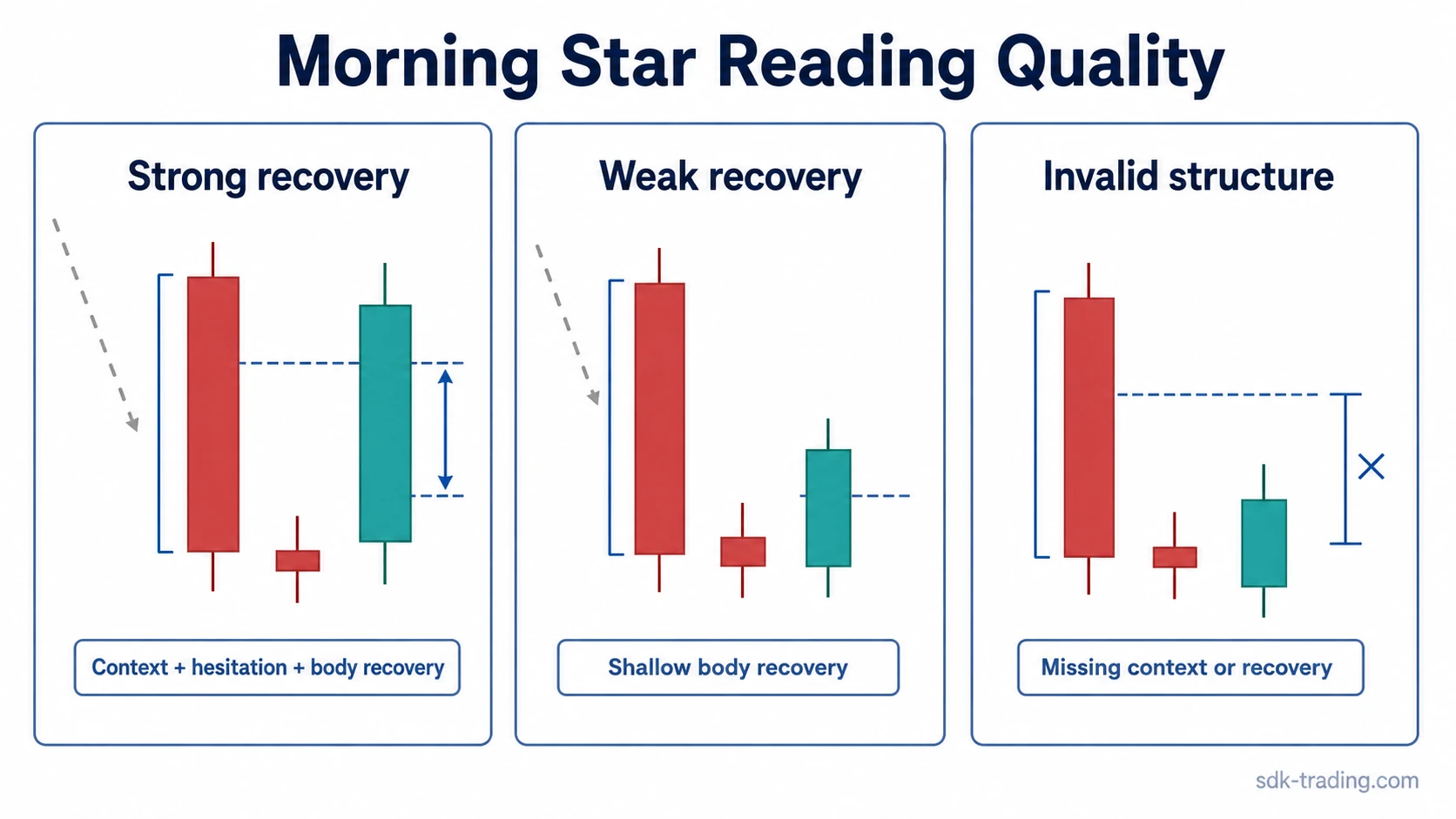
Similar three-candle groups can carry different quality. The difference usually comes from context, hesitation quality, and third-candle recovery depth.
| Quality | Typical structure | Diagnostic read | Common problem |
|---|---|---|---|
| Clean | Downside context, small middle hesitation candle, and a third candle closing meaningfully into Candle 1’s body | The downside candle is being challenged by visible recovery | Still needs later price behavior to avoid overclaiming the pattern |
| Weak | Some hesitation appears, but Candle 3 only recovers shallowly or stalls near the lower edge of Candle 1’s body | The sequence shows a pause, but recovery pressure is limited | Calling a shallow bounce a full morning star reading |
| Invalid or mislabeled | No prior downside context, no clear middle hesitation, or no meaningful recovery into Candle 1’s body | The candles do not complete the downside-to-recovery relationship | Labeling any small candle followed by a bullish candle as a morning star |
A morning star is not validated by shape alone. A clean structure needs a visible prior decline, a pause near the lower area, and a recovery candle that changes the relationship to the first candle’s body.
How to Identify a Morning Star Without Overreading It
Identification starts with the candle relationship, then moves to quality. The safest sequence is to check context first, then the middle candle, then the recovery depth.
- Look for visible downside pressure before the three-candle group.
- Check that Candle 1 creates a real body worth measuring against.
- Check that Candle 2 shows hesitation near the lower part of the sequence.
- Check that Candle 3 recovers into Candle 1’s real body.
- Compare the recovery depth with the midpoint of Candle 1’s body as a quality clue.
- Watch whether later candles hold or reject the recovery area.
Common misread: A small candle followed by a green candle is not automatically a morning star. The third candle must recover enough of Candle 1’s body to show that the prior downside candle is being challenged.
Example of a Basic Morning Star Reading
Price presses lower for several candles, then prints a larger bearish candle into a tested lower area. The next candle is small and stops extending the decline. The third candle closes back into the first candle’s real body, making the recovery visible rather than only implied.
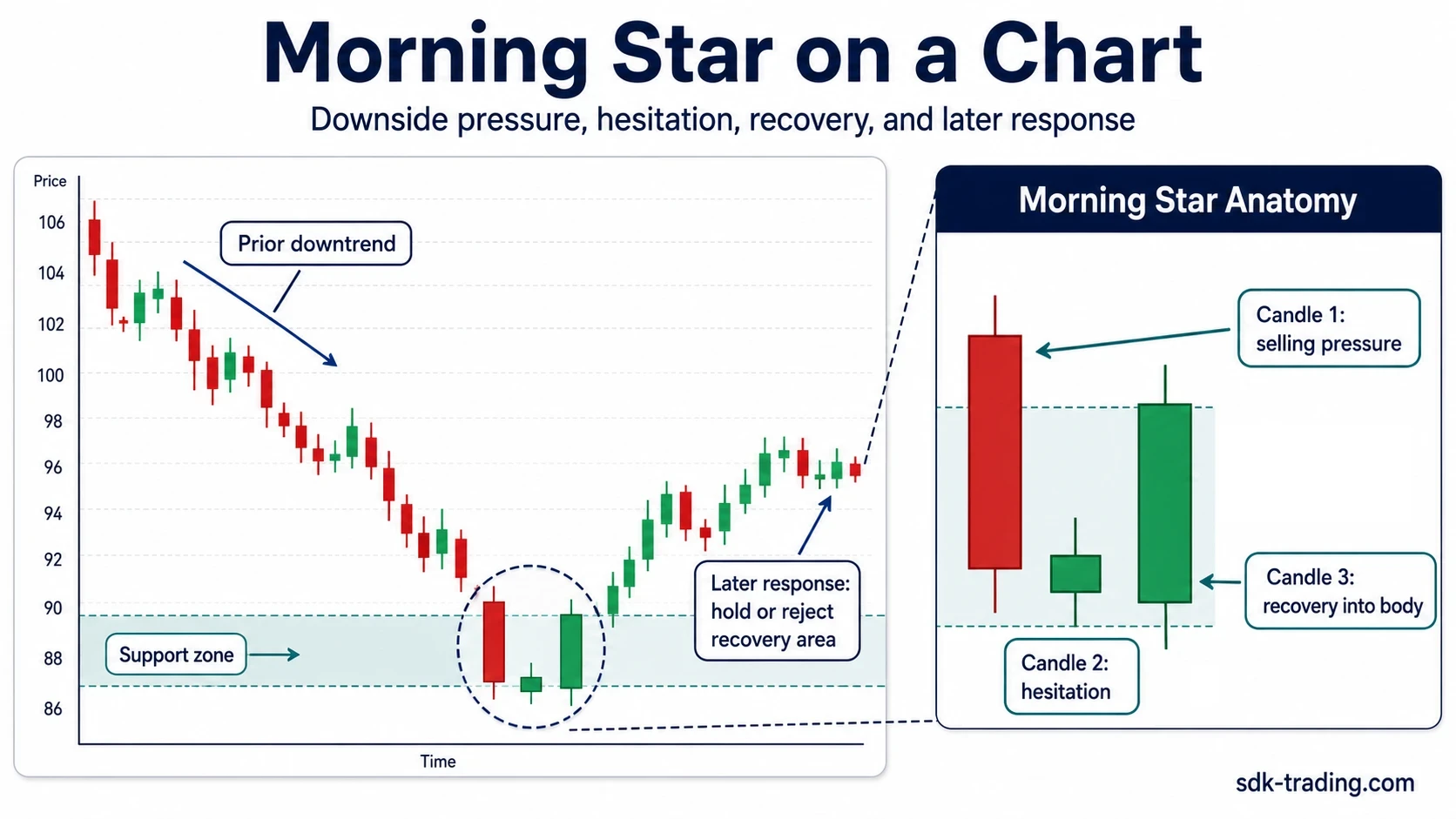
The read is still incomplete if the third candle only touches the lower edge of Candle 1’s body and the next response immediately stalls. A cleaner case develops when the recovery area is held on later candles. A weaker or failed case develops when the recovery is quickly rejected and price returns below the hesitation candle.
How Traders Use the Morning Star Pattern
Traders usually use a Morning Star as a context signal, not as an automatic entry trigger. The pattern can highlight a possible shift from downside pressure into recovery pressure, but the decision usually depends on support context, recovery depth, volume, broader trend structure, and follow-through after the third candle.
A conservative reading usually checks whether the pattern appears after a real decline, whether the third candle closes meaningfully into the first candle, whether price holds the recovery area afterward, and whether invalidation is clear if the recovery fails.
Method note: Candlestick analysis is a timing layer, not the trading system. The pattern can warn that pressure is changing, but structure decides whether the reading deserves attention.
Does the Middle Candle Have to Be a Doji?
The middle candle does not have to be a doji. In a standard morning star candlestick pattern, Candle 2 only needs to show hesitation or reduced downside momentum near the lower area of the sequence.
A true doji-centered version belongs closer to the Morning Doji Star. That distinction matters because the standard morning star allows a small real body, while the doji version puts more emphasis on open-close indecision in the middle candle.
Body color on the middle candle is secondary. A small bearish, bullish, or neutral-looking middle body can still perform the hesitation role if it interrupts downside extension and sets up the third-candle recovery test.
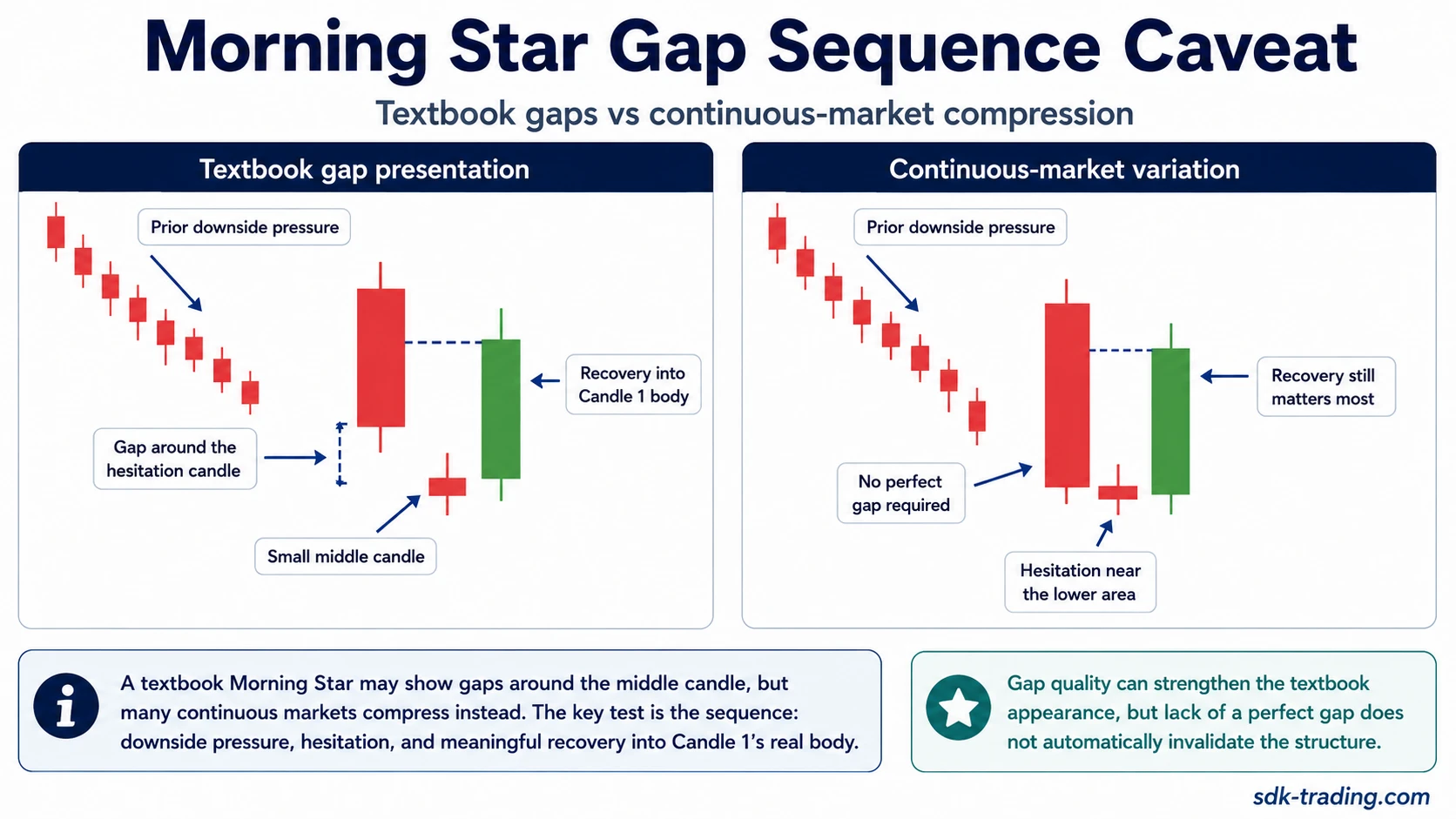
Morning Star Gap Sequence Caveat
Textbook examples often show gaps around the middle candle. Real charts do not always present that cleanly. Gaps are easier to see in some stock charts, while continuous markets may show compression, small separation, or a narrow hesitation candle instead of a clear gap.
| Market display | What to check | What not to overread |
|---|---|---|
| Clear gap sequence | Whether Candle 2 still acts as hesitation and Candle 3 recovers into Candle 1 | Do not treat the gap alone as the pattern |
| No obvious gap | Whether the candle relationship still shows pressure, pause, and recovery | Do not reject the structure only because textbook gaps are absent |
| Continuous market compression | Whether the middle candle marks a real slowdown near the lower area | Do not force a star reading inside ordinary sideways noise |
Morning Star vs Nearby Triple-Candle Patterns
The morning star is a downside-to-recovery sequence. Nearby triple-candle patterns can look related on a chart, but they use different structural rules.
| Pattern | Main relationship | How it differs from Morning Star |
|---|---|---|
| Evening Star | Upside pressure, hesitation, then bearish rejection | It is the opposite directional structure: advance-to-rejection instead of decline-to-recovery |
| Morning Doji Star | Downside pressure, doji-centered hesitation, then recovery | It requires a doji-like middle candle, while the standard morning star allows a small real body |
| Doji-centered star variants | Star structures where the middle candle is defined by doji-style indecision | The doji requirement changes the diagnostic emphasis of the middle candle |
| Morning Star and Evening Star comparison | Same star-family logic, opposite directional sequence | The comparison is useful when the chart structure is clear but the directional label is being confused |
Morning Star Reliability and Limitations
A morning star candlestick pattern can mark a shift from downside pressure into recovery pressure, but it does not determine what price must do next. The structure records a change in candle behavior; it does not guarantee a reversal.
The read becomes weaker when it appears without prior downside pressure, when the middle candle is not a real hesitation point, when the third candle fails to recover meaningful body depth, or when later candles immediately reject the recovery area.
Candlestick analysis is strongest when it supports a broader chart structure. A morning star near a tested lower area is more informative than the same shape floating inside random sideways movement. Candles can warn, but structure decides.
FAQ
What is a Morning Star candlestick pattern?
A Morning Star candlestick pattern is a three-candle bullish reversal structure that appears after downside pressure. Candle 1 shows selling pressure, Candle 2 shows hesitation, and Candle 3 recovers into Candle 1’s real body.
Does the middle candle have to be a doji?
No. The middle candle only needs to show hesitation or reduced downside momentum. If the middle candle is a true doji, the structure is closer to a Morning Doji Star.
Does a Morning Star require a gap?
Not always. Some textbook examples show gaps around the middle candle, but continuous markets may show compression or small separation instead. The candle relationship matters more than the gap alone.
What confirms a Morning Star candlestick pattern?
Useful confirmation can include prior downside context, meaningful third-candle recovery, support context, volume expansion, and follow-through after the third candle. These factors improve the reading but do not guarantee a reversal.
What makes a Morning Star reading weak?
A Morning Star reading weakens when there is no clear prior decline, the middle candle does not show hesitation, the third candle recovers only shallowly, or later candles reject the recovery area.
How is Morning Star different from Evening Star?
Morning Star is a downside-to-recovery structure. Evening Star is an upside-to-rejection structure. They use similar three-candle star logic, but the directional sequence is opposite.