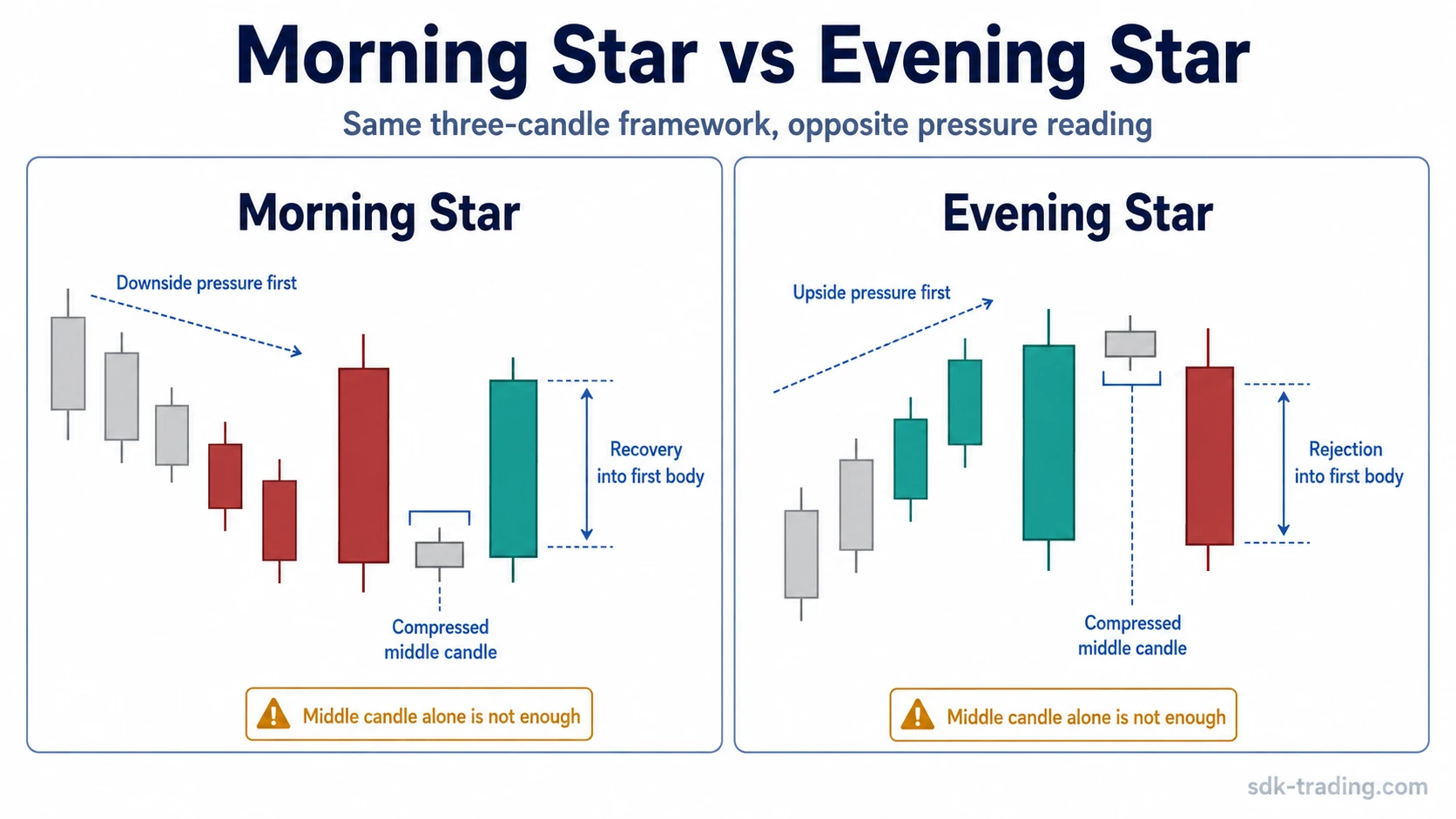
A Morning Star and an Evening Star are mirrored three-candle candlestick patterns: the Morning Star forms after downside pressure and shows recovery, while the Evening Star forms after upside pressure and shows rejection.
They are easy to confuse because both use the same broad sequence: an impulse candle, a smaller middle candle, and a third candle that moves in the opposite direction. The boundary is not the middle candle alone. The correct label depends on the direction of the prior pressure and how far the third candle moves back into the first candle’s body.
Key Points
- Morning Star: downside pressure first, smaller middle candle, then bullish recovery into the first candle’s body.
- Evening Star: upside pressure first, smaller middle candle, then bearish rejection into the first candle’s body.
- Main distinction: the same three-candle framework receives opposite meaning because the prior pressure and third candle point in opposite directions.
- Common mistake: treating any small middle candle as enough, without checking context and third-candle depth.
Morning Star vs Evening Star: The Core Difference
The Morning Star belongs to a recovery structure. It appears after sellers have already pushed price lower, then shows a pause or compression candle, followed by a bullish candle that recovers meaningful ground.
The Evening Star belongs to a rejection structure. It appears after buyers have already pushed price higher, then shows a pause or compression candle, followed by a bearish candle that gives back meaningful ground.
The cleanest distinction is directional. Morning Star asks whether downside pressure is losing control. Evening Star asks whether upside pressure is being rejected. Both readings remain conditional if the third candle is shallow, closes indecisively, or does not meaningfully challenge the body of the first candle.
Comparison Criteria
| Criterion | Morning Star | Evening Star |
|---|---|---|
| Prior pressure | Downside pressure first | Upside pressure first |
| First candle | Bearish candle showing supply pressure | Bullish candle showing demand pressure |
| Middle candle | Small or compressed candle showing pause, hesitation, or loss of downside momentum | Small or compressed candle showing pause, hesitation, or loss of upside momentum |
| Third candle | Bullish candle that recovers into the first candle’s body | Bearish candle that retraces into the first candle’s body |
| Structural reading | Demand-side recovery attempt after prior selling | Supply-side rejection attempt after prior buying |
| Main misread | Calling the structure too early when the recovery candle is shallow | Calling the structure too early when the rejection candle is shallow |
| Related boundary | Morning Doji Star or Abandoned Baby if doji compression or gap isolation owns the structure | Evening Doji Star or Abandoned Baby if doji compression or gap isolation owns the structure |
Why the Same Three-Candle Framework Has Opposite Meaning
The shared framework is impulse, pause, and opposite movement. That framework is not enough by itself because the same shape can sit in opposite market locations.
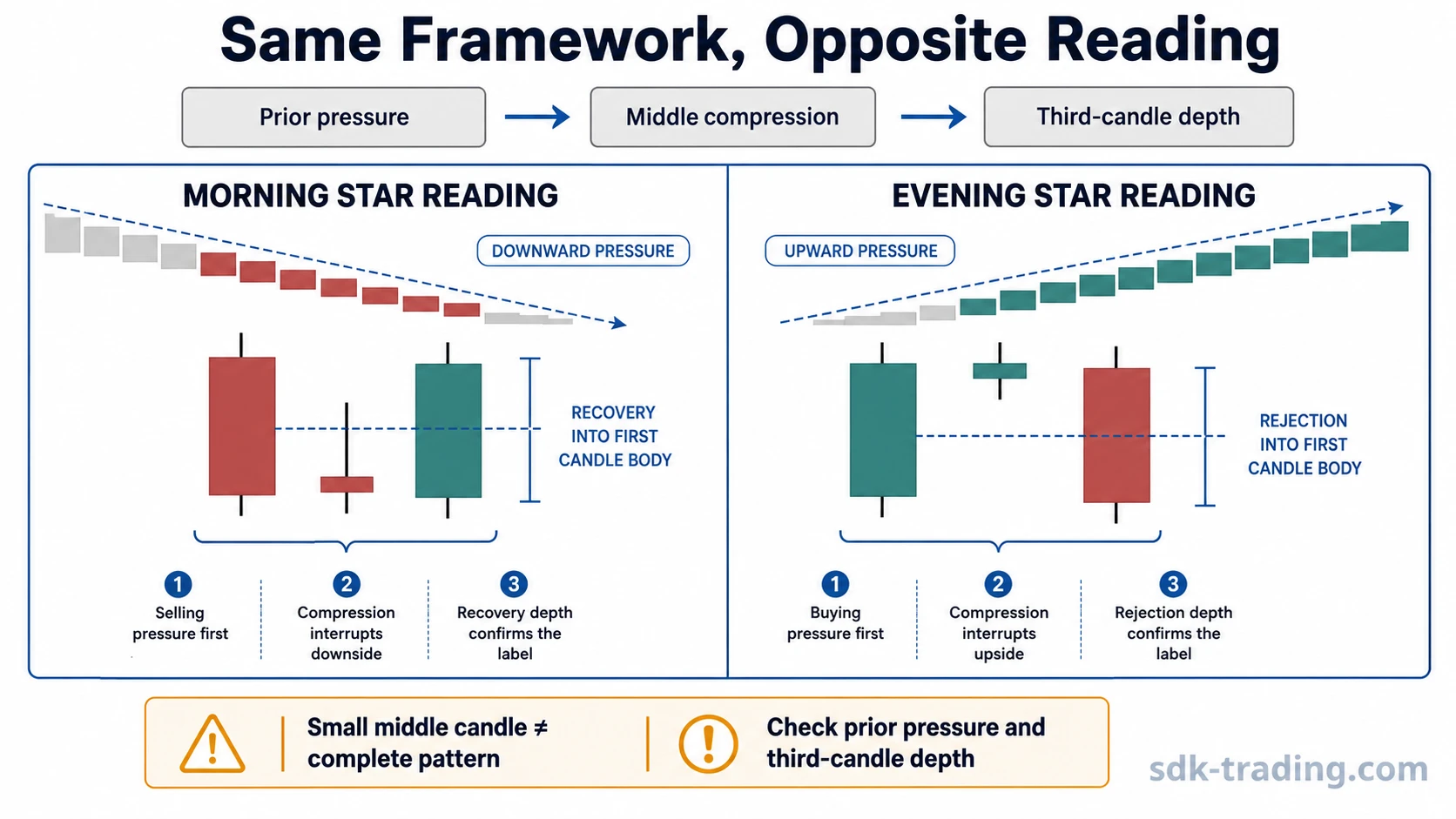
In a Morning Star reading, the first candle shows sellers pressing lower. The middle candle shows that the downside push is no longer expanding cleanly. The third candle matters because it shows whether buyers can recover enough of the first candle’s body to change the immediate reading from continued pressure to potential recovery.
In an Evening Star reading, the first candle shows buyers pressing higher. The middle candle shows that the upside push is no longer expanding cleanly. The third candle matters because it shows whether sellers can reject enough of the first candle’s body to change the immediate reading from continuation to potential distribution or rejection.
Decision boundary: a Morning Star is assigned when the three-candle structure appears after downside pressure and the third candle recovers meaningfully. An Evening Star is assigned when the structure appears after upside pressure and the third candle rejects meaningfully.
When the Morning Star Label Fits
The Morning Star label is strongest when the sequence follows visible downside pressure rather than sideways noise. Sellers should control the first candle, the middle candle should interrupt that pressure, and the third candle should recover enough of the first candle’s body to make the prior selling look less accepted.
A weak Morning Star reading appears when the third candle is small, closes near the middle candle, or leaves the first candle mostly unrecovered. In that case, the sequence may show hesitation, but not enough recovery depth to separate it from ordinary consolidation.
Context also matters. A Morning Star printed after a long, noisy sideways range has less diagnostic value than one that appears after a clear downside push. The pattern is most useful as a classification tool when the prior direction is visible and the third candle changes the pressure balance.
When the Evening Star Label Fits
The Evening Star label is strongest when the sequence follows visible upside pressure. Buyers should control the first candle, the middle candle should interrupt that advance, and the third candle should reject enough of the first candle’s body to make the prior buying look less accepted.
A weak Evening Star reading appears when the third candle only drifts slightly lower, closes near the middle candle, or does not retrace far into the first candle. That structure may show hesitation, but it does not create a strong rejection boundary.
The label becomes less useful when the structure appears in the middle of a flat range or after an unclear advance. Without prior upside pressure, the third candle is harder to read as rejection because there is no clean prior demand push to reject.
Same Scenario, Different Reading
A realistic chart-reading difference can appear around a prior reaction zone. Price sells down into that area and prints a large bearish candle. The next candle compresses, with a smaller body and less directional range. A third candle then pushes back into the body of the first candle and closes with a visible recovery. That sequence fits a Morning Star reading because the market first showed downside pressure, then interrupted it, then recovered against it.
Now reverse the pressure. Price advances into a prior reaction zone and prints a large bullish candle. The next candle compresses near the upper area. A third candle then moves back down into the body of the first candle and fails to hold the higher area. That sequence fits an Evening Star reading because the market first showed upside pressure, then paused, then rejected the advance.
The temptation is to call both structures “a reversal pattern” and stop there. That is incomplete. The better diagnostic question is which side was pressing first, and whether the third candle did enough to challenge that pressure.
| Reading question | Morning Star answer | Evening Star answer |
|---|---|---|
| What pressure came first? | Selling pressure | Buying pressure |
| What did the middle candle do? | Interrupted downside expansion | Interrupted upside expansion |
| What must the third candle show? | Recovery into the prior bearish body | Rejection into the prior bullish body |
| What weakens the read? | Shallow recovery or no acceptance above the middle area | Shallow rejection or quick acceptance back near the upper area |
Common Misreads
| Misread | Why it is incomplete | Safer diagnostic check |
|---|---|---|
| Calling the pattern from the middle candle alone | The middle candle only shows pause or compression. | Check the prior pressure and the third-candle depth. |
| Using “bullish vs bearish” as the only distinction | Direction matters, but the location of prior pressure gives the label its meaning. | Ask whether the sequence follows downside pressure or upside pressure. |
| Accepting a shallow third candle | A small opposite candle may show hesitation, not a completed three-candle boundary. | Look for meaningful recovery or rejection into the first candle’s body. |
| Ignoring the surrounding range | Inside sideways price action, three-candle labels can become noisy. | Check whether the structure appears after a visible directional push. |
| Treating the pattern as a standalone decision | A candlestick pattern is context, not a complete trading process. | Use it as one diagnostic layer alongside structure and later acceptance or failure. |
How Nearby Triple-Candle Patterns Differ
Several nearby patterns can resemble a Morning Star or Evening Star at first glance, but each has a different boundary.
| Nearby pattern | Main boundary | How it differs |
|---|---|---|
| Morning Doji Star | Middle candle is specifically a doji or near-doji | The doji quality carries more weight than in a normal Morning Star. |
| Evening Doji Star | Middle candle is specifically a doji or near-doji | The rejection structure is similar to Evening Star, but the middle candle has stricter compression. |
| Abandoned Baby Candlestick | Middle candle is isolated by gaps | The gap separation is the defining feature, not only the recovery or rejection candle. |
| Three White Soldiers | Three consecutive bullish candles | It is not an impulse, pause, and opposite-candle structure. |
The safest way to separate these patterns is to identify what owns the structure: third-candle recovery, third-candle rejection, doji compression, gap isolation, or consecutive directional candles.
FAQ
Is a Morning Star just the bullish version of an Evening Star?
They are mirrored structures, but the distinction is more specific than bullish versus bearish. Morning Star follows downside pressure and requires recovery. Evening Star follows upside pressure and requires rejection.
Does the middle candle have to be a doji?
No. A doji can appear in related doji-star variants, but a standard Morning Star or Evening Star can use a small or compressed middle candle. The third candle still needs meaningful recovery or rejection.
How deep should the third candle move?
The cleaner reading has the third candle move meaningfully into the first candle’s body. If the move is shallow, the structure may show hesitation rather than a clear Morning Star or Evening Star boundary.
Can either pattern work without trend context?
The label becomes weaker without visible prior pressure. Morning Star needs downside pressure first, while Evening Star needs upside pressure first. In a flat range, the same candles may be only local noise.