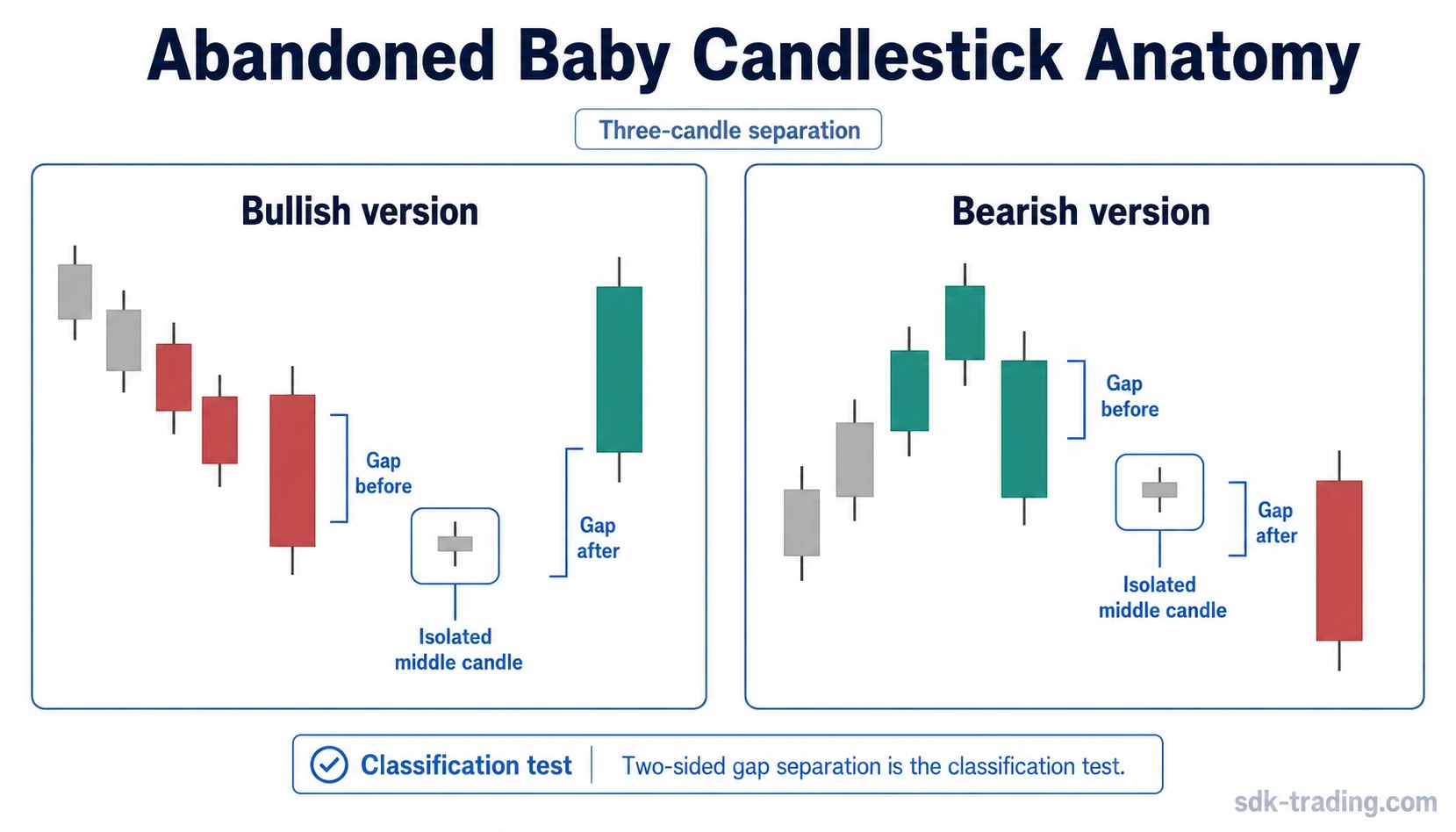
An abandoned baby candlestick is a rare three-candle formation where the middle candle is separated by a gap before and after, creating visible three-candle separation on the chart.
The useful test is structural. A valid reading needs a first candle that extends the prior move, a small middle candle that stands apart from nearby price action, and a third candle that moves away from that isolated middle candle. Bullish and bearish versions use the same isolation logic in opposite directions.
Key Points
- A cleaner abandoned baby has a visible gap before the middle candle and a visible gap after it.
- The middle candle is usually a doji or very small-bodied candle, but the body alone is not enough.
- The pattern is stronger as a classification when the middle candle remains isolated instead of overlapping surrounding price action.
- A weak or invalid reading usually comes from partial gaps, noisy overlap, or a third candle that quickly erases the separation.
What Is an Abandoned Baby Candlestick?
An abandoned baby candlestick is a triple-candle pattern built around an isolated middle candle. The name comes from the way the middle candle appears visually separated from the first and third candles.
The middle candle often has a doji-like body, which means the open and close are very close together. A small body alone does not create the abandoned baby. The defining feature is the gap structure around that middle candle.
The pattern is usually read as an exhaustion structure because the prior move extends into the first candle, stalls in an isolated middle candle, and then shifts away from that isolated area. That does not make the structure a prediction. It only defines what the candle sequence is showing.
How the Abandoned Baby Candlestick Forms
The abandoned baby forms through three visible steps. First, price continues in the direction of the prior move. Second, a small-bodied candle appears after a gap, leaving it separated from the previous candle. Third, price gaps away from the middle candle and moves in the opposite direction.
Core identification test:
- The structure has three candles.
- The first candle extends the prior direction.
- The middle candle is small-bodied, often doji-like, and visibly isolated.
- There is a gap before the middle candle.
- There is a gap after the middle candle.
- The third candle moves away from the isolated middle candle.
The gap before and after the middle candle is the classification filter. Without that separation, the same chart area may be closer to a morning star, evening star, morning doji star, evening doji star, or another small-body candle sequence.
In liquid markets or intraday charts, perfect gaps may be less common. That makes the diagnostic boundary stricter, not looser. If the middle candle is not clearly separated, the reading becomes questionable rather than automatically valid.
Why Gap Integrity Matters
Gap integrity means the middle candle remains visually separate from the first and third candles. The cleaner the separation, the easier it is to classify the structure as an abandoned baby instead of a looser three-candle pause.
A strong gap before the middle candle shows that the prior move extended into a new price area. A strong gap after the middle candle shows that price moved away from that isolated area rather than continuing to trade around it.
The gap test also prevents a common false positive: calling any doji between two larger candles an abandoned baby. A doji can appear in many patterns. The abandoned baby requires the doji-like candle to be separated by price gaps on both sides.
Bullish vs Bearish Abandoned Baby Candlestick
A bullish abandoned baby appears after downside pressure. The first candle continues lower, the middle candle gaps down and becomes isolated, and the third candle gaps up away from the isolated candle.
A bearish abandoned baby appears after upside pressure. The first candle continues higher, the middle candle gaps up and becomes isolated, and the third candle gaps down away from the isolated candle.
| Version | Prior move | Middle candle position | Third candle behavior | Diagnostic reading |
|---|---|---|---|---|
| Bullish abandoned baby | Downward pressure | Gaps lower and stands apart | Gaps upward away from the middle candle | Possible downside exhaustion structure |
| Bearish abandoned baby | Upward pressure | Gaps higher and stands apart | Gaps downward away from the middle candle | Possible upside exhaustion structure |
The direction changes, but the classification test does not. Both versions need a prior move, an isolated middle candle, and a gap on each side of that middle candle.
Abandoned Baby Diagnostic Boundary Map
The abandoned baby is easiest to misread when a chart contains a small candle near a turn. The boundary map separates cleaner readings from weak or invalid versions.
| Reading area | Cleaner abandoned baby | Weak or questionable version | Invalid or false positive | Why it matters |
|---|---|---|---|---|
| Middle candle isolation | The middle candle stands clearly apart from both neighboring candles. | The middle candle is slightly separated but still close to nearby ranges. | The middle candle overlaps normal surrounding price action. | Isolation is the feature that separates the abandoned baby from ordinary small-body pauses. |
| First gap | The first gap clearly separates the middle candle from the prior candle. | The gap is small, partial, or visible only on a narrow timeframe. | No real gap appears before the middle candle. | The first gap creates the abandoned middle-candle location. |
| Second gap | The third candle opens or trades away from the middle candle with clear separation. | The second gap exists but is quickly filled or visually unclear. | The third candle overlaps the middle candle immediately. | The second gap completes the separation on both sides. |
| Third candle behavior | The third candle moves away from the isolated middle candle. | The third candle moves away but closes with hesitation or overlap. | The third candle returns into the middle candle’s area without preserving separation. | The third candle tests whether the isolated area still has diagnostic value. |
| Bullish version | Downside extension, isolated lower middle candle, upward gap away. | Downside pressure exists, but the lower gap is thin or noisy. | The middle candle is only a small candle during sideways trade. | The bullish version still needs full isolation, not only a small candle after decline. |
| Bearish version | Upside extension, isolated upper middle candle, downward gap away. | Upside pressure exists, but the upper gap is thin or quickly overlapped. | The middle candle is just a small candle near the high without two-sided separation. | The bearish version depends on the same gap logic as the bullish version. |
| Similar-pattern confusion | The middle candle is abandoned by gaps on both sides. | The structure resembles a star pattern but the gaps are incomplete. | The sequence belongs more naturally to a morning star, evening star, morning doji star, or evening doji star family. | Nearby triple-candle structures can look similar without meeting the abandoned baby test. |
| Follow-through / failed diagnostic value | Later price behavior respects the isolated area instead of immediately erasing it. | Price hesitates around the isolated area and reduces clarity. | Price immediately trades back through the isolated area and removes the separation value. | The pattern weakens when later candles treat the gap area as ordinary overlap. |
Clean, Weak, and Invalid Abandoned Baby Readings
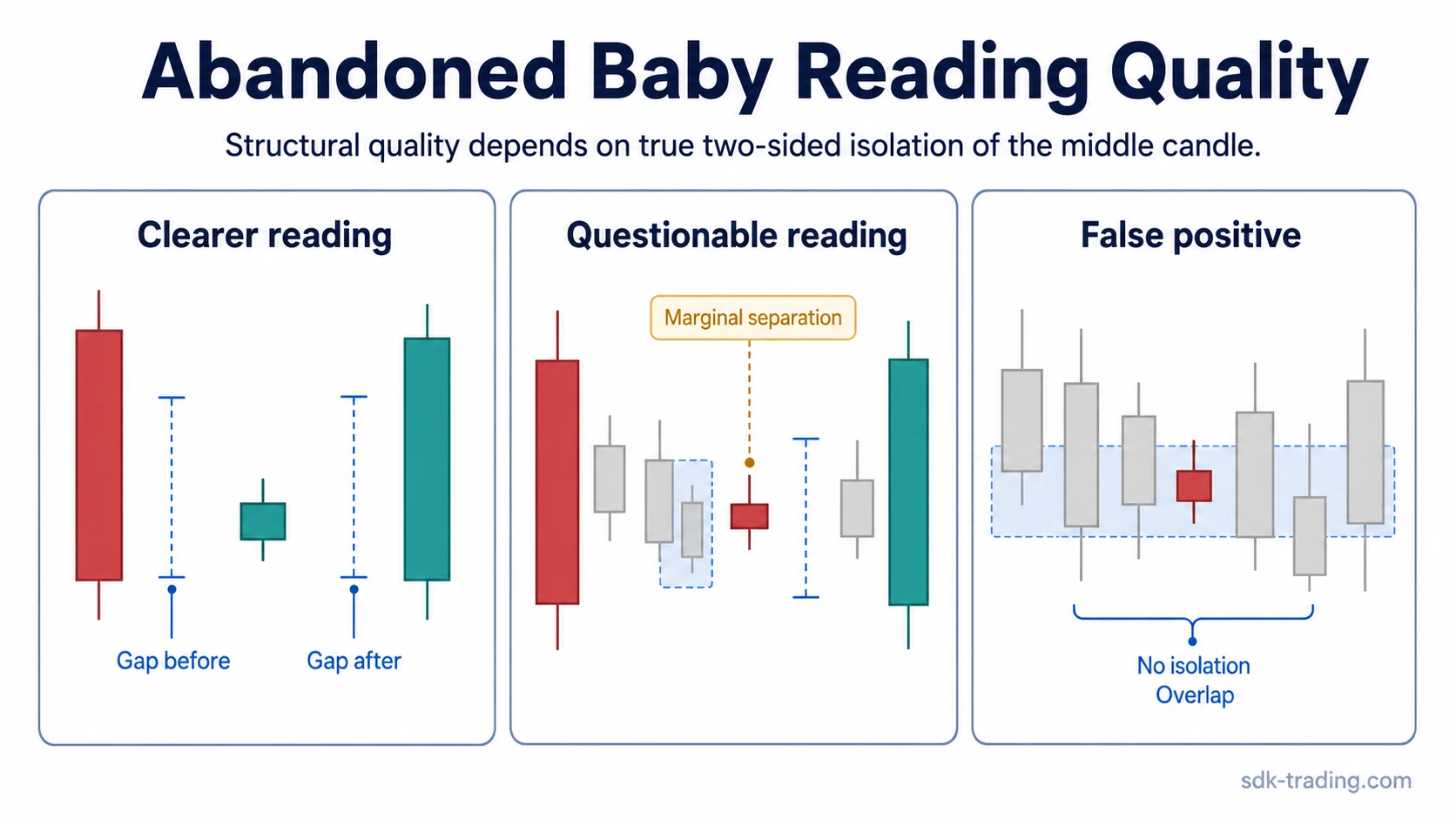
A clean abandoned baby has a visible gap before the middle candle, a visible gap after it, and a middle candle that remains isolated from both surrounding ranges. The middle candle can be doji-like, but the isolation is the stronger classification feature.
A weak abandoned baby has the same general shape, but one or both gaps are marginal. It may still show hesitation around the prior move, but the classification becomes less defensible if the middle candle is not clearly separated.
An invalid abandoned baby reading usually comes from forcing the label onto a normal small candle, an ordinary doji pause, or a loose star pattern. If the chart does not preserve the gap before and after the middle candle, the abandoned baby classification is not supported.
Abandoned Baby vs Similar Candlestick Patterns
The abandoned baby overlaps visually with several triple-candle structures, but its boundary is narrower. The middle candle must be visibly abandoned by gaps on both sides.
An evening doji star can also use a doji-like middle candle after upside pressure, but the abandoned baby label requires stricter two-sided isolation. Morning star and evening star structures may show a pause and directional change without the same two-gap isolation.
The distinction also matters against broader triple-candle continuation and pressure structures. For example, patterns close to three white soldiers focus on a sequence of directional bodies, while the abandoned baby focuses on the isolated middle candle.
| Nearby structure | Main overlap | Boundary against abandoned baby |
|---|---|---|
| Morning star | Three-candle structure after downside pressure | May not require the middle candle to be fully isolated by gaps on both sides. |
| Evening star | Three-candle structure after upside pressure | Can show a transition without the abandoned baby’s stricter two-gap separation. |
| Morning doji star | Doji-like middle candle after a decline | The doji feature matters, but the abandoned baby label needs gap integrity. |
| Evening doji star | Doji-like middle candle after an advance | The abandoned baby version is narrower because the middle candle must stand apart. |
| Ordinary doji pause | Small-bodied candle with open-close compression | A doji without two-sided separation is not an abandoned baby. |
Simple Abandoned Baby Candlestick Example
A cleaner reading can appear when a market has been pushing lower, then gaps into a small isolated candle, and then gaps upward away from that isolated candle. The first gap creates the abandoned area, and the second gap shows that price has moved away from it.
The reading weakens when the middle candle is small but the gaps are marginal. The sequence may still show hesitation, but the abandoned baby label becomes more fragile if the candle is not clearly separated from the surrounding ranges.
The structure becomes invalid when the middle candle is only a normal small candle inside noisy sideways action. In that case, the chart may still contain a single candle within a broader sequence, but the abandoned baby classification is not supported by the gap test.
Common Mistakes With the Abandoned Baby Candlestick
The most common mistake is treating the middle candle’s small body as the whole pattern. The real classification depends on where that candle appears and whether the chart leaves it isolated.
Another mistake is relaxing the gap requirement until any three-candle pause qualifies. That makes the abandoned baby label too broad and blurs it with star patterns, ordinary doji pauses, and noisy pullback structures.
A third mistake is reading the pattern as a complete trading decision. The abandoned baby is a structural observation. Its value comes from the quality of the gap sequence, the surrounding price movement, and whether later behavior preserves or erases the isolated area.
Limitations of the Abandoned Baby Candlestick
The abandoned baby is rare because it requires two visible gaps around the middle candle. Markets that trade continuously, overlap heavily, or show inconsistent gaps may produce many near-patterns and few clean examples.
Feed differences can also affect the reading. A structure that looks separated on one chart may look overlapped on another chart if session settings, liquidity, or price aggregation differ.
The safest classification is conservative: if the middle candle is not visibly isolated, the structure should be treated as weak or invalid rather than forced into the abandoned baby category.
Abandoned Baby Candlestick FAQ
What does an abandoned baby candlestick mean?
An abandoned baby candlestick means price created a rare three-candle separation around a small middle candle. The structure can reflect exhaustion around the prior move, but its meaning depends on the quality of the two gaps and the isolated middle candle.
How do you identify an abandoned baby candlestick?
Identify an abandoned baby candlestick by looking for three candles: a first candle that extends the prior move, a small isolated middle candle, a gap before that middle candle, and a gap after it.
Is an abandoned baby the same as a morning star or evening star?
No. Morning star and evening star patterns can have a similar three-candle shape, but an abandoned baby requires the middle candle to be visibly separated by gaps on both sides.
Can an abandoned baby candlestick fail?
Yes. The reading weakens or fails when the gaps are unclear, the middle candle is not isolated, or later price action quickly overlaps the area that made the middle candle look abandoned.