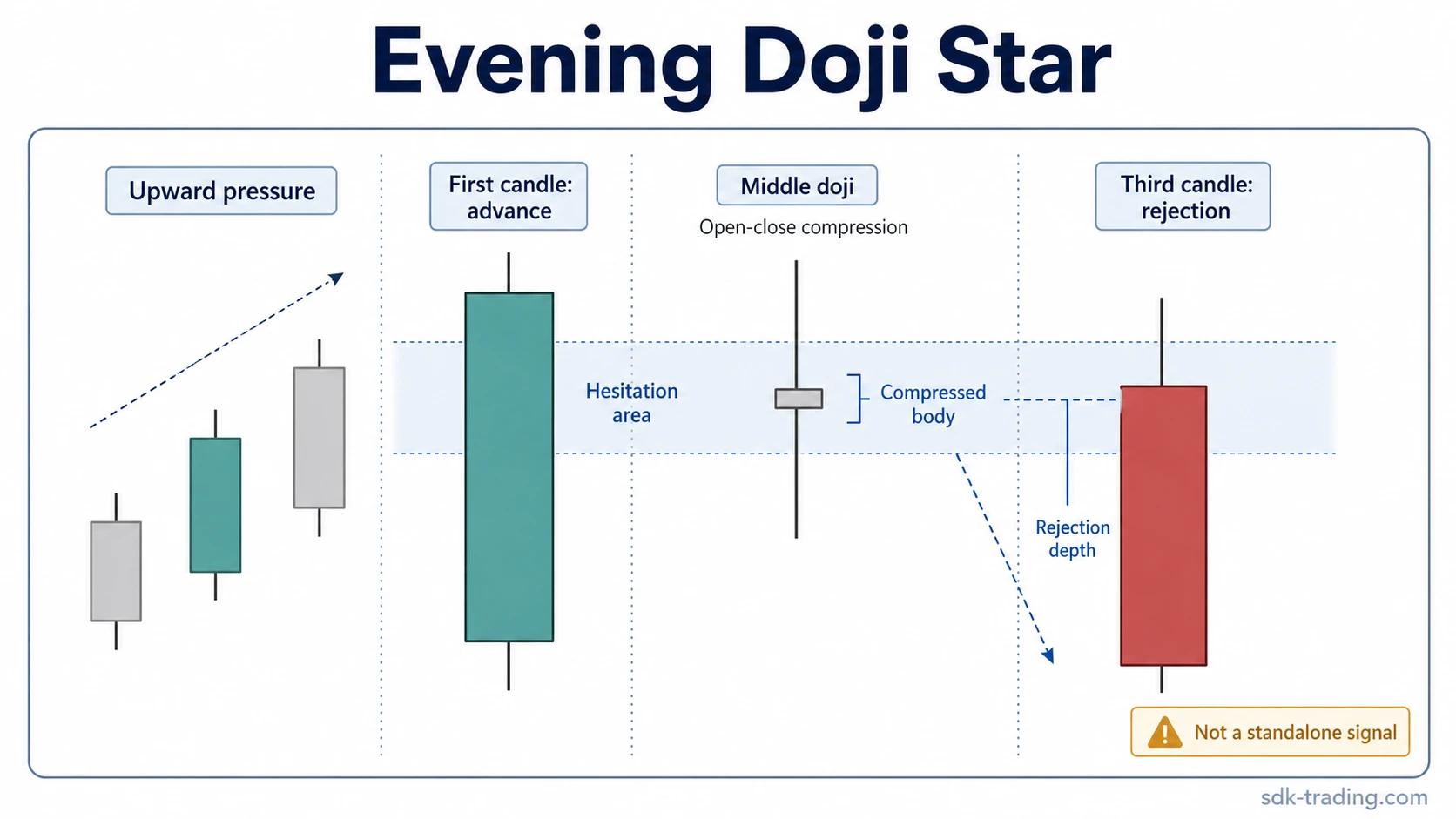
An Evening Doji Star begins as an upside-to-rejection sequence: price advances into a middle doji with open-close compression, then a third candle rejects that hesitation area. The pattern is not just a regular evening formation with any small middle candle. Its diagnostic value depends on the doji-centered pause and on how strongly the third candle pushes back into the prior advance.
The structure can suggest that upside pressure has stalled, but it does not prove that a decline must follow. A cleaner reading needs visible upward pressure before the pattern, a true or near-true doji in the middle, and a bearish third candle with enough body rejection depth to show that buyers failed to hold the hesitation area.
Key Points
- An Evening Doji Star is a three-candle structure that appears after upward pressure.
- The middle candle should show doji-level open-close compression, not just a slightly smaller body.
- The third candle should reject the hesitation area with meaningful bearish body depth.
- A weak reading often has shallow rejection, unclear prior pressure, or quick higher acceptance after the pattern.
- The main boundary is doji quality: without a real doji-style middle candle, the pattern is closer to a broader evening formation.
What Is an Evening Doji Star?
An Evening Doji Star is a bearish-leaning triple candlestick pattern built from three parts: an upward candle, a middle doji that shows open-close compression, and a bearish third candle that moves away from the doji area. The middle doji is the defining feature. It marks a pause after upward pressure before the third candle tests whether that pause becomes rejection.
The pattern belongs to the evening-star family, but it is more specific than a standard evening formation. A regular evening structure may use a small middle candle. An Evening Doji Star requires the middle candle to behave like a doji, where the open and close are very close relative to the candle’s range.
How the Evening Doji Star Forms
The first candle shows that upward pressure is still active. It is usually a bullish candle or a strong candle that extends the prior advance. This first candle does not complete the pattern by itself. It only gives the middle doji something to interrupt.
The second candle is the doji. Its real body is very small because the open and close are close together. That compression shows hesitation after the prior advance. Depending on charting convention and market structure, the doji may appear separated from the first candle body or simply positioned high enough to show a clear transition from upward pressure into balance.
The third candle is the rejection test. A cleaner third candle closes meaningfully back into the first candle’s body area or below a relevant part of the prior advance. That body movement matters more than the candle label alone. Without enough rejection depth, the pattern can remain an unresolved pause rather than a completed bearish doji-star boundary.
| Part of the pattern | What to look for | Why it matters |
|---|---|---|
| First candle | Upward pressure or a strong bullish candle | Creates the advance that the doji later interrupts |
| Middle doji | Very small real body from open-close compression | Shows hesitation after the advance instead of continued control |
| Third candle | Bearish body that rejects the doji area | Tests whether hesitation turns into supply-side pressure |
What Makes the Middle Doji Important
The doji changes the reading because it narrows the middle candle’s job. A generic small-bodied candle can show slower buying, short-term pause, or reduced range. A doji is more compressed: the open and close finish close together, which makes the middle candle less about direction and more about unresolved balance.
That distinction is the main reason the Evening Doji Star deserves its own boundary. The pattern does not depend only on a bearish third candle. It depends on the shift from upside pressure, to doji compression, to third-candle rejection. If the middle candle has a visible real body and does not behave like a doji, the structure is usually better read as a broader Evening Star variation rather than a clean Evening Doji Star.
How to Identify an Evening Doji Star Without Overreading It
Identification should start with the sequence, not the name. A candle label can be misleading if the surrounding structure does not show the upside-to-rejection transition.
- Look for prior upward pressure before the three-candle structure begins.
- Check that the first candle reflects continued upside participation.
- Confirm that the second candle has doji-level open-close compression.
- Check whether the doji sits near the upper part of the prior advance rather than in a random sideways range.
- Look for a third bearish candle that rejects the doji area with meaningful body depth.
- Treat quick acceptance back above the rejection area as a warning that the reading may have failed.
The Common Misread: Any Small Middle Candle Is Not Enough
The most common mistake is treating the pattern as “an Evening Star with any small middle candle.” That shortcut removes the doji-specific information. The middle candle should show open-close compression strong enough to represent unresolved balance, not just a smaller candle after an advance.
A second mistake is treating any bearish third candle as enough. The third candle needs body rejection depth. If the third candle is shallow, closes near the doji, or fails to move back into the prior advance, the pattern may show hesitation but not a strong bearish doji-star boundary.
| Misread | Better diagnostic check |
|---|---|
| The middle candle is small, so it must be an Evening Doji Star. | Check whether the open and close are compressed enough to behave like a doji. |
| The third candle is red, so the pattern is complete. | Check whether the third candle meaningfully rejects the doji area and prior advance. |
| The structure appears near a high, so it must be bearish. | Check whether price quickly accepts higher again after the rejection attempt. |
Clean, Weak, and Invalid Evening Doji Star Readings
The pattern is easier to evaluate when it is separated into clean, weak, and invalid readings. This keeps the candle label from becoming a mechanical conclusion.
| Reading quality | Observable structure | Interpretation boundary |
|---|---|---|
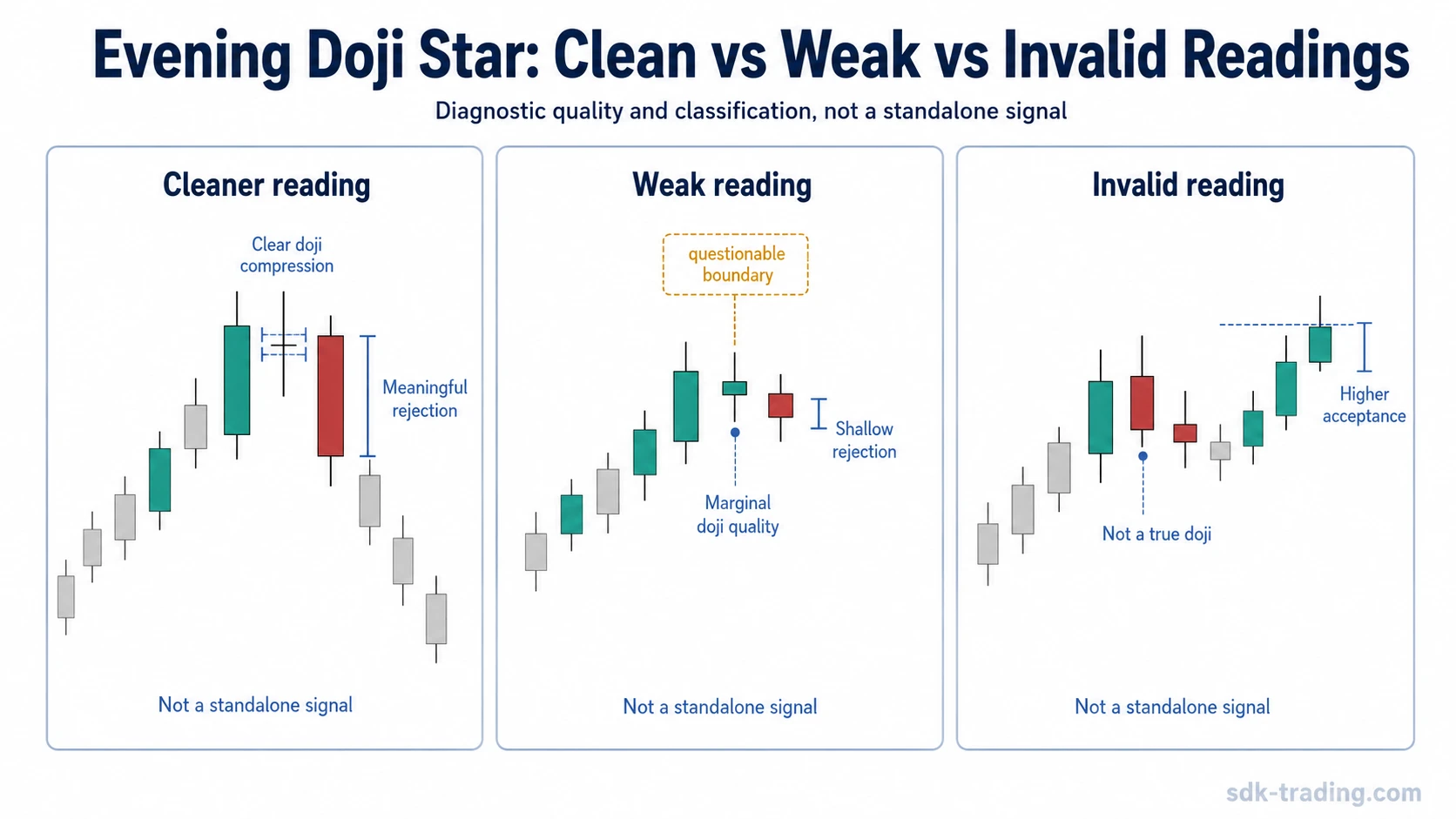
| Clean | Clear upward pressure, doji-level open-close compression, and a third candle with meaningful bearish body rejection. | The doji-centered evening transition is visible, and price does not quickly accept above the rejection area. |
| Weak | Prior pressure is unclear, the middle candle is only marginally doji-like, or the third candle has shallow body rejection depth. | The structure may show an unresolved pause rather than a completed bearish doji-star boundary. |
| Invalid or false positive | No real doji, no meaningful third-candle rejection, or price quickly accepts higher after the apparent pattern. | The candle sequence no longer supports the Evening Doji Star reading and should not be treated as a completed pattern. |
A Diagnostic Reading Sequence
A common scenario is that price advances into an area where prior buying has already become stretched. The first candle extends the move, then the middle candle opens and closes almost at the same level while still trading through a wider range. That doji can be tempting to read as immediate exhaustion, but by itself it only shows unresolved balance.
The reading becomes more defensible if the third candle rejects the doji area and closes with enough body depth back into the prior advance. It becomes weaker if the third candle is shallow, stalls near the doji, or is followed by quick higher acceptance. In that weaker version, the market has not clearly moved from hesitation into rejection.
Evening Doji Star vs Similar Patterns
Nearby patterns can look similar because several of them involve three-candle transitions or small middle candles. The separation should stay focused on structure: direction before the pattern, middle-candle quality, gap or isolation behavior, and how the third candle responds.
| Pattern | Main difference | Boundary to check |
|---|---|---|
| Evening Doji Star | Uses a doji middle candle after upward pressure. | Open-close compression plus third-candle rejection depth. |
| Evening Star | The middle candle can be small-bodied without being a true doji. | Do not call it doji-based unless the middle candle has doji-level compression. |
| Morning Doji Star | Uses the opposite direction: downside pressure, middle doji, then bullish rejection. | Direction before the pattern separates the bearish evening version from the bullish doji-star version. |
| Morning Star | Belongs to the opposite morning/evening family and does not require the same bearish context. | Morning Star logic starts from downside pressure, not upside pressure. |
| Abandoned Baby | Requires cleaner isolation around the middle candle, usually through clearer gap separation. | If the middle candle is not clearly isolated, the structure may be a doji-star variation rather than an abandoned-baby structure. |
Limitations and Failure Conditions
An Evening Doji Star weakens when the third candle does not reject enough of the prior advance. A shallow bearish body can leave the structure unresolved, especially if the candle closes near the doji rather than pushing back into the first candle’s range.
The reading also weakens when price quickly accepts higher after the apparent rejection. That behavior can show that the doji pause did not become supply-side pressure. In that case, the pattern label remains less useful than the failed bearish doji-star boundary.
Gap wording also needs care. Some sources describe the middle doji as separated from the first and third candles, while real-market charts may show partial separation rather than clean gaps. The safer reading is to focus on whether the middle doji is visibly distinct enough to show a transition, and whether the third candle meaningfully rejects that transition area.