The evening star candlestick pattern is a bearish three-candle structure that appears after upside pressure and moves from advance, to hesitation, to downside rejection. Its useful reading comes from the candle relationship: the third candle must close far enough back into the first candle’s real body to show that the prior upside sequence has been rejected, not guaranteed to reverse.
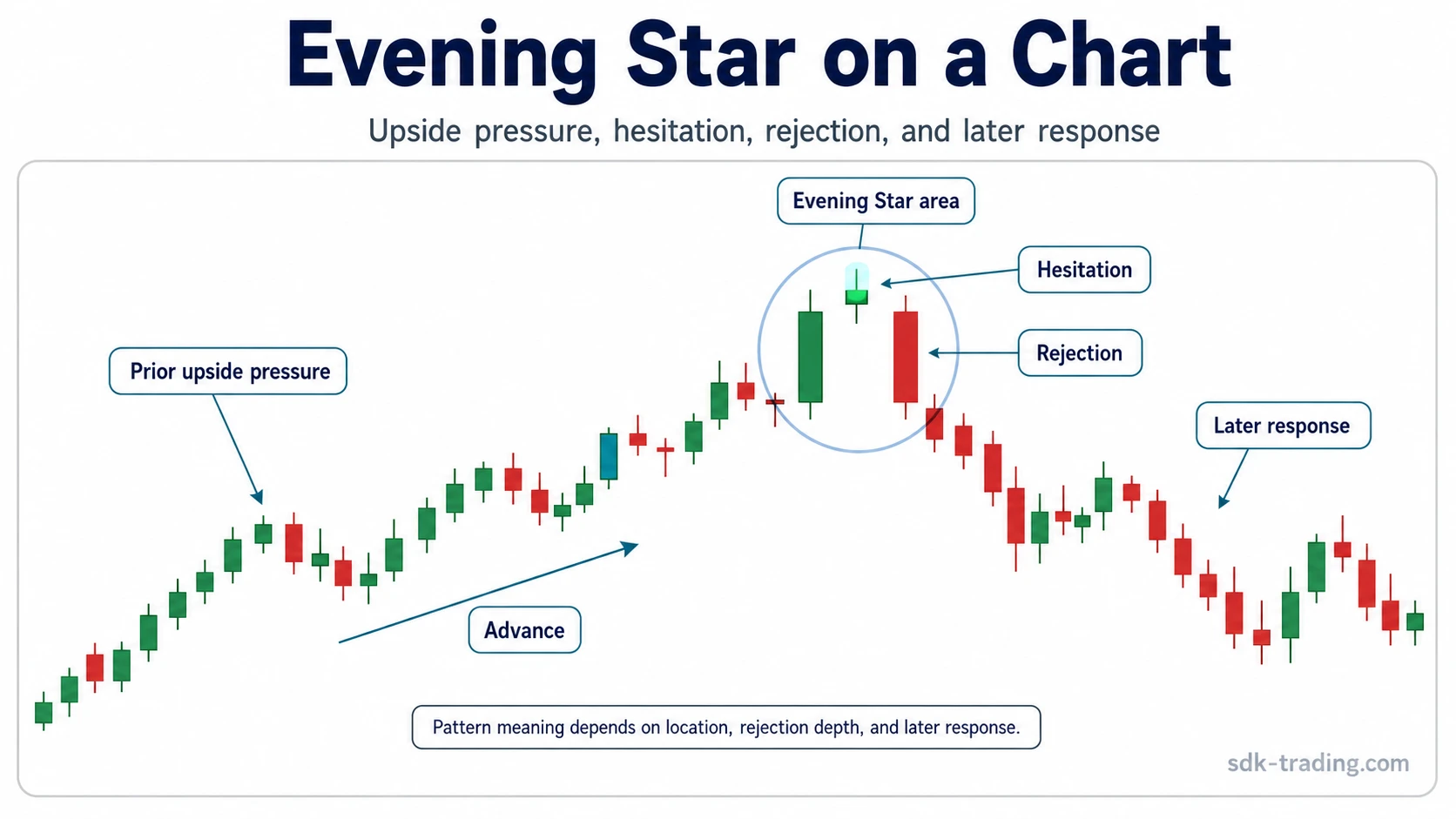
Quick reading checks:
- The evening star is a triple candlestick pattern, not a single-candle signal.
- The first candle shows upside continuation, the middle candle shows hesitation, and the third candle shows rejection.
- A cleaner reading usually needs the third candle to close meaningfully into the first candle’s real body.
- The pattern weakens when it appears in chop, after shallow upside pressure, or with a third candle that barely rejects the prior move.
Evening Star Pattern Classification
The evening star is a candlestick pattern, a triple-candle formation, and a rejection structure after upside pressure. It is not a complete trading plan and should not be treated as a standalone market instruction.
| Classification | What it means | What it does not mean |
|---|---|---|
| Candlestick pattern | It is read from candle bodies, wicks, closes, and sequence. | It does not predict the next move by itself. |
| Triple candlestick pattern | All three candles are needed for the structure. | One small candle near a high is not enough. |
| Rejection pattern | The third candle tests whether prior upside pressure is being rejected. | A shallow pullback does not automatically complete the reading. |
Evening Star Pattern Formation and Structure
The structure begins with a visible upward move or upside pressure. The first candle continues that pressure, the second candle creates hesitation near the upper area, and the third candle rejects the prior advance.
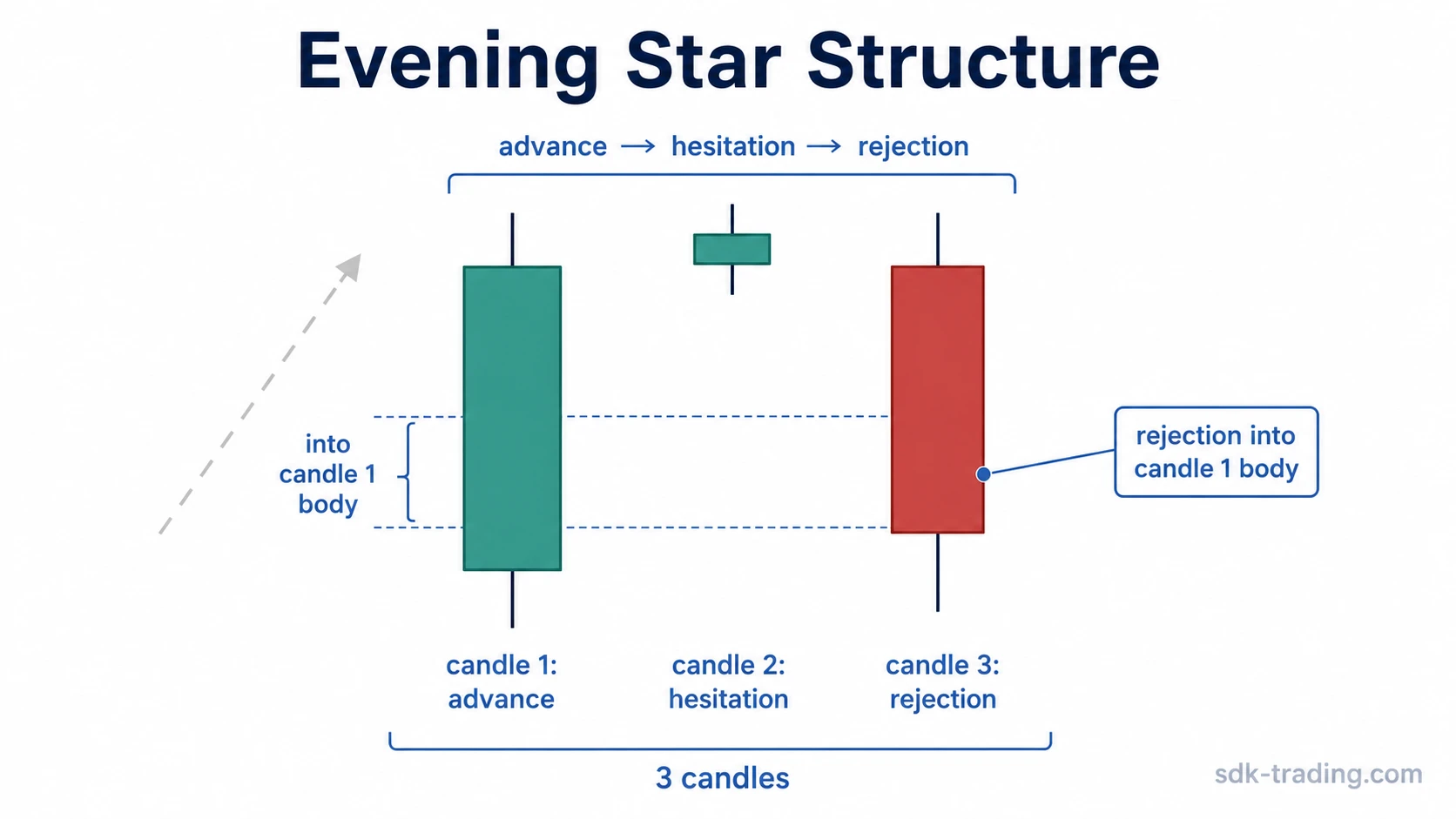
| Candle | Structural role | Cleaner reading | Weaker reading |
|---|---|---|---|
| Candle 1 | Advance candle | Shows clear upside pressure. | Appears inside sideways chop or after little prior movement. |
| Candle 2 | Hesitation candle | Has a small real body near the upper area. | Is too large or does not show real pause. |
| Candle 3 | Rejection candle | Closes meaningfully into the first candle’s real body. | Barely retraces the prior advance. |
The third candle decides whether the structure is only a pause or a real rejection attempt. The close does not need to erase the entire first candle, but it should cut far enough into that body to show that the prior advance has been challenged.
How to Identify an Evening Star
Identification fails when the middle candle is checked before the chart context. The small candle only matters if it appears after upside pressure and separates the final advance from a meaningful rejection candle.
- Start with the prior sequence: the pattern needs visible upside pressure before it forms.
- Check candle 1: it should extend the prior move rather than sit inside random sideways action.
- Check candle 2: it should show pause or hesitation near the upper area.
- Check candle 3: it should close far enough into candle 1’s real body to show rejection.
- Reject the label when the candle group has the shape but not the sequence.
The middle candle can be small bullish, small bearish, spinning-top-like, or doji-like. If the middle candle is specifically doji-like, the structure is closer to an evening doji star.
Clean, Weak, and Invalid Evening Star Readings
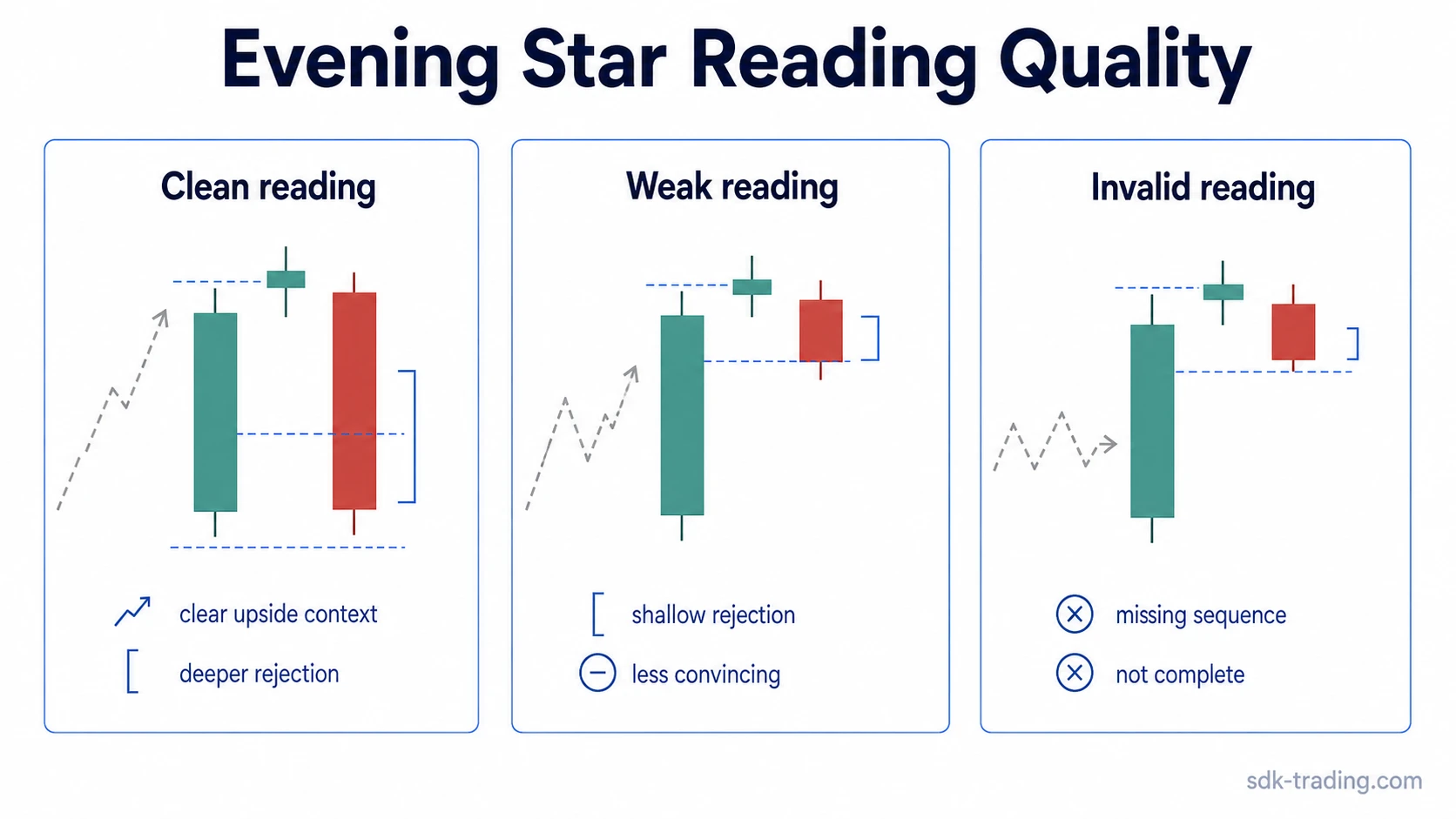
The same three-candle outline can carry different quality depending on context and rejection depth. A clean structure has visible prior upside pressure, a real hesitation candle, and a third candle that rejects enough of the prior move to matter.
| Reading | What it looks like | Interpretation limit |
|---|---|---|
| Clean | Clear upside context, small middle candle, and strong third-candle close into candle 1. | Still needs later context before being treated as meaningful market evidence. |
| Weak | Choppy context, oversized middle candle, or shallow third-candle rejection. | The pattern shape is present, but the rejection message is less convincing. |
| Invalid | No prior upside pressure, no real hesitation candle, or no meaningful rejection into candle 1. | The candle group should not be labeled a complete evening star pattern. |
Evening Star Confirmation and Context
Confirmation should not be reduced to one extra candle. The useful question is whether later price action respects the rejection or immediately absorbs it. A lower follow-through candle, failed recovery above the hesitation area, or broader resistance context can make the rejection more meaningful.
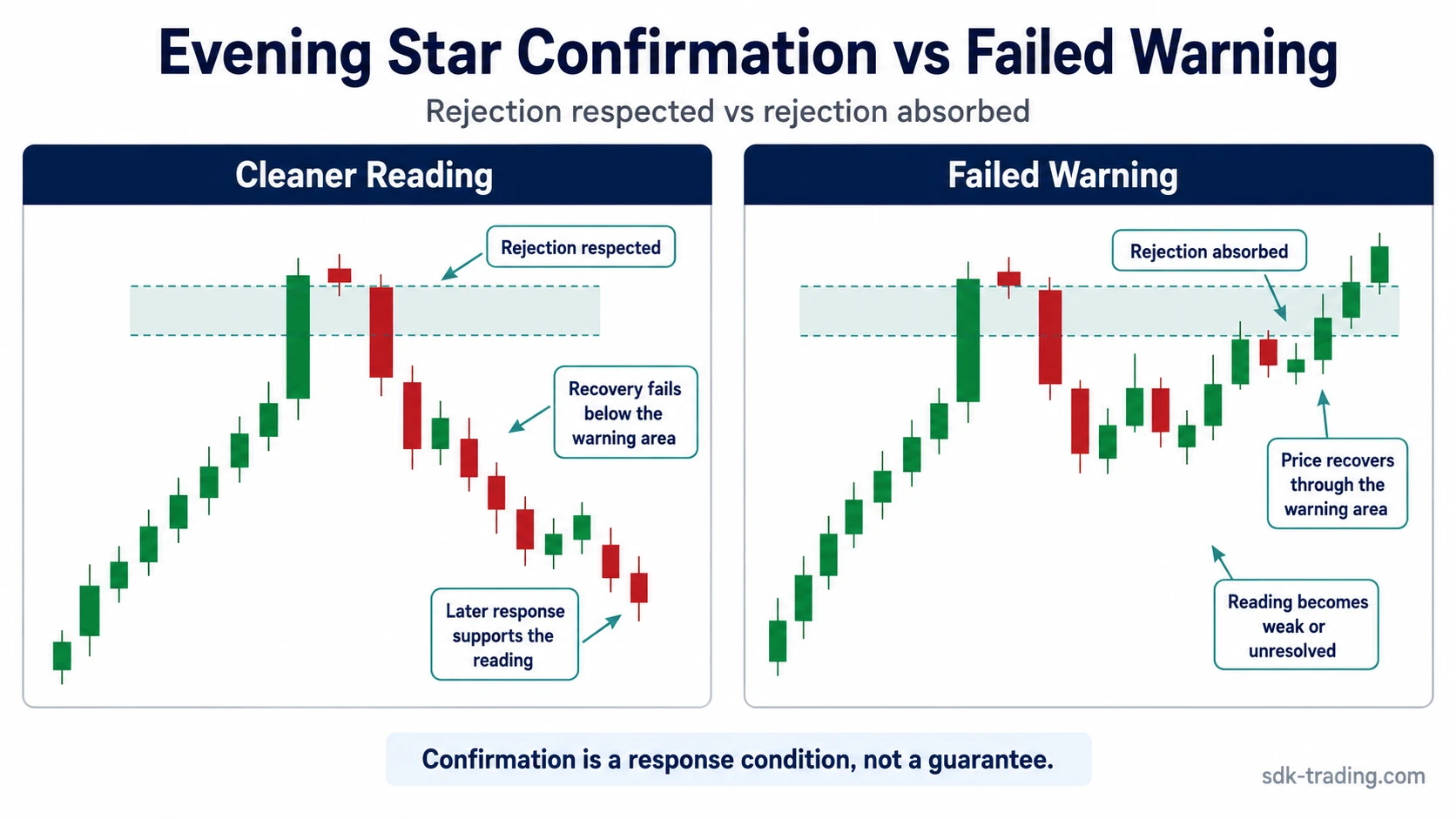
The reading becomes weaker when the next candles recover the rejected area quickly, when volume and range do not support the rejection, or when the structure appears in a sideways market with no prior advance. Candlestick analysis works best as a context layer, not as a full trading system.
Common False Positives
False positives usually appear when three adjacent candles resemble the pattern but do not carry the required sequence. The mistake is labeling the shape before checking context, hesitation quality, and rejection depth.
- No prior upside pressure: the candle group appears inside a range instead of after an advance.
- Weak first candle: the first candle does not show real upside continuation.
- Oversized middle candle: the middle candle expands instead of pausing.
- Shallow third candle: the rejection candle does not close meaningfully into the first candle’s body.
- Mechanical scanner match: the candle count is correct, but the market behavior is not.
Evening Star vs Evening Doji Star
The evening doji star is a stricter variation of the evening star. Both use the same broad sequence of advance, hesitation, and rejection, but the evening doji star requires the middle candle to be specifically doji-like.
| Pattern | Middle candle rule | Main distinction |
|---|---|---|
| Evening star | Small hesitation candle. | The middle candle can be small bullish, small bearish, spinning-top-like, or doji-like. |
| Evening doji star | Doji-like middle candle. | The middle candle has a stricter open-close compression requirement. |
Evening Star vs Morning Star
The evening star and morning star use opposite sequences. An evening star appears after upside pressure and moves from advance to hesitation to rejection. A morning star appears after downside pressure and moves from decline to hesitation to recovery.
| Pattern | Typical context | Three-candle sequence |
|---|---|---|
| Evening star | After upside pressure | Advance → hesitation → downside rejection |
| Morning star | After downside pressure | Decline → hesitation → upside recovery |
The shared logic is the three-candle transition. The difference is direction and context. Doji-star variants use stricter middle-candle hesitation rules.
Evening Star vs Bearish Candlestick Patterns
Nearby bearish candlestick patterns can look similar because they also involve rejection, hesitation, or downside pressure. The difference is the structural rule used to define each pattern.
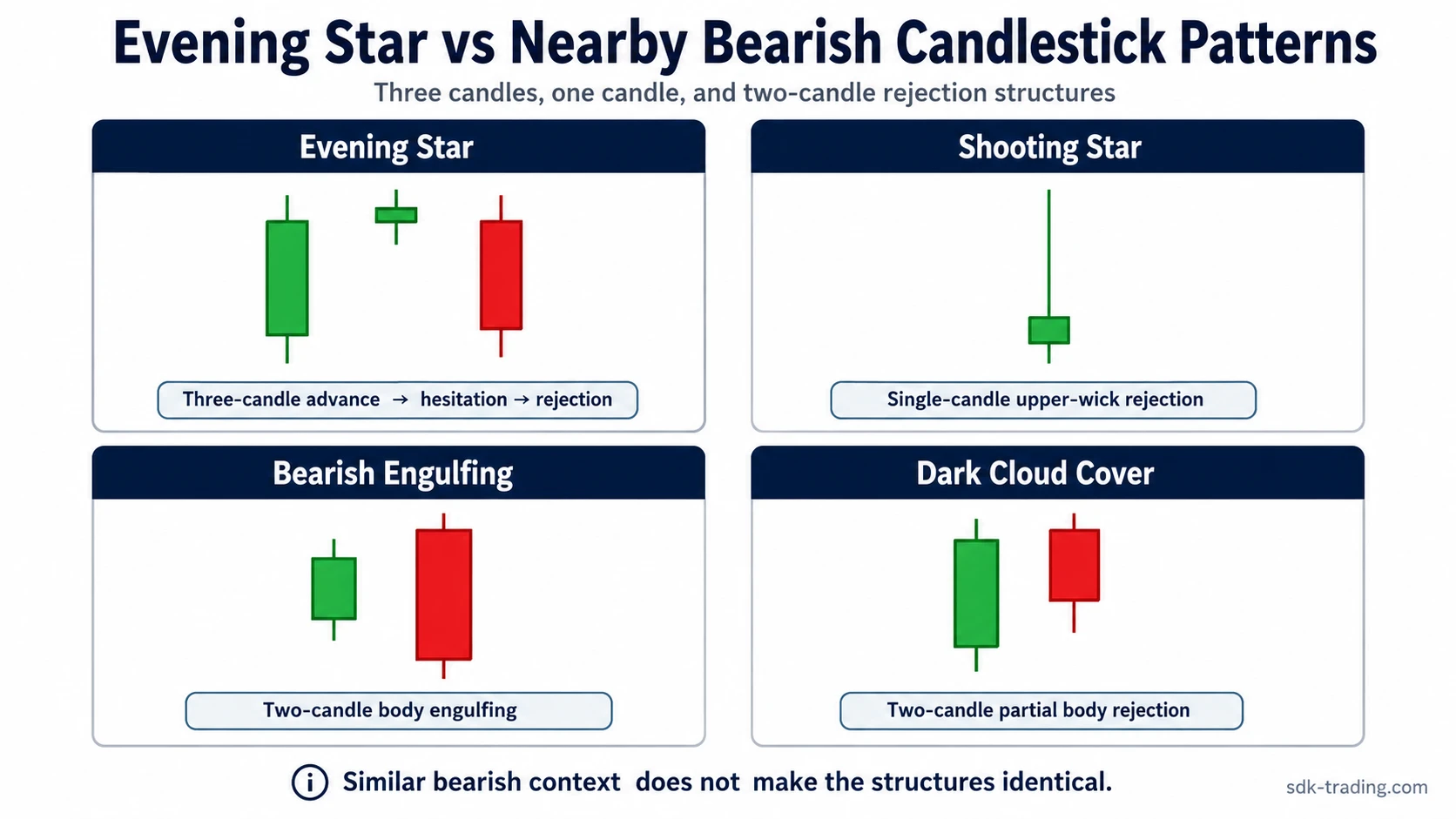
| Pattern | Main structural rule | Key difference from evening star |
|---|---|---|
| Evening star | Three-candle advance, hesitation, and rejection sequence. | Requires a middle hesitation candle between the advance and rejection. |
| Shooting star | Single candle with a long upper wick after an advance. | Does not require a three-candle sequence. |
| Bearish engulfing | Two-candle body relationship where the bearish body engulfs the prior body. | Defined by body coverage, not a three-candle star sequence. |
| Dark cloud cover | Two-candle structure where the second candle closes deeply into the prior bullish body. | Uses partial body rejection instead of a separate middle hesitation candle. |
FAQ
What is an evening star pattern?
An evening star pattern is a three-candle candlestick pattern after upside pressure. It moves from advance, to hesitation, to downside rejection.
Is an evening star always bearish?
It is commonly labeled bearish, but it should not be treated as a guaranteed bearish outcome. Context and later price behavior still matter.
How many candles are in an evening star pattern?
An evening star pattern has three candles: an advance candle, a hesitation candle, and a rejection candle.
What is the most important candle in an evening star?
The third candle is the key diagnostic candle because it shows whether the prior upside move is meaningfully rejected.
What is the difference between an evening star and an evening doji star?
An evening doji star is a stricter variation where the middle candle is doji-like. A standard evening star allows a broader range of small hesitation candles.
What invalidates an evening star pattern?
The reading is invalid when there is no prior upside pressure, no real hesitation candle, or no meaningful third-candle rejection into the first candle’s body.
How is an evening star different from a morning star?
An evening star appears after upside pressure and shows rejection. A morning star appears after downside pressure and shows recovery.