A morning doji star is a three-candle candlestick pattern that forms after downside pressure. It starts with a bearish candle, moves into a small doji or near-doji that shows open-close compression, and then adds a recovery candle that pushes back into the first candle’s body.
The pattern is not defined only by the presence of a small middle candle. Its quality depends on the sequence: selling pressure first, hesitation through the middle doji, and enough third-candle recovery to show that the prior decline has been challenged. A shallow recovery or a weak middle candle can turn the same visual idea into a poor reading.
Key Points
- A morning doji star is a three-candle structure that appears after a decline or downside pressure.
- The middle candle should be a doji or near-doji, with the open and close compressed close together.
- The third candle should recover meaningfully into the first candle’s body, not merely print a small bounce.
- Gap rules vary across sources, so the gaps should be treated as a classification detail rather than the only test.
- The pattern weakens when the doji is not compressed, the recovery is shallow, or later candles accept lower prices again.
What Is a Morning Doji Star?
A morning doji star is a three-candle recovery structure built around a doji in the middle of a morning-star formation. The first candle shows downside pressure, the second candle shows hesitation through open-close compression, and the third candle shows recovery from that hesitation area.
The word “doji” is the important distinction. A regular morning star can have a small-bodied middle candle, but the morning doji star requires the middle candle to behave more like a doji: the open and close should be very close together relative to the candle’s full range.
That compression is what gives the pattern its diagnostic value. It shows that the prior downside move paused before the third candle tested whether buyers could regain enough ground to change the short-term reading.
Morning Doji Star Candlestick Anatomy
The pattern is easiest to read as a sequence rather than as three isolated candles.
| Candle | What it shows | What to check |
|---|---|---|
| First candle | Downside pressure before the pattern | The body should show that sellers were active before the pause. |
| Second candle | Doji or near-doji compression | The open and close should be close together, not just a normal small body. |
| Third candle | Recovery from the doji area | The close should move meaningfully back into the first candle’s body. |
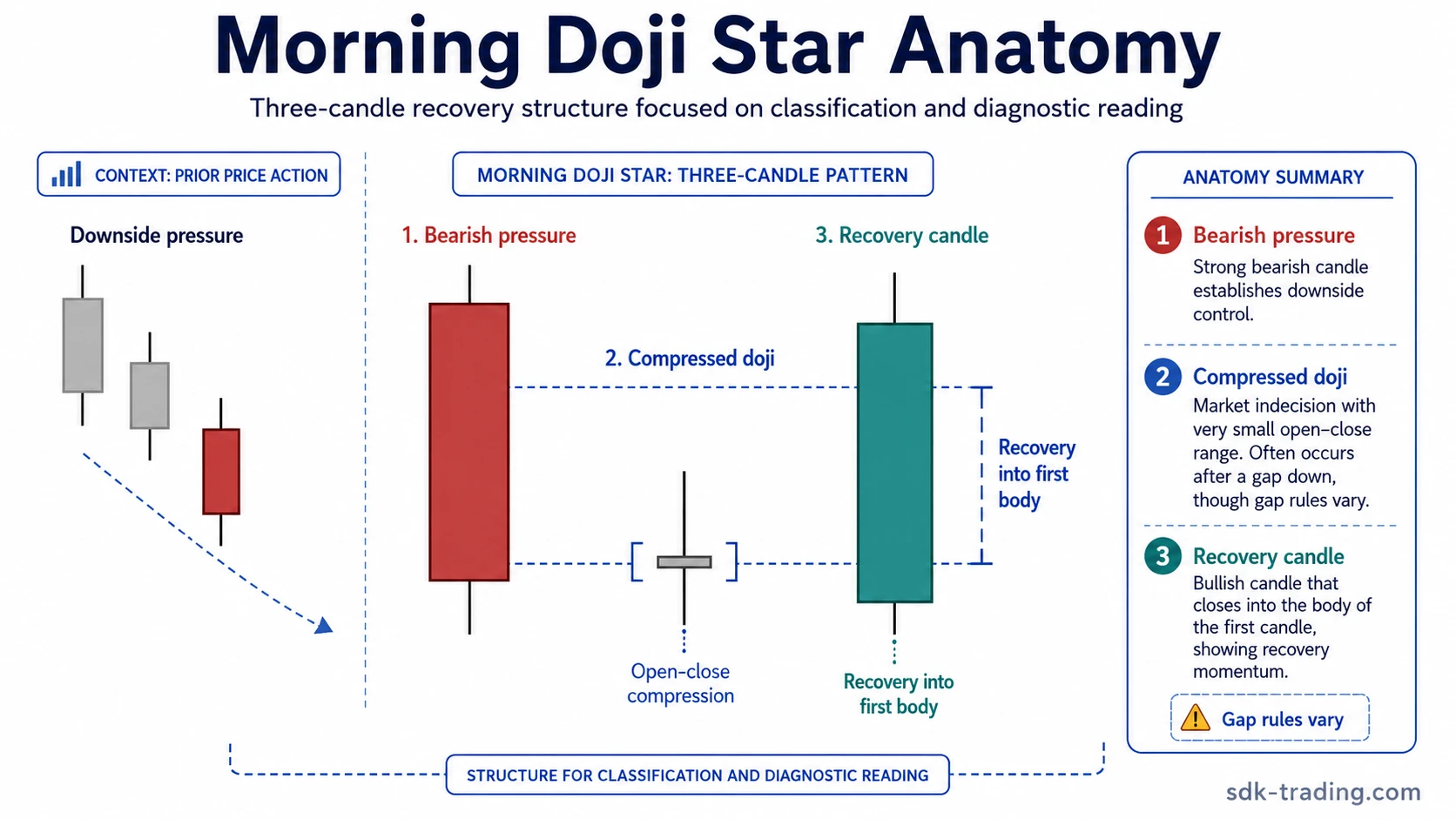
The third candle does not need to erase the whole first candle, but a stronger reading usually closes above the midpoint of the first candle’s real body. A close that barely lifts from the doji area leaves the pattern unresolved.
How to Identify a Clean Morning Doji Star
A clean morning doji star starts with visible downside pressure. Without that prior pressure, the pattern loses its morning-transition logic and becomes closer to ordinary sideways indecision.
The second candle should then show compression. A true doji has an open and close at, or very near, the same level. A near-doji can still be useful if the body is very small compared with the full candle range, but the farther the body expands, the more the reading moves away from a doji-centered pattern.
The third candle is the confirmation of recovery in the visual structure. It should reclaim a meaningful part of the first candle’s body. A candle that closes slightly above the doji but remains far below the first candle’s midpoint may show only a pause, not a strong transition.
Clean reading: downside pressure comes first, the middle candle compresses into a clear doji or near-doji, and the third candle recovers deeply enough to challenge the first candle’s bearish body.
Clean, Weak, and Invalid Morning Doji Star Readings
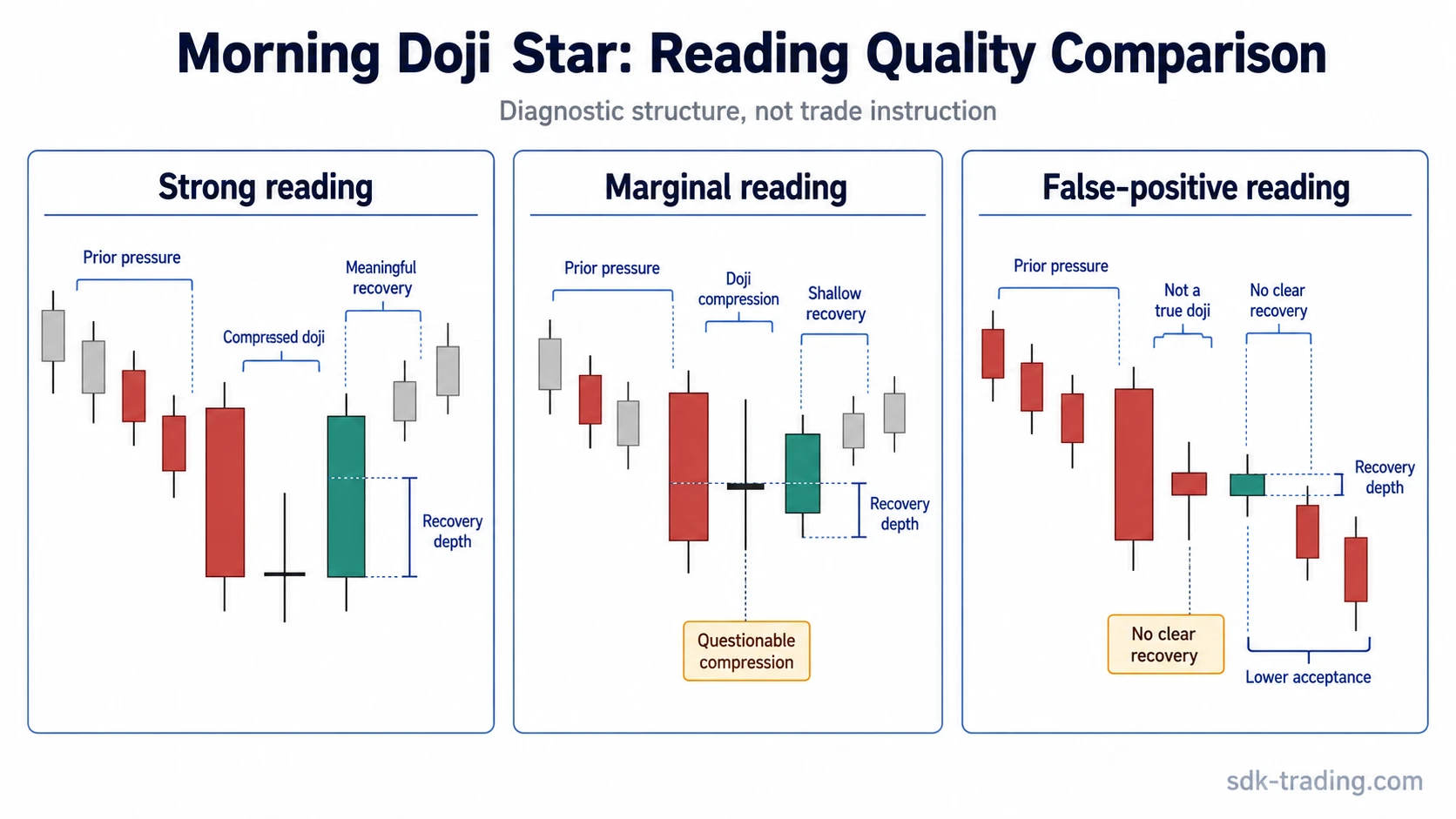
The same three-candle outline can produce very different readings. The useful question is not whether the pattern resembles the textbook shape, but whether the candles show pressure, compression, and recovery in the right order.
| Reading quality | Structure | Diagnostic meaning |
|---|---|---|
| Clean | Clear decline, compressed middle doji, strong third-candle recovery into the first candle’s body | The prior downside move has been challenged by a visible recovery attempt. |
| Weak | Marginal doji quality, unclear prior pressure, or shallow third-candle recovery | The chart may show hesitation, but the recovery is not strong enough to create a clean reading. |
| Invalid | No real doji, no meaningful recovery, or later candles quickly accept lower prices again | The structure does not support a morning doji star classification. |
Gap placement can affect classification, but it should not replace the core reading. The middle candle still needs doji-like compression, and the third candle still needs enough recovery depth to matter.
Morning Doji Star vs Morning Star
The difference between a morning doji star and a morning star is the middle candle. A morning star can use a small-bodied middle candle that shows hesitation. A morning doji star is narrower because the middle candle should be a doji or near-doji.
That difference matters because a doji-centered pattern puts more weight on open-close compression. If the middle candle has a visible real body, the structure may still resemble a morning star, but it is less precise as a morning doji star.
Morning Doji Star vs Abandoned Baby
A morning doji star and an abandoned baby can look similar because both may include a small or compressed middle candle after downside pressure. The difference is the role of isolation.
An abandoned baby depends more heavily on the middle candle being separated by gaps on both sides. A morning doji star focuses more on the doji quality of the middle candle and the recovery depth of the third candle.
When the main feature is doji compression followed by recovery, morning doji star is usually the cleaner classification.
Morning Doji Star vs Evening Doji Star
The evening doji star is the opposite structure. It appears after upward pressure, uses a doji or near-doji as the middle candle, and then shows downside rejection through the third candle.
The morning doji star starts with sellers in control and asks whether recovery is strong enough to challenge that pressure. The evening version starts with buyers in control and asks whether rejection is strong enough to challenge the advance.
The related evening star has the same bearish-side relationship that morning star has on the recovery side: the doji version is more specific because the middle candle must show stronger open-close compression.
What Can Invalidate a Morning Doji Star?
A morning doji star can fail as a classification when the visible candle sequence does not support the name. The most common problem is a middle candle that is small but not really compressed. A small real body is not automatically a doji.
The second problem is shallow recovery. If the third candle cannot reclaim a meaningful part of the first candle’s body, the pattern may show hesitation rather than a real recovery attempt.
The third problem appears after the pattern. If later candles move below the doji area or accept lower prices again, the earlier recovery loses diagnostic value. The pattern should then be treated as a failed or weak reading rather than as a clean reversal structure.
Common invalidation signs:
- The middle candle has too much real body to qualify as a doji or near-doji.
- The third candle closes only slightly above the doji area.
- The recovery does not reach far enough into the first candle’s body.
- Later candles fail to hold the recovery area.
- Nearby supply absorbs the bounce and price accepts lower levels again.
How to Read the Pattern as Diagnostic Structure
A morning doji star is best treated as a diagnostic structure, not a standalone decision rule. It can show that downside pressure paused and that recovery appeared, but it does not prove that a new trend has started.
The useful reading is conditional. The structure becomes cleaner when the doji is compressed, the third candle recovers deeply, and later price action respects the recovery area. It weakens when the candles only resemble the outline without showing that pressure, hesitation, and recovery actually changed.
Candles can warn, but structure decides. A morning doji star matters most when it appears where a recovery attempt already makes structural sense, rather than as an isolated candle label.
Related Candlestick Patterns
Morning doji star belongs to the same triple-candle family as morning star, evening doji star, evening star, and abandoned baby structures. The useful distinction is not only direction, but also what the middle candle proves or fails to prove.
Three White Soldiers can appear later in a broader recovery sequence, but it is not part of the Morning Doji Star structure because it does not depend on a compressed middle doji.
Morning Doji Star FAQ
What is a Morning Doji Star?
A Morning Doji Star is a three-candle pattern that appears after downside pressure. It has a bearish first candle, a doji or near-doji middle candle, and a third candle that recovers into the first candle’s body.
How do you identify a clean Morning Doji Star?
A clean Morning Doji Star has clear downside pressure first, a compressed middle doji, and a third candle that recovers meaningfully into the first candle’s body.
What is the difference between Morning Doji Star and Morning Star?
A Morning Doji Star requires the middle candle to be a doji or near-doji. A Morning Star can use a broader small-bodied middle candle.
What is the difference between Morning Doji Star and Abandoned Baby?
A Morning Doji Star focuses on doji compression and third-candle recovery. An Abandoned Baby depends more on a clearly isolated middle candle separated by gaps.