A bullish three line strike is a four-candle candlestick pattern: three progressive bullish candles are followed by a larger bearish strike candle that cuts back through the prior sequence and closes below the open of the first candle. The word “bullish” is a classification label, not a guaranteed bullish outcome.
The structure is easy to misread because the final candle moves against the first three candles. The useful reading is structural: the pattern describes a sequence, a strike candle, and a closing boundary. It is not a complete trade decision by itself.
Key Points
- It uses four candles, not three.
- The first three candles form the bullish sequence.
- The fourth candle is the bearish strike candle.
- The strike candle must close below the first candle open.
- The bullish label is a classification boundary, not a forecast.
What Is a Bullish Three Line Strike?
A bullish three line strike is identified by a specific four-candle relationship. The first three candles show progressive upward pressure, usually through rising bodies and higher closes. The fourth candle then opens near the upper end of that sequence and reverses through much of it, closing below the open of the first candle.
Definition: A bullish three line strike is a four-candle candlestick pattern where three bullish candles are followed by a bearish strike candle that closes below the first candle open.
The pattern name can sound directionally positive, but the final candle is bearish. The bullish classification comes from the traditional pattern family. The actual reading still depends on whether the four-candle structure is complete and whether later price behavior supports or weakens the observation.
Bullish Three Line Strike Structure
The structure starts with three bullish candles that create a readable upward sequence. The fourth candle tests that sequence. For the pattern to remain intact, the fourth candle needs enough range to strike back through the earlier candles and close below the first candle open.
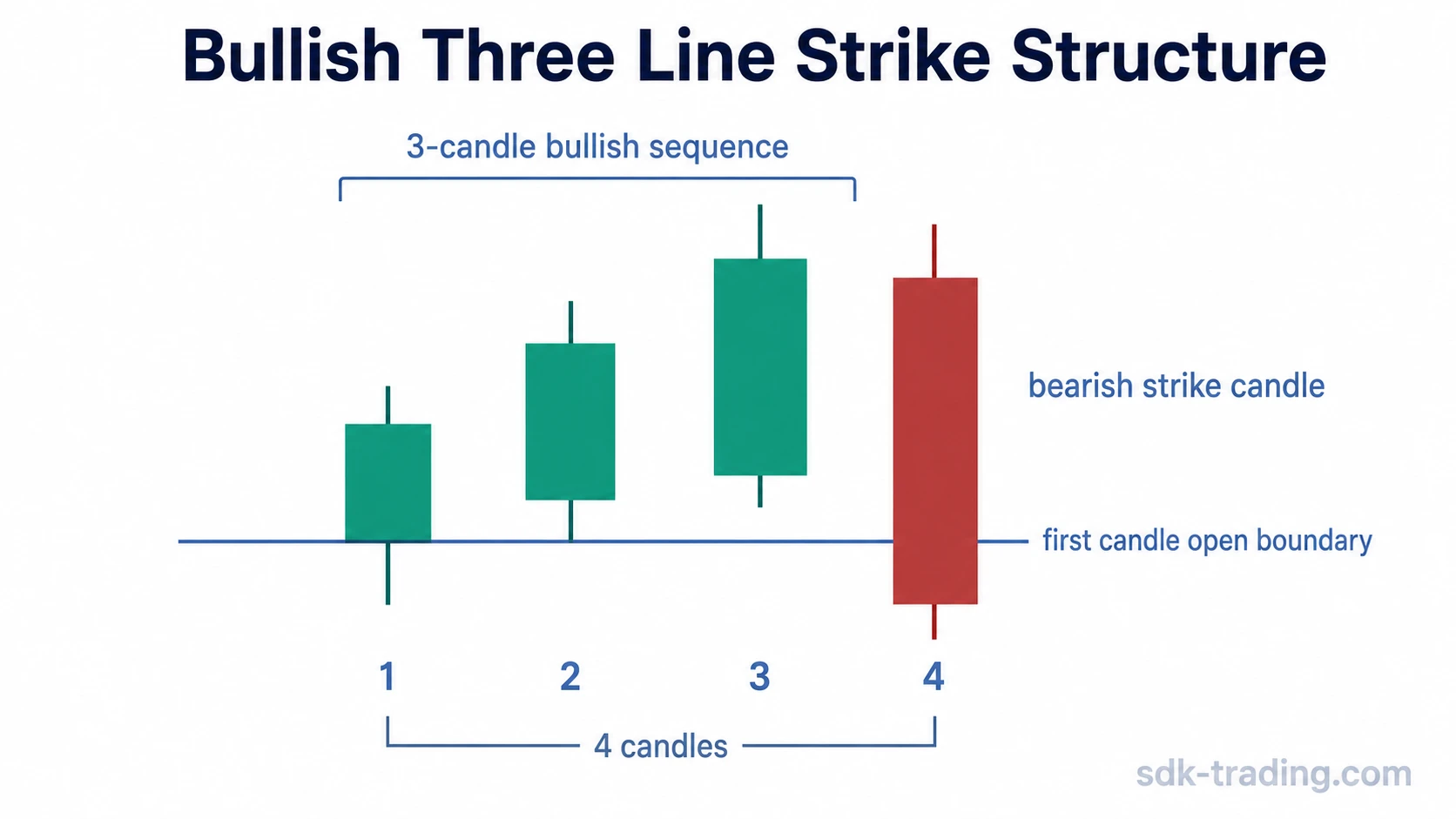
| Candle | Structural role | What to check |
|---|---|---|
| Candle 1 | Starts the bullish sequence | Its open becomes the lower boundary for the strike test. |
| Candle 2 | Extends the sequence | It should support the sense of progressive upward pressure. |
| Candle 3 | Completes the three-candle advance | It should not be so overlapping or weak that the sequence becomes unclear. |
| Candle 4 | Forms the bearish strike candle | It must close below the open of the first candle to complete the structure. |
How to Identify a Clean Bullish Three Line Strike
A clean bullish three line strike has sequence integrity. The first three candles should read as a connected upward progression, not as a sideways cluster with mixed bodies. The fourth candle should be visually decisive enough to strike through the earlier movement and close beyond the required boundary.
The key boundary is the open of the first candle. If the fourth candle does not close below that level, the sequence may still show a sharp reaction, but it does not complete the strict bullish three line strike structure.
| Reading | Structure | Interpretation boundary |
|---|---|---|
| Clean | Three bullish candles show progressive closes, then a larger bearish strike candle closes below the first candle open. | The four-candle relationship is intact. |
| Weak | The first three candles overlap heavily, have inconsistent closes, or the fourth candle only partially retraces the sequence. | The pattern may look similar, but the structure is less clean. |
| Invalid | The candle count is wrong, the prior sequence is not upward, or the fourth candle does not close below the first candle open. | The structure belongs outside the strict bullish three line strike definition. |
Diagnostic Boundary
The diagnostic boundary separates the bullish three line strike from looser four-candle reactions. The pattern is not defined by the name alone. It is defined by the sequence, the strike candle, and the close through the first candle open.
| Diagnostic question | Required answer |
|---|---|
| What is it? | A four-candle structure with three bullish candles followed by a bearish strike candle. |
| What is it not? | It is not any bearish candle after three green candles, and it is not a three-candle pattern. |
| What supports the structure? | A clear three-candle upward progression and a fourth candle that closes below the first candle open. |
| What invalidates it? | Wrong candle count, no upward sequence, heavy overlap, or a fourth candle that fails to close through the required boundary. |
Why the Bullish Label Can Be Misleading
The bullish label can be misleading because the fourth candle is bearish. The name comes from the traditional classification of the pattern, not from a guaranteed bullish result. A safer reading starts with the candle relationship and only then considers surrounding market structure.
This distinction matters because the fourth candle can also be read as failed demand inside the four-candle sequence. If the first three bullish candles show upward pressure but the fourth candle erases that movement, the structure should be treated as a completed pattern only when the close crosses the required boundary.
Bullish Three Line Strike vs Nearby Patterns
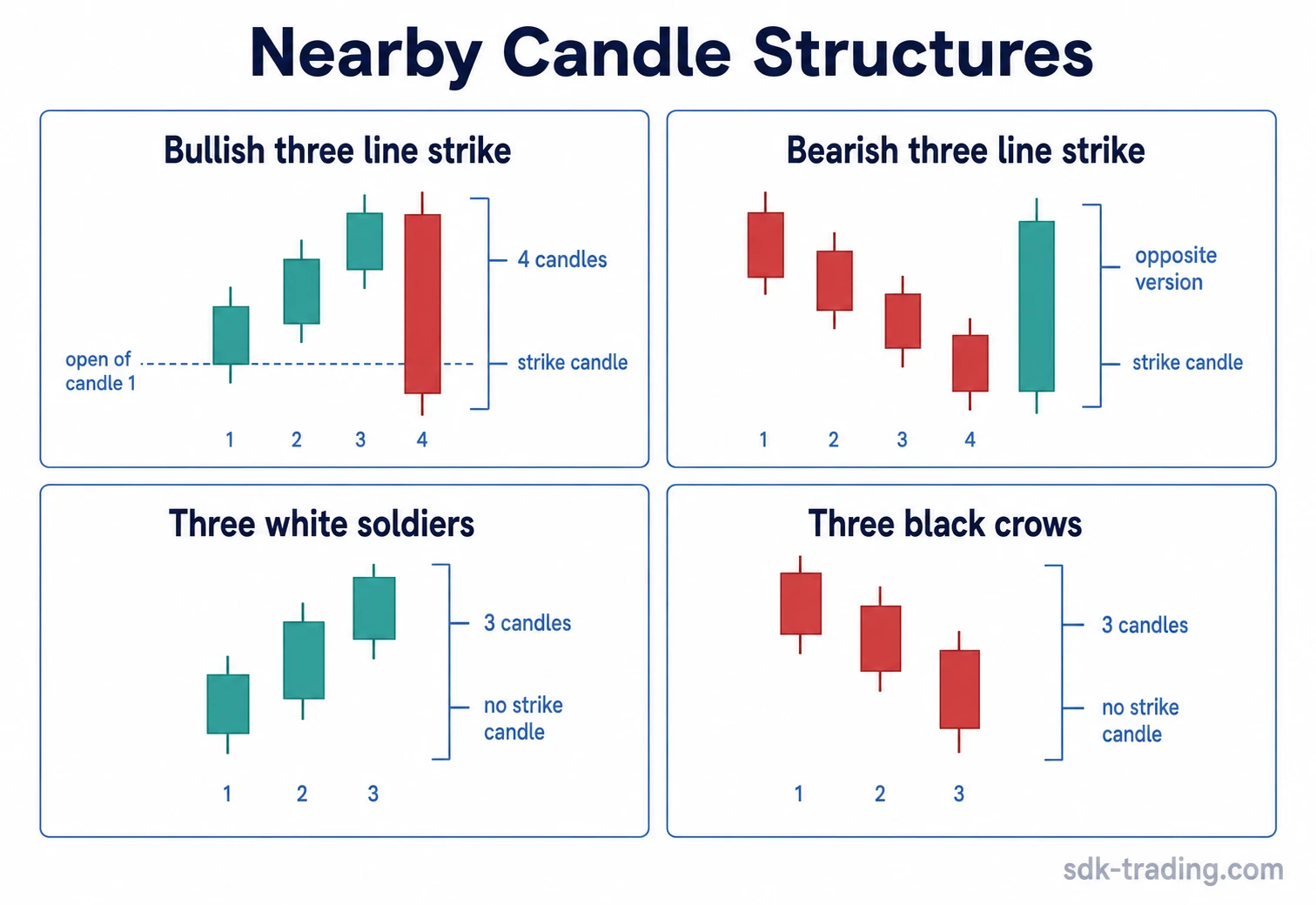
Nearby candlestick patterns can look similar because they also use short candle sequences, but they do not use the same four-candle strike relationship. The difference is the rule being measured: candle count, body direction, closing boundary, or gap-and-transition logic.
| Nearby pattern | Main difference |
|---|---|
| Bearish three line strike | Uses the opposite directional version and strike relationship. |
| Three white soldiers | Uses a three-candle bullish progression without the fourth strike candle. |
| Three black crows | Uses a three-candle bearish progression, not a four-candle strike structure. |
| Three inside down | Uses an inside-structure reversal sequence rather than a four-candle strike relationship. |
Common Mistakes
The most common mistake is counting the first three candles and ignoring the fourth candle’s closing boundary. Without the fourth candle closing below the first candle open, the setup may show a reaction, but it is not the strict bullish three line strike pattern.
Another mistake is treating the word “bullish” as a forecast. The label does not remove the need to check candle sequence, close location, overlap, timeframe, and liquidity.
Limitations
The bullish three line strike can be rare, visually misread, and sensitive to candle overlap. It is also affected by timeframe and liquidity because thin or irregular candles can make the first-three-candle sequence look cleaner than it really is.
The structure is best treated as a classification pattern, not as a standalone signal. Later candles, trend location, and nearby support or resistance can change whether the observation remains useful or becomes only a completed candle formation with weak follow-through.
FAQ
Why is it called bullish if the fourth candle is bearish?
It is called bullish because of the traditional pattern classification, but the fourth candle itself is bearish. The name should not override the structure: three bullish candles are followed by a bearish strike candle that closes below the first candle open.
How many candles are in a bullish three line strike?
A bullish three line strike uses four candles. The first three candles form the bullish sequence, and the fourth candle is the bearish strike candle.
What invalidates a bullish three line strike?
The pattern is invalid if the candle count is wrong, the first three candles do not form an upward sequence, or the fourth candle does not close below the open of the first candle.
Is a bullish three line strike a buy signal?
No. A bullish three line strike is a candlestick structure, not a buy signal by itself. The pattern only describes the four-candle relationship and needs broader context before it can be interpreted.