A bearish three line strike is a bearish-classified four-candle candlestick pattern where three candles form the initial directional sequence and the fourth candle strikes back through much of that prior movement. The “bearish” label is convention-sensitive: it describes the pattern family and sequence, not a guaranteed bearish outcome.
The useful reading comes from the full four-candle relationship. The first three candles create the setup, the fourth candle changes the structure, and the final interpretation depends on whether the sequence remains clean, weak, or invalid.
Key Points
- A bearish three line strike uses four candles, not three.
- The first three candles create the initial sequence; the fourth candle creates the strike relationship.
- The bearish label needs context because sources may emphasize the classification convention differently.
- The pattern is stronger when the sequence is clean and weaker when candles overlap or fail to form a clear strike.
- The pattern should not be treated as a standalone forecast, reversal claim, or continuation claim.
What Is a Bearish Three Line Strike?
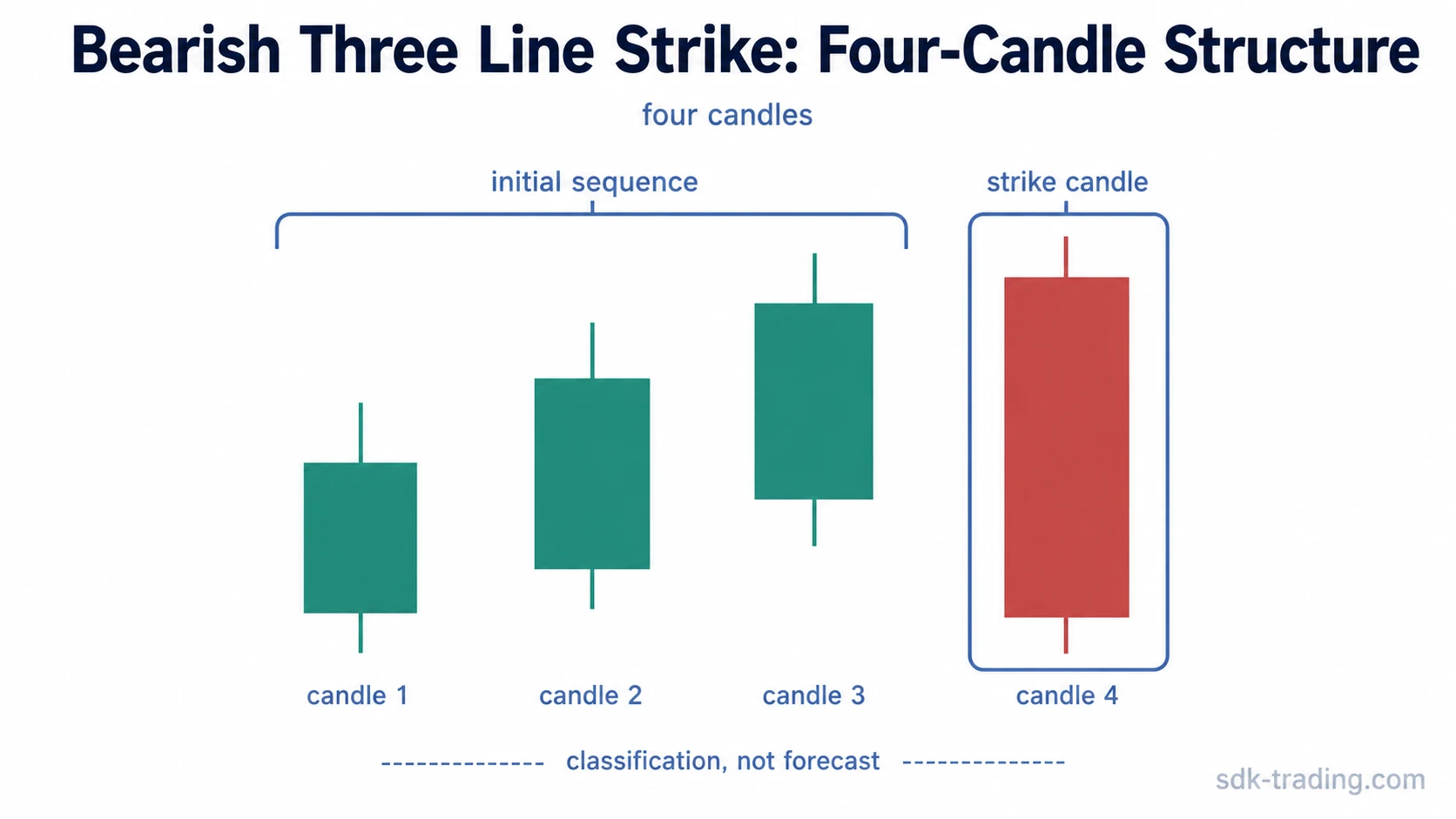
Definition: A bearish three line strike is a four-candle candlestick structure where three candles form a directional sequence and the fourth candle pushes back through much of that prior three-candle movement.
The pattern is easiest to read as a candle-sequence relationship rather than as a simple label. The first three candles define the prior pressure. The fourth candle tests that pressure by moving against it strongly enough to change the immediate interpretation.
Because naming conventions differ across sources, the bearish label should be handled carefully. Some traders classify the pattern by the direction of the first three candles, while others focus more on the fourth strike candle. That disagreement is why the visible candle anatomy matters more than the label by itself.
How to Identify the Four-Candle Structure
A bearish three line strike needs a visible four-candle sequence. The candles should not look like four unrelated bars placed next to each other. The structure is cleaner when the first three candles form a readable directional move and the fourth candle clearly changes that move.
- Candle 1: starts the directional sequence.
- Candle 2: continues the same pressure rather than fully reversing it.
- Candle 3: extends the sequence enough to make the prior move visible.
- Candle 4: strikes back through much of the prior three-candle movement.
The fourth candle is the structural hinge. If it only pauses, overlaps slightly, or produces a small mixed candle, the sequence may become too weak to classify cleanly. If the fourth candle overwhelms the prior movement but the first three candles were not a clear sequence, the pattern may also lose its usefulness as a named structure.
Clean, Weak, and Invalid Readings
The same label can hide very different candle quality. A clean bearish three line strike has sequence integrity; a weak one has overlap or mixed pressure; an invalid one no longer matches the required four-candle relationship.
| Reading | What the sequence shows | What can be inferred safely | What should not be assumed |
|---|---|---|---|
| Clean reading | The first three candles form a visible directional sequence, and the fourth candle strikes back through that movement. | The pattern has a recognizable four-candle structure and can be used as a candle-sequence observation. | It does not prove the next move or settle the continuation-versus-reversal question by itself. |
| Weak reading | The first three candles overlap, the bodies are mixed, or the fourth candle only partially changes the sequence. | The pattern may still resemble a three line strike, but the reading needs more caution. | The label should not be treated as stronger than the actual candle relationship. |
| Invalid reading | The first three candles do not form a sequence, or the fourth candle fails to create the strike relationship. | The candle group may belong to another structure or may be ordinary price movement. | It should not be forced into a bearish three line strike classification. |
Why the Bearish Label Needs Context
The bearish three line strike is easy to misread because the word “bearish” can sound more decisive than the structure itself. In many candlestick references, the label belongs to a classification convention. It should not be treated as a forecast on its own.
A safer reading starts with the observable sequence: three candles form the initial movement, then a fourth candle pushes against that movement. From there, the surrounding trend, location, volatility, and later market behavior may affect interpretation. The pattern can organize what happened inside the candle sequence, but it does not replace broader market structure.
Limitation: The pattern is relatively specific and can be rare on some instruments or timeframes. If the first three candles are messy, if the fourth candle is not a true strike candle, or if the setup appears inside noisy sideways movement, the sequence becomes less useful.
Bearish Three Line Strike vs Nearby Triple Patterns
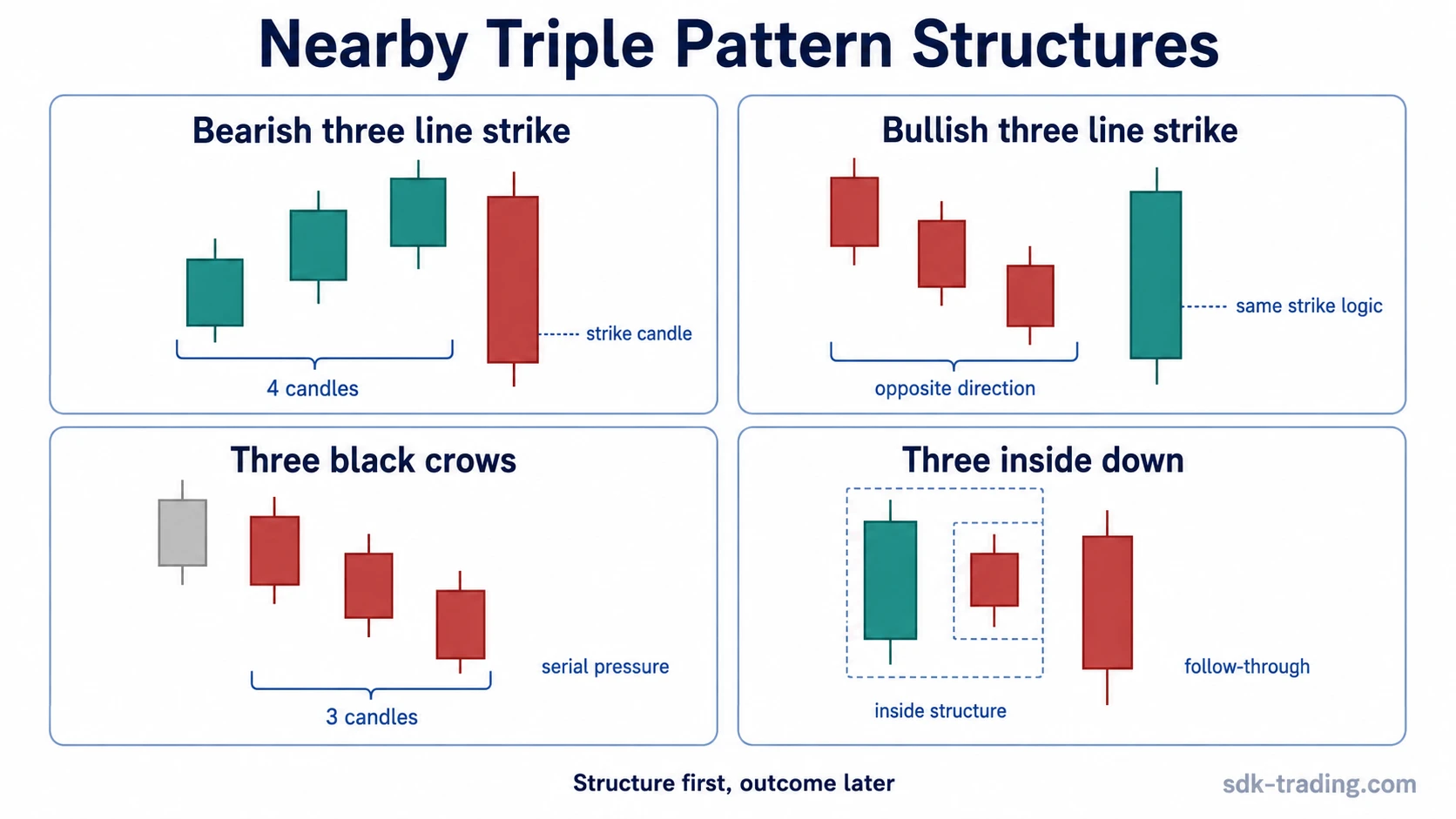
A bearish three line strike can sit near several other triple-candle structures, but the rule is different. The distinction comes from the relationship between the sequence and the fourth strike candle.
| Pattern | Main structure | Key distinction |
|---|---|---|
| Bullish three line strike | Opposite direction convention inside the same strike family. | The classification flips direction, but the same four-candle strike logic remains central. |
| Three black crows | Three consecutive bearish candles showing serial selling pressure. | It does not need a fourth candle striking back through the prior three-candle sequence. |
| Three inside down | An inside structure followed by bearish follow-through. | Its logic comes from inside containment and follow-through, not a four-candle strike relationship. |
Example Scenario
A common version appears when three candles close progressively in one direction, making the short sequence visible. The fourth candle then expands against that move and closes back through much of the prior three-candle range. Under the relevant naming convention, that creates the bearish three line strike relationship, but the label still depends on the candle sequence being clean enough to classify.
The common mistake is to read the name first and the candles second. If the first three candles were not clean, or if the fourth candle did not truly strike back through the sequence, the label becomes less useful. The structure has to earn the name through the candle relationship.
FAQ
What does a bearish three line strike mean?
A bearish three line strike means a four-candle sequence has formed where the fourth candle sharply changes the reading of the prior three-candle movement. The useful reading starts with the relationship between the first three candles and the later strike candle.
How many candles are in a bearish three line strike?
A bearish three line strike uses four candles. The first three candles create the initial sequence, and the fourth candle forms the strike candle that pushes back through much of that sequence.
Why is the bearish three line strike confusing?
It is confusing because different sources may emphasize the classification label or the fourth strike candle differently. The safest reading starts with the visible four-candle anatomy before interpreting the name.