The Klinger Oscillator is a volume-based momentum indicator that compares smoothed volume-force behavior across two calculation windows. It is also called the Klinger Volume Oscillator, or KVO, because its reading is built from a volume-force value and then expressed as an oscillator line.
The indicator is used to examine whether volume-adjusted pressure is expanding, fading, or diverging from price behavior. It does not predict price direction by itself. Its value comes from the boundary between the KVO line, its signal line, the zero line, and the price structure around the reading.
What Is the Klinger Oscillator?
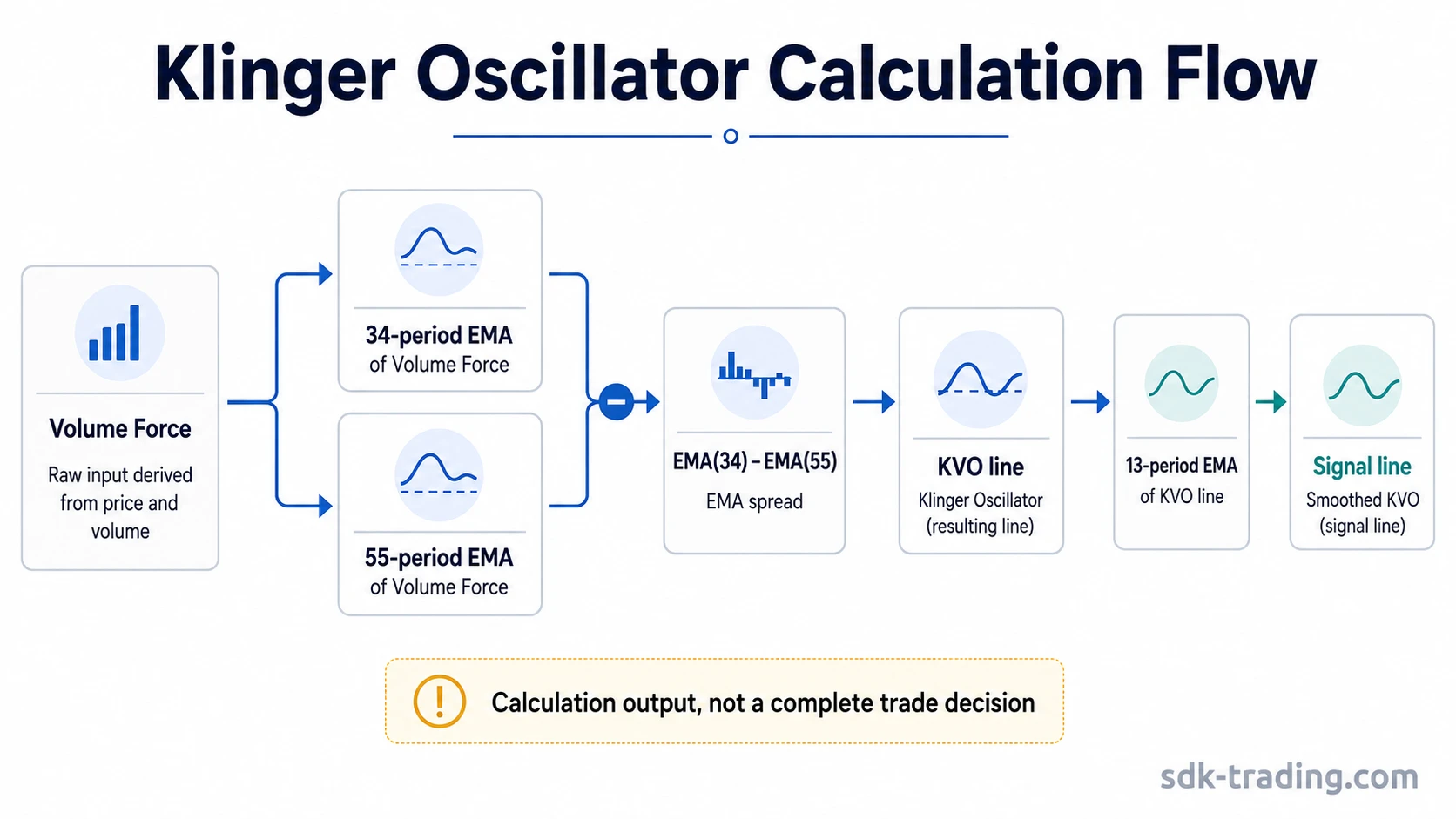
The Klinger Oscillator is an indicator that converts high-low-close price behavior and volume into a value often described as Volume Force. That value is then smoothed with two exponential moving averages, commonly a faster 34-period EMA and a slower 55-period EMA. The oscillator is the difference between those smoothed values.
This makes the Klinger Oscillator different from a simple volume bar or a cumulative volume line. It does not only ask whether current volume is high or low. It tries to show whether volume-adjusted pressure is changing across two smoothing windows.
Definition: The Klinger Oscillator measures the spread between two smoothed versions of Volume Force, then compares that oscillator line with a signal line and the zero line.
| What it is | What it is not |
|---|---|
| A volume-force oscillator based on smoothed calculations. | Not a direct forecast of the next price move. |
| A diagnostic tool for comparing pressure, smoothing, and price behavior. | Not a complete trading system or standalone entry rule. |
| A way to compare KVO, signal line, zero line, and divergence conditions. | Not proof that accumulation or distribution will continue. |
How the Klinger Oscillator Is Calculated
The calculation starts with Volume Force, a value derived from price behavior and volume. Platform settings can vary, but the core calculation structure is consistent: Volume Force is smoothed through a faster EMA and a slower EMA, and the spread between those smoothed values becomes the KVO line.
In its common form, the Klinger Oscillator compares a 34-period EMA of Volume Force with a 55-period EMA of Volume Force: KVO = EMA(34, Volume Force) – EMA(55, Volume Force). A separate signal line is commonly plotted as a 13-period EMA of the KVO line, although platform settings can usually be adjusted.
| Calculation layer | Role in the reading | Boundary to remember |
|---|---|---|
| Volume Force | Combines price behavior and volume into the base pressure series. | It is still a model of pressure, not direct evidence of hidden buying or selling. |
| Fast smoothing window | Usually reacts more quickly to changes in the volume-force series. | A faster response can also create more noise. |
| Slow smoothing window | Creates the slower reference for the volume-force trend. | A slower reference can lag when market conditions change sharply. |
| KVO line | Shows the difference between the fast and slow smoothed volume-force values. | The line can move before price confirms or rejects the pressure shift. |
| Signal line | Commonly a 13-period EMA of the KVO line. | It smooths the oscillator; it does not turn a crossover into a complete trade signal. |
How to Read the Klinger Oscillator
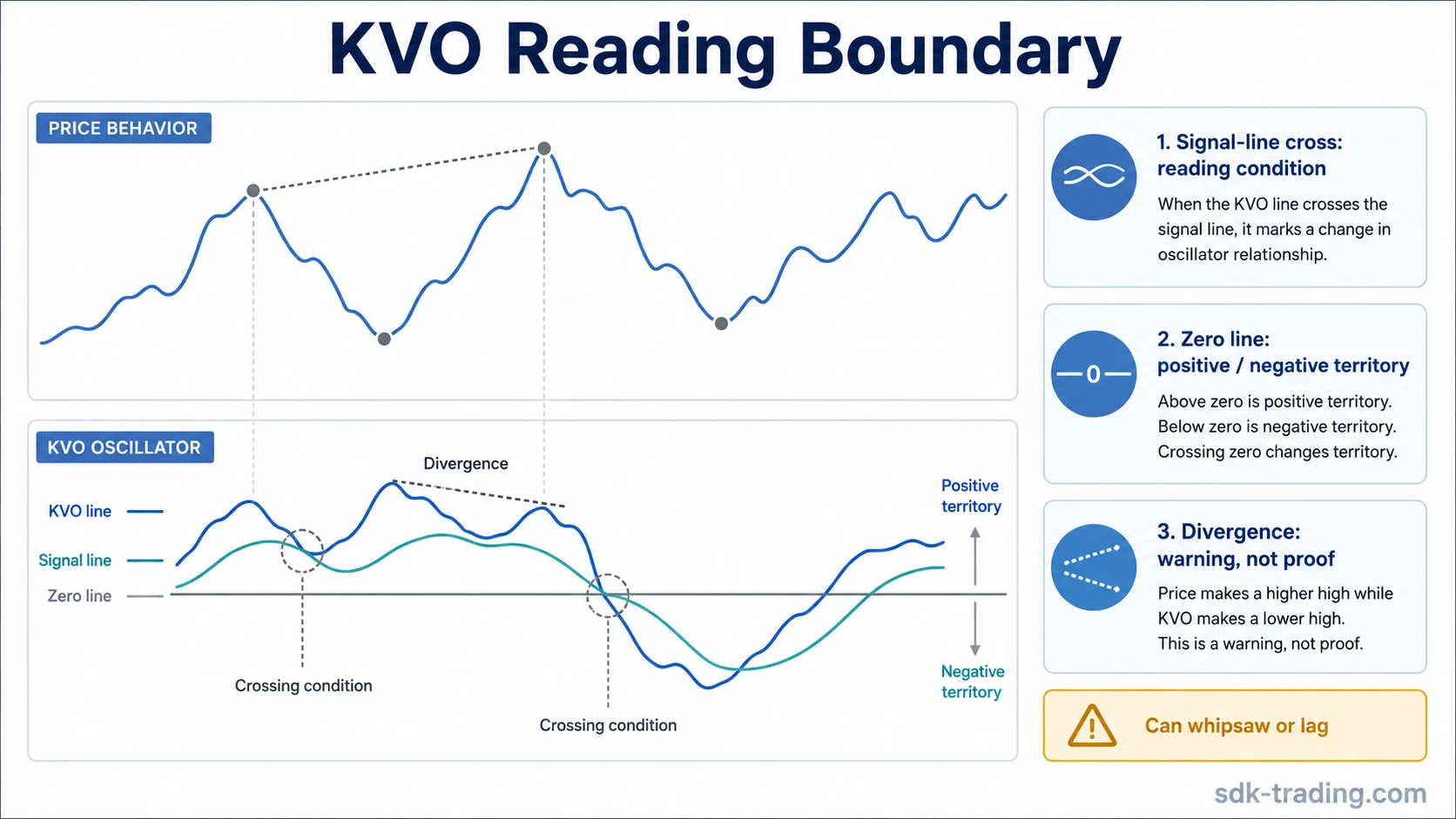
The Klinger Oscillator is usually read through three relationships: KVO versus signal line, KVO versus zero line, and KVO versus price behavior. None of these relationships is complete alone. The reading becomes more useful when the indicator and the price structure are interpreted together.
KVO and Signal Line: When the KVO line crosses above or below its signal line, the short-term oscillator behavior is changing relative to its own smoothed reference. That can show a shift in volume-force momentum, but it can also happen repeatedly during choppy price movement.
KVO and Zero Line: The zero line separates positive and negative oscillator territory. A move above zero can show that the faster volume-force average is above the slower one. A move below zero can show the opposite. The limitation is that zero-line movement can lag or whipsaw when pressure changes without sustained price acceptance.
KVO and Divergence: Divergence appears when price and the Klinger Oscillator stop confirming each other. Price may continue to make a higher high while the oscillator fails to do the same, or price may make a lower low while the oscillator does not confirm that lower pressure reading. Divergence is a warning condition, not proof that a reversal is underway.
| Reading | Possible interpretation | Main limitation |
|---|---|---|
| KVO crosses above signal line | Shorter-term volume-force behavior is strengthening relative to its signal reference. | Can appear during a noisy bounce without broader price acceptance. |
| KVO crosses below signal line | Shorter-term volume-force behavior is weakening relative to its signal reference. | Can occur during consolidation without a meaningful breakdown. |
| KVO moves above zero | The faster smoothed volume-force value is above the slower one. | May lag after price has already moved. |
| KVO moves below zero | The faster smoothed volume-force value is below the slower one. | Can whipsaw if price is rotating inside a range. |
| Price and KVO diverge | Volume-force behavior is not confirming the latest price extension. | Divergence can appear early and remain unresolved for a long time. |
Klinger Oscillator vs Klinger Volume Oscillator
Klinger Oscillator and Klinger Volume Oscillator are usually used to describe the same indicator family. The KVO label emphasizes that the indicator is built around volume-force behavior, while the shorter Klinger Oscillator label is the cleaner search and page title form.
The naming difference is secondary. The mechanism matters more: KVO uses Volume Force and smoothing windows rather than a direct comparison of raw volume bars.
Klinger Oscillator vs a Generic Volume Oscillator
A generic volume oscillator usually compares volume values or smoothed volume values directly. The Klinger Oscillator is more specific because it first transforms price and volume behavior into a volume-force series, then compares smoothed versions of that series.
| Indicator type | Core input | Reading boundary |
|---|---|---|
| Klinger Oscillator | Volume Force smoothed across two EMA windows. | Best read through KVO, signal line, zero line, and price behavior together. |
| Generic volume oscillator | Volume values or smoothed volume values. | Best read as a direct comparison of volume behavior, not as a Klinger-specific pressure model. |
| OBV-style reading | Cumulative volume added or subtracted by close direction. | Different calculation lens; it does not use the Klinger Volume Force structure. |
| Chaikin-style reading | Close location inside the high-low range with volume weighting. | Different calculation lens; it focuses on close location rather than KVO smoothing spread. |
What the Klinger Oscillator Does Not Confirm by Itself
The Klinger Oscillator can show a change in volume-force behavior, but it does not confirm intent, future price direction, or trade quality by itself. A crossover can appear without sustained price acceptance. Divergence can appear early. A zero-line move can lag. A large oscillator expansion can also reflect one abnormal volume print, thin liquidity, or a temporary high-volatility condition.
The safer reading is conditional: the indicator describes a pressure relationship that must be checked against price structure, liquidity conditions, and whether the market continues to accept the move after the reading appears.
| Condition | Reading is stronger when | Reading is weaker when |
|---|---|---|
| Signal-line crossover | The cross appears with sustained price acceptance and cleaner market structure. | The cross appears repeatedly inside a noisy range. |
| Zero-line movement | The move aligns with a broader change in price behavior. | The move appears after a stretched move with no fresh confirmation. |
| Divergence | Price starts failing to hold the extension that created the divergence. | Price keeps accepting beyond the prior high or low. |
| Large KVO expansion | The expansion occurs with stable liquidity and sustained participation. | The expansion follows one abnormal volume print or thin trading period. |
Key Points
- The Klinger Oscillator is a volume-force oscillator, not a standalone trading strategy.
- Its common reading structure compares the KVO line, signal line, zero line, and price behavior.
- The formula is built around Volume Force and smoothing windows, commonly a 34-period and 55-period EMA spread.
- Signal-line crossovers can show changing pressure, but they can also whipsaw in noisy markets.
- Divergence can warn that volume-force behavior is not confirming price, but it does not confirm reversal by itself.
FAQ
What is the Klinger Oscillator?
The Klinger Oscillator is a volume-based momentum indicator that compares smoothed volume-force values across two calculation windows. It is used to read changes in volume-adjusted pressure, not to predict price by itself.
Is the Klinger Oscillator the same as the Klinger Volume Oscillator?
In most trading and charting contexts, Klinger Oscillator and Klinger Volume Oscillator refer to the same indicator family. The KVO name emphasizes the indicator’s volume-force construction.
What is the Klinger Oscillator signal line?
The signal line is a smoothed version of the KVO line. It is used as a reference for crossovers, but a crossover should be treated as a reading condition rather than a complete trade signal.
Can the Klinger Oscillator give false signals?
Yes. False signals can appear during choppy price movement, low-liquidity periods, abnormal volume prints, or high-volatility conditions. Divergence and crossovers can also appear before price confirms any sustained change.