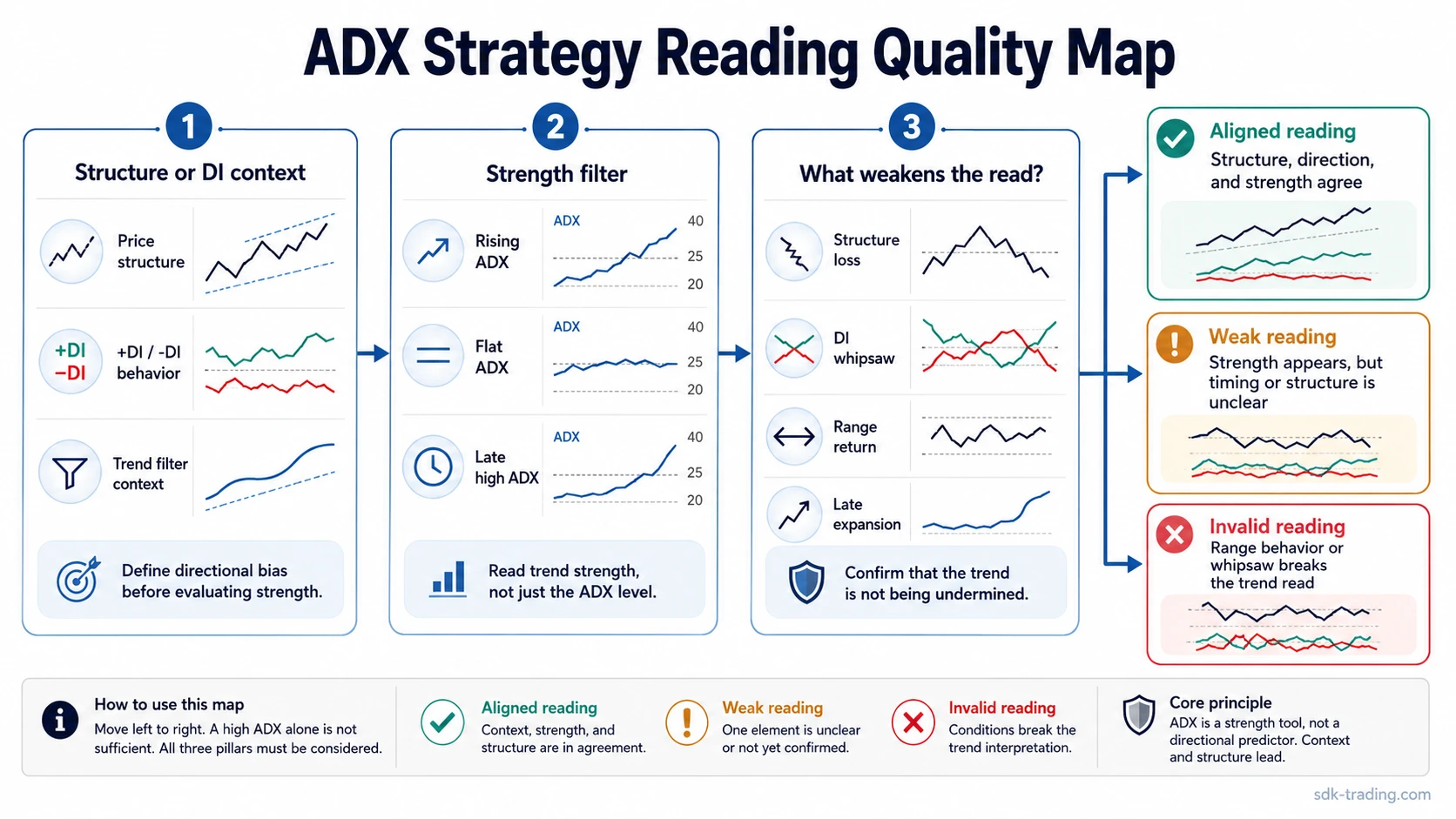
An ADX strategy uses trend strength as a regime filter after market direction has already been defined. The ADX line measures the strength of directional movement, not whether price is bullish or bearish. A threshold such as 20 or 25 therefore answers a strength question, not a direction question.
Definition: An ADX strategy combines a directional premise with an ADX strength condition. Price structure, +DI/-DI, or another directional filter identifies the side of the market, while the ADX threshold determines whether trend strength is sufficient for the framework being used.
What an ADX Threshold Actually Does
An ADX threshold defines the minimum trend-strength state required by a strategy framework. It does not indicate whether price should move up or down.
Common reference bands often place weaker or non-trending conditions below about 20, treat the 20 to 25 area as transitional, and treat readings above about 25 as stronger trend conditions. These levels are useful conventions, but they are not universal boundaries that work identically across every market, timeframe, and strategy.
Threshold boundary: ADX above 25 does not mean bullish, bearish, buy, or sell. It means that the measured directional movement has reached a stronger regime under a commonly used ADX convention.
Lower vs Higher ADX Thresholds
Choosing an ADX threshold creates a timing and filtering trade-off. A lower threshold allows the strategy to recognize developing trend strength sooner. A higher threshold demands more established directional movement before the regime qualifies.
| Threshold choice | What it does | Main trade-off |
|---|---|---|
| Lower threshold | Accepts developing trend-strength conditions earlier. | Allows more weak, transitional, or choppy movement into the strategy regime. |
| Moderate threshold | Requires clearer evidence that directional movement has strengthened. | Filters more weak conditions but recognizes some trends later. |
| Higher threshold | Requires an already strong ADX reading. | Produces stronger filtering but can qualify only after a substantial part of the move has already occurred. |
This is why there is no useful threshold discussion without considering the strategy objective. A framework designed to detect early trend development has a different threshold problem from one designed to participate only after trend strength is clearly established.
ADX Strength Is Separate From Direction
ADX can rise during an advancing market or a declining market. The line measures the strength of directional movement regardless of which side is controlling price.
Direction therefore has to come from another part of the framework. +DI and -DI can supply directional-movement information, while price structure or a trend baseline can provide an independent directional premise.
| Question | Primary input |
|---|---|
| Which direction is price structure favoring? | Price structure, +DI/-DI, or another directional filter |
| How strong is the directional movement? | ADX |
| Has strength reached the strategy’s required regime? | ADX threshold |
| Has the directional premise failed? | Price structure and failure conditions |
The ADX Strategy Sequence
- Define direction. Establish whether the directional premise is bullish, bearish, or unresolved before using ADX.
- Choose the strength condition. Define the ADX threshold or strength state required by the strategy.
- Check the threshold. Determine whether ADX has reached the required strength regime.
- Check alignment. Confirm that the directional premise and the strength reading still describe the same market state.
- Define failure. Identify what price behavior would invalidate the directional premise even if ADX remains elevated.
Framework example: Price establishes an upward structure and +DI remains above -DI. ADX then rises through the framework’s chosen strength threshold. The threshold qualifies the strength regime, but the bullish direction still comes from the directional inputs. If price later loses the structure while ADX remains high, the old ADX value does not preserve the bullish premise.
Rising ADX vs High ADX
The level of ADX and the direction of the ADX line answer related but different questions. A rising ADX shows that measured trend strength is increasing. A high ADX shows that the recent directional movement has already produced a strong reading.
This matters because a high value can occur late in a mature trend. ADX can remain elevated after the cleanest structural expansion has already happened. A strategy that uses only a high absolute threshold can therefore recognize strength after price has become extended.
| ADX state | What it describes | Main caution |
|---|---|---|
| Low and flat | Limited directional strength | A trend-following framework may be operating inside rotation rather than expansion. |
| Rising from a lower area | Directional strength is increasing | Direction still has to be supplied separately. |
| High and rising | Strong directional movement is still expanding | The move may already be well developed. |
| High but falling | Recent strength remains elevated while directional expansion is weakening | The absolute number can look strong even as the current trend loses momentum. |
Using ADX With Directional Filters
The ADX line solves only the strength part of the framework. Other components can supply direction or a trend baseline, but they should not be treated as interchangeable with ADX.
| Component | Role | What it adds |
|---|---|---|
| +DI and -DI | Directional movement context | Helps identify which side currently has stronger directional movement. |
| Price structure | Directional premise and failure definition | Provides a structural reason for the directional bias and a way to identify when that premise no longer holds. |
| EMA | Responsive trend baseline | Can provide faster directional context relative to recent price. |
| SMA | Slower trend baseline | Can provide broader directional context with less sensitivity to recent movement. |
| HMA | Smoother responsive baseline | Can reduce some apparent lag while still providing directional context. |
| WMA | Weighted trend baseline | Places more emphasis on recent prices when defining the baseline. |
These filters do not make ADX predictive. Their job is to provide the directional information that the ADX strength measurement does not contain.
When an ADX Strategy Weakens
An ADX framework becomes less reliable when its strength state and directional premise stop describing the same market behavior.
| Condition | Why the reading weakens |
|---|---|
| Repeated DI crossings inside a range | Directional control is unstable even if short bursts of movement increase ADX. |
| ADX qualifies only after a long price extension | The threshold confirms established strength late rather than identifying an early trend regime. |
| Price loses the directional structure while ADX remains high | The strength reading reflects recent movement but the original directional premise has changed. |
| Threshold repeatedly switches on and off near the boundary | The chosen regime cutoff may be operating inside transitional or choppy conditions. |
Common ADX Threshold Mistakes
| Mistake | More precise approach |
|---|---|
| Treating ADX above 25 as a bullish signal | Use ADX for strength and obtain direction from a separate directional input. |
| Assuming 25 is universally optimal | Treat the threshold as a framework parameter whose filtering and timing trade-offs should be understood. |
| Ignoring whether ADX is rising or falling | Compare the absolute level with whether measured trend strength is expanding or contracting. |
| Using high ADX without checking location in the trend | Distinguish an emerging strength regime from a reading that appears after a mature expansion. |
| Keeping the directional premise after structure fails | Let the structural failure condition override an old strength reading. |