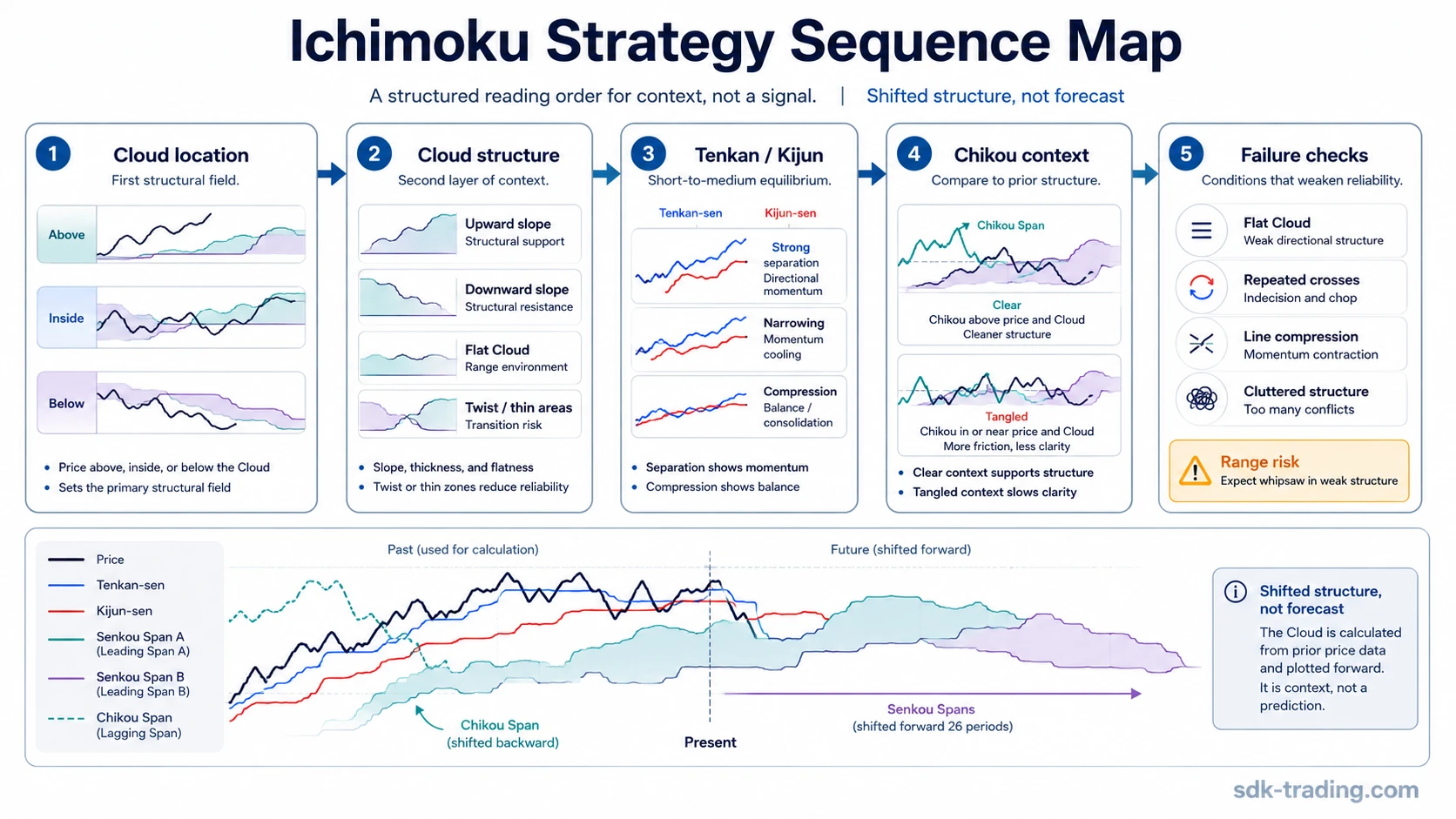
Ichimoku strategy begins with sequence: Cloud structure first, Tenkan-sen and Kijun-sen relationship second, Chikou Span context third, and failure conditions before any trend reading is treated as stable.
The framework separates the structural field, short-to-medium equilibrium, and historical comparison instead of letting one component dominate the interpretation. It becomes less reliable when those components compress, overlap, or contradict each other, especially when price rotates inside a flat Cloud.
Key Points
- Ichimoku strategy is a reading sequence, not a single-line trigger.
- Cloud position and Cloud structure define the first structural field.
- Tenkan-sen and Kijun-sen show short-to-medium equilibrium interaction.
- Chikou Span checks whether current price is clear of prior structure.
- The reading weakens in flat, crowded, range-bound, or noisy conditions.
What Is an Ichimoku Strategy?
An Ichimoku strategy is a conditional framework for reading trend structure through the Cloud, Tenkan-sen, Kijun-sen, Senkou Span A, Senkou Span B, and Chikou Span. The purpose is not to isolate one line and treat it as a decision rule. The purpose is to check whether several structural readings point in the same direction or whether the chart is too compressed to interpret cleanly.
Definition: An Ichimoku strategy is a sequence for interpreting Cloud location, Cloud shape, line relationship, and historical price context before deciding whether a trend reading is coherent, unstable, or too crowded to use.
For a full component definition, start with Ichimoku Cloud. The strategy framework here focuses on application order, failure conditions, and how the components interact without turning the indicator into a mechanical trading system.
Ichimoku Strategy Sequence
The sequence should start with the broad field, then move toward the faster components. Reading the Tenkan-sen or Kijun-sen first can make a chart look more decisive than it is, because a line relationship may change while price is still trapped in a weak Cloud structure.
| Step | What to check | What it can show | What can weaken it |
|---|---|---|---|
| 1. Cloud location | Price above, below, or inside the Cloud | Whether price is outside or inside the main structural field | Price moving back into the Cloud after a brief extension |
| 2. Cloud structure | Cloud slope, thickness, flatness, and twist risk | Whether the field is expanding, compressing, or neutral | Flat or thin Cloud zones that invite repeated rotation |
| 3. Tenkan/Kijun relationship | How the shorter conversion line behaves against the base line | Whether short-term pressure is aligned with medium-term equilibrium | Frequent crossing, tight overlap, or shallow separation |
| 4. Chikou context | Whether Chikou Span is clear of or tangled with prior price | Whether the current reading has clean historical separation | Chikou moving through crowded prior candles or prior swing structure |
| 5. Failure checks | Range behavior, line compression, low-timeframe noise, and clutter | Whether the reading is still usable or too unstable | All components pointing to congestion instead of accepted trend behavior |
Ichimoku Components Used in the Strategy
The components should not be read as equal votes. Cloud structure carries the broadest field reading, while Tenkan-sen, Kijun-sen, and Chikou Span refine that reading. The forward-shifted Cloud is derived from prior calculations; it should be treated as a displaced structural reference, not as a forecast.
| Component | What it contributes | What can mislead |
|---|---|---|
| Cloud / Kumo | Shows the broad structural field created by Senkou Span A and Senkou Span B | Assuming the Cloud guarantees support or resistance |
| Tenkan-sen | Reflects shorter-term conversion pressure through a midpoint-style calculation | Treating a fast line turn as a complete strategy |
| Kijun-sen | Acts as a medium-term base or equilibrium reference | Assuming price returning toward Kijun always has the same meaning |
| Senkou Span A | Forms one side of the forward-shifted Cloud from Tenkan/Kijun midpoint logic | Calling the forward shift a prediction |
| Senkou Span B | Forms the other side of the Cloud from longer lookback midpoint logic | Ignoring flat areas where equilibrium may be sticky |
| Chikou Span | Compares current price action with prior price structure by shifting price backward | Using Chikou as a separate confirmation rule without checking surrounding structure |
How the Cloud Defines the Structural Field
The Cloud gives the first structural reading. Price above the Cloud can show that current price is outside the main equilibrium field, while price below the Cloud can show the opposite directional pressure. Price inside the Cloud is less clean because the chart is still moving through the structural zone rather than clearly away from it.
Cloud thickness changes the interpretation. A thick Cloud can represent a wider equilibrium or volatility boundary, which may make the reading slower and less precise. A thin Cloud may mark an easier transition area, but that does not make a reversal automatic.
Cloud limitation: A flat or sideways Cloud often warns that the market is rotating around equilibrium. In that condition, repeated price crosses and repeated line turns can reflect noise rather than accepted trend behavior.
Cloud displacement also needs careful wording. The forward Cloud is built from historical calculations shifted forward on the chart. It can frame possible structural reference zones, but it does not predict future price.
How Tenkan, Kijun, and Chikou Change the Reading
Tenkan-sen and Kijun-sen refine the Cloud reading by showing how short-term conversion pressure behaves against a medium-term base. A clean separation can make the condition easier to interpret, but a crossover by itself is still too narrow to define the whole strategy.
The line relationship becomes less informative when Tenkan-sen and Kijun-sen flatten, overlap, or cross repeatedly near the Cloud. In that setting, the chart is often showing compression rather than directional acceptance.
Chikou Span adds a historical comparison. If Chikou is tangled with prior candles or prior swing structure, the current condition is less coherent because the chart is still interacting with older congestion. If Chikou is separated from prior structure, the framework is easier to interpret, but it still needs the Cloud and line relationship to agree.
Ichimoku Strategy Checklist
This checklist is diagnostic only. It is designed to organize interpretation, not to define entries, exits, targets, stop placement, or trade timing.
| Question | More coherent condition | Less coherent condition |
|---|---|---|
| Where is price relative to the Cloud? | Clearly outside the Cloud with stable separation | Inside the Cloud or repeatedly crossing it |
| What is the Cloud doing? | Sloped and structurally coherent | Flat, thin, twisting, or directionless |
| How are Tenkan-sen and Kijun-sen behaving? | Separated in a way that matches the broader Cloud reading | Compressed, flat, or repeatedly crossing |
| What does Chikou Span show? | Clearer separation from prior structure | Entanglement with earlier candles or swing areas |
| Are failure conditions present? | Few signs of range-bound compression | Multiple signs of overlap, clutter, or low-timeframe noise |
Generic Diagnostic Scenario
Illustrative scenario: Price is above a rising Cloud, Tenkan-sen remains above Kijun-sen, and Chikou Span is not tangled with prior price structure. That is a more coherent trend-reading condition because the structural field, line relationship, and historical comparison are not fighting each other.
The framework loses clarity if price falls back into a flat Cloud, Tenkan-sen and Kijun-sen compress, and Chikou Span moves into prior congestion. The issue is not that one component changed. The issue is that the sequence no longer shows clean separation.
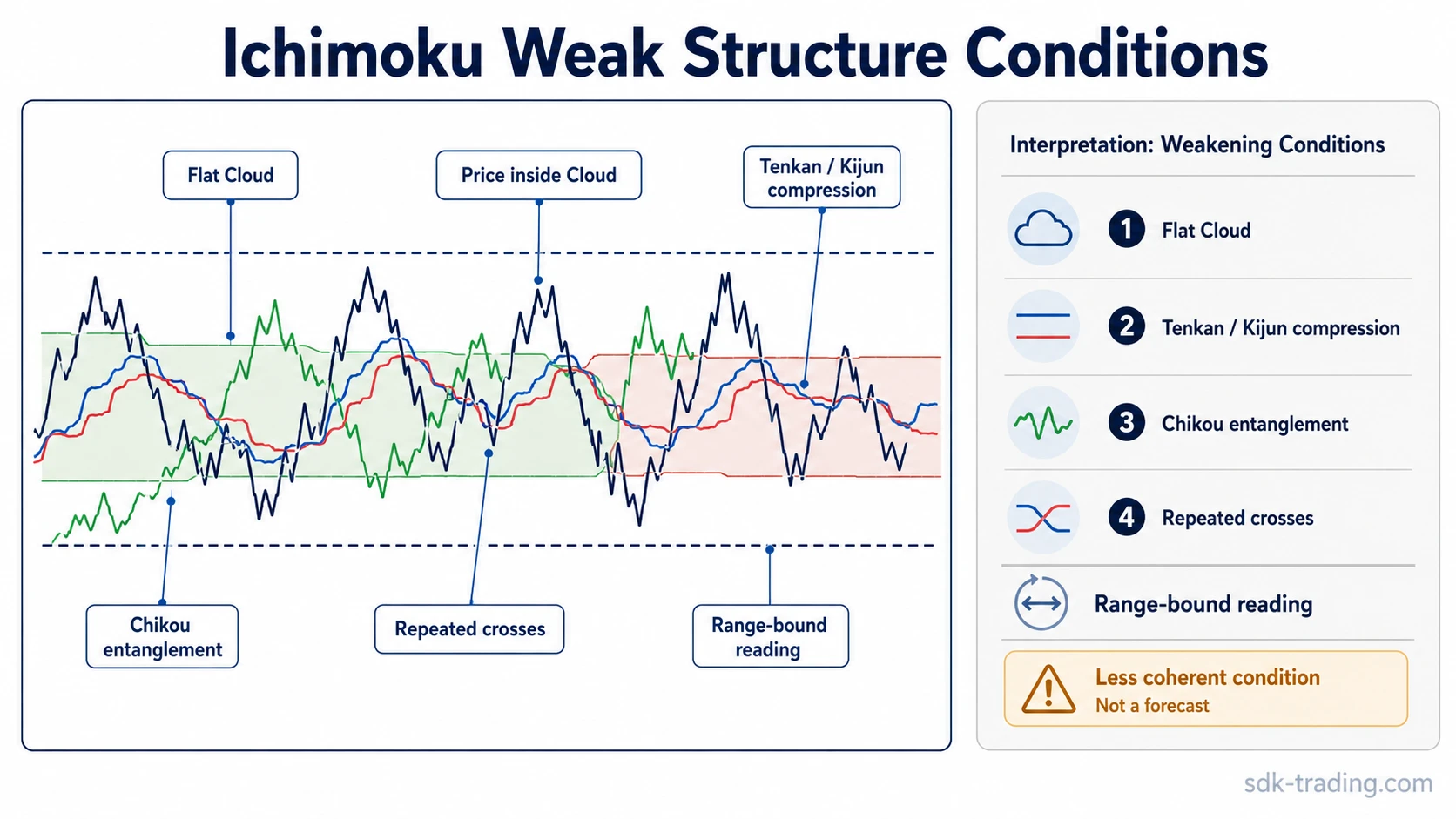
When an Ichimoku Strategy Weakens
Ichimoku becomes harder to interpret when structure, equilibrium, and historical comparison no longer separate cleanly. Range-bound markets create this problem often: many components can move, but the movement may only reflect rotation inside a crowded field.
| Weak condition | Why it matters | Safer interpretation |
|---|---|---|
| Price inside the Cloud | The structural field is unresolved | Treat the reading as mixed until price shows cleaner separation |
| Flat Cloud | Equilibrium may be dominant | Expect more rotation risk and less directional clarity |
| Tenkan/Kijun overlap | Short and medium equilibrium are compressed | A crossover has less interpretive value |
| Chikou entanglement | Current price is not clearly separated from prior structure | Historical comparison remains crowded |
| Low-timeframe noise | Components can turn repeatedly without stable structure | Do not treat every component change as meaningful |
| Chart clutter | Too many lines can create false confidence | Return to sequence instead of counting component agreement mechanically |
Common Ichimoku Strategy Mistakes
A common mistake is treating a Tenkan-sen and Kijun-sen cross as enough information by itself. The cross can change the line relationship, but it does not resolve Cloud structure, Chikou context, or range conditions.
Another mistake is reading price inside the Cloud as accepted trend behavior. Inside the Cloud, the chart is still moving through the structural field, so interpretation should remain more cautious and less directional.
The projected Cloud is also easy to misread. Because the Cloud is plotted forward, it may look predictive. The calculation is still based on prior price data, so the forward shift should be treated as displaced structure rather than a forecast.
Chikou Span can also be overused. It should help check whether current price is clear of prior structure, not act as a separate rule that overrides the rest of the framework.
The final mistake is using every component equally. Ichimoku is more useful when the reading follows order: Cloud field, Cloud structure, Tenkan/Kijun relationship, Chikou context, then failure conditions.
Ichimoku Strategy vs Moving Average Strategies
Ichimoku differs from a single-line moving average strategy because it combines a structural Cloud, forward-shifted equilibrium zones, and a backward-shifted historical comparison. A moving average line usually compresses price into one smoothing reference, while Ichimoku gives several related structural references.
An EMA-based trend reading reacts through weighted smoothing, so it is easier to compare as a single-line response tool. Ichimoku is broader because the Cloud and Chikou Span add structural and historical context.
A responsive moving average such as HMA may turn faster than slower averages, but faster reaction does not replace Cloud structure or Chikou comparison. The tools answer different questions.
A simple moving-average framework is usually easier to read because it has fewer parts. Ichimoku can offer more structure, but that extra structure also creates more room for clutter and false confidence.
ADX belongs in a different comparison bucket. An ADX trend-strength reading is mainly about strength assessment, while Ichimoku strategy is about sequencing Cloud structure, equilibrium lines, and historical comparison.
FAQ
What is the basic Ichimoku strategy sequence?
The basic sequence is Cloud location, Cloud structure, Tenkan-sen and Kijun-sen relationship, Chikou Span context, and failure conditions. Reading the sequence in that order helps avoid treating one line movement as a complete strategy.
Is Ichimoku better for trends or ranges?
Ichimoku is usually cleaner when the chart shows separation between price, Cloud structure, and the main lines. It becomes harder to interpret in ranges because price can cross the Cloud and the lines repeatedly without accepted trend behavior.
Does Ichimoku work for day trading?
Ichimoku can be applied to lower timeframes, but lower-timeframe charts often contain more noise, faster compression, and repeated line crossings. The framework should be judged by structure, component separation, and failure conditions rather than by timeframe alone.
What makes an Ichimoku reading weak?
A weak reading often includes price inside the Cloud, a flat or twisting Cloud, compressed Tenkan-sen and Kijun-sen, Chikou Span tangled with prior structure, or repeated component changes inside a range.
Is the Ichimoku Cloud predictive?
No. The forward Cloud is plotted ahead on the chart, but it is calculated from prior price data. It can frame displaced structural reference zones, but it should not be described as a price forecast.