A mat hold candlestick pattern is a five-candle continuation structure where an initial impulse is interrupted but not fully absorbed. The key test is whether the middle candles remain contained enough for the final candle to restore the original direction.
Definition: The mat hold candlestick pattern is a continuation pattern built from an impulse candle, a short interruption of smaller candles, and a final candle that pushes back in the original direction. The pattern is more coherent when the interruption stays contained instead of erasing the first candle’s work.
Key Points
- A mat hold pattern is recognized through a five-candle sequence, not one candle alone.
- The first candle should show clear directional initiative before the smaller interruption begins.
- The middle candles should pause or test the move without fully absorbing the impulse.
- The final candle should keep the prior move intact; without that, the mat hold label becomes weaker.
- The structure is weakest when the middle candles become ordinary consolidation, deep absorption, or a failed continuation attempt.
What Is a Mat Hold Candlestick Pattern?
The mat hold candlestick pattern is a continuation pattern that forms when a market pauses after a directional candle but does not fully reject the prior move. The pattern is mainly described as a bullish continuation structure. Bearish continuation comparisons are better handled as reversed structure or through related patterns such as falling three methods, rather than forcing the mat hold label onto every downside sequence.
The central idea is interruption without absorption. The first candle creates the directional impulse. The next few candles test that move, often with smaller bodies or overlapping price action. The final candle attempts to show that the pause did not change control.
The mat hold label should be used carefully because the middle candles can easily turn the structure into ordinary consolidation, a failed continuation attempt, or a nearby three-methods pattern. The label becomes more useful when the candle sequence remains visible and the final candle shows renewed directional initiative.
How the Mat Hold Structure Forms
A clean mat hold begins with directional control that already exists before the five-candle sequence completes. Without that prior move, the structure loses its continuation meaning and becomes only a small candle cluster.
| Stage | What to observe | Why it matters |
|---|---|---|
| Prior direction | Price is already moving with a clear directional bias. | The pattern needs something to continue. |
| Candle 1 | A strong impulse candle pushes in the direction of the existing move. | This creates the move that later candles must preserve. |
| Candles 2-4 | Smaller candles interrupt the move without fully erasing the first candle’s structure. | The counter-move tests whether the original move is being absorbed. |
| Gap or body relationship | The interruption may test the impulse area, but it should not close or erase the relationship created by the first strong candle. | The mat hold reading weakens when the counter-move absorbs the impulse instead of preserving it. |
| Candle 5 | A final candle pushes back in the original direction and reclaims directional control. | The continuation reading depends on renewed initiative in the original direction. |
The exact candle colors and gap behavior can vary by market, data feed, and chart style. The safer reading comes from the relationship between impulse, interruption, and renewed control rather than from memorizing a rigid picture.
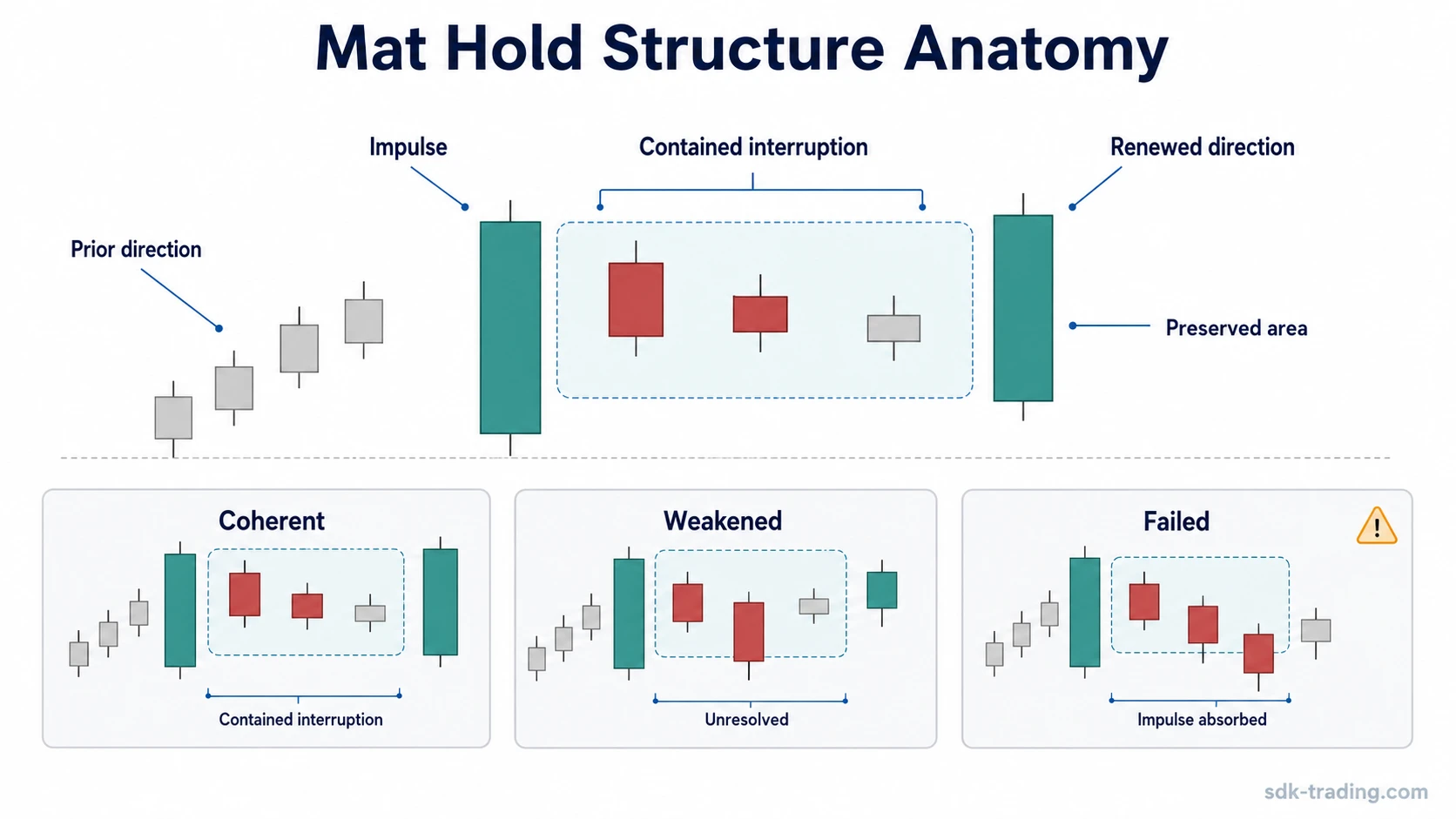
Mat Hold Observable Classification Test
The mat hold pattern becomes easier to evaluate when the candle sequence is classified by what remains visible after the interruption. The test is not whether the candles resemble a textbook diagram perfectly. The test is whether the first impulse survives the middle candles and whether the final candle restores the original direction.
| Reading | Observable condition | Interpretation boundary |
|---|---|---|
| Clean mat hold | Prior direction exists, the first candle shows clear impulse, the middle candles stay contained, and the final candle reclaims directional control. | The continuation reading is structurally coherent, though still conditional on broader market context. |
| Weaker mat hold | The middle candles expand, overlap deeply, or make the original impulse harder to see. | The pattern becomes less distinct from ordinary consolidation or a hesitant pause. |
| Invalid or failed reading | The pullback erases the impulse, breaks the contained structure, or the final candle fails to regain initiative. | The mat hold label should be avoided or heavily qualified. |
Candlestick structure can warn or clarify, but it should not replace the larger market structure around the pattern. A visually neat five-candle sequence carries less meaning if it forms in a random area with no directional context.
How to Identify a Mat Hold Without Overreading It
A mat hold reading should start with the sequence, then move to the boundary conditions. The pattern becomes weaker when the label is forced onto any five candles that appear after a move.
- Check the prior move first. A continuation pattern needs a directional move already in place.
- Look for a clear first impulse candle. The first candle should create the move that the later candles are testing.
- Study the middle candles as a group. They should interrupt the move without fully reversing or absorbing it.
- Compare the pullback with the impulse. A deep or wide counter-move weakens the mat hold reading.
- Require a meaningful final candle. The last candle should reclaim directional initiative rather than leave the structure unresolved.
The most common overread is treating candle count as enough. Five candles alone do not create a mat hold. The sequence needs direction, containment, and renewed initiative.
Mat Hold vs Nearby Continuation Patterns
Mat hold is close to several continuation structures, so the distinction should stay focused on visible candle behavior. The main difference is the impulse-interruption-restoration sequence and whether the counter-move remains contained enough to preserve the original move.
| Pattern | Main structure | How it differs from mat hold |
|---|---|---|
| Mat hold | Strong impulse, contained interruption, final continuation candle. | The middle candles should not erase the first candle’s directional work. |
| Rising three methods pattern | Bullish continuation pattern with a strong first candle, smaller pullback candles, and a final bullish continuation candle. | Mat hold puts more weight on impulse preservation and on whether the interruption fails to absorb the first candle’s work. |
| Falling three methods | Bearish continuation pattern with a downward impulse, smaller counter-move candles, and renewed downside initiative. | Falling three methods owns the standard bearish continuation structure; mat hold should not be used loosely just because a downside sequence also has five candles. |
| Tasuki-style gap continuation | Continuation reading built around how a gap is tested and whether it remains preserved. | Mat hold is broader than a pure gap test because the full five-candle sequence matters. |
The safest comparison is structural, not tactical. Neighboring continuation patterns can look similar, but the mat hold reading depends on whether the first impulse remains visible through the interruption and whether the final candle restores the original direction.
Common Mistakes and Limitations
The mat hold pattern is easy to over-label because many chart pauses contain five candles. A useful reading requires more than a count. It needs a prior move, a visible impulse, a contained interruption, and a final candle that makes the continuation interpretation more defensible.
Common mistake: Calling every small pullback after a large candle a mat hold. If the middle candles become wide, chaotic, or deeply overlapping, the structure may be ordinary consolidation rather than a clean continuation pattern.
Limitation: Mat hold patterns can be difficult to separate from related three-methods structures or from noisy pauses in volatile markets. Strict labeling is less useful than the visible boundary between preserved impulse and failed continuation.
The reading also weakens when the final candle does not carry the move forward. A final candle that closes indecisively, stalls inside the interruption, or fails to reclaim directional initiative leaves the sequence unresolved.
Mat Hold Candlestick Pattern Example in Context
Price advances through a prior resistance area and prints a strong bullish candle. The next three candles pause the move, but their bodies remain relatively small and do not push deeply back through the impulse candle. A final bullish candle then closes above the interruption area and restores upside initiative.
That structure creates a cleaner mat hold reading because the interruption did not fully absorb the first candle. The reading becomes less convincing if the middle candles expand sharply, overlap most of the impulse, or the final candle fails to close with renewed control. If the next response immediately falls back into the interruption area, the reading remains unresolved.
The diagnostic point is the survival of the impulse. When the first candle’s work remains visible after the interruption, the mat hold label is more defensible. When the interruption erases that work, a different continuation or consolidation reading may fit better.
FAQ
Is the mat hold candlestick pattern bullish or bearish?
The mat hold pattern is most commonly described as a bullish continuation pattern. A bearish sequence may share the same impulse-interruption-restoration logic, but it should be labeled carefully and compared with related bearish continuation patterns.
How many candles are in a mat hold pattern?
A mat hold pattern uses five candles: an initial impulse candle, several smaller interruption candles, and a final candle that attempts to restore the original directional move.
What makes a mat hold reading weak?
A mat hold reading weakens when the middle candles expand too much, overlap deeply, erase the first impulse, or leave the final candle unable to reclaim directional control.
When is a five-candle pause not a mat hold?
A five-candle pause is not a clean mat hold when the middle candles absorb the first impulse, become ordinary consolidation, or leave the final candle unable to restore the original direction.