Rising three methods is a bullish continuation candlestick pattern made of five candles: a strong bullish candle, three smaller corrective candles contained within its range, and a final bullish candle that completes the upward sequence. The reading depends on sequence integrity: three small candles after a bullish candle are not enough unless they stay contained and the final candle confirms continuation pressure.
Definition: Rising three methods is a five-candle bullish continuation pattern that appears after upward pressure and shows a controlled pause before buyers try to continue the original move.
Key Points
- The pattern needs prior upward pressure, not a random bullish candle in isolation.
- The first candle should create the range that the middle candles mostly respect.
- The three middle candles should look corrective rather than like a full loss of control.
- The final bullish candle should close back in line with the prior move, not only briefly trade higher.
- The reading loses quality when containment breaks or the final candle cannot complete the structure.
What Is Rising Three Methods?
Rising three methods is a continuation pattern in candlestick analysis. It belongs to bullish continuation context because the sequence starts after upward pressure, pauses through smaller candles, and then attempts to continue in the same direction.
The core idea is structure first. The first bullish candle establishes control, the middle candles test whether that control is being lost, and the final candle decides whether the pause still belongs to the prior upward move. Without that sequence, the pattern becomes only a loose cluster of candles.
How the Five-Candle Structure Works
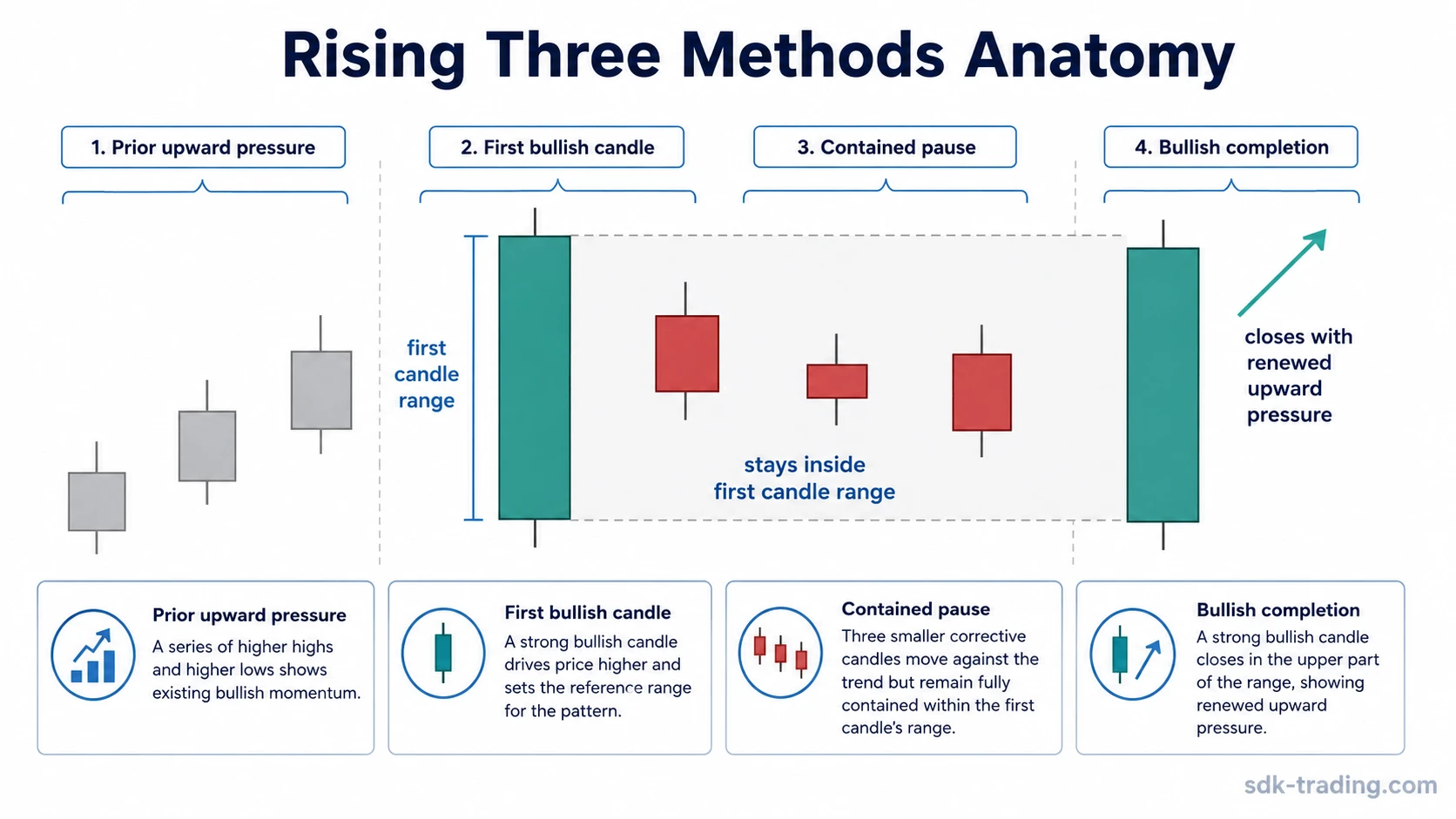
The first candle should be a relatively strong bullish candle. It creates the reference range for the rest of the pattern and shows the initial upward push.
The next three candles are smaller corrective candles. They may be bearish, mixed, or narrow-bodied, but their role is to pause the move rather than erase it. The cleaner version keeps these candles within the range of the first bullish candle.
The fifth candle should be bullish and should reassert the prior upward direction. A wick above the corrective area is weaker than a candle that closes with visible continuation pressure. Sequence quality comes from acceptance, not from a brief excursion beyond the prior candles.
Rising Three Methods Identification Criteria
Identification works best when the pattern is read as a sequence rather than a candle count alone. The middle candles and the final candle must both support the same interpretation.
| Part of the sequence | What to observe | Why it matters |
|---|---|---|
| Prior context | Price has already shown upward pressure. | The pattern is a continuation reading, not a reversal reading. |
| First candle | A large bullish candle creates a visible reference range. | The range defines the area that the corrective candles should respect. |
| Middle candles | Three smaller candles pause or correct inside the first candle’s range. | Containment suggests the pause has not fully displaced the earlier bullish pressure. |
| Final candle | A bullish candle completes the continuation sequence. | The structure remains incomplete if the final candle cannot reassert the prior direction. |
The standard version uses three middle candles. Minor chart variation can appear, but stretching the count too far makes the reading less precise. The pattern is clearest when the sequence remains compact and the corrective candles do not take control of the structure.
Clean, Weak, and Invalid Rising Three Methods Readings
The main distinction is not whether five candles can be counted. The stronger distinction is whether the sequence still preserves the original bullish pressure.
| Reading quality | Sequence behavior | Interpretation boundary |
|---|---|---|
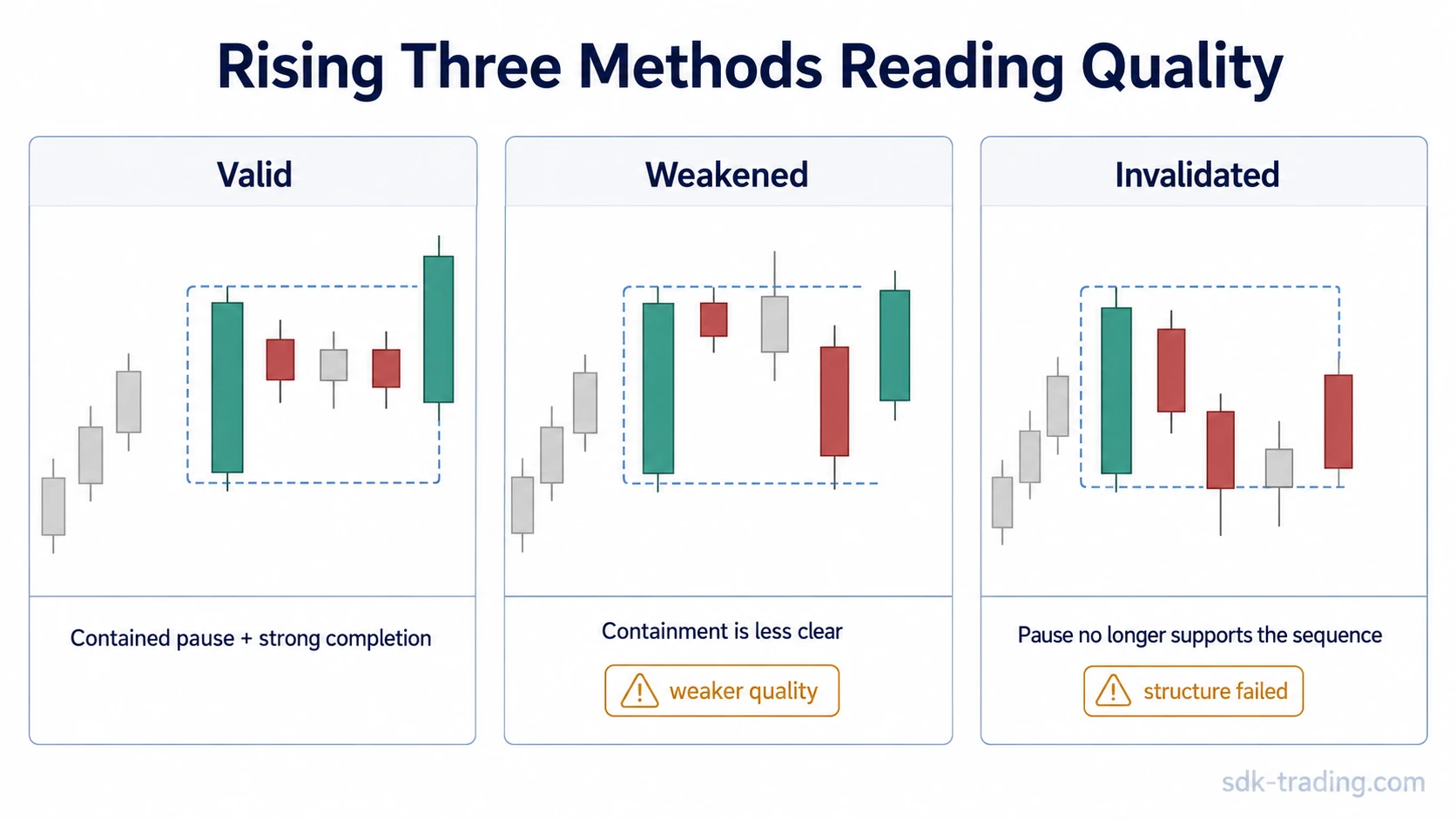
| Clean reading | The middle candles stay contained, remain smaller than the first candle, and the final candle closes with renewed bullish control. | The pause still behaves like controlled consolidation inside the prior bullish move. |
| Weak reading | The middle candles stretch too far, overlap aggressively, or the final candle closes without much force. | The sequence may still resemble the pattern, but the quality of continuation pressure is less clear. |
| Invalid reading | The corrective candles materially break containment, or the final candle fails to close back in line with the prior move. | The structure no longer supports a clean rising three methods interpretation. |
Common Misunderstanding
Common mistake: Counting any three small candles after a bullish candle as rising three methods.
The safer reading starts with containment. If the middle candles expand beyond the first candle’s range, close heavily against the prior move, or turn the pause into a broad reversal attempt, the structure has changed. The final candle also has work to do. It must close with enough bullish pressure to complete the sequence.
A pause alone does not create the pattern. A bullish continuation reading becomes more defensible only when the first candle, the corrective candles, and the final candle all point toward the same sequence.
Simple Rising Three Methods Example in Context
Price advances into a new short-term high and forms a wide bullish candle. Over the next three candles, sellers press back, but each candle remains relatively small and contained inside the first candle’s range. The decline does not show broad acceptance below the original bullish candle.
The next bullish candle pushes back through the corrective area and closes firmly in the direction of the prior move. That produces a cleaner rising three methods reading. If the corrective candles had broken below the first candle’s range, or if the final candle had stalled inside the pause, the same five-candle area would remain weaker or unresolved.
Rising Three Methods vs Falling Three Methods
Rising three methods and falling three methods use mirror-like logic. Rising three methods belongs to bullish continuation context, while falling three methods belongs to bearish continuation context.
The structure is similar: an impulse candle, a contained corrective pause, and a final candle that restores the original direction. The difference is polarity. Rising three methods starts from upward pressure and resolves upward, while falling three methods starts from downward pressure and resolves downward.
Reliability and Limitations
Rising three methods is more useful as a sequence-quality reading than as a complete decision model. The candle pattern can help classify a pause, but the surrounding trend, range position, volume behavior, and later acceptance still affect interpretation.
The interpretation deteriorates when the first candle is not dominant, the middle candles are too large, the corrective area loses containment, or the final candle cannot reassert the prior direction. A pattern that looks correct by candle count can still be poor by sequence quality.
The pattern also becomes less useful in choppy markets where candles repeatedly overlap without directional commitment. In that environment, the five-candle shape may appear visually but fail to show a clean continuation sequence.
Related Continuation Pattern Context
Rising three methods is one member of a broader family of trend continuation candlestick patterns. The shared idea is that a market pauses without fully rejecting the prior direction.
Nearby patterns should not be blended mechanically. Mat hold, upside tasuki gap, separating lines, and other continuation structures use different mechanics. Rising three methods depends most on contained middle candles and a final bullish completion candle.
FAQ
Is rising three methods bullish or bearish?
Rising three methods is a bullish continuation candlestick pattern. It appears after upward pressure and describes a contained pause followed by a bullish completion candle.
Does rising three methods always need exactly five candles?
The standard pattern has five candles: one strong bullish candle, three smaller corrective candles, and one final bullish candle. If the structure stretches too far, the reading becomes less precise.
What makes a rising three methods reading weak?
The reading weakens when the middle candles break containment, overlap too aggressively, or when the final bullish candle cannot restore upward pressure.
Can rising three methods appear without a prior uptrend?
Without prior upward pressure, the pattern loses its continuation context. The candle sequence may still resemble the shape, but the interpretation is weaker.