Trend continuation candlestick patterns are candle sequences read after an existing directional move, when price pauses and then shows whether the prior direction is still being accepted. The pattern name is only useful after the sequence, the pause, the gap behavior, and the next response are judged together.
Definition: A trend continuation candlestick pattern is a multi-candle structure that appears after a prior advance or decline and tests whether the existing direction can remain intact. It is a context reading, not a trade instruction or a guarantee of follow-through.
Key Points
- Trend continuation candlestick patterns need an established directional move before the candle sequence has meaning.
- Gap retention, contained pauses, and separating-line behavior create different continuation-reading problems.
- A continuation reading weakens when the pause breaks containment, the gap disappears, or the final candle fails to restore directional pressure.
- Candlestick continuation patterns are candle-sequence readings, not large chart formations or complete trading systems.
What Trend Continuation Candlestick Patterns Mean
A continuation candlestick reading starts with sequence before pattern. The market must first show directional pressure. Then the candle structure is judged by how well it preserves that pressure during a pause, pullback, or short counter-move.
In an uptrend, the pullback is judged by whether it erases the prior upward pressure or remains contained. In a downtrend, the recovery attempt is judged by whether buyers reclaim enough ground to disrupt the decline or fail below the prior bearish structure.
The pattern name becomes useful only after that context is clear. A candle shape that looks like continuation in one area can become noise in another if it appears without a prior trend, after exhaustion, or inside a sideways range.
How To Sort Continuation Patterns By Structure
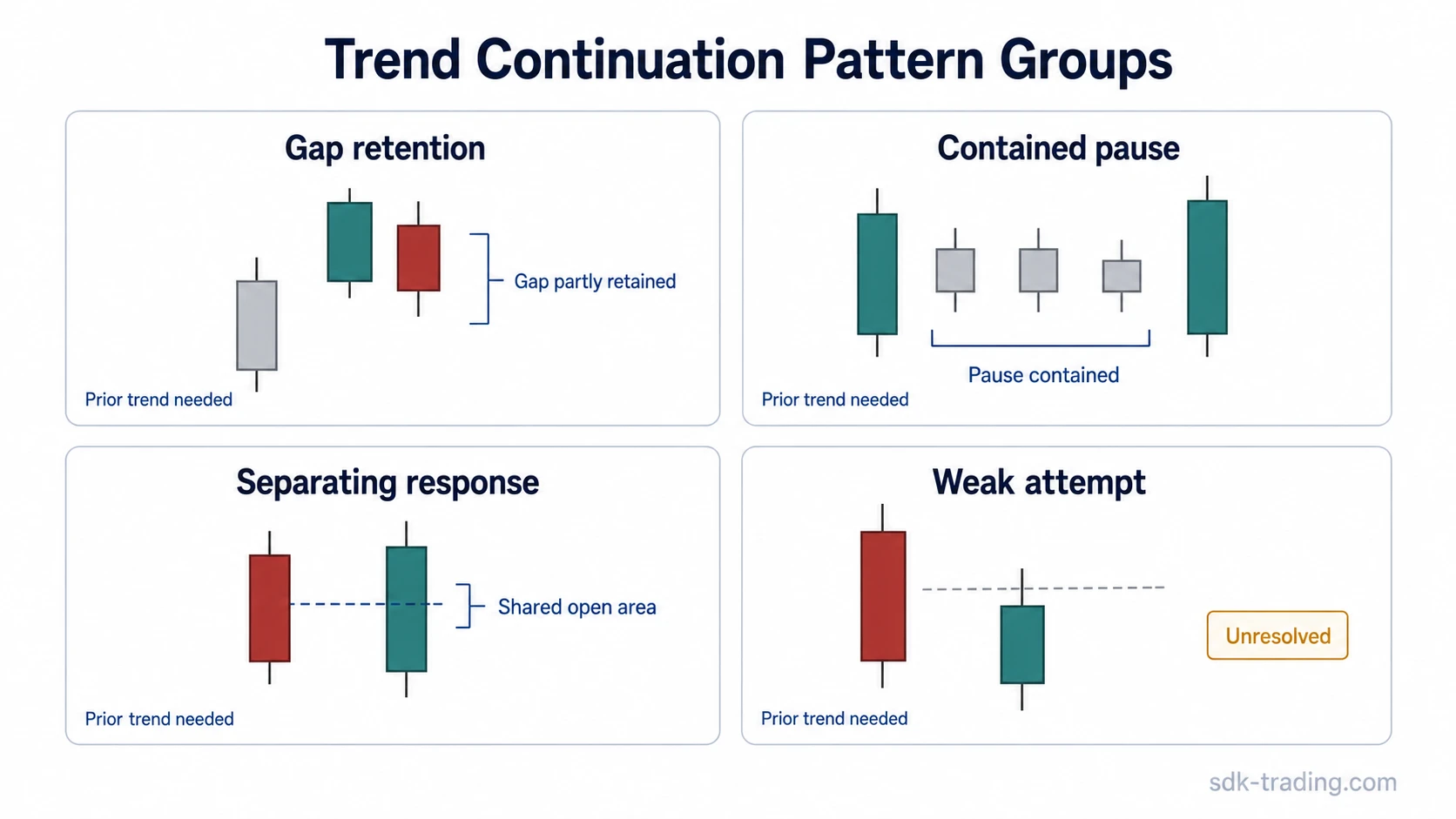
Trend continuation candlestick patterns become easier to read when they are grouped by the problem they solve. Some preserve a gap. Some pause inside the prior candle structure. Some restart directional pressure with a separating candle. Others create weaker or more ambiguous continuation attempts that require more caution.
| Structure group | Reading problem | What to check | Pattern to study next |
|---|---|---|---|
| Gap-retention patterns | Price gaps in the trend direction and then tests whether part of that gap remains open. | Prior trend, second-candle gap, third-candle test, and whether the gap is fully erased. | Tasuki gap continuation structures |
| Upside gap-retention patterns | An upward gap appears after bullish pressure, then the market tests whether buyers still defend part of the gap. | Gap location, pullback depth, and whether the third candle closes through the gap. | Upside Tasuki Gap patterns |
| Downside gap-retention patterns | A downward gap appears after bearish pressure, then the market tests whether sellers keep control of the gap area. | Downside gap size, recovery attempt, and whether buyers fully close the gap. | Downside Tasuki Gap readings |
| Contained-pause patterns | A strong directional candle is followed by smaller candles that pause without breaking the original structure. | First candle strength, contained middle candles, and whether the final candle restores direction. | Mat Hold continuation pauses |
| Separating-line continuation | A counter candle appears, then a new candle opens near the prior open and pushes back in the trend direction. | Trend direction, shared-open behavior, and whether the second candle rejects the counter move. | Separating-line continuation patterns |
| Weak or ambiguous continuation attempts | The market partially recovers after a bearish candle but does not fully overturn the prior pressure. | Midpoint behavior, close location, and whether the recovery is too weak to become reversal evidence. | Thrusting pattern continuation attempts |
Trend Context Before Pattern Names
A continuation pattern without a prior trend is usually a weak label. The prior move creates the pressure being tested. The candle sequence then shows whether the pause is orderly, disruptive, or unresolved.
Four checks keep the reading grounded. First, price should already have a directional bias. Second, the pause should avoid fully cancelling the prior move. Third, the key candle relationship should remain intact, such as a retained gap, contained middle candles, or a separating-line response. Fourth, later price behavior should not immediately close back through the structure being tested.
This keeps candlestick analysis as a secondary timing and interpretation layer. The candle pattern may help organize the observation, but the surrounding structure determines whether the label deserves weight.
Common Misreads In Continuation Candlestick Patterns
The main error is naming a continuation pattern before the market has established a trend context. A similar candle sequence inside a range can look organized without carrying the same continuation meaning.
| Misread | Why it weakens the continuation reading | Safer interpretation |
|---|---|---|
| The pattern appears without a prior trend | There is no clear directional pressure for the pattern to continue. | Treat the sequence as range behavior until direction is clearer. |
| The counter candle is treated as reversal too early | A pause against the trend may be normal if it remains contained. | Check whether the counter move accepts new ground or fails to hold it. |
| The gap fully closes | Gap-retention logic weakens when the tested gap disappears. | Reassess whether the structure still belongs to a gap-based continuation family. |
| The final candle fails to restore direction | Contained-pause patterns need a directional response after the pause. | Keep the reading unresolved until the market shows acceptance or failure. |
| Large chart formations dominate the reading | Candle-sequence patterns can become confused with broader chart-pattern analysis. | Separate short candle relationships from larger multi-swing structures. |
Candlestick Continuation vs Broader Chart Continuation
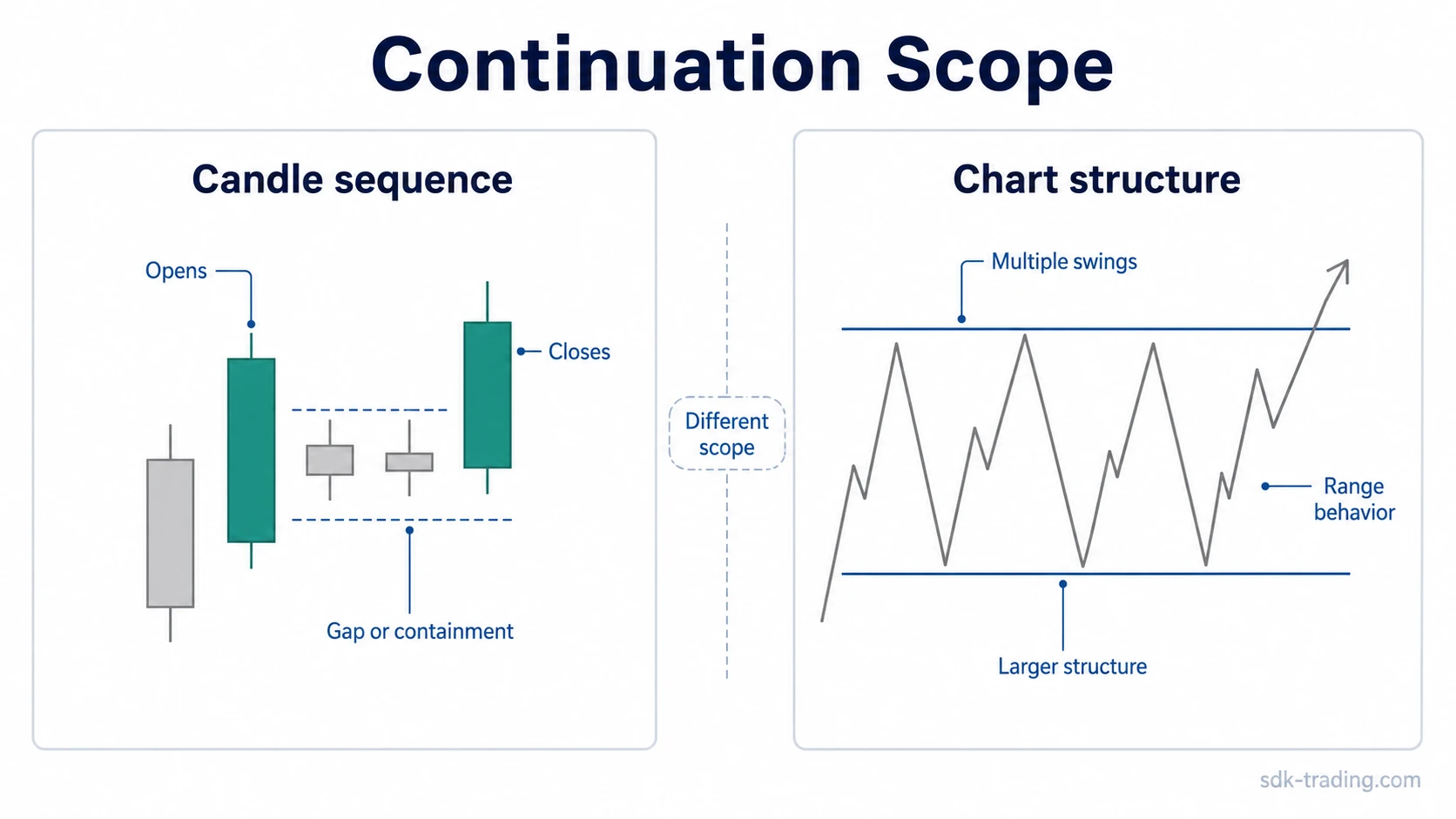
Candlestick continuation patterns work at the candle-sequence level. They focus on opens, closes, gaps, candle size, containment, and how a short pause behaves after a directional move.
Broader chart continuation patterns work across larger structures. They usually involve multiple swings, trendlines, consolidation ranges, or multi-session formations. Those structures can share the same continuation theme, but they should not replace the candle-level reading.
The clean distinction is scope. Candlestick continuation patterns help classify short sequences. Broader chart continuation structures help classify larger market pauses. Mixing the two too early can make a simple candle reading sound more certain than the evidence supports.
Simple Trend Continuation Candlestick Pattern Example
Price has already advanced, then pauses in a small group of candles without closing back through the structure created by the prior impulse. If the next candle restores part of the original pressure while the pause remains contained, the sequence can keep a continuation reading open. The reading is still conditional because a later close back through the tested structure would change the interpretation.
The same idea weakens when the pause expands beyond the original structure, closes the gap that created the pattern, or fails to produce any directional response after the test. Under those conditions, the pattern label becomes less useful than the failed acceptance around the pause.
Where The Main Continuation Patterns Fit
The main continuation candlestick patterns fit different recognition problems. The pattern family should narrow the study path, not replace interpretation.
- Gap tests point toward Tasuki Gap variations.
- Contained pauses point toward Mat Hold-type structures.
- Same-open rejection points toward Separating Lines.
- Partial recovery after bearish pressure points toward Thrusting Pattern-type ambiguity.
Gap behavior, pause quality, and follow-through still need to agree with the prior trend context before a continuation label deserves weight.
FAQ
Can a continuation candlestick pattern appear without a clear trend?
A similar candle shape can appear without a clear trend, but the continuation reading becomes much weaker because there is no established direction for the pattern to continue.
Are continuation candlestick patterns the same as chart continuation patterns?
No. Continuation candlestick patterns focus on short candle sequences, while broader chart continuation patterns usually involve larger multi-swing structures and longer consolidation behavior.