An upside tasuki gap is a three-candle bullish continuation candlestick pattern that appears after an upward move. The second candle gaps higher, and the third candle pulls back into that gap without fully closing it. If the gap is fully closed, the upside tasuki gap reading weakens or fails.
Definition: An upside tasuki gap forms when a bullish candle appears in an upward move, the next bullish candle opens above the prior candle and leaves an upside gap, and a third bearish candle retraces into that gap while leaving part of it open.
Key Points
- The upside tasuki gap is a bullish continuation candlestick pattern.
- The structure depends on a visible upside gap after a prior upward move.
- The third candle should retrace into the gap without closing it completely.
- Full gap closure weakens or invalidates the pattern classification.
- Later price structure matters more than the pattern name alone.
What Is an Upside Tasuki Gap?
The upside tasuki gap belongs to the tasuki gap family of continuation candlestick patterns. Its bullish version appears during an existing advance, where price gaps higher and then tests part of that gap without fully erasing it.
The pattern is not defined by three candles alone. The surrounding movement, the visible gap, and the third candle’s failure to close the gap are all part of the classification. A three-candle pullback after a rising move is not an upside tasuki gap if the gap condition is missing.
The useful reading is structural. Buyers created a gap higher, sellers tested part of that gap, and the market did not fully reject the higher price area by closing the gap. That does not prove continuation, but it preserves the bullish continuation interpretation better than a full gap failure would.
Upside Tasuki Gap Classification Test
The classification test separates the pattern from a generic pullback after a bullish gap. The gap must exist, the sequence must appear after upward movement, and the third candle must leave some of the gap open.
| Condition | What must be visible | Why it matters | What breaks the reading |
|---|---|---|---|
| Prior movement | Price is already moving upward before the pattern begins. | The pattern is a continuation structure, not a stand-alone reversal shape. | No clear upward context before the candles. |
| First candle | A bullish candle appears within the upward move. | It provides the reference candle before the gap. | A weak or unrelated candle that does not belong to the advance. |
| Second candle | A bullish candle opens above the prior candle and leaves an upside gap. | The upside gap is the core structural feature. | No real gap between the first and second candles. |
| Third candle | A bearish candle pulls back into the gap. | The market tests the gap rather than continuing in a straight line. | The third candle does not interact with the gap at all. |
| Gap boundary | Part of the original upside gap remains open after the third candle closes. | Gap preservation keeps the continuation reading intact. | The third candle closes the gap completely. |
Upside Tasuki Gap Anatomy
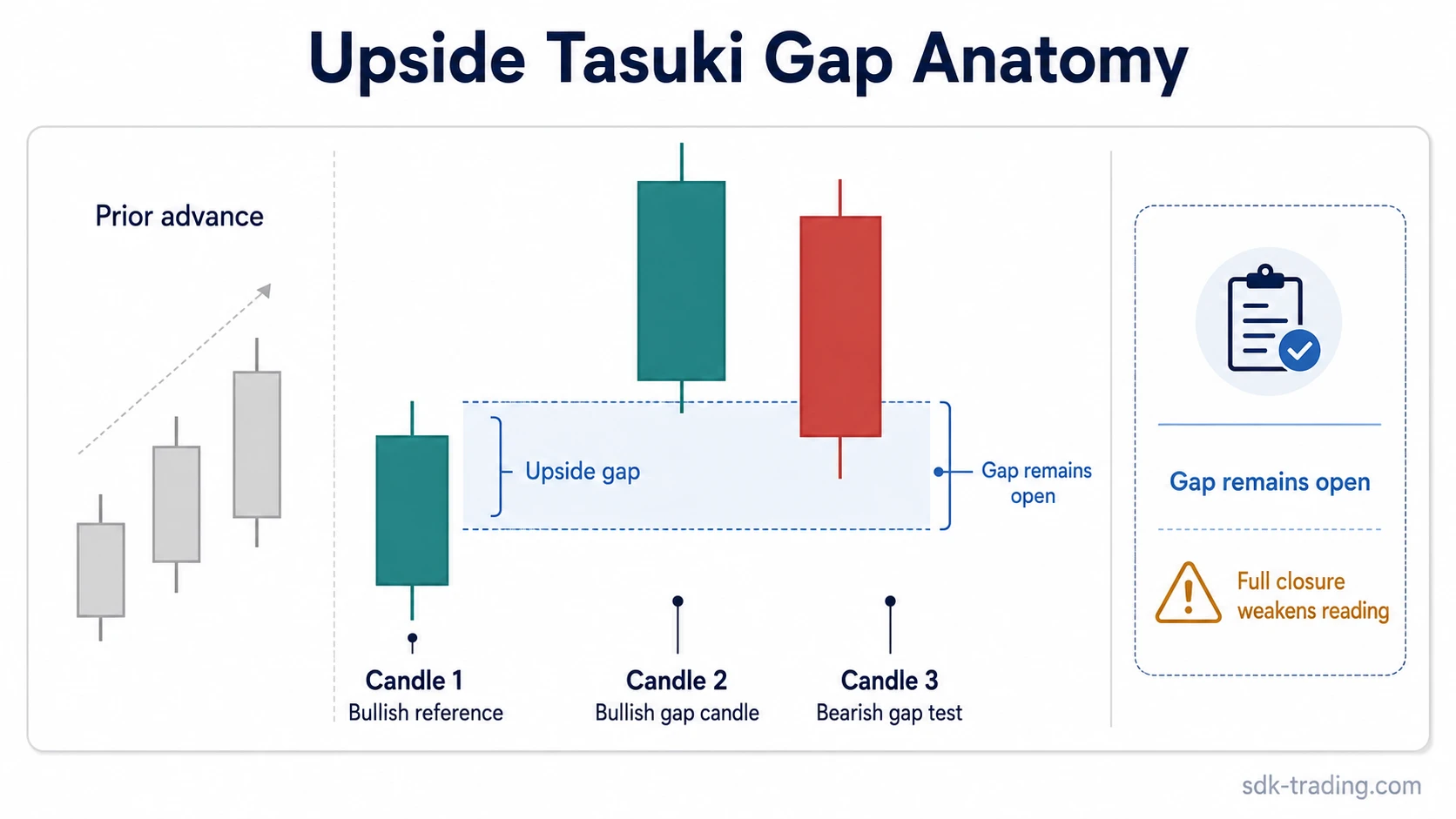
The pattern has three main candles, but the setup begins before the first candle. A prior upward move gives the formation its continuation context. Without that context, the same three-candle sequence can become a less meaningful gap-and-pullback structure.
| Candle | Role in the pattern |
|---|---|
| Candle 1: Bullish reference candle | The first candle is bullish and appears inside an upward move. It gives the pattern a reference point for the gap that follows. |
| Candle 2: Bullish gap candle | The second candle is also bullish and opens above the first candle’s range, leaving a visible upside gap. This gap is the central feature of the upside tasuki gap. If the second candle opens inside or near the prior range without a meaningful gap, the pattern loses its defining structure. |
| Candle 3: Bearish gap test | The third candle is bearish and pulls back into the gap. The important boundary is not that the third candle is bearish by itself. The important boundary is whether its close leaves part of the gap open. Candles can warn, but structure decides whether the pattern still fits. |
Clean, Weak, and Invalid Readings
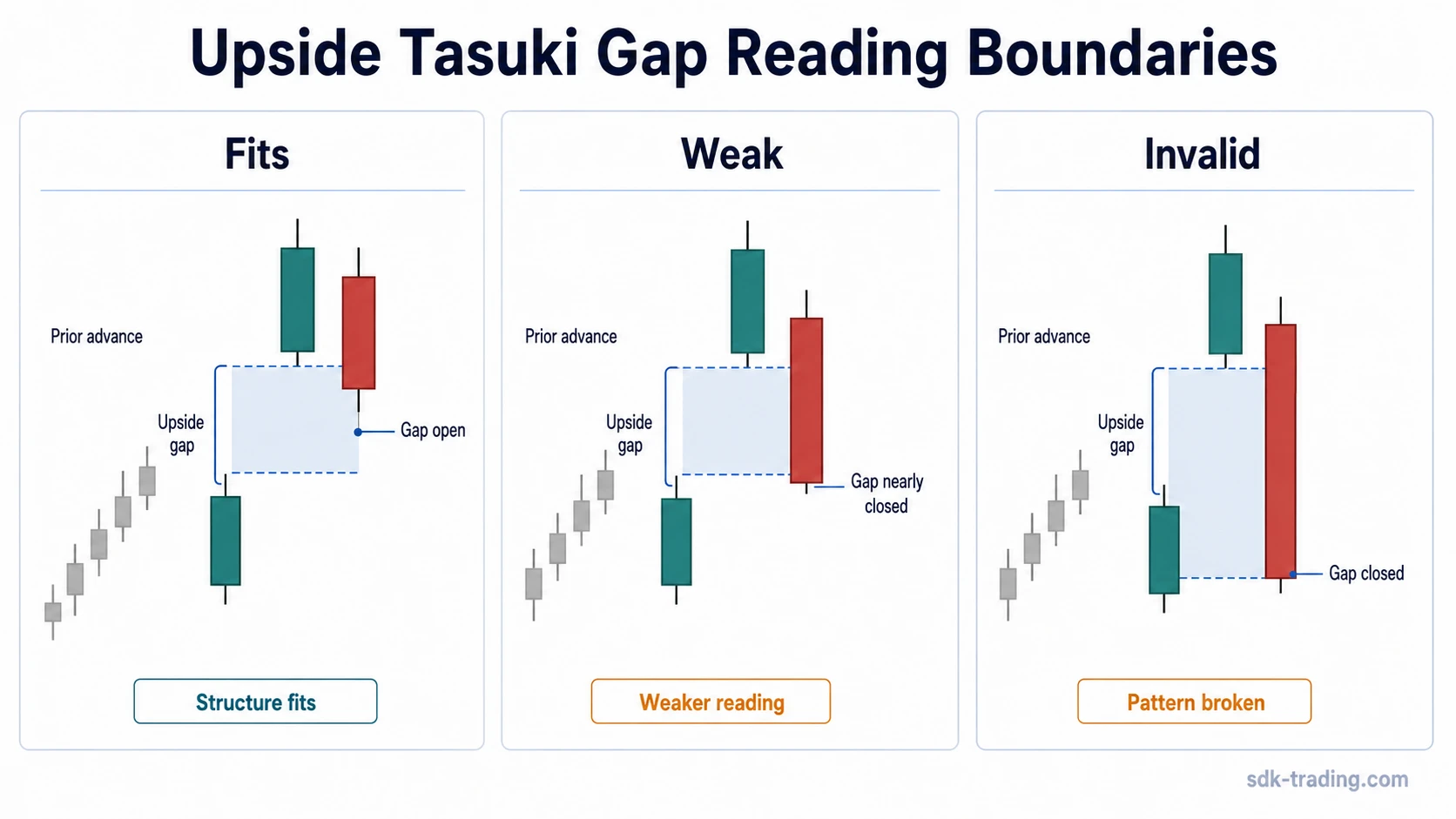
The strongest version of the upside tasuki gap keeps the gap boundary clear. A weaker version may still resemble the pattern, but it leaves more room for doubt. An invalid version removes the structural feature that gives the pattern its name.
| Reading | Typical structure | Diagnostic boundary | Safer interpretation |
|---|---|---|---|
| Clean | Prior upward move, strong bullish gap candle, bearish third candle retraces only part of the gap. | The upside gap remains visibly open after the third candle closes. | The pattern fits the bullish continuation classification, while still needing later confirmation from price structure. |
| Weak | The third candle closes deep into the gap, the prior trend is unclear, or the gap is very small. | The gap technically survives, but the structure is not clean. | The structure remains possible but less reliable as a classification. |
| Invalid | The third candle fully closes the gap, no prior upward move exists, or the second candle does not gap higher. | The pattern’s defining condition is missing or broken. | The structure is better read as a failed gap, a normal pullback, or another candlestick formation. |
Limitation: Gap preservation keeps the pattern classification alive, but it does not guarantee bullish follow-through. A preserved gap can still fail if later candles accept prices back inside or below the gap area.
What the Pattern Can and Cannot Suggest
An upside tasuki gap can suggest that the prior upward move has not been fully rejected. The gap higher shows an attempt to reprice upward, and the third candle tests that gap without completely erasing it.
A clean pattern classification does not confirm continuation by itself. Later acceptance above the gap, failure back into the gap, or broader trend weakness can all change the interpretation.
The most useful question is not whether the name appears on a chart. The more important question is whether the gap survives, whether the prior move supports a continuation reading, and whether later candles respect or reject the higher price area.
Example of a Basic Upside Tasuki Gap Reading
Price advances through a prior congestion area and prints a bullish candle. The next candle opens higher, leaving a visible upside gap, and closes bullish. A third candle then pulls back into the gap but closes before the gap is fully filled.
The pattern fits more cleanly if the third candle’s pullback looks like a controlled test rather than a full rejection of the gap. The reading becomes weaker if the third candle nearly closes the gap, and it fails if the gap is fully closed before the candle ends.
The next comparison is acceptance. If later candles hold above or near the preserved gap, the continuation interpretation remains more defensible. If price quickly trades back through the gap and holds below it, the original classification loses much of its practical value.
Upside Tasuki Gap vs Related Patterns
The upside tasuki gap is easy to confuse with nearby continuation patterns because several of them include bullish candles, pauses, or gaps. The difference is the exact sequence and the role of the gap.
| Pattern | Main difference | Boundary to check |
|---|---|---|
| Upside tasuki gap | Three-candle bullish continuation structure with an upside gap and a bearish third candle testing the gap. | The third candle must not fully close the gap. |
| Downside tasuki gap | Bearish mirror version that appears after downward movement. | The downside gap should remain partly open after the third candle tests it. |
| Tasuki gap family | The broader family includes both upside and downside versions. | The family logic depends on a gap that is tested but not fully closed. |
| Rising three methods | Uses a bullish candle, a small countertrend pause, and a later bullish continuation candle, usually without the same gap boundary. | The middle candles should remain within the prior bullish range rather than revolve around a gap test. |
| Mat hold | Often includes a bullish gap and a controlled pause, but the formation has a broader multi-candle continuation structure. | The pause structure and final continuation candle matter more than a single third-candle gap test. |
| Separating lines | Focuses on opposing candles with similar or shared opens, not a gap that remains partly open. | The shared-open relationship is the key feature, not gap preservation. |
Common Mistakes
Calling the pattern valid after full gap closure. Once the third candle closes the upside gap completely, the defining gap-preservation feature is gone.
Ignoring the prior upward move. The upside tasuki gap is a continuation pattern. Without upward context, the formation becomes a weaker gap-and-pullback observation.
Treating any three-candle pullback as Tasuki. The pattern requires a specific sequence: bullish candle, bullish gap candle, bearish candle testing the gap without fully closing it.
Using the pattern as a complete decision. The pattern is a structural clue. Trend context, gap behavior, and later acceptance or rejection decide how useful the clue becomes.
FAQ
Is an upside tasuki gap bullish?
An upside tasuki gap is classified as a bullish continuation candlestick pattern, but the classification is conditional. The gap must remain partly open, and later price behavior still affects the interpretation.
How many candles form an upside tasuki gap?
An upside tasuki gap uses three candles: a bullish candle in an upward move, a second bullish candle that gaps higher, and a third bearish candle that pulls into the gap without fully closing it.
What invalidates an upside tasuki gap?
The pattern is weakened or invalidated when the third candle fully closes the upside gap, when there is no prior upward movement, or when the second candle does not create a real upside gap.
What is the opposite of an upside tasuki gap?
The opposite version is the downside tasuki gap. It appears after downward movement and uses a downside gap that is tested but not fully closed.
Does an upside tasuki gap guarantee continuation?
No. It can support a bullish continuation reading when the structure is clean, but it does not guarantee follow-through. Later candles and broader market structure can confirm, weaken, or reject the reading.