A separating lines candlestick pattern is a two-candle continuation pattern in candlestick trading. The key feature is that the second candle opens at or near the first candle’s open, then moves back in the direction of the prior trend.
Definition: Separating lines form when a counter-trend candle is followed by a candle that opens at nearly the same price but closes in the original trend direction. Bullish or bearish meaning depends on the prior trend, the candle colors, and the way price behaves after the second candle.
The pattern is best treated as a classification clue, not a complete trading method. A shared open alone is not enough; the prior trend, candle direction, and follow-through all affect whether the reading is clean, weak, or invalid.
Key Points
- Separating lines are a two-candle continuation pattern.
- The second candle opens at or near the first candle’s open.
- Bullish and bearish versions depend on the prior trend and candle direction.
- A clean reading needs more than a similar opening price.
- The next candles can support, weaken, or invalidate the continuation reading.
What Is a Separating Lines Candlestick Pattern?
A separating lines candlestick pattern appears when a market briefly moves against the existing trend, then immediately reopens near the same level and continues in the trend direction. The shared or nearly shared open is the feature that separates this family from many other two-candle continuation patterns.
In an upward trend, the first candle is bearish and the second candle is bullish. In a downward trend, the first candle is bullish and the second candle is bearish. Without that prior trend, the same two-candle shape becomes much less meaningful because there is no clear continuation context to resume.
The pattern does not confirm continuation by itself. It only marks a moment where the counter-trend interruption failed to gain immediate acceptance and the original direction returned quickly.
Separating Lines Anatomy
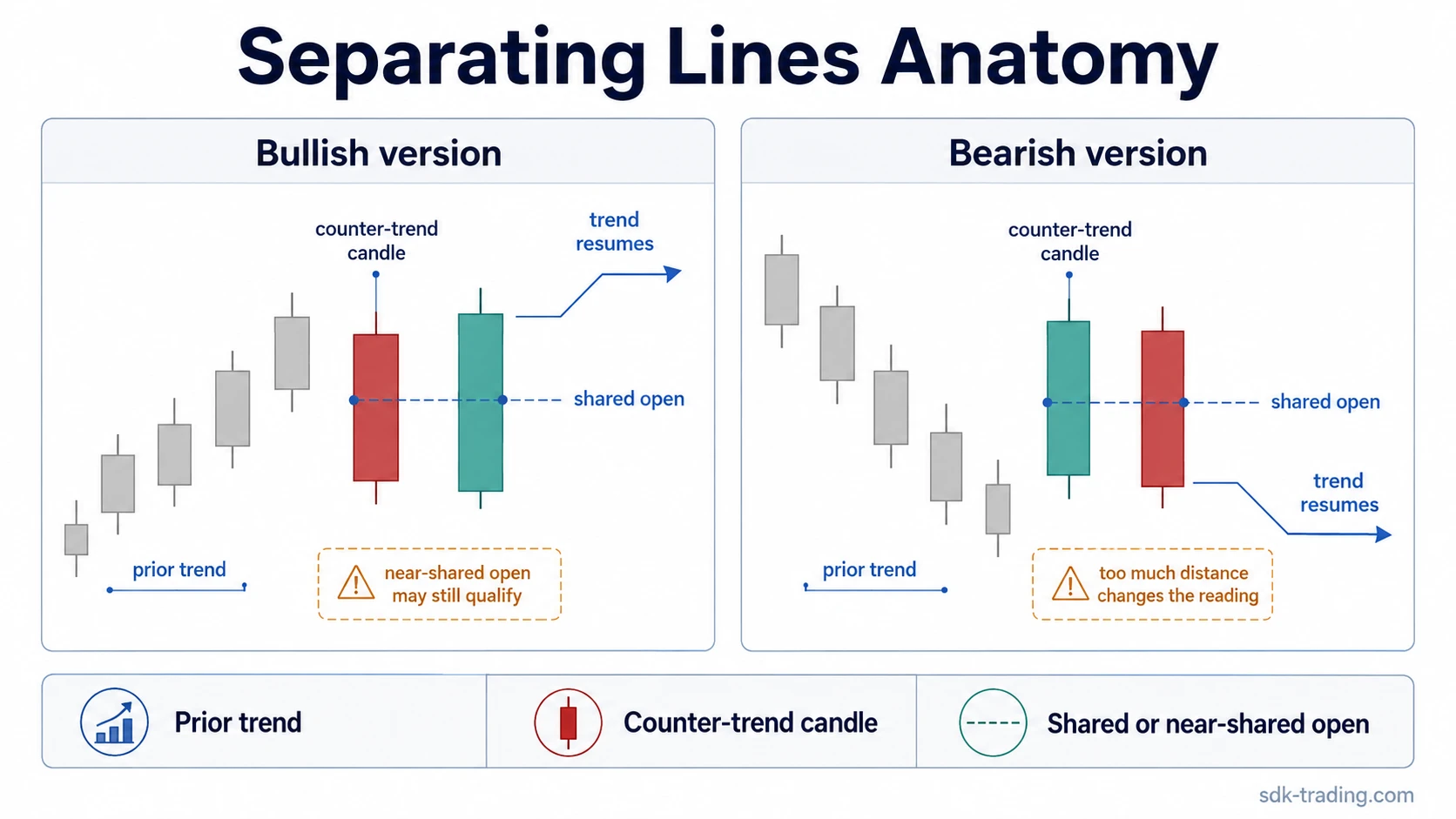
The anatomy of separating lines is simple, but the boundary is strict. The second candle should open at the same level as the first candle or close enough that the market appears to reset from nearly the same starting point.
| Part of the pattern | What to observe | Why it matters |
|---|---|---|
| Prior trend | Price is already moving upward or downward before the two candles form. | The pattern is a continuation structure, so trend context gives the sequence meaning. |
| First candle | The first candle moves against the prior trend. | It creates the interruption that tests whether the trend is losing control. |
| Second candle open | The second candle opens at or very near the first candle’s open. | The near-shared open is the defining boundary of the pattern. |
| Second candle direction | The second candle moves in the direction of the prior trend. | The interruption is rejected quickly instead of developing into a reversal attempt. |
| Follow-through context | The surrounding chart shows whether the resumed direction is accepted or rejected. | The pattern remains only a classification until further context supports the reading. |
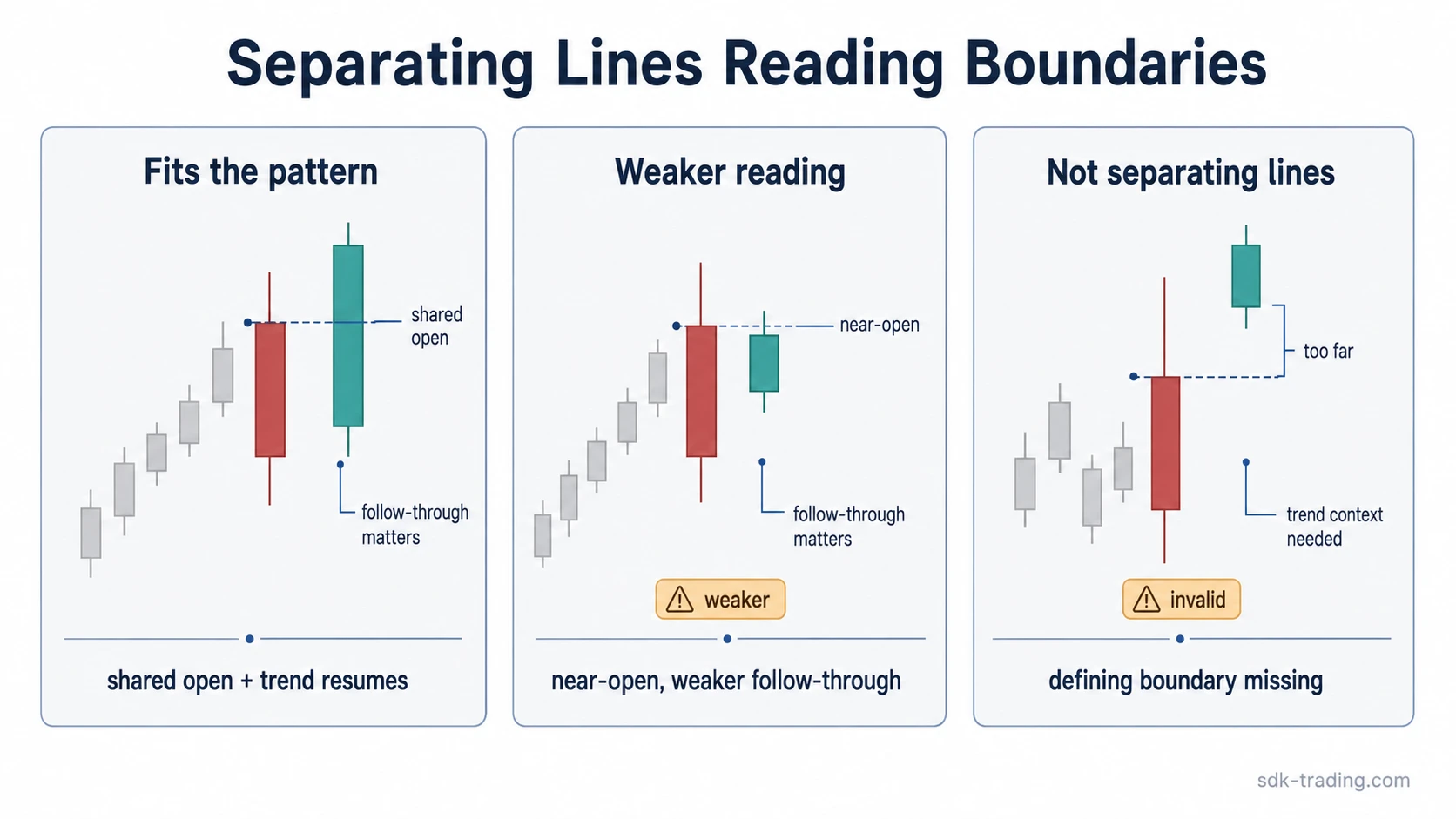
An exact shared open is the ideal form. A small difference may still be acceptable on some charts, but too much separation turns the structure into a different reading. If the opening gap becomes the main feature, the pattern may be closer to a gap-based continuation or reversal structure than separating lines.
Bullish vs Bearish Separating Lines
The bullish and bearish versions use the same shared-open mechanism, but the prior trend and candle colors reverse. The family concept stays the same: a counter-trend candle appears first, then the next candle opens from nearly the same level and resumes the original direction.
| Version | Prior trend | Candle sequence | Core reading |
|---|---|---|---|
| Bullish separating lines | Upward trend | Bearish candle, then bullish candle opening at or near the same open | The counter-trend interruption fails to hold, and upward continuation becomes the cleaner reading if follow-through supports it. |
| Bearish separating lines | Downward trend | Bullish candle, then bearish candle opening at or near the same open | The counter-trend interruption fails to hold, and downward continuation becomes the cleaner reading if follow-through supports it. |
The family-level distinction is the shared opening level. The directional versions matter because the same two-candle relationship changes meaning when the prior trend changes.
Clean, Weak, and Invalid Separating Lines
A separating lines reading improves when the structure is tight and the second candle clearly resumes the prior trend. It weakens when the shared-open feature is loose, the trend context is unclear, or the next candles reject the implied continuation.
| Classification | Conditions | Interpretation boundary |
|---|---|---|
| Clean reading | Clear prior trend, counter-trend first candle, second candle opens at or near the same open and closes in the trend direction. | The pattern fits the separating lines definition, but further context still decides whether continuation is accepted. |
| Weak reading | The second candle opens near the first candle’s open, but the prior trend is shallow, the close is indecisive, or follow-through stalls quickly. | The shape may resemble separating lines, but the continuation reading is less clear. |
| Invalid reading | No clear prior trend, the candles do not use the correct directional sequence, or the second candle opens too far from the first candle’s open. | The setup should not be classified as separating lines because the defining structure is missing. |
Interpretation note: Candlestick analysis works better as a timing and classification layer than as the whole decision process. Separating lines can describe a specific candle relationship, but market structure, trend quality, volatility, and follow-through still matter.
How to Identify Separating Lines Without Overreading Them
A cleaner way to identify separating lines is to start with the structure, then test the context. The pattern should not be accepted only because two candles open from a similar level.
- Start with the prior trend. Upward trend for the bullish version, downward trend for the bearish version.
- Check that the first candle interrupts that trend rather than continuing it.
- Confirm that the second candle opens at or very near the first candle’s open.
- Check that the second candle closes in the direction of the prior trend.
- Look for follow-through before treating the continuation reading as stronger.
Common mistake: Similar openings do not create separating lines by themselves. The reading becomes unsafe when the prior trend is missing, the second candle does not resume the trend direction, or price quickly rejects the continuation area.
Simple Separating Lines Example in Context
Price advances through a short upward sequence, then prints a bearish candle that appears to interrupt the move. The next candle opens near the same level as the bearish candle’s open and closes higher, bringing the market back into the prior upward direction.
The bullish separating lines reading is cleaner if later candles hold the recovered area instead of immediately falling back into the interruption. The reading stays weak if the next recovery attempt stalls near the same level or price quickly rejects the resumed direction. The candle pair defines the pattern; the surrounding behavior decides whether the classification remains useful.
Separating Lines vs Related Candlestick Patterns
Separating lines can be confused with several nearby continuation and reversal structures. The main difference is that separating lines are built around a shared or nearly shared open, not around a gap, a multi-candle pause, or a same-close relationship.
| Nearby pattern | Main confusion | Cleaner distinction |
|---|---|---|
| Counterattack lines | Both can involve opposite candle colors after a trend move. | Counterattack lines focus on a similar closing level, while separating lines focus on a similar opening level. |
| Meeting lines | Both can show two candles meeting around a shared price area. | Meeting lines are usually read through the close relationship, not the shared-open continuation mechanism. |
| Tasuki gap patterns | Both can appear during continuation attempts. | Tasuki gap patterns depend on a preserved gap; separating lines depend on the second candle opening near the first candle’s open. |
| Rising and falling three methods | Both describe continuation after interruption. | Three methods patterns use a multi-candle pause inside a larger structure, while separating lines use a two-candle shared-open sequence. |
| Mat hold | Both can describe continuation after a controlled interruption. | Mat hold is a five-candle structure; separating lines are a two-candle family. |
Limitations of Separating Lines
Separating lines are narrow pattern labels. They describe a specific relationship between two candles, but they do not measure trend strength, liquidity, volatility, or broader market participation.
The reading is less useful when the market is moving sideways, when candle bodies are very small, or when the second candle fails to create meaningful directional progress. A technically correct shared-open structure can still be low value if the surrounding chart lacks a clean trend or if the resumed direction is rejected quickly.
Limitation: A separating lines pattern can identify a continuation attempt, but it cannot confirm the quality of that attempt alone. Structure, location, and follow-through are needed before the pattern becomes a useful part of a broader chart reading.
FAQ
What does the separating lines candlestick pattern mean?
It means a market briefly moved against the prior trend, then reopened near the same level and moved back in the trend direction. The meaning depends on the prior trend and the candle sequence.
How many candles form separating lines?
Separating lines use two candles. The first candle moves against the prior trend, and the second candle opens at or near the first candle’s open before moving with the trend.
What is the difference between bullish and bearish separating lines?
Bullish separating lines appear after an upward trend and use a bearish candle followed by a bullish candle. Bearish separating lines appear after a downward trend and use a bullish candle followed by a bearish candle.
Is the same open required for separating lines?
An exact same open is the ideal form. A small difference may be acceptable in practical chart reading, but a large opening difference weakens or invalidates the classification.
Can separating lines be used without confirmation?
Separating lines should not be treated as a complete trading method by themselves. Later price behavior is needed to judge whether the continuation reading is being accepted or rejected.