Bullish separating lines are a two-candle continuation candlestick pattern that can appear during an existing uptrend when a bearish candle is followed by a bullish candle that opens at the same or nearly the same price.
The pattern describes a demand-side recovery after a short interruption. The first candle shows selling pressure inside the uptrend, while the second candle reopens near the same level and moves upward, suggesting that buyers have not fully lost control of the prior advance.
Definition: Bullish separating lines form when a bearish candle in an uptrend is followed by a bullish candle that opens at or near the prior candle’s open, creating a recovery-side continuation reading rather than a guaranteed outcome.
Key Points
- Bullish separating lines require an existing uptrend before the two-candle pattern forms.
- The first candle is bearish, and the second candle is bullish.
- The shared or nearly shared opening price is the main structural feature.
- The reading is cleaner when the second candle shows strong recovery and later price action holds the recovery area.
- The pattern weakens when the market accepts back below the recovery candle or the prior trend is unclear.
Bullish Separating Lines Definition
In candlestick analysis, bullish separating lines belong to the continuation pattern family. They are not defined by a gap, a full engulfing relationship, or a reversal attempt. The defining relationship is the nearly shared open between the bearish interruption candle and the bullish recovery candle.
The broader separating lines family includes both bullish and bearish variants. The bullish version applies when the prior movement is upward and the second candle restores the direction of that upward movement.
How Bullish Separating Lines Form
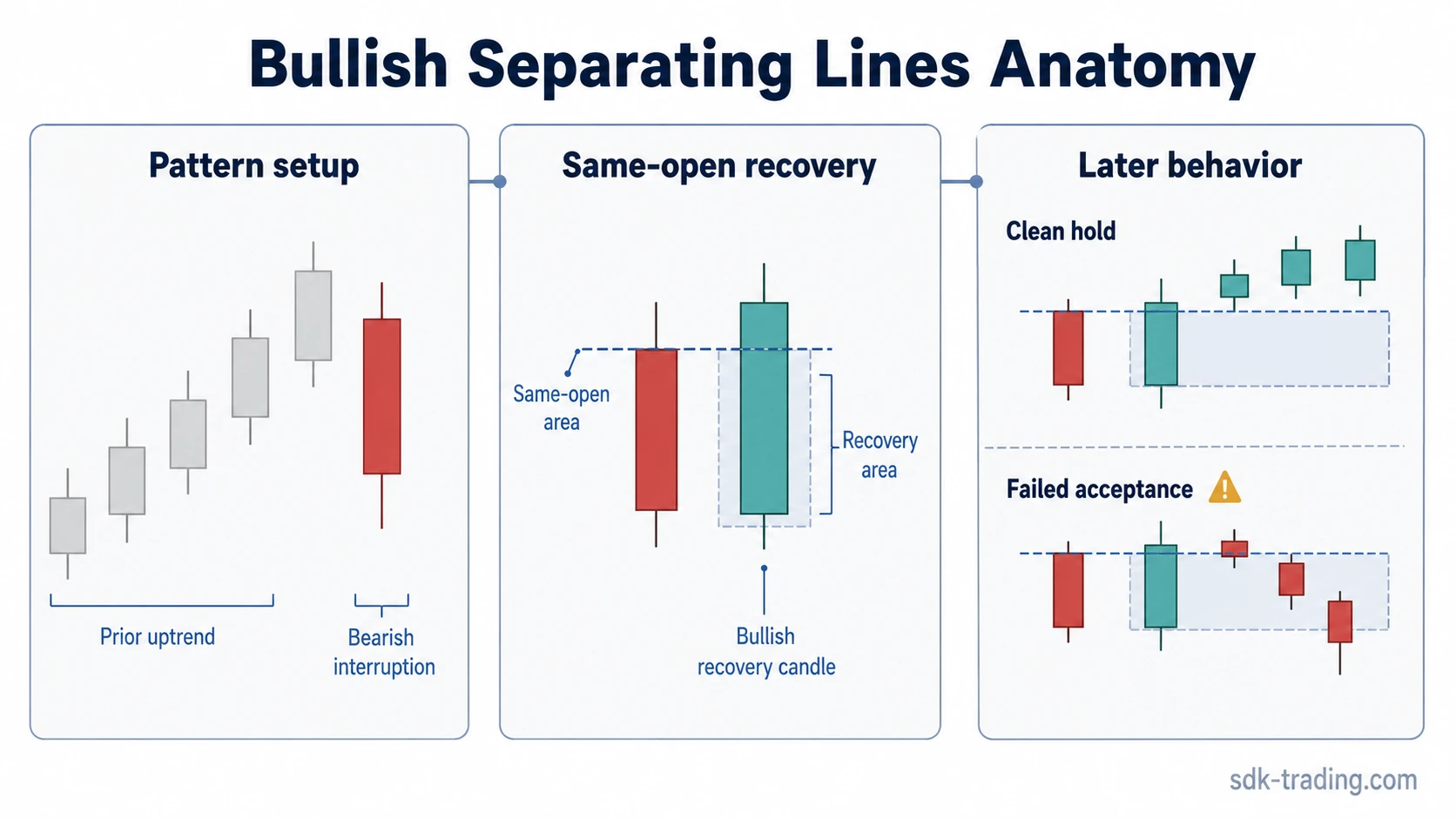
The structure begins with an established upward move. A bearish candle then interrupts that move, creating a moment where supply appears to challenge the advance. The next candle opens near the same price as the bearish candle and then closes bullish, creating the visual separation between the bearish interruption and the renewed upward candle body.
The same-open relationship matters because it shows that the second candle did not begin from a materially different price area. Instead, the market revisits the same starting point and produces a different result. That result is the core of the bullish classification boundary.
Same-open tolerance: The two opens do not need to match tick-for-tick on every chart feed. A small difference can still preserve the reading if the candles clearly share the same opening area and the second candle restores bullish control. A wide opening difference turns the pattern into a weaker or different structure.
How to Identify the Pattern
A bullish separating lines reading depends on the relationship between trend context, candle color, open location, and recovery quality. The candle shape alone is not enough.
| Identification point | What to look for | Why it matters |
|---|---|---|
| Prior trend | Price is already moving upward before the pattern appears. | The pattern is classified as a bullish continuation reading, not a standalone reversal structure. |
| First candle | A bearish candle interrupts the upward move. | This candle creates the supply-side challenge that the second candle must answer. |
| Second candle | A bullish candle follows immediately after the bearish candle. | The second candle restores the direction of the prior advance. |
| Opening relationship | The second candle opens at or near the first candle’s open. | The shared opening area is the feature that separates the pattern from many other two-candle formations. |
| Recovery quality | The bullish candle closes with enough strength to challenge the bearish interruption. | A weak recovery candle can leave the pattern unresolved rather than cleanly supportive. |
| Later behavior | Price holds the recovery area instead of accepting below it. | Later acceptance supports or weakens the classification without turning the pattern into a trade instruction. |
Clean, Weak, and Invalid Readings
The most useful boundary is not whether two candles look similar to a textbook diagram. The useful boundary is whether the prior uptrend, same-open relationship, recovery candle, and later price behavior all support the same interpretation.
| Reading quality | Typical structure | Interpretation boundary |
|---|---|---|
| Clean reading | Clear prior uptrend, bearish interruption, bullish second candle, same or nearly same open, and later holding above the recovery area. | The bullish continuation classification is easier to defend because the market does not quickly reject the recovery area. |
| Weak reading | Unclear prior trend, loose same-open relationship, small recovery candle, or immediate hesitation after the second candle. | The candle pair may still resemble bullish separating lines, but the structure gives less weight to the continuation reading. |
| Invalid or failed reading | Price accepts below the recovery candle, the second candle fails to restore demand, or the supposed uptrend was not established. | The bullish separating lines classification becomes difficult to defend because the market no longer supports the recovery-side structure. |
Limitation: Bullish separating lines describe a pattern structure, not a forecast. The reading carries more weight when the candle pair fits the surrounding trend and later price action does not erase the recovery candle.
Simple Bullish Separating Lines Example
Price advances through a steady upward sequence, then prints a bearish candle that briefly challenges the move. The next candle opens near the same level as the bearish candle and closes bullish, returning pressure to the upside. The reading is cleaner if later candles hold above the recovery candle’s body area. It becomes weaker if the next candles trade back through the recovery body, fail to reclaim that area, and leave the bullish candle looking like a failed demand attempt.
Bullish Separating Lines vs Related Patterns
Bullish separating lines can be confused with nearby continuation patterns because several of them involve a short interruption followed by renewed directional pressure. The difference is the same-open recovery relationship, not simply the fact that price keeps moving upward.
| Related concept | Main difference | Boundary for bullish separating lines |
|---|---|---|
| Separating lines | The umbrella concept includes both bullish and bearish variants. | The bullish variant requires an existing upward move and a bullish second candle. |
| Bearish separating lines | The bearish version appears in a downward context and uses the opposite directional relationship. | The bullish version restores upward pressure after a bearish interruption. |
| Tasuki gap | Tasuki patterns depend on gap structure. | Bullish separating lines depend on the same or nearly same opening price, not a gap. |
| Upside tasuki gap | The upside tasuki gap uses a gap continuation structure and a later pullback candle. | Bullish separating lines use two candles with a shared opening area. |
| Thrusting pattern | A thrusting pattern has a different candle relationship and often carries more ambiguity. | Bullish separating lines require the second candle to restore the prior upward direction from the same opening area. |
Common Misread
| Misreading | Why it weakens the label | Better diagnostic check |
|---|---|---|
| The name is treated as a broad separation or reversal event | Bullish separating lines are generally a bullish continuation structure, not a generic reversal label. | Check for prior uptrend, bearish interruption, bullish recovery candle, and a same-open relationship. |
| The matching open is treated as a mechanical rule | A perfect open does not rescue the reading if the trend is missing or the recovery candle fails. | Use the same or near-same opening area only when the surrounding bullish continuation context is present. |
| A loose near-open relationship is accepted too easily | If the second candle opens far from the first candle’s open, the structure may be ordinary volatility instead of separating lines. | Require both candles to begin from the same visible opening area before using the pattern label. |
FAQ
What are bullish separating lines?
Bullish separating lines are a two-candle continuation candlestick pattern that can form in an uptrend when a bearish candle is followed by a bullish candle opening at or near the same price.
Do bullish separating lines require the exact same open?
The cleanest version uses the same open, but a small tolerance can still preserve the reading if both candles clearly begin from the same opening area and the second candle restores bullish pressure.
What weakens a bullish separating lines reading?
The reading weakens when the prior uptrend is unclear, the second candle fails to recover strongly, the opening relationship is loose, or later price action accepts below the recovery candle.
How are bullish separating lines different from bearish separating lines?
Bullish separating lines appear in an upward context with a bullish second candle, while bearish separating lines appear in a downward context with a bearish second candle.