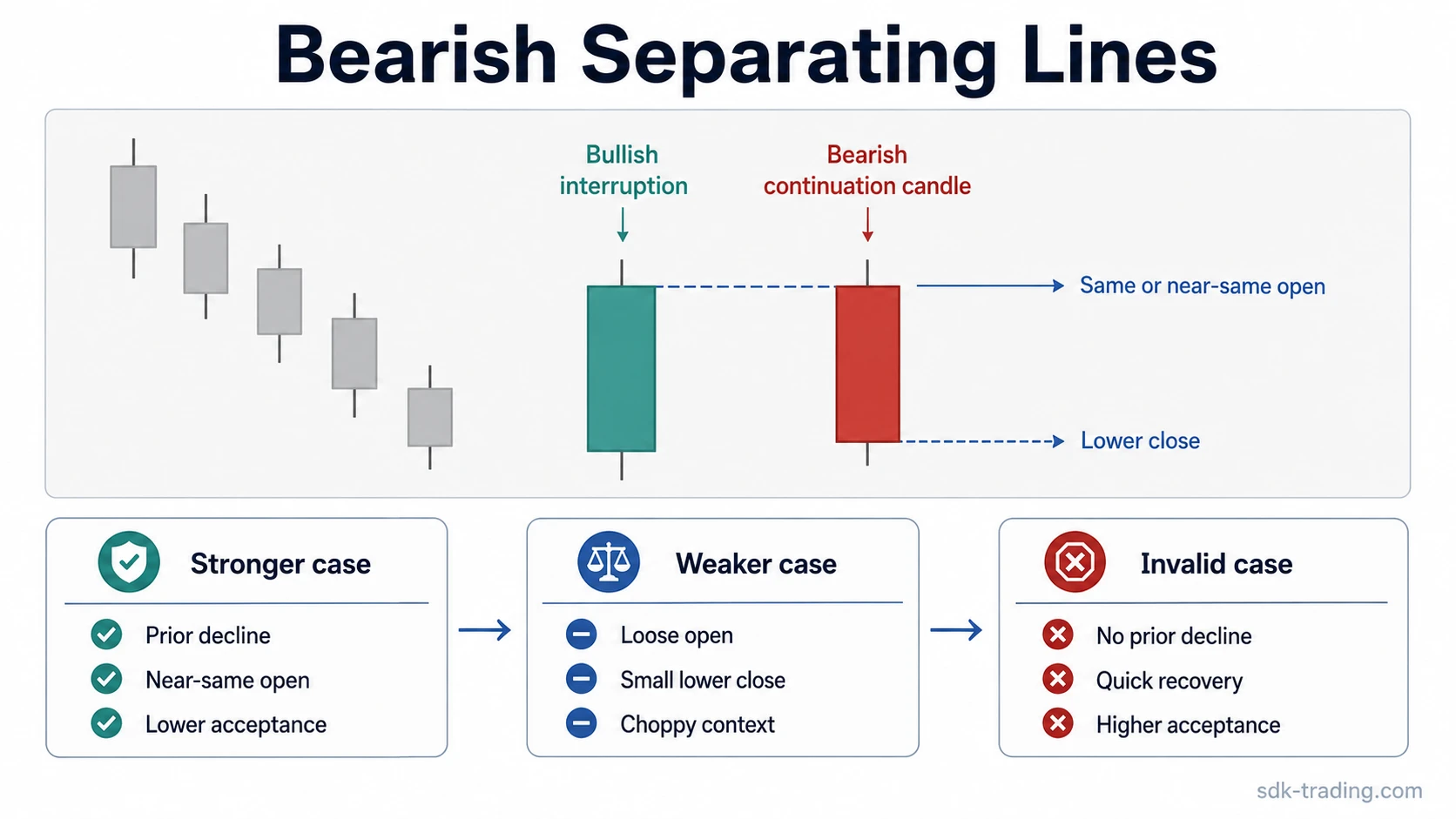
Bearish separating lines are a two-candle bearish continuation candlestick pattern that can appear during an existing downtrend. The first candle is bullish, but the second candle opens at or near the same level and closes bearish, showing that the bullish response failed to change control.
Definition: Bearish separating lines form when a bullish candle appears against a decline, followed by a bearish candle that opens at or near the prior candle’s open and then closes lower. The first candle is the interruption; the second candle is the test of whether bearish continuation pressure returns from roughly the same opening area.
The candle pair is the surface clue; context and follow-through decide whether the interpretation holds. The continuation case is cleaner when later candles keep accepting lower prices. It loses value when price quickly reclaims the failed bullish candle area.
Key Points
- Bearish separating lines are a two-candle bearish continuation pattern.
- A prior downtrend or bearish continuation structure is required.
- The second candle opens at or near the first candle’s open and closes bearish.
- The continuation case can fail if later candles reject lower prices and recover the tested area.
What Bearish Separating Lines Mean
Bearish separating lines describe a failed bullish interruption inside a decline. The first candle shows an attempt to respond against selling pressure. The second candle opens near the same starting level, but closes lower, suggesting that sellers regained control before the market accepted a meaningful recovery.
The pattern alone does not prove that a downtrend will continue. It can indicate that bearish pressure remains active, but only when the surrounding structure supports that interpretation. A candle pair appearing in a sideways range, after an exhausted selloff, or without later downside acceptance is much less useful.
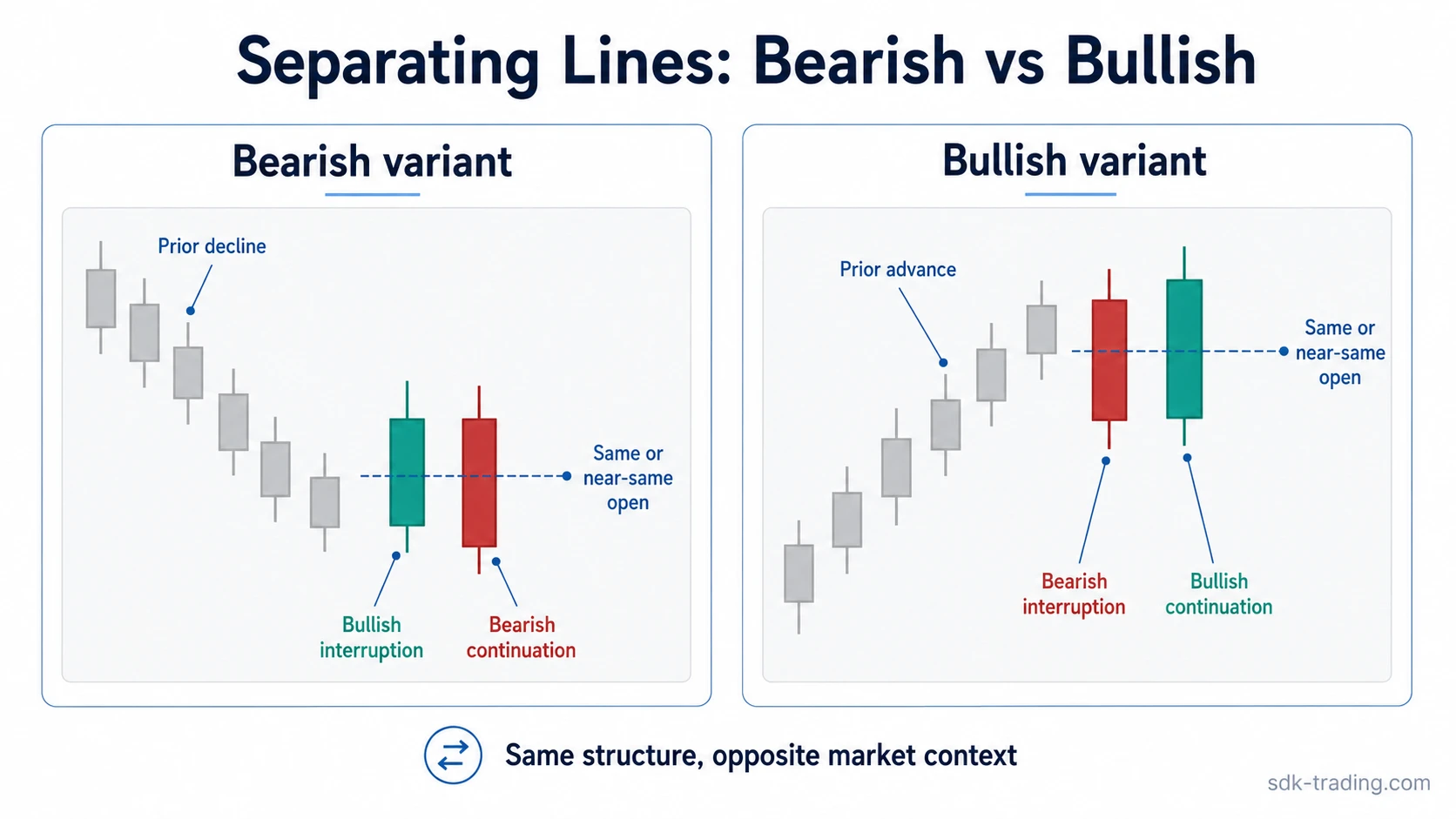
For the broader two-sided family, Separating Lines explains how bullish and bearish variants fit under the same-open continuation concept.
How to Identify Bearish Separating Lines
Identification depends on the prior move, the relationship between the two opens, and the result of the second candle. The structure is not just any bullish candle followed by a bearish candle.
| Element | What to look for | Why it matters |
|---|---|---|
| Prior context | A downtrend or bearish continuation structure is already present. | Without bearish context, the pattern loses its continuation meaning. |
| First candle | A bullish, white, or green candle appears against the decline. | It shows a temporary attempt to respond against selling pressure. |
| Second candle | A bearish, black, or red candle follows. | It shows that sellers returned after the bullish response. |
| Open relationship | The second candle opens at or near the first candle’s open. | The shared or near-shared open is the key structural feature of the pattern. |
| Close and result | The second candle closes lower, preferably with clear bearish range expansion. | The close shows whether bearish pressure actually regained control. |
Exact same opens are cleaner, but real charts often require a conservative near-same-open interpretation. The tolerance should be small enough that the second candle still appears to restart from roughly the same price area, not from a new gap or unrelated level.
Why the Second Candle Matters
The second candle carries most of the diagnostic weight. The first candle can look constructive because it moves against the decline. The bearish candle then tests whether that response can hold. When the second candle opens near the same level and closes lower, the bullish response has failed to create acceptance above its own starting area.
Mechanism: the bullish candle creates a recovery attempt, but the bearish candle resets from a similar open and closes lower. That sequence can show that sellers absorbed the response and pushed price back in the direction of the existing decline.
Follow-through after the second candle gives the continuation interpretation more structural support. If the next candles continue to trade lower or fail to reclaim the bullish candle’s body, the bearish case has more support. If price quickly recovers through the bearish candle and holds above the failed area, the interpretation is no longer clean.
Clean, Weak, and Invalid Bearish Separating Lines Readings
The same two-candle outline can produce different interpretations depending on context and later price behavior. The useful distinction is not whether the pattern name fits mechanically, but whether the market accepts the bearish continuation attempt.
| Reading type | Typical behavior | Diagnostic interpretation |
|---|---|---|
| Clean reading | Price is already declining, the first candle rallies modestly, the second candle opens near the same level and closes firmly bearish, and later candles fail to reclaim the bullish candle area. | The bullish response was rejected and bearish continuation remains structurally supported. |
| Weak reading | The candle pair appears after choppy movement, the second candle barely closes lower, or the near-same open is loose rather than precise. | The pattern shape exists, but the evidence for seller control is limited. |
| Invalid reading | Price quickly recovers above the bearish candle, holds above the failed area, or the pattern appears without a prior bearish structure. | The continuation interpretation has failed or should not be assigned in the first place. |
Price advances briefly against a decline, then a bearish candle opens near the same level as the prior candle and closes below it. The case is cleaner if the next candles remain below the failed recovery area. It becomes unresolved if price immediately returns into that area and begins holding there instead of accepting lower prices.
Bearish Separating Lines vs Related Patterns
Bearish separating lines are the bearish variant of the same-open continuation structure. Bullish Separating Lines use the opposite market logic: a bearish candle interrupts an advance, then a bullish candle opens at or near the same level and restores upward pressure.
| Pattern or concept | Main distinction | Boundary to keep clear |
|---|---|---|
| Bearish separating lines | Bearish continuation pattern after a prior decline. | First candle is bullish, second candle is bearish, and the second candle opens at or near the first candle’s open. |
| Bullish separating lines | Bullish continuation pattern after a prior advance. | The polarity is reversed: bearish interruption first, bullish continuation candle second. |
| Separating lines | Umbrella concept covering bullish and bearish variants. | The family concept should not replace the variant-specific trend context. |
| Thrusting pattern | Different bearish continuation structure with different second-candle behavior. | The same-open relationship is not the defining feature. |
| Tasuki gap | Gap-based continuation structure. | The gap is the central feature, not the shared or near-shared open. |
Common Misreadings
| Misreading | Why it weakens the label | Better diagnostic check |
|---|---|---|
| Same color sequence is treated as enough | A bullish candle followed by a bearish candle does not automatically form bearish separating lines. | Check the open relationship and the prior bearish context before assigning the pattern name. |
| A loose near-same open is accepted too easily | If the second candle opens far away from the first candle’s open, the structure may belong to another pattern or ordinary volatility. | Use the pattern only when both candles clearly begin from the same or very similar price area. |
| Volume is treated as proof of continuation | Higher activity on the second candle may support the idea that sellers returned, but it cannot prove continuation alone. | Use price result and later acceptance as the main continuation checks. |
| The pattern is treated as a complete trading system | Candlestick analysis works better as a timing and context layer. | Use structure and follow-through to decide whether the interpretation remains valid. |
FAQ
Is bearish separating lines a reversal pattern?
No. Bearish separating lines are normally treated as a bearish continuation pattern because the structure depends on an existing decline or bearish continuation context.
Does the second candle need to open at the exact same price?
An exact same open is cleaner, but a small near-same-open difference may still be usable if the two candles clearly begin from the same price area. A loose open relationship weakens the pattern.
Can bearish separating lines fail?
Yes. The reading can fail if price quickly reclaims the bearish candle area, holds above the failed continuation attempt, or appears without a valid prior bearish structure.