A thrusting pattern is a two-candle candlestick pattern usually read as a bearish continuation structure after a decline. It forms when a bullish second candle opens below the prior bearish candle, recovers into that body, but closes below the midpoint of the prior real body.
Definition: A thrusting pattern is a bearish continuation candlestick pattern built around a failed full recovery. The second candle pushes upward, but the close does not reclaim enough of the prior bearish candle to shift the structure away from sellers.
The important boundary is not that the second candle is bullish. The important boundary is where that candle closes inside the prior bearish body. A close below the midpoint keeps the upside response limited; a close above that area changes the classification and can weaken or invalidate the thrusting-pattern reading.
Key Points
- A thrusting pattern usually appears after bearish pressure or a decline.
- The first candle is bearish, and the second candle opens lower.
- The second candle moves into the first candle’s body but closes below its midpoint or lower half.
- The midpoint test separates a cleaner thrusting pattern from a weak or invalid reading.
- The pattern is a classification tool, not a complete trading method.
What Is a Thrusting Pattern?
A thrusting pattern is a two-candle candlestick structure that appears after selling pressure. The first candle shows downside control. The second candle opens below the first candle’s close, then moves upward into the prior bearish body without closing high enough to reclaim the midpoint.
That limited reclaim is why the pattern is commonly treated as a bearish continuation reading. Buyers respond, but the response remains contained inside the prior bearish candle instead of reversing the pressure from the first candle.
The classification is conditional. A thrusting pattern can support a continuation interpretation when the candle structure remains intact, but the pattern does not prove that the decline must continue.
How the Thrusting Pattern Forms
The thrusting pattern is easier to classify when the candle sequence is broken into its parts. The pattern depends on the relationship between the two candles, not on the color of the second candle alone.
| Stage | What to observe | Why it matters |
|---|---|---|
| Background | Price has been declining or showing bearish pressure. | The pattern is normally interpreted inside a bearish continuation setting. |
| Candle 1 | A bearish candle creates a clear body to measure against. | The first candle becomes the reference body for the recovery test. |
| Candle 2 open | The second candle opens below the prior close or lower than the first candle’s body area. | The lower open shows that bearish pressure has not disappeared at the start of the second candle. |
| Candle 2 advance | The second candle moves upward into the body of the first bearish candle. | The advance tests how much of the prior bearish candle can be reclaimed. |
| Close location | The second candle closes below the midpoint or lower half of the first candle’s body. | The upward response stays limited, which preserves the thrusting-pattern classification. |
The midpoint is the main diagnostic line. If the second candle cannot close beyond that area, the bounce remains partial. If the second candle closes above it, the candle relationship no longer fits the cleaner thrusting-pattern boundary.
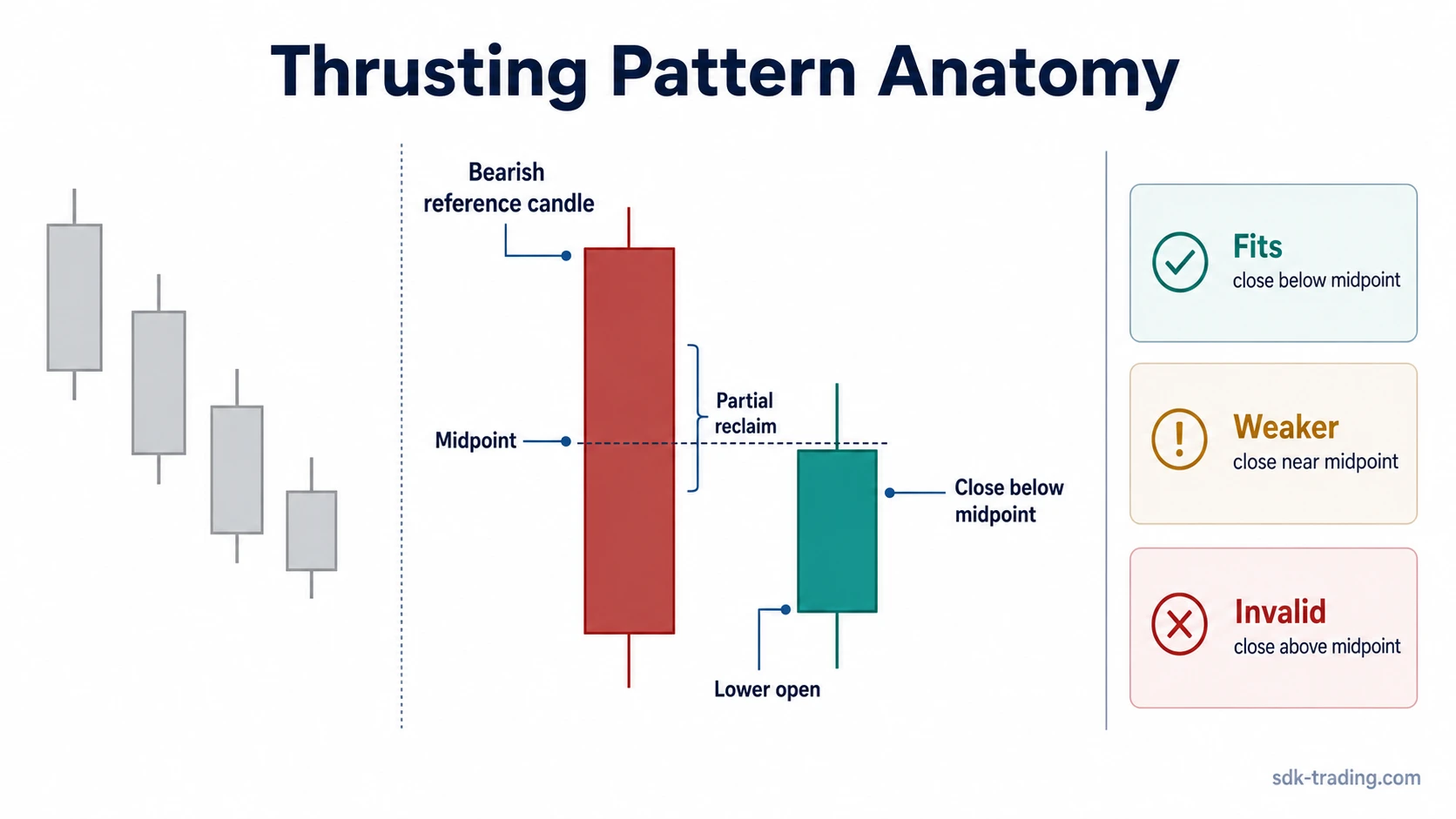
Thrusting Pattern Classification Test
The thrusting pattern can be read through a simple sequence: structure, midpoint result, and later acceptance behavior. That keeps the classification tied to observable candle relationships rather than a broad continuation assumption.
| Test | Cleaner thrusting-pattern condition | Classification risk |
|---|---|---|
| Prior pressure | The pattern appears after a decline or a bearish swing. | Without bearish background, the continuation reading becomes weaker. |
| Lower open | The second candle begins below the first candle’s closing area. | If the second candle does not open lower, the structure may belong to another two-candle pattern. |
| Body overlap | The bullish second candle enters the first candle’s bearish body. | If there is no meaningful move into the body, the pattern may be too weak to classify clearly. |
| Midpoint test | The second candle closes below the midpoint or lower half of the first candle’s body. | A close above the midpoint can invalidate the cleaner thrusting-pattern reading. |
| Later acceptance | Following candles do not hold above the pattern area. | Acceptance above the recovery zone can weaken the bearish continuation interpretation. |
Observability note: The thrusting pattern is mainly a candle-relationship test. The midpoint and body-overlap result carry more weight than a generic label attached after two opposite-colored candles appear.
Clean, Weak, and Invalid Thrusting Pattern Readings
The same two-candle outline can lead to different classifications depending on the close location and how price behaves around the pattern area afterward.
| Reading | Structure | Interpretation boundary |
|---|---|---|
| Clean reading | The second candle opens lower, moves into the prior bearish body, and closes below the midpoint. | The upside response stays contained, so the bearish continuation reading remains structurally intact. |
| Weak reading | The second candle pushes close to the midpoint, or the next candles hesitate around the recovery area. | The pattern still resembles a thrusting structure, but seller control is less clean. |
| Invalid reading | The second candle closes above the midpoint, or later candles accept above the prior bearish body. | The failed-reclaim logic breaks down, so another candle interpretation may fit better. |
A clean reading does not create certainty. It only means the candle structure still fits the thrusting-pattern definition. A weak or invalid reading means the same visual area should be classified more carefully before assigning continuation meaning.
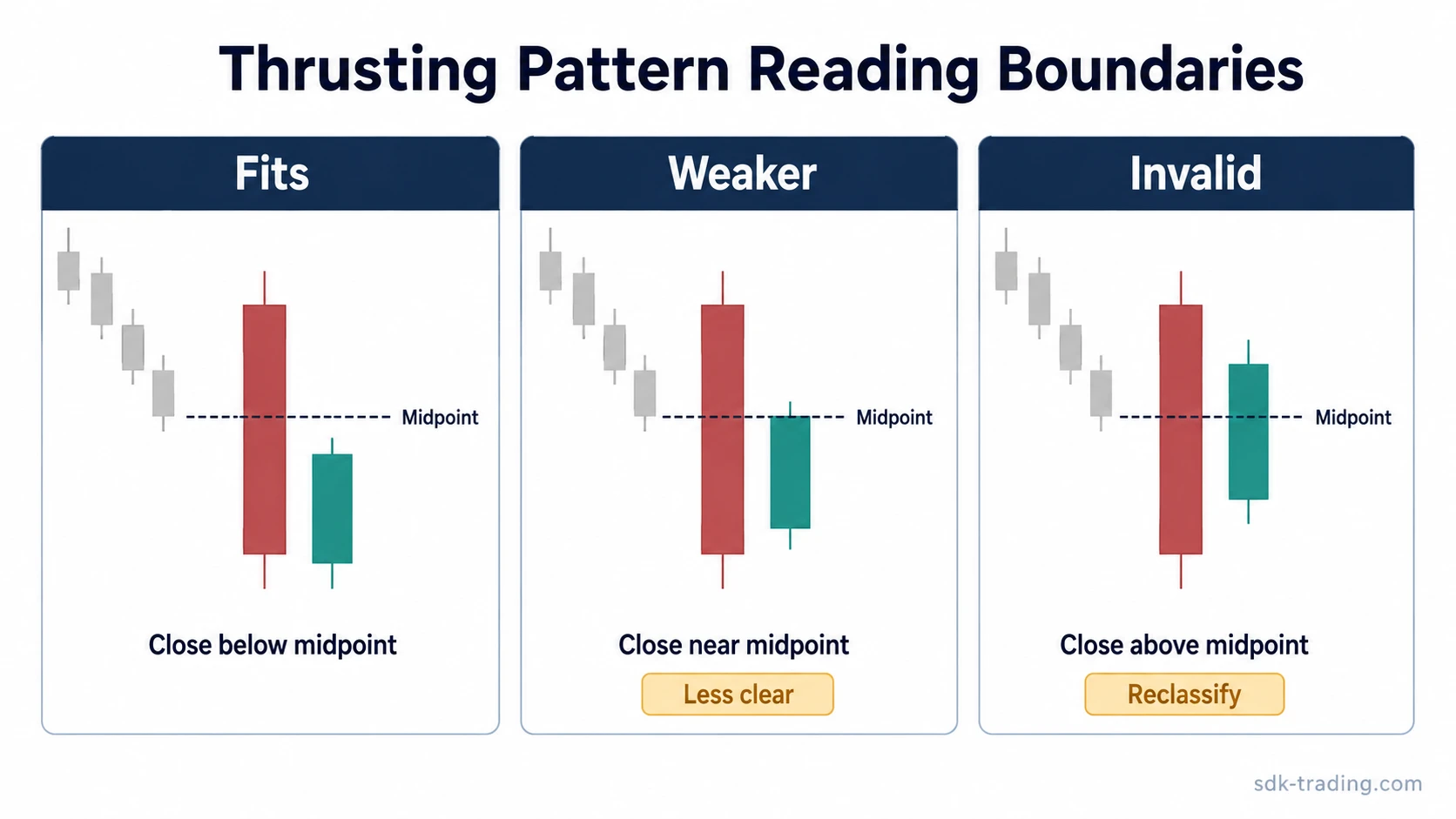
Thrusting Pattern vs Bearish Separating Lines
The thrusting pattern and bearish separating lines can both appear in bearish continuation analysis, but they are built from different candle relationships.
| Pattern | Main candle relationship | Key classification boundary |
|---|---|---|
| Thrusting pattern | A lower open is followed by a bullish move into the prior bearish candle. | The second candle must close below the midpoint or lower half of the prior bearish body. |
| Bearish separating lines | The candles share or nearly share an opening area, then move in opposite continuation contrast. | The shared-open relationship is more important than a midpoint recovery test. |
The practical distinction is the diagnostic anchor. Thrusting-pattern analysis focuses on the lower open and partial reclaim of the prior bearish body. Bearish separating lines focus on the shared or near-shared open between the two candles.
Common Misreadings and Limits
A common mistake is treating the bullish second candle as enough to change the whole reading. In a thrusting pattern, the second candle is bullish, but its close is still measured against the prior bearish body. The close location decides whether the upward response is limited or whether the classification has changed.
Common mistake: Calling any two-candle bounce a thrusting pattern. The second candle must open lower, move into the prior bearish body, and fail to close above the midpoint area.
Another mistake is using the pattern label without checking what follows around the same area. If later candles accept above the first candle’s body or hold above the midpoint zone, the original bearish continuation reading becomes less defensible.
Candlestick patterns are best treated as a classification layer inside broader chart structure. The thrusting pattern can describe a specific two-candle relationship, but it should not replace analysis of trend, levels, volatility, volume behavior, or broader market conditions.
Example of a Basic Thrusting Pattern Reading
Price declines for several candles and then prints a wide bearish candle. The next candle opens lower, which keeps bearish pressure visible at the start of the session. During the candle, price moves into the body of the prior bearish candle, but the close remains below that candle’s midpoint.
That sequence fits the basic thrusting-pattern structure because the bounce is visible but still contained. The reading becomes less clean if the second candle closes near the midpoint and the following candles begin holding above the recovery area. It becomes invalid if the market accepts above the prior bearish body, because the failed-reclaim logic no longer holds.
The useful comparison is between movement into the prior candle and acceptance above it. A thrusting pattern can include a visible bounce, but the classification depends on whether that bounce actually reclaims the prior bearish candle’s body.
FAQ
What invalidates a thrusting pattern?
A thrusting pattern becomes invalid when the second candle closes above the midpoint of the prior bearish candle or when later candles accept above the prior bearish body. In that case, the structure no longer fits the failed-reclaim reading.
How is a thrusting pattern different from a piercing pattern?
A thrusting pattern closes below the midpoint or lower half of the prior bearish candle. A piercing pattern closes above the midpoint of the prior bearish candle, which gives it a different candle relationship and interpretation.
Is the thrusting pattern a continuation reading?
Yes, it is commonly read as a bearish continuation structure when it appears after a decline and the midpoint test remains intact. The continuation interpretation becomes weaker if later price behavior reclaims the prior bearish body.