Falling three methods is a bearish five-candle continuation candlestick pattern that forms during an existing decline. The pattern describes a short counter-move that stays contained inside the prior bearish pressure, followed by a final bearish candle that restores downside pressure.
Definition: Falling three methods is a bearish continuation pattern made of one strong bearish candle, three smaller corrective candles, and a final bearish candle that completes the bearish sequence.
The middle candles test whether the decline is only pausing or starting to lose control. A contained rise inside the first candle keeps the bearish sequence intact. A larger recovery, high close, or expanded overlap can change the interpretation from a brief pause into a broader consolidation.
Key Points
- Falling three methods is a bearish five-candle continuation candlestick pattern.
- The three middle candles should remain relatively small and contained inside the first bearish candle’s range.
- The final bearish candle completes the pattern by showing renewed selling pressure.
- The reading weakens when the middle candles expand, close too high, or erase the structure of the first candle.
What Falling Three Methods Means
A falling three methods pattern describes a bearish sequence where a short corrective move fails to reverse the prior decline. The first candle shows strong selling pressure, the middle candles show temporary buying or reduced selling, and the last candle shows renewed bearish control.
The pattern is best understood as a sequence integrity test. The bearish reading depends less on the name of the pattern and more on whether the candles preserve the structure: prior decline, strong bearish candle, contained counter-move, and renewed downside movement.
The three rising or corrective candles do not automatically turn the pattern into a reversal. Their role is limited if they remain small, overlapping, and unable to reclaim the first candle’s range in a meaningful way. A stronger recovery changes the message because the counter-move is no longer contained.
Falling Three Methods Anatomy
The structure normally starts with a prior downtrend or bearish swing already in place. Without that bearish background, the same five candles may simply describe volatility or consolidation rather than a continuation pattern.
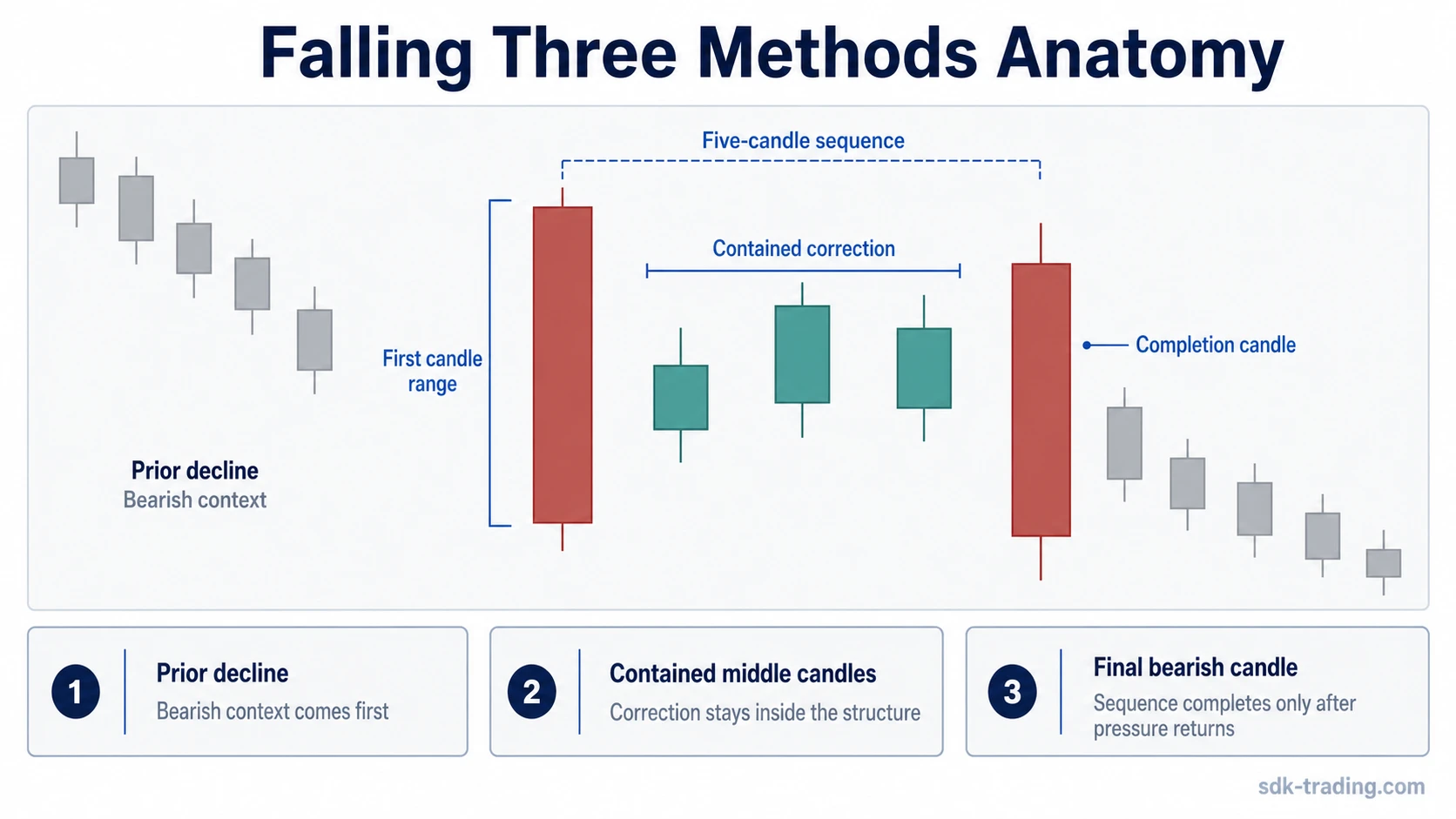
| Part of the sequence | What to observe | Why it matters |
|---|---|---|
| Prior decline | Price is already moving lower before the pattern starts. | The pattern needs bearish context before it can be read as continuation. |
| First candle | A relatively large bearish candle establishes the first pressure leg. | It creates the range that the middle candles are judged against. |
| Middle candles | Three smaller candles rise or move sideways without taking control away from the first candle. | They represent a contained correction rather than a confirmed reversal. |
| Final candle | A bearish candle brings pressure back into the decline and closes below the relevant prior reference area. | The continuation reading is incomplete without renewed bearish participation. |
The middle candles do not need to be perfectly identical. The important point is that the counter-move remains contained enough that the first bearish candle still defines the structure.
Different references define containment slightly differently. Some focus on whether the middle candles stay inside the first candle’s full range, while others emphasize the body of the first candle and the failure of the corrective candles to reclaim control. The safer interpretation is to examine the whole sequence rather than one candle in isolation.
What Makes the Sequence Clean or Weak
A clean falling three methods pattern keeps the correction small enough that the first bearish candle still controls the structure. The middle candles can rise, but they should not erase the bearish candle, expand aggressively, or create a new upward acceptance area.
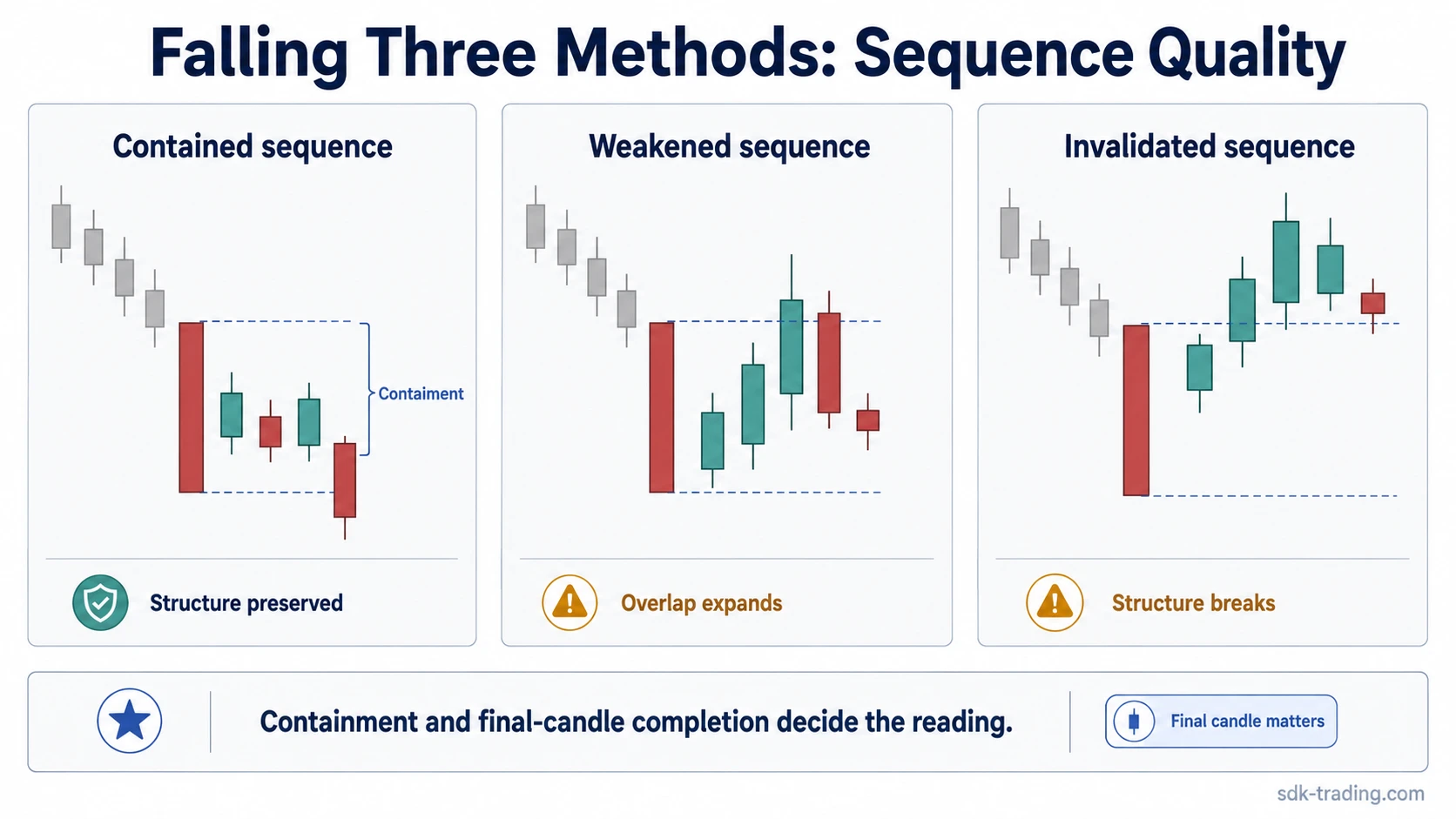
| Reading | Typical structure | Interpretation |
|---|---|---|
| Clean | The first bearish candle is clear, the three middle candles remain small and contained, and the final bearish candle brings selling pressure back into the sequence. | The sequence supports a bearish continuation reading, while still requiring broader chart context. |
| Weak | The middle candles expand, overlap heavily, close high inside the first candle, or show stronger recovery than expected. | The pattern becomes less reliable as a continuation structure because the correction is no longer brief or controlled. |
| Invalid | The corrective move breaks above the first candle’s structure, the final bearish candle fails to restore pressure, or price accepts higher levels after the sequence. | The candles no longer support a falling three methods reading and may belong to another consolidation or reversal context. |
Limitation example: A sequence can look acceptable while the middle candles are still small and contained. The reading weakens when those candles expand upward, close near the top of the first candle’s range, or turn the pause into a broader consolidation. The final bearish candle then has more work to do because the prior pressure has already been diluted.
The main diagnostic issue is overlap contamination. A small corrective pause can preserve the bearish structure. A larger overlap can blur the pattern so much that the label adds little value. In that case, the better question is whether the market is still accepting lower prices or merely moving sideways after a decline.
How Falling Three Methods Differs From Nearby Patterns
Falling three methods is the bearish counterpart of Rising Three Methods. The logic is similar, but the direction is reversed: falling three methods appears in bearish continuation context, while the bullish counterpart appears in bullish continuation context.
Mat Hold can also involve continuation after a brief interruption, but its internal pressure and candle relationships are different. The pattern should not be merged with falling three methods only because both belong to continuation-pattern families.
Downside Tasuki Gap is different again because the gap is central to the pattern. Falling three methods does not depend on a gap-based structure. Its main diagnostic feature is the contained three-candle correction between two bearish pressure candles.
Reliability and Limitations
Falling three methods is visually specific, but clean textbook versions are not common on every chart. Many real sequences contain uneven candle size, partial overlap, different wick behavior, or middle candles that do not fit the ideal version neatly.
The pattern should be treated as candlestick interpretation, not as a mechanical trade trigger. It can help describe how a decline pauses and resumes, but it does not prove that continuation will follow. Volume, market structure, support and resistance, volatility, and the quality of later price acceptance can all change the reading.
The most common mistake is overreading the label after only the first few candles. The three middle candles are not enough on their own. The final bearish candle is important because it tests whether the correction actually failed or whether the market is still building a wider range.
A cleaner reading has a visible bearish background, a contained middle pause, and a final candle that does not need forced interpretation. A weaker reading usually needs too many excuses, especially when the middle candles have already reclaimed much of the first bearish candle.
Falling Three Methods FAQ
Is falling three methods a bearish continuation pattern?
Yes. Falling three methods is normally classified as a bearish continuation candlestick pattern because it appears after a decline and describes a contained counter-move followed by a bearish continuation candle.
How many candles are in falling three methods?
The classic structure has five candles: one strong bearish candle, three smaller corrective candles, and a final bearish candle that completes the continuation reading.
When does falling three methods become weak?
The reading weakens when the middle candles expand too far, close high inside the first candle’s structure, or turn the pause into a broader consolidation instead of a contained correction.
When does falling three methods become more defensible?
The reading becomes more defensible when the middle candles stay contained inside the first bearish candle’s structure and the final bearish candle restores acceptance in the original downside direction.