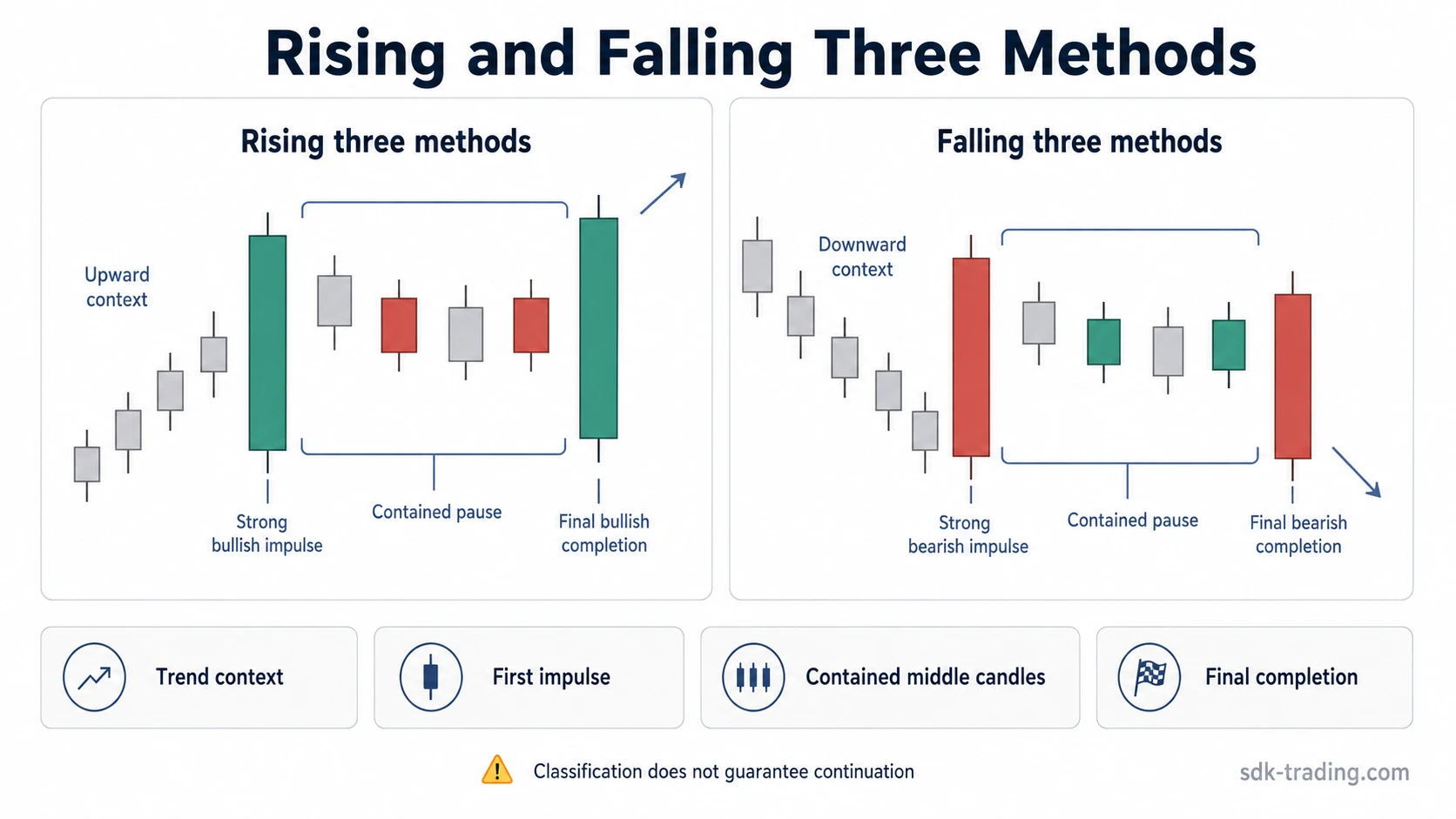
Rising and falling three methods are mirror-like five-candle continuation patterns in candlestick analysis. Rising three methods belongs to bullish continuation context after upward pressure, while falling three methods belongs to bearish continuation context after downward pressure.
Both patterns use the same basic structure: a strong first candle, three smaller corrective candles, and a final candle in the original direction. The difference is polarity. In the bullish version, the first and final candles show upward control. In the bearish version, the first and final candles show downward control.
Definition: Rising and falling three methods are five-candle continuation patterns that compare a strong directional impulse, a contained three-candle pause, and a final candle that tries to restore movement in the original trend direction.
Key Points
- Rising three methods appears after upward pressure and needs a final bullish candle in the original direction.
- Falling three methods appears after downward pressure and needs a final bearish candle in the original direction.
- The three middle candles should remain contained inside the range of the first impulse candle.
- The final candle completes the classification, but it does not guarantee continuation.
- The cleanest comparison comes from trend context, containment quality, and final-candle direction.
What Rising and Falling Three Methods Have in Common
The shared idea is continuation after a controlled pause. The first candle creates the directional impulse. The next three candles form a smaller corrective interruption. The final candle tries to reassert the original direction.
The middle candles matter because they separate a controlled pause from a failed continuation classification. If those candles expand too far, close beyond the first candle’s range, or erase too much of the original impulse, the structure becomes less useful as a continuation pattern.
The final candle is also essential. Without a candle that restores movement in the original direction, the sequence is incomplete. A pause alone is only an interruption. Continuation is easier to classify when the final candle shows that the pause did not fully shift control.
The Key Difference Between Rising and Falling Three Methods
The key difference is trend polarity. Rising three methods is a bullish continuation pattern. It starts from upward pressure, pauses through smaller candles, and needs a final bullish candle to restore the upward sequence.
Falling three methods is a bearish continuation pattern. It starts from downward pressure, pauses through smaller corrective candles, and needs a final bearish candle to restore the downward sequence.
The two patterns can look structurally similar because both use a five-candle pause-and-continuation format. The interpretation changes because the background trend, first impulse candle, and final candle point in opposite directions.
Rising vs Falling Three Methods Criteria
| Criterion | Rising Three Methods | Falling Three Methods |
|---|---|---|
| Trend context | Appears after upward pressure or a bullish continuation attempt. | Appears after downward pressure or a bearish continuation attempt. |
| First candle | Large bullish candle that establishes the impulse range. | Large bearish candle that establishes the impulse range. |
| Middle candles | Three smaller corrective candles that remain contained inside the first candle’s range. | Three smaller corrective candles that remain contained inside the first candle’s range. |
| Final candle | Bullish candle that tries to restore the upward sequence. | Bearish candle that tries to restore the downward sequence. |
| Clean reading | Pause stays controlled and the final candle closes with clear bullish direction. | Pause stays controlled and the final candle closes with clear bearish direction. |
| Weak reading | Middle candles push too high or too low, or the final bullish candle lacks clear directional control. | Middle candles push too high or too low, or the final bearish candle lacks clear directional control. |
| Invalid reading | The pause breaks containment or the final candle fails to restore upward movement. | The pause breaks containment or the final candle fails to restore downward movement. |
Rising Three Methods Reading
Rising three methods begins with a strong bullish candle after upward pressure. The next three candles should look corrective rather than dominant. They may move against the first candle, but they should not fully reject its range.
The final bullish candle is the completion point. A clean version closes with enough upward control to suggest that the corrective pause stayed contained. A weaker version may still have the five-candle shape, but the middle candles or final candle make the continuation classification less reliable.
Falling Three Methods Reading
Falling three methods starts with a strong bearish candle after downward pressure. The middle candles should act as a contained recovery attempt, not as a full reversal of the first bearish impulse.
The final bearish candle completes the classification when it restores downside movement after the pause. If the final candle is small, indecisive, or unable to move back in the original direction, the five-candle sequence becomes weaker as a bearish continuation pattern.
Same Five-Candle Pause, Different Meaning
Price can form a similar-looking three-candle pause after both an upward impulse and a downward impulse. Shape alone is not enough. The same middle-candle interruption can support opposite readings when the surrounding trend and final candle point in opposite directions.
Example of a basic comparison: Price advances, forms a strong bullish candle, then pauses for three smaller candles that remain inside the impulse range. If the next candle closes back in the original upward direction and the pause has not been accepted below the impulse range, the sequence is easier to classify as rising three methods.
In the opposite context, price declines, forms a strong bearish candle, then pauses through three smaller candles that stay contained. If the next candle closes back in the original downward direction and the recovery attempt remains contained, the same pause structure is easier to classify as falling three methods.
The important distinction is not that either pattern guarantees continuation. Trend polarity, containment, and final-candle direction decide whether the five-candle structure is bullish continuation, bearish continuation, weak, or invalid.
Clean, Weak, and Invalid Readings
| Reading quality | Rising three methods | Falling three methods |
|---|---|---|
| Clean | Prior upward pressure is visible, the first bullish candle is clear, the middle candles stay contained, and the final bullish candle restores upward movement. | Prior downward pressure is visible, the first bearish candle is clear, the middle candles stay contained, and the final bearish candle restores downward movement. |
| Weak | The pause expands too much, the middle candles close awkwardly inside the range, or the final bullish candle lacks clear strength. | The pause expands too much, the middle candles close awkwardly inside the range, or the final bearish candle lacks clear strength. |
| Invalid | The corrective candles break the structure of the first candle or the final candle fails to restore bullish control. | The corrective candles break the structure of the first candle or the final candle fails to restore bearish control. |
A clean pattern depends on structure, not just candle count. A weak pattern may still resemble the textbook version, but the behavior no longer supports the same quality of continuation classification. An invalid pattern loses the containment or final-candle completion that the classification depends on.
Common Mistakes When Comparing the Two Patterns
One common mistake is treating the middle three candles as a reversal simply because they move against the first candle. In both patterns, the middle candles are supposed to interrupt the trend. The question is whether that interruption remains contained or turns into acceptance in the opposite direction.
Another mistake is focusing only on the final candle. The final candle matters, but it cannot repair a sequence where the middle candles already broke containment. A strong final candle after a messy structure may be less useful than a moderate final candle after a controlled pause.
A third mistake is comparing the patterns without trend context. Rising three methods and falling three methods are not interchangeable labels for any five-candle sequence. The surrounding trend and the direction of the first impulse decide which side of the comparison is relevant.
When Each Pattern Applies
| Market condition | More relevant concept | Why it fits |
|---|---|---|
| Upward pressure is already present, followed by a controlled three-candle pause. | Rising three methods | The structure tests whether bullish control can resume after a contained interruption. |
| Downward pressure is already present, followed by a contained three-candle recovery. | Falling three methods | The structure tests whether bearish control can resume after a contained interruption. |
| The middle candles expand beyond the first candle’s structure. | Neither reading is clean | Containment is no longer strong enough for a clean continuation classification. |
| The final candle fails to restore movement in the original direction. | Weak or invalid reading | The sequence lacks the completion candle needed for a stronger continuation interpretation. |
Limitations of the Comparison
The comparison helps classify candle structure, but it does not create certainty about what happens next. A rising or falling three methods pattern can fail if the surrounding market structure, volume behavior, volatility, or follow-through does not support the initial interpretation.
The patterns are more useful as classification tools than as isolated decision rules. The same five-candle structure deserves different weight depending on where it appears, how contained the middle candles are, and whether later price behavior accepts or rejects the continuation attempt.
FAQ
Are rising and falling three methods the same pattern?
They share the same five-candle continuation structure, but they apply to opposite trend contexts. Rising three methods is bullish continuation, while falling three methods is bearish continuation.
What is the most important difference between rising and falling three methods?
The most important difference is direction. Rising three methods needs upward context and a final bullish candle in the original direction. Falling three methods needs downward context and a final bearish candle in the original direction.
Can the middle candles move against the trend?
Yes. The middle candles usually represent a pause or correction. The reading weakens when those candles expand too far, break containment, or show stronger acceptance against the original trend.
Does the final candle guarantee continuation?
No. The final candle completes the pattern classification, but it does not guarantee continuation. Later market behavior can still weaken or invalidate the interpretation.