Candlestick continuation patterns are candle structures that appear during a pause inside an existing directional move. They are used to sort the pause by structure: gap behavior, contained pullback, shared-open interruption, or a boundary test that may or may not continue in the prior direction.
Definition: A candlestick continuation pattern is a candle formation that develops after an existing move and helps frame whether price can keep holding in the same direction after a pause, interruption, or partial counter-move.
Key Points
- Continuation candle patterns are best read as pause structures inside an already visible move.
- The structure family matters more than memorizing a long list of pattern names.
- The reading loses quality when price stops holding in the prior trend direction.
How Continuation Candlestick Patterns Are Grouped
Continuation patterns usually begin with the same question: did the market pause without breaking the logic of the prior move? The answer depends on how the pause is built.
| Structure family | What the candles are testing | Typical continuation question |
|---|---|---|
| Gap-based continuation | Whether price can hold beyond a gap area instead of immediately trading back through it. | Does the gap remain part of the active move or become a failed displacement? |
| Contained pullback | Whether a short counter-move stays subordinate to the prior impulse. | Does the pullback stay controlled, or does it begin to absorb the earlier move? |
| Shared-open interruption | Whether a bearish or bullish interruption fails to change control after a similar opening level. | Does the second candle restore the prior directional pressure? |
| Boundary-test continuation | Whether a candle testing into the prior candle area remains only a partial challenge. | Does the test fail to create control against the prior move? |
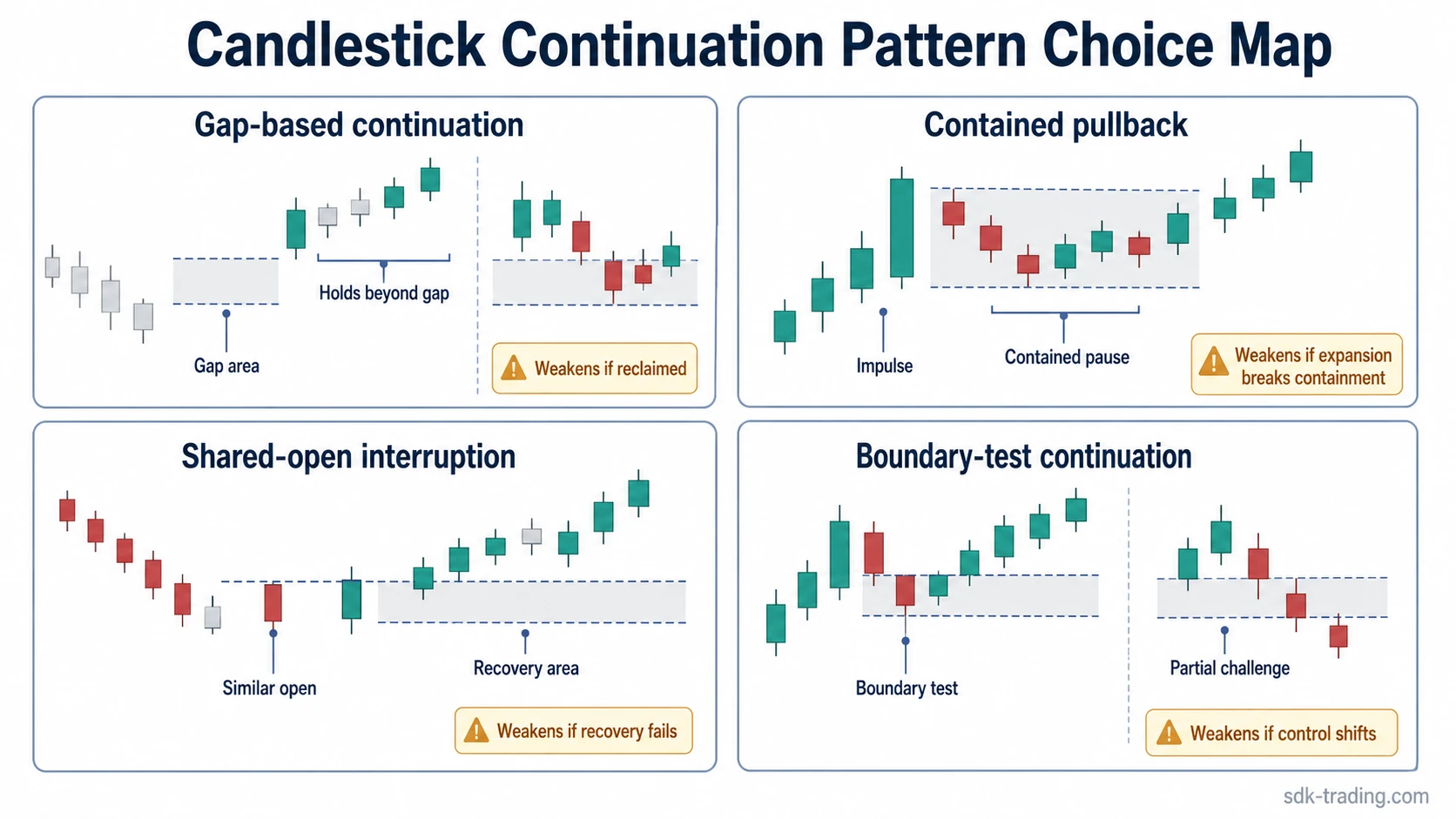
Continuation Candlestick Pattern Structure Filter
Continuation candle analysis starts with the evidence inside the pause, not the pattern name. A gap, contained pullback, shared open, or boundary test changes which structure family is most relevant.
| Visible structure | Likely structure family | Closest structure to compare | When the reading weakens |
|---|---|---|---|
| A gap appears in the direction of the existing move, then later candles test whether the gap area remains respected. | Gap-based continuation family | The broader gap continuation family helps frame how the gap and later test relate. | Price trades back through the gap area instead of holding beyond it. |
| A bullish move gaps higher, then the market tests whether the upside gap can stay part of the active structure. | Bullish gap continuation | Upside gap continuation logic is the closer fit when the structure is built above the prior range. | The later candles fail to hold above the gap area and begin working lower. |
| A bearish move gaps lower, then price tests whether the downside gap remains unresolved. | Bearish gap continuation | Downside gap continuation logic is the closer fit when the gap extends a falling move. | The later candles reclaim the gap area and reduce the quality of the downside continuation read. |
| A strong directional candle is followed by a small, controlled counter-move that stays inside the prior impulse area. | Contained pullback | A contained pullback in a mat hold structure focuses on whether the pause remains subordinate. | The pullback expands, breaks containment, or starts absorbing the prior impulse. |
| A bearish or bullish interruption opens near the same level as the prior candle, then the next candle attempts to restore the earlier direction. | Shared-open interruption | Shared-open separating lines are the relevant structure when the opening level is central. | The second candle fails to restore directional pressure and the interruption begins to matter more than the recovery. |
| A candle tests into the prior candle area but does not fully reverse the existing pressure. | Boundary-test continuation ambiguity | The thrusting pattern boundary test helps separate partial challenge from full reversal pressure. | The boundary test turns into sustained control against the prior move. |
Bullish and Bearish Continuation Readings
A bullish continuation reading appears when a pause develops after upward pressure and price later holds above the area being tested. The candle structure may include an upside gap, a controlled pullback, or a same-open interruption that fails to stop the prior upward pressure.
A bearish continuation reading appears when a pause develops after downward pressure and price later holds below the area being tested. The structure may involve a downside gap, a weak recovery attempt, or a partial boundary test that cannot reclaim the earlier range.
The bullish or bearish label describes direction only. It does not prove that the move will continue, and it does not turn the candle formation into a trade instruction.
Where Continuation Pattern Readings Weaken
A continuation read depends on the pause staying subordinate to the prior impulse. The structure becomes less useful when the pause stops acting like a pause and begins creating control against the earlier move.
Common mistake: Treating any small pause after a trend candle as continuation. A pause has better continuation quality when the market protects the relevant gap, boundary, or containment area instead of trading back through it.
| Weakening behavior | Why it matters | Safer interpretation |
|---|---|---|
| Price trades back into a gap area. | The gap no longer acts as clean displacement in the prior direction. | The pattern remains unresolved or carries failed continuation risk until structure becomes clearer. |
| A contained pullback expands beyond the prior impulse area. | The counter-move may be absorbing the earlier pressure instead of pausing it. | Compare the pullback size, close location, and follow-through before the continuation read remains coherent. |
| A shared-open recovery candle cannot hold its recovery area. | The interruption may be more important than the attempted continuation candle. | The continuation label loses quality until later candles reclaim the recovery area. |
| A boundary test turns into sustained movement against the prior move. | The structure may be shifting from partial challenge to broader control change. | Separate the candle label from the later market behavior. |
Continuation vs Reversal Pattern Boundary
The boundary between continuation and reversal is not the candle name alone. A continuation pattern remains tied to the prior move because the pause, test, or counter-candle does not create sustained control in the opposite direction.
A reversal reading becomes more defensible only when price starts holding against the prior move and the earlier continuation structure stops working. The same candle shape can carry a different meaning when it appears after exhaustion, at a major boundary, or after repeated failed follow-through.
Limitation: Continuation candle names describe structure. Later holding behavior, failed holding behavior, and location inside the broader trend decide whether the label remains useful.
Gap-Based Continuation Reading Example
Price advances into a prior resistance area, gaps higher, and then pulls back only into part of the gap. The gap family is the first structure to check because the market is testing whether the new area can remain part of the active move. If later candles hold above the gap and the pullback stays contained, the continuation read remains more coherent. If price trades back through the gap and cannot reclaim it, the structure no longer behaves like a clean continuation pause.
FAQ
What separates a continuation candlestick pattern from a normal pause?
A continuation candlestick pattern needs a pause that still respects the prior directional structure. A normal pause can become unresolved if it does not preserve the relevant gap, containment area, shared open, or boundary test.
Can a continuation candlestick pattern be bearish?
Yes. A bearish continuation pattern appears when price pauses during downside pressure and later behavior keeps holding in the same downward direction.
What weakens a continuation candlestick reading first?
The earliest warning is usually a failure of the structure that made the pause useful: a gap gets reclaimed, a contained pullback expands, or a boundary test starts holding against the prior move.
Why should the structure family be checked before the pattern name?
The structure family shows what evidence is being tested. A gap, contained pullback, shared open, and boundary test can all belong to continuation analysis, but they fail in different ways.