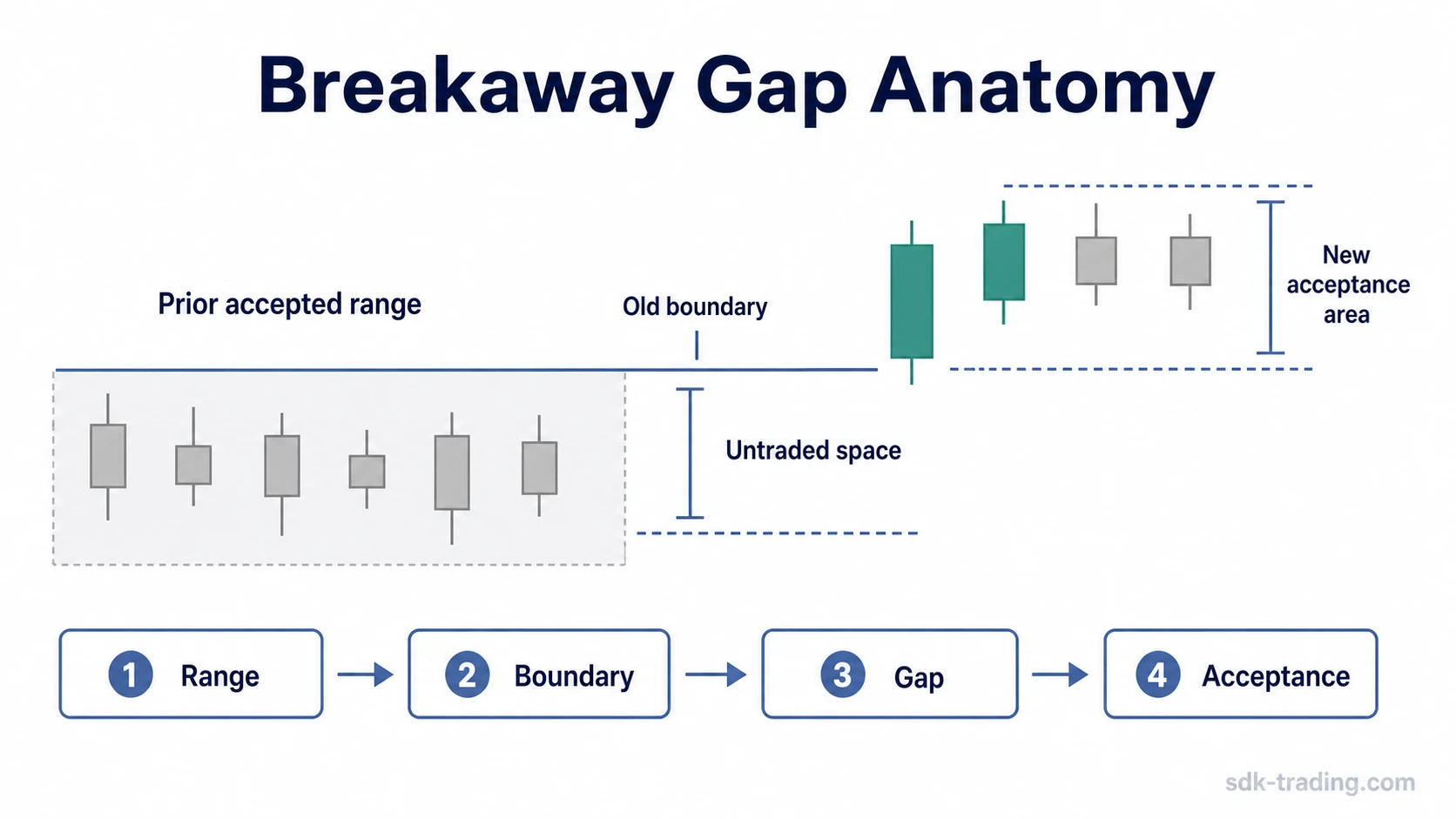
A breakaway gap is a price-chart gap where price opens beyond a prior accepted range, base, support area, or resistance area, leaving untraded space between the old range and the new price area. In candlestick and chart analysis, the important boundary is not the size of the gap alone, but whether price has moved away from an area where trading had previously been accepted.
Not every gap beyond a visible level deserves the breakaway label. The reading becomes stronger when the prior range is clear, the gap separates old and new price areas, participation expands, and later candles continue to accept price outside the former range. The reading weakens if the gap is quickly retraced, appears in the middle of an already extended move, or has no meaningful range to break away from.
Definition: The breakaway label depends on three visible conditions: a prior accepted range, a gap outside that boundary, and later behavior that continues to accept the new price area rather than quickly returning into the old range.
Key Points
- A breakaway gap requires a visible prior range, base, support boundary, or resistance boundary.
- The gap should create empty price space between the old accepted area and the new trading area.
- Volume and participation can support the reading, but they do not prove it by themselves.
- A quick return into the old range weakens the classification and may turn the move into a failed gap reading.
- The pattern is best read as a diagnostic structure, not as a standalone forecast.
What Is a Breakaway Gap?
A breakaway gap marks a visible separation between a previous area of price acceptance and a new area where trading begins. The prior area may be a sideways range, a compression zone, a base, or a well-tested support or resistance boundary. The gap becomes meaningful because price does not merely move within the old structure. It opens beyond it.The old range matters because it gives the gap a reference point. Without that reference, a gap may still be large, but it is harder to classify as breakaway. A large opening move after a long trend, for example, may belong closer to exhaustion behavior. A gap that appears after price is already moving strongly may belong closer to a runaway gap. The breakaway reading depends on a visible change from old acceptance to new acceptance.In an upward breakaway gap, price leaves a prior range from above. In a downward breakaway gap, price leaves a prior range from below. The direction changes the visual appearance, but not the classification test. The same questions remain: was there a real boundary, did price gap beyond it, and did later behavior accept the new area?
How to Identify a Breakaway Gap
A controlled way to identify a breakaway gap is to read the structure in sequence. The gap is not only a blank space on the chart. It is a relationship between the prior range, the opening displacement, the empty price area, and the behavior that follows.
| Diagnostic Step | What to Check | Why It Matters |
|---|---|---|
| Prior range | Price had a visible base, compression, support area, or resistance area before the gap. | The old accepted area gives the gap its reference boundary. |
| Boundary break | Price opens outside that range rather than still overlapping it. | The move begins in a new price area instead of remaining inside the old structure. |
| Untraded space | There is visible empty space between the old range and the new open. | The gap separates old acceptance from new acceptance. |
| Participation | Volume or range expansion supports the idea that more participants are involved. | Participation strengthens the reading, but it remains supporting evidence rather than proof. |
| Acceptance | Later candles continue to hold outside the former boundary. | Holding the new area makes the breakaway classification more defensible. |
A gap with only one of these features is incomplete. A wide opening gap with no prior range can be dramatic, but classification remains weak. A gap beyond a range with thin participation can still matter, but later acceptance becomes more important. A gap that immediately returns into the prior range loses much of its breakaway quality because the market has not sustained the new price area.
Bullish and Bearish Breakaway Gaps
A bullish breakaway gap forms when price opens above a prior range or resistance boundary and begins trading in a higher area. The gap suggests that the old range may no longer be the dominant area of acceptance. The reading improves when the new area holds and follow-through does not immediately reject the move.A bearish breakaway gap forms when price opens below a prior range or support boundary and begins trading in a lower area. The gap suggests that the former support area has lost acceptance. The reading improves when price remains below the old boundary and the later candles do not quickly recover the gap.Both versions require the same caution. The gap direction alone is not enough. A bullish gap can fail if price returns into the former range. A bearish gap can fail if price quickly recovers the broken boundary. The classification depends on structure plus follow-through, not on the first gap candle alone.
Clean, Weak, and Invalid Breakaway Gaps
Breakaway gaps are easier to classify when the reading is separated into clean, weak, and invalid versions. The labels do not predict the future. They describe how well the observed structure fits the pattern boundary.
| Reading | Typical Structure | Classification Logic |
|---|---|---|
| Clean breakaway gap | Clear prior range, visible gap beyond the boundary, stronger participation, and continued acceptance outside the old range. | The old accepted area is left behind, and later behavior supports the new area. |
| Weak breakaway gap | Prior range is visible but not clean, the gap is marginal, volume is mixed, or later candles hesitate near the old boundary. | The structure may still qualify, but the evidence is incomplete and needs later acceptance evidence. |
| Invalid breakaway gap | No meaningful prior range, immediate return into the old area, or a gap that appears after an already extended move. | The move is better treated as another gap type or as a failed gap reading. |
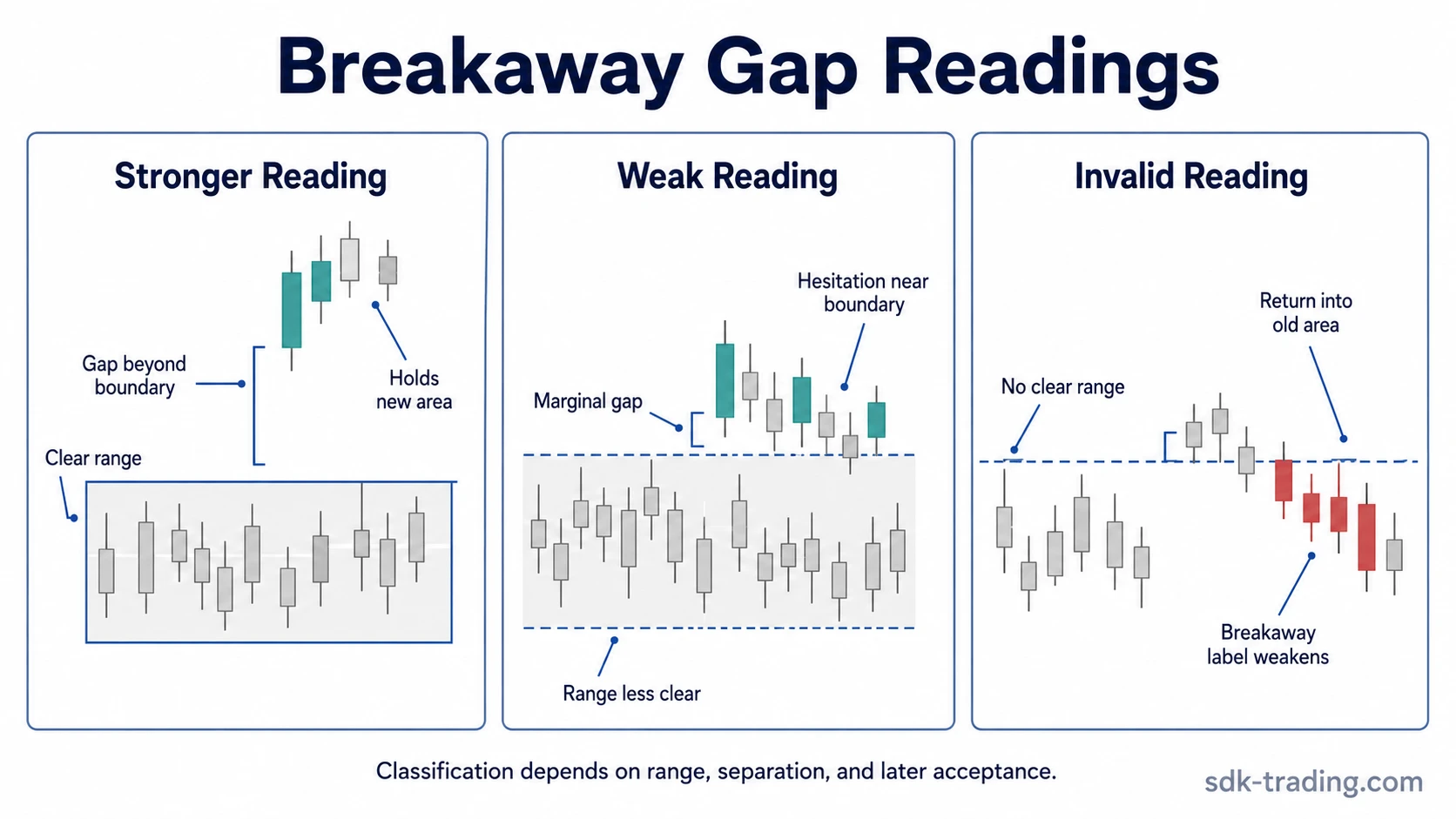
The most common mistake is treating gap size as the whole pattern. A large gap can still be a poor breakaway reading if it appears without a clear base, if it occurs late in an extended move, or if price quickly accepts the old range again. A smaller gap can be more structurally meaningful if it cleanly separates a long-accepted range from a new area that later holds.
Example of a Basic Breakaway Gap Reading
A common scenario begins with price moving sideways for several sessions or candles. The highs and lows form a visible range, and each attempt to leave that range is pulled back into the same area. Then price opens above the upper boundary, leaving empty space between the prior range and the new open.The first reading is tempting because the gap appears to leave the old range behind. That is still incomplete. The stronger case develops only if later candles continue to hold outside the old range and participation looks broader than the quiet range that came before it. The weaker case develops if price stalls near the boundary, overlaps the old range, or shows little participation after the gap.If price later returns into the former range and spends time there, the breakaway reading becomes less reliable. At that point, the return into the empty gap area becomes part of the classification evidence rather than a separate prediction.
Breakaway Gap vs Runaway Gap, Exhaustion Gap, and Common Gap
Nearby gap types often look similar at first glance. The difference comes from location, context, and what price does after the gap.
| Gap Type | Usual Location | Main Diagnostic Difference |
|---|---|---|
| Breakaway gap | At the edge of a prior range, base, support area, or resistance area. | Price leaves an old accepted area and begins testing acceptance in a new area. |
| Runaway gap | During an already active directional move. | The gap appears after the move is underway, not at the original range boundary. |
| Late-stage exhaustion gaps | Near the end of an extended move. | The gap can reflect stretched participation and may be followed by failure or reversal behavior. |
| Common gap | Inside ordinary range activity or low-conviction movement. | The gap lacks a decisive boundary change and often carries less structural meaning. |
The same initial gap can be reclassified after later price behavior develops. A gap that begins as a possible breakaway can weaken if it quickly returns into the old range. A gap that forms during an already strong move may be better classified as a continuation-type gap. A gap that appears after broad participation is already stretched may belong closer to exhaustion behavior.
Do Breakaway Gaps Get Filled?
Breakaway gaps can be filled, but a fill is not automatic. The important question is not whether every gap eventually closes. The important question is how price behaves around the empty space and the former range boundary.If price holds outside the old range, the gap remains more consistent with a breakaway reading. If price returns into the gap and then into the former range, the reading weakens. If price spends meaningful time back inside the old range, the original gap may no longer represent a durable separation between old and new acceptance.Volume and participation can help interpret the fill attempt. A quiet pullback toward the gap area may not carry the same meaning as a fast return into the old range with expanding activity. The classification improves when price behavior, participation, and boundary acceptance point in the same direction.
Breakaway Gap Reliability and Limitations
A breakaway gap is more reliable as a classification when several conditions align: a clear prior range, a clean gap outside the boundary, visible separation between old and new areas, stronger participation, and continued acceptance outside the former range. When those conditions are missing, the label becomes less stable.The main limitation is that a gap is an opening condition, not a complete reading by itself. A chart can gap beyond a level for reasons that later lose force. Event-driven movement, thin participation, or short-lived pressure can create a gap that looks decisive at first but fails once the market tests the new area.The most useful breakaway gap reading stays conditional. It asks whether price has truly left an old area of acceptance, whether the new area is being accepted, and whether later behavior supports or weakens the original classification.
FAQ
What does a breakaway gap mean?
A breakaway gap means price has opened beyond a prior accepted range or important boundary, leaving empty space between the old range and the new price area. The reading becomes stronger when later price behavior continues to accept the new area.
How do you identify a breakaway gap?
Identify a breakaway gap by checking for a prior range or boundary, a gap outside that boundary, visible untraded space, supporting participation, and later candles that hold outside the old range.
Is a breakaway gap bullish or bearish?
A breakaway gap can be bullish or bearish. A bullish version opens above a prior range or resistance boundary. A bearish version opens below a prior range or support boundary. The direction changes, but the classification test remains the same.
When does a breakaway gap reading weaken?
The reading weakens when price returns into the gap area, accepts the former range again, or fails to hold outside the prior boundary. A gap that keeps accepting the new area remains structurally stronger.
What makes a breakaway gap invalid?
A breakaway gap becomes invalid or weak when there is no clear prior range, when the gap quickly returns into the old range, when participation is thin, or when the move fits a different gap type more cleanly.
How is a breakaway gap different from a runaway gap?
A breakaway gap appears as price leaves a prior accepted range or boundary. A runaway gap appears after a directional move is already underway. Location and context create the main difference.