A gap fill in stocks happens when price moves back into the price space left by a previous gap. The move can fill only part of the gap or return to the earlier reference completely, but a gap beginning to close does not mean the entire gap must fill.
A gap fill is a description of price behavior, not a prediction that every open gap will eventually close. Gap type, location, trend context, and later acceptance or rejection all affect how the move should be interpreted.
Key Points
- A gap fill begins when price moves back into the empty price area created by an earlier gap.
- A partial fill enters only part of the gap, while a full fill reaches the earlier reference that created it.
- Not all gaps fill, and the first move into a gap can remain only a test.
- Acceptance inside the gap gives the fill more weight than a brief wick or immediate rejection.
- Breakaway, continuation, and exhaustion contexts can produce very different gap behavior.
See a Gap Fill on a Real Chart
This short example shows how price can move back toward an earlier gap and why the first retest should be separated from a guaranteed full fill.
The video shows a common gap-fill sequence. It should not be read as a rule that every gap must close. The key distinction is whether price continues accepting inside the gap or rejects the area.
Partial vs Full Gap Fill
The amount of the gap that price revisits changes the classification. Entering the gap is not the same as closing it completely.
| Gap Behavior | What Happens | How to Read It |
|---|---|---|
| Gap test | Price approaches or briefly touches the gap area. | The gap is being tested, but a fill has not yet developed. |
| Partial gap fill | Price trades back into part of the gap but stops before the earlier reference. | Part of the gap has been revisited, while the remaining gap stays open. |
| Full gap fill | Price returns through the gap to the relevant prior close, range, or pre-gap reference. | The entire gap has been revisited, but the fill does not determine what happens next. |
| Failed fill attempt | Price enters the gap and then quickly rejects the area. | The gap was tested, but the new post-gap structure may still be active. |
Why Some Gaps Fill and Others Stay Open
A gap creates separation between the earlier trading area and the new price area. Later price may revisit that space, but whether it does so depends on the structure surrounding the gap.
A gap that appears inside ordinary consolidation can behave differently from one that launches price away from an important range. Likewise, a gap appearing late after an extended move can carry different information from one that forms during an established trend.
The practical question is therefore not simply whether gaps tend to fill. It is whether later price behavior continues to defend the new area or begins accepting the old gap area again.
How Gap Type Changes the Fill Reading
Gap classification provides context before any fill assumption is made. The broader types of gaps in trading framework separates gaps by where they appear and what the surrounding price structure is doing.
| Gap Context | What It Suggests | Fill Interpretation |
|---|---|---|
| Ordinary or common gap | The gap does not clearly launch a major structural move. | A later fill may be easier to interpret as a normal revisit of the prior area. |
| Breakaway gap | Price leaves a range, congestion area, or important boundary. | An immediate fill assumption is weaker while price continues holding outside the old structure. |
| Runaway gap | The gap appears during an active directional move. | Continuation can remain more important than an immediate expectation of a fill. |
| Exhaustion gap | The gap appears late after an extended move and follow-through begins to weaken. | A return into the gap can carry more weight when the preceding extension is already losing momentum. |
An island reversal uses a different gap relationship because price becomes isolated between two gaps. That structure should not be reduced to a normal gap-fill assumption.
Clean, Weak, and Overread Gap-Fill Readings
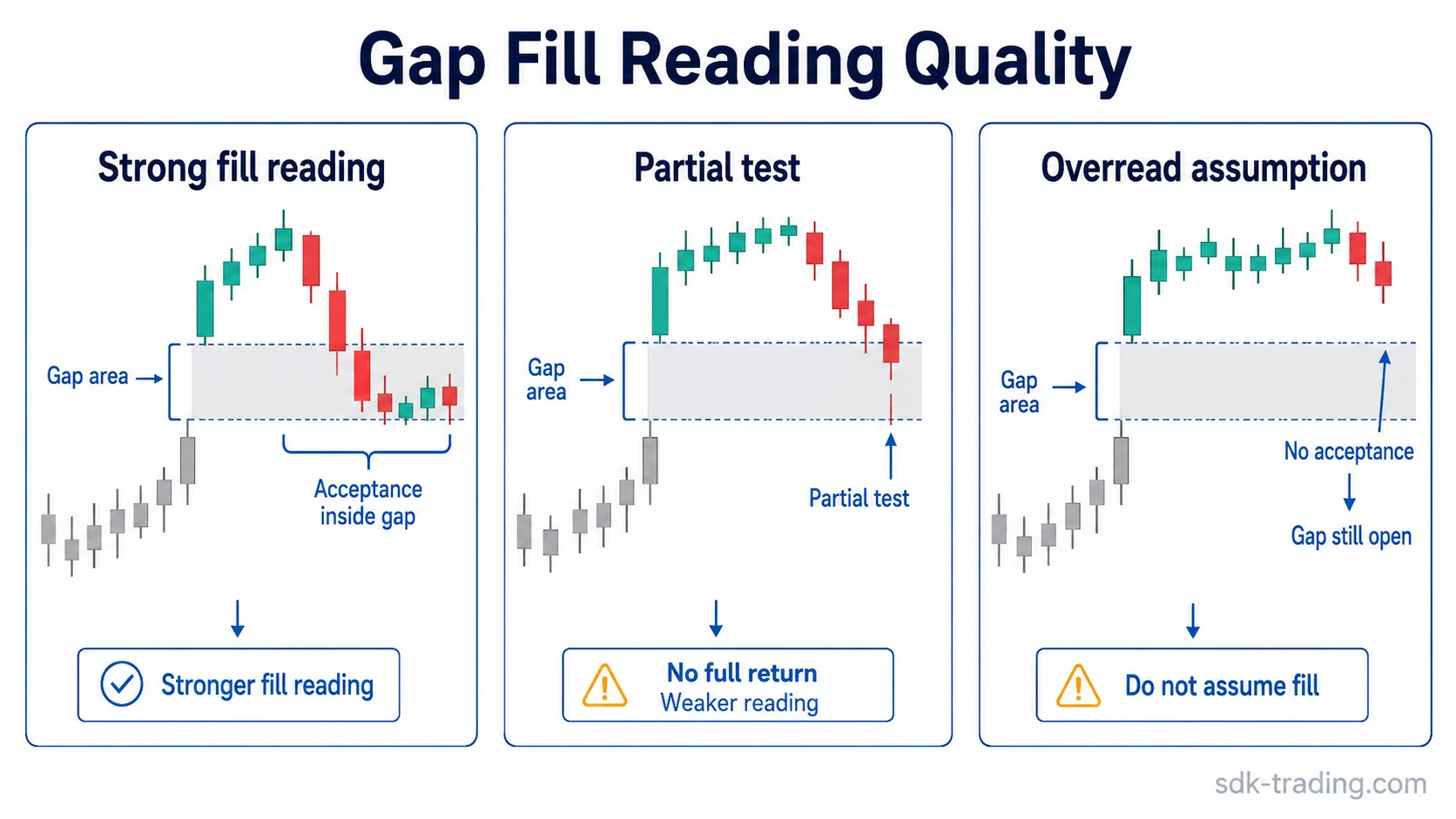
The main distinction is what price does after reaching the gap. A clean fill develops through acceptance inside the area, while a weak attempt only tests it. An overread occurs when a trader assumes the gap must fill despite price continuing to defend the new structure.
| Reading | Typical Behavior | Diagnostic Meaning |
|---|---|---|
| Stronger fill reading | Price enters the gap and continues trading inside it rather than immediately rejecting. | The market is meaningfully revisiting the old price area. |
| Partial or weak test | Price enters only part of the gap, stalls, or quickly reverses. | The gap has been tested, but a full fill remains unresolved. |
| Overread assumption | Price never establishes meaningful acceptance inside the gap. | The mistake is assuming that an open gap must eventually close despite stronger continuation evidence. |
How to Read a Gap-Fill Attempt
- Identify the price area that was skipped when the gap formed.
- Determine whether price is only approaching the gap or has actually entered it.
- Separate a partial fill from a complete return to the earlier reference.
- Check whether price remains accepted inside the gap or rejects it quickly.
- Compare the gap with the larger trend and the type of gap that formed.
- Do not assume that closing the gap determines the direction of the next move.
Common Gap Fill Mistakes
| Common Mistake | Why It Weakens the Reading | Better Check |
|---|---|---|
| Assuming every gap must fill | Some gaps remain open because price continues accepting the new area. | Judge the gap in the context of the larger structure. |
| Calling a touch a full fill | A wick into the edge of the gap does not mean price returned to the original reference. | Separate a gap test, partial fill, and full fill. |
| Ignoring the gap type | A breakaway or runaway gap can behave differently from an ordinary gap. | Classify the structural context before assuming mean reversion. |
| Treating a full fill as a directional signal | Returning to the prior reference does not determine whether price reverses or continues afterward. | Evaluate the reaction after the gap has been filled. |
| Ignoring rejection inside the gap | Price can enter the gap briefly and then resume away from it. | Look for sustained acceptance rather than one isolated candle or wick. |
When a Gap Fill Reading Is Most Useful
Gap-fill analysis is most useful as a narrow diagnostic question: is price beginning to accept the old gap area again, or is it only testing that area while the newer structure remains intact?
| Later Price Behavior | Reading |
|---|---|
| Price enters the gap and remains inside it. | The fill attempt carries more structural weight. |
| Price enters the gap and quickly rejects. | The fill attempt remains weak or unresolved. |
| Price never establishes acceptance inside the gap. | The original post-gap structure may still be dominant. |
A broader gap trading strategy adds other questions such as location, confirmation, invalidation, and risk. The gap-fill reading itself should remain limited to what price is doing around the open gap area.